Today is our last day in Israel, and we are making sure to enjoy every minute! We had our last gigantic hotel breakfast at Hotel Yearim, loaded the buses and headed off to Har Herzl, Israel’s military cemetery in Jerusalem. Our three soldiers wore their uniforms as per protocol. We started our tour of the cemetery by learning about the branches of the military and the various uniforms.
Weird and Crazy Kosher Animals
Original Article Published on The Jerusalem Post, Jerusalem Post Children’s Articles
Ari Zivitovsky is a little like an ancient explorer. The scientist rabbi travels the world looking for different kosher animals. Zivitovsky has come head to head with grasshoppers, guinea fowl, buffalo even giraffes!
Zivitovsky and his childhood friend, Rabbi Ari Greenspan, are both Americans who came to live in Israel. They are both rabbis and doctors. Lots of information has been lost about which animals are kosher, so these guys are on a mission to find the secrets of weird and crazy kosher animals! A friend came to the two Ari‛s and asked them if a kosher pheasant could be prepared. Neither of them was sure, since the Torah tells us about the 24 birds that are not kosher, but since those times, many more species of birds have been discovered! The rabbi doctors did lots of research and Rabbi Yosef Kafich taught them that pheasant is kosher, and in his Yemenite family, they have been eating kosher pheasant for centuries!

Zivitovsky and Greenspan have travelled the word together in search of exotic kosher animals. They went to Turkey in search of the Talmudic Shiboota fish, to Cyprus, in search of a special grasshopper that is considered kosher, and recently they were called to an animal park in Israel to research giraffes. Giraffes are considered kosher. The reason we don’t eat them is because giraffes are so strong that they could kill a lion with one kick. It would be very hard for a shochet to try and hold them down!
Since 2002, Zivitovsky and Greenspan have been holding special dinner parties, where people can come try all sorts of newfound kosher animal dishes, including pigeon, sparrow, water buffalo, fallow deer, red deer, Muscovy duck, partridge and pheasant. And for dessert? Grasshoppers! The two Ari’s have certainly shown us that there is more to keeping kosher than eating lots of chicken!

It’s Chic to be Anti-Israel: Israeli-Born Academic’s Play at Capital Fringe
Original Article Published On The Washington Jewish Week
Doron Ben-Atar is difficult to place in a neat category. The former Macabi Tel Aviv basketball player was born in Israel, chairs the history department at Fordham University in New York, is a member of the school’s Middle East Studies and Women’s Studies programs and is working on his third play.
His Peace Warriors will premier July 10 at the Capital Fringe Festival in the District. The festival presents one-act plays, comedies, dramas, musicals, dance, puppetry, improvisation, clowns, hip-hop, jazz, poetry, mime and more through July 26.
Ben-Atar, of New Haven, Conn., describes Peace Warriors as “a dramatic exploration of the fashion of taking anti-Israel positions among the American intellectual elite.” In the play, four academics and one teenage girl “flaunt their peace activism. A visit from an old family friend sparks rivalries and hidden affairs.”
Ben-Atar wrote Peace Warriors “because we are living through a worrisome dramatic rise in global anti-Semitism. Leading the charge is the intellectual elite who are demonizing Israel and delegitimizing its existence.”
He reports on the situation on college campuses where professors “teach students that Israel is the new Nazi state, and that terrorism against Jewish targets in Israel and around the globe is a justifiable anti-colonial act of resistance,” and where Israeli academics are subject to boycotts and harassment.
Perhaps ironically, Ben-Atar is himself a member of “the peace camp” in Israel and is opposed to what he calls “the occupation” and “settlement policy.”
“But the conversation about this subject is reduced to a vile shrill,” reports Ben-Atar. “Settlers are the most demonized group in the world. Not to acknowledge their humanity and the life they live — that they live in constant threat — is not fair.”
He feels it is ironic that members of the peace camp know more Palestinians than “settlers,” whom they imagine are “beastly violent fascist fanatics.”
A call from the Hillel director at Yale University, requesting that Ben-Atar house a troupe of coexistence actresses, inspired the play. Ben-Atar recalls, “The Israeli Arab refused to stay at our house because she hated the Israeli activist and could not bear to be in the same house with her.”
Director Michael Behar notes, “This show is about coexistence, not only with others whose views may different, but with many elements in our own
person.”
Ben-Atar’s first play, Behave Yourself Quietly, based on the book he co-wrote with his mother, Roma Nutkiewicz Ben-Atar, about her experience at Auschwitz, was performed for one night in 2007 in New Haven. Ben-Atar’s next play is set at an old age home and looks at the question of “who are the real children?”
Another Jewish-themed show in the festival is Jay Nachman’s I’m Not Oedipus, a comedy about death, full of themes of religion, sex and rock ‘n’ roll. Publicity for the show by Nachman, public relations manager at the National Museum of American Jewish History in Philadelphia, describes it as “[a] cheery little tale about the death of the performer’s mother, laced with themes of religion, sex, loss, and rock & roll. The perfect show for anyone who has, or has ever had, a mother.”
Peace Warriors will be shown at Warehouse-Mainstage in the District on July 10 at 6pm, July 12 at 11am, July 23 at 9pm and July 25 at 1pm I’m Not Oedipus will be at the DC Arts Center on July 10 and July 11 at 9:15pm. All tickets are $15 (plus a one-time purchase of a $5 Fringe button) and can be purchased at http://www.capitalfringe.org or by calling 866-811-4111.
“Dr. Ruth” recalls Kindertransport experience at Yale’s Slifka Center

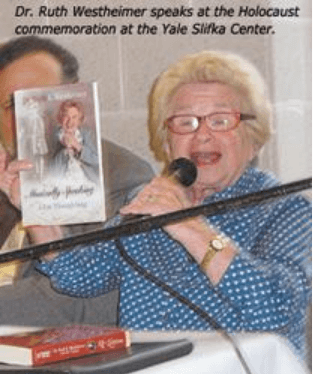
NEW HAVEN — Dr. Ruth Westheimer shared her experience as part of the Holocaust’s Kindertransport at “Orphans of the Holocaust,” the opening event of the Yom Hashoah-HolocaustRemembrance Day commemoration at Yale University’s Joseph Slifka Center for Jewish Life. Westheimer is co-teaching a course on “The Family and the Jewish Tradition” at Yale this semester with the university’s Jewish chaplain, Rabbi James Ponet.
Dr. Ruth Westheimer was born in 1928 in Frankfurt, an only child in a lower middle class Orthodox family. When her father was taken by the Nazis, her mother and grandmother thought it would be safest for her to be evacuated from Germany.
“They closed the Samson Raphael Hirsch Orthodox school, and I was told I had to join a group of children going to Switzerland or my father couldn’t return.” Wertheimer boarded the kindertransport to Heiden, Switzerland on Jan. 5, 1939. She waved to her mother for what would be the last time.
In Switzerland, Westheimer, then only ten years old, lived in a children’s home overlooking Lake Constance. “We could see Germany,” she recalls. She was enrolled in vocational training, where she learned to care for Swiss children (bathing them, doing their laundry and cleaning their toilets). Westheimer wasn’t permitted to attend school, though she had dreamed of studying medicine. She communicated with her parents and hoped she would see them again. The letters stopped suddenly in September of 1941; she later learned that her parents had been taken to the Lodz Ghetto, where her father was a cemetery gardener, and most likely killed in Auschwitz.
At the conclusion of the war, Westheimer was 17 years old. She decided to go to Palestine, where she lived on a kibbutz picking olives and tomatoes. She also served in the Haganah, a precursor to the Israel Defense Forces, where she became a sharpshooter. She was badly injured on her twentieth birthday, while doing guard duty; an Arab shell exploded at her feet. Luckily, she recovered and was able to walk.
Westheimer moved to France in 1950. Eventually, she resettled in New York, and received a doctorate in education from Teachers College of Columbia University. Affectionately known as “Dr. Ruth,” Westheimer is best known for her radio program, “Sexually Speaking,” which began in Sept. 1980. Westheimer spoke movingly of her parents and grandparents and of the importance of early childhood socialization. She spoke of how the orphans “created a community to have a family again,” and of how “many boys and girls went in to the helping professions.”
Sharing the stage with Westheimer at the Holocaust commemoration was a local Kindertransport survivor, Irm (Irmgard) Wessel. A social worker, Wessel is a long-time resident of New Haven and a member of Congregation B’nai Jacob in Woodbridge. During the war, she was sent to England from her home in Kassel, Germany. Unlike Westheimer, Wessel was eventually reunited with her parents in America.
Describing her family as “German first and Jewish second,” Wessel said her businessman father, the vice president of a steel factory, held positions of importance in the synagogue and in the Jewish community. His position of importance, and his role as a mediator between the Jews and the Nazis would prove useful in getting Irm on the Kindertransport to England.
The audience listened intently as Wessel shared the details of her story, including the actual date of Krystallnacht. While most histories report Krystallnacht to have taken place in Germany on Nov. 9 and 10, Wessel notes, “The Nazis practiced in Kassel on Nov. 7, 1938.”
Kessel also spoke about being forced to add the name “Sarah” to her name (all girls were forced to add “Sarah” and males, “Israel”), seeing her father cry for the first time, the train ride to England, and life in her English foster home.
Upon arriving in New York at age 14, Kessel was forced to throw her stamp collection overboard as she was told she could not enter the U.S. with “anything of value.” Following her reunification with her parents and resettling in Iowa and later Illinois (partially assisted by the American Friends/Quakers), Wessel eventually settled in Connecticut where she is a member of the therapeutic community, and an activist.