Access Israel

Original Article Published On the Jerusalem Post

The two organizations are in the midst of 12 days of hiking in New York with teams consisting of people with and without disabilities.

NEW YORK – Not every hiking trail in the world is accessible for people with disabilities, but don’t tell that to Friends of Access Israel (FAISR) and Paratrek. They simply don’t agree. 

The two organizations, which have already accompanied four people with paraplegia to reach the not-so-accessible top of Mount Kilimanjaro, Africa’s highest mountain, are in the midst of 12 days of hiking in New York with teams consisting of people with and without disabilities. 

The USA treks (August 1 to 3 and 8 to 11) are taking place in Rockefeller State Park in Pleasantville, New York (USA). Teams from Israel and Delaware, Pennsylvania, Connecticut, Florida and New York in the United States are participating in hikes that vary in level of difficulty. Each day’s hiking adventure is led by a person with a disability.

 August 1 is Team Colton, August 2 is Team Alan, August 3 is Team Fred and August 4, the only day taking place in New York City’s Central Park, is Team Paratrek, named after the trekker vehicle that assists people with physical disabilities to access rugged terrains. August 9 to 11 is Team Chapel Haven, in honor of hike participants from Chapel Haven in New Haven, Connecticut (USA), a nationally accredited transitional living program founded in 1972 and devoted to teaching adults with cognitive disabilities and social disabilities to live independent and productive lives.

James A. Lassner, Executive Director of FAISR, refers to the hike as the “FAISR Universal Expedition – USA Trek #1,” with the hashtag, #AccessibleTogether. Lassner notes, “The hike/trek capitalizes on team members’ respective physical strengths, mental toughness and diverse abilities.” 

The word “Universal” is meaningful and intentional. “Universal’ is the concept of planning in advance to build events, schools, workplaces and technology so they are usable by a wide range of people, regardless of age or disability status. While universal design promotes access for individuals with disabilities, it also benefits everyone. Universal has added meaning because the word “universal” contains the letters ‘USA’ and the word ‘Israel.’” 

Colton Robinson, an 11-year-old model who was born with spina bifida, is the namesake for Team Colton. When Colton was five years old he was a finalist for a “Cutest Kid” contest for Parents Magazine and was signed by a modeling agency in NYC. He was the first model signed to this agency’s diversity division. Colton has modeled for Tommy Hilfiger, Runway of Dreams, Toys R Us, Target, Lands End and many other companies. He was also the first child that uses a wheelchair to model in New York Fashion Week. 

“Colton is currently a model for Target stores both online and at their various USA locations. More importantly he is a fine model of being a perfect gentleman. We have a lot to learn from him!” says Lassner.

The hike’s first day marked the US debut of the Paratrek Trekker, the brainchild of Israeli inventor Omer Zur. On his post-army trip many years ago, Zur wanted to hike in Turkey with his father, a person with quadriplegia as a result of fighting in the Sinai during the Six Day War. Zur soon realized that he had to come up with a suitable device that can handle off-road hiking without taking away his father’s independence. The simple-looking yet highly sophisticated Paratrek trekker can successfully traverse through rough and rocky terrain, steep inclines, narrow paths, over sand, boulders, rock and gravel. 

The Trekker successfully navigated Kilimanjaro with people with paraplegia less than two years ago.

“We are thrilled to debut our trekker at the FAISR Universal Expedition in New York. Our trekker has made it to 19,341 feet of Mount Kilimanjaro with FAISR, the Dead Sea in Israel which is the lowest place on earth and many other sites and trails around the world,” said Zur. “Our vision is to make it possible for individuals, families and groups to choose for themselves if, when, and where they wish to enjoy the great outdoors. As we introduce our trekker, we are confident that National and State parks will be interested in them as they will enhance accessibility at each of their venues.”

Fred Maahs Jr, a wheelchair user who is also chief operations officer for Travel for All and editor of Melange, Accessibility for All magazine, is heading up Team Fred on Day 3. 

“Travel for All is proud to be a partner of Friends of Access Israel and to assist with the travel arrangements for the Faisr Universal Expedition. Our missions align – we both believe that the world should be accessible and inclusive so that all people can explore and experience its beauty and wonders.”

Future hikes and treks will take place mostly in Israel with some events taking place in the United States. The ultimate goal is to make specific trails in both countries accessible for everyone.

Friends of Access Israel, together with its collaborative partner, Access Israel, strive to improve accessibility and inclusion globally for people with disabilities and the elderly via advocacy, education and inclusion. 

“With each improvement we empower them to live self-determined lives enabling them to work, travel, study and consume with dignity, equality and maximum independence,” reports FAISR’s Lassner. 

Read more

Original Article published in the Jerusalem Post

“For Friends of Access Israel and our collaborative partners Access Israel, disability awareness and inclusion is our daily calling,” said executive director Jaime Lassner.

An online series featuring an array of impressive individuals who are involved in the field of disability access is taking place this month to mark Jewish Disabilities Awareness, Acceptance and Inclusion Month (JDAIM).The series is the brainchild of Jamie Lassner, executive director of Friends of Access Israel (FAISR) who, when he first learned about JDAIM, began thinking of creative ways to share stories with the wider world of the strengths and accomplishments of people with disabilities. Lassner created and is hosting a month-long interactive Zoom series every Monday through Thursday in February (8 p.m. Israel time) featuring an all-star cast of speakers with disabilities and people connected to the disabilities’ community.

The series, titled, Access Is-Real features Richard Bernstein, a blind judge; Stephen Shore, an autistic professor; SpaceIL founder Yariv Bash; business owners Mark and John Cronin (John’s Crazy Socks) and Bill Morris (Blue Star Recyclers), who are noted for impressive practices of training and hiring people with disabilities; Omer and Shmulik Zur, creators of Paratrek; and other similarly impressive personalities. Lassner has reached out to schools around the world to participate and learn from the speakers and enjoy a break from the traditional day of in-person or virtual learning. FAISR will offer prizes to three winners who write poems or essays reflecting on what they have learned from the speaker series and on actions they will take to be more inclusive in their own lives.“For Friends of Access Israel and our collaborative partners Access Israel, disability awareness and inclusion is our daily calling. We hope that Access Is-Real is a catalyst for all to become more aware, involved and inclusive of all,” said Lassner.In the first session, Lassner interviewed Pascale Bercovitch, a paralympian who has participated in three Olympics in three different sports. She shared the story of losing both legs at age 17, making aliyah from France, and competing in swimming, hand-biking and currently in kayaking. She is proud of how far Israel has come in the area of accessibility.“Thirty-six years ago, I didn’t even know how to say ‘accessible’ in Hebrew! Nothing was accessible.” Thanks to the efforts of Access Israel, she reports that she is  now able to go to the beach, take buses and move around fairly freely. “Israel is now one of the more advanced countries when it comes to accessibility.”

The series is co-sponsored by the Consulate of Israel in New York, which has shared the event widely on social media.Access Israel regularly hosts an international conference in Israel each year, and recently hosted its seventh international online webinar, titled “Accessible Future: Innovation in Web and App Accessibility.” The webinar was attended by 800 people from 80 countries. Access Israel founder Yuval Wagner and CEO Michal Rimon were Access Is-Real guests on February 2nd.According to Shelly Christensen, CEO of Inclusion Innovations and co-founder of JDAIM in 2009, February has long been known in the Jewish world as Jewish Disability Awareness and Inclusion Month and is “a unified effort among Jewish organizations worldwide to raise awareness and foster acceptance and inclusion of people with disabilities and mental health conditions and those who love them. JDAIM is a call to action for all of us to act in accordance with our Jewish values, honoring the gifts and strengths that we each possess.”During the month of February, the Jewish Federations of North America sponsors the similarly named Jewish Disability Advocacy Month, which they describe as “a month of education, solidarity-building, and empowerment in support of people with disabilities.” The theme for their month-long series of programs is “From Empowerment to Advocacy.”JDAIM events around the world, mostly virtual this year, are an important initiative to raise awareness about disabilities, inclusion and belonging in the Jewish world and in the larger society.

Read more

Original Article Published On The Jewish News Syndicate

Michal Rimon, CEO of Access Israel, recently put an important note on her door: “Do Not Disturb—I’m With Dubai.” Rimon’s two extended meetings and webinars in one day with colleagues in the United Emirates offer an important window into collaborations already in progress between the disability inclusion communities of both countries.

Rimon started her day at the Hod Hasharon offices of Access Israel. She attended the virtual two-day Tolerance & Inclusivity Week at Expo 2020 Dubai. The conference’s goal was to “work together as global citizens to foster greater common understanding for more inclusive societies,” and to “reimagine how social spaces, physical environments and modes of storytelling can be more inclusive and foster greater multiculturalism and co-existence.” She participated on a panel with five disability-inclusion colleagues from around the world. The panel was titled, “Accessibility Spotlight: The Value of Difference.”

Minutes after the discussion, Rimon was back on Zoom, this time with her colleague and new friend from the United Arab Emirates, Dr. Ayesha Saeed Husaini, founder and director of Manzil, a not-for-profit organization based in Sharjah. She started the first support group in the UAE in 1999 and founded Manzil in 2005 to serve people with disabilities in the areas of educational inclusion, employment, social support, consultancy and research.

Israel and the United Arab Emirates only recently entered into the Abraham Accords, signed in Washington, D.C., on Sept. 15 and ratified by the Knesset on Oct. 15. The UAE became the third Arab country, after Egypt in 1979 and Jordan in 1994, to agree to formally normalize its relationship with Israel—the first Persian Gulf country to do so.

While the relationship is formally still in its infancy, Husaini and Rimon actually met in person before the countries had formal relations—in February 2020 in Austria at the Zero Project Conference, which brought together accessibility leaders and organizations from around the world. “My first real memory of Michal was from breakfast at the Zero Project, reports Husaini. “Someone said, ‘You have to meet Michal!’ ” Rimon, an ambassador for the project, took an instant interest in Husaini. “She was amazingly helpful, taking me table to table introducing me to people.”

Michal Rimon, CEO of Access Israel, attending remotely the Tolerance & Inclusivity Week at Expo 2020 Dubai. Credit: Courtesy.

The two knew they could not, at the time, continue their relationship with in-person meetings in Israel or the UAE. They remained determined. “I like to think out of the box. I was very impressed [after talking with Michal] but just couldn’t think of any way we could possibly exchange knowledge,” says Husaini. “We discussed what options we do have,” recalls Rimon. At the time, Rimon had no idea that in a few short months, Israel and the UAE would sign historic accords.

‘What we can change is tomorrow’

Husaini and Rimon both have distinguished careers advocating in their own countries for people with disabilities and in creating programs for them. In the late 1990s, Husaini learned from students in the university classes she taught of the stigma they felt having a sibling with disabilities. She created a support group for families and began to engage her students as volunteers. “I had to start somewhere,” she reports, reasoning that she could begin to change attitudes in her country towards people with disabilities if she started with the younger generation. She playfully notes, “What we can change is tomorrow!”

Husaini continued to spread awareness about disabilities and founded Manzil in 2005. Soon after, the UAE began changing its laws around the inclusion of people with disabilities. “UAE lawmakers were always very open-minded,” she reports. “The challenge was not from the government, but from being in a nascent stage; we needed more professionals and best practices.”

Ayesha Saeed Husaini. Source: LinkedIn.

The process of moving towards greater inclusion in the UAE was actively promoted by Husaini and her colleagues. Husaini serves on several advocacy committees and boards as Governor of Inclusion. In 2005, she implemented a program at Manzil with a “reverse inclusion” approach, inviting people without disabilities to join programs serving people with disabilities.’ She smiles. “We got a lot of attention in the media and from people in the government.” UAE Law # 29, which was passed at the end of 2006 to protect the rights of people with disabilities, finally gave wings to her inclusion project.

Rimon notes that Israel passed an equality law in 1994. And in 2005, around the same time that the UAE was passing similar legislation, Israel passed an Accessibility Clause requiring every ministry to issue regulations to require accessibility. Access Israel was established the same year to increase awareness and assist in the implementation of the accessibility laws. Husaini was pleased to add that “this was the same year that Manzil was formally launched.”

Rimon speaks with admiration and appreciation to Access Israel’s founder, Yuval Wagner. A wheelchair user, he requested a meeting with the CEO of a large cinema chain in Israel, expressing concern over the lack of accessibility in 11 theaters. The CEO was impressed with Wagner’s professional response and his making a strong business case for accessibility. As Wagner stated, “An accessible business is a more profitable business.”

Yuval Wagner. Credit: Courtesy.

In Access Israel’s early years, they worked to address physical accessibility, then social accessibility. Rimon, like her colleague, Husaini, then turned her attention to working with young children. “The kindergarten students learned that people with disabilities are like everyone else, and that inclusion is accepting everyone and treating them the same.”

Now, Husaini and Rimon have an unprecedented opportunity to move forward together. “I have spent many a sleepless night dreaming about all the different ways in which we can collaborate,” says Husaini. “There is so much potential, so much synergy between the two organizations; there are so many similarities. When the skies are open, we are ready to fly.”

Adds Rimon: “The excitement is there. The sky is the limit. We can do amazing things together.”

‘Both can learn from each other’

Fred J. Maahs Jr., president of FJM Solutions, chief operations officer of Travel for All and editor of Melange, Accessibility for All, is enthusiastic about the potential of this relationship. “I am overjoyed that Israel and the UAE have entered into a peace agreement that will restore business relations, direct flights, tourism and even sharing of best practices on some levels. As a person with a disability who uses a wheelchair, I am hopeful that both countries will also share what’s working and what’s not when it comes to accessibility for people with disabilities.

“The UAE has abundant resources,” he says, “and is using them, along with advice from experts from all over the world, to help make the UAE the top accessible tourist destination in the world. They are in a position to share their resources—financial and otherwise—with Israel, which tends to struggle to a degree with a budget, especially when it comes to accessibility. However, this does not minimize Israel as a resource to the UAE.”

Maahs says Israel has done an excellent job with making more modern cities like Tel Aviv and ancient cities like Jerusalem, including its holy sites, mostly accessible. And they have been able to do it with far less financial support. “Both can learn from each other,” he assures.

He is in the UAE for meetings this month and hopes to attend the next Access Israel conference in Israel.

Laura Kam, president of Kam Global Strategies, an Israel-based communications firm that is working with UAE clients and media, says that “building truly deep bonds between Israel and the UAE will come not from business deals alone, but through relationships formed between civil society groups. Individuals who come together to work on solutions for issues related to disability issues will develop ties that will be more personal in nature—not simply transactional—and those are the type of relations that are strongest and longest-lasting.”

James A. Lassner, executive director of Friends of Access Israel (FAISR), found the recent Zoom meeting with Husaini and Rimon meaningful, encouraging and one more step in forging ties between the two organizations and countries.

“The blessing of peace brings with it many seeds,” he says. “It is humbling to be part of a warm connection that is beginning to blossom between Manzil and Access Israel based on the common goal of ‘leave no one behind.’ ”

Read more

Original Article Published On The Jerusalem Post

“I almost feel like Neil Armstrong right now, the first person there doing this. A small step in moving the journey forward, sharing best practices and keep going!”

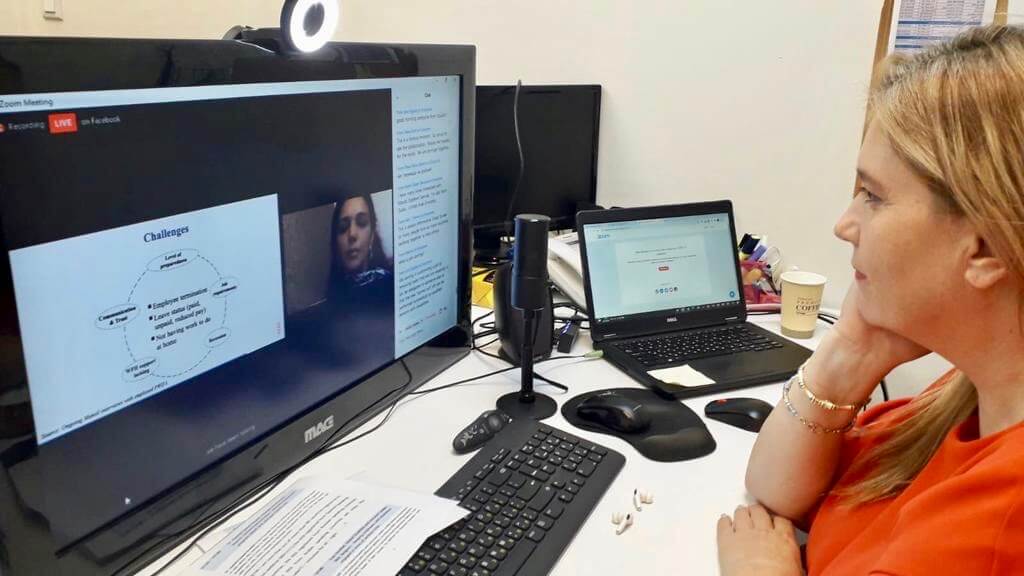
On the same day that a small senior delegation from the United Arab Emirates, including ministers of economy and finance and two deputy ministers, met in Israel, more than 650 people from 83 countries met on Zoom and Facebook to also make history. They participated in a four-hour conference sponsored by Access Israel, featuring Dr. Ayesha Saeed Husaini, founder and director of Manzil from the United Arab Emirates.

Husaini’s presentation on PRIDE (People Receiving Independence and Dignity through Empowerment), the Manzil employment program for people with disabilities, was part of the international webinar, titled “Employment of People with Disabilities – Challenges, Solutions, Technologies and Best Practices.” It was simultaneously translated into Spanish, Russian, Hebrew, Arabic and American Sign Language and was closed-captioned. The webinar included attendees from the United Arab Emirates.

Michal Rimon, the CEO of Access Israel, met Husaini in February 2020 in Austria at the Zero Project Conference, which brought together accessibility leaders and organizations from around the world. Rimon was particularly impressed with Husaini and the work she and her team were and are doing at Manzil, and began wondering how the organizations might work together.

“We discussed what options do we have? I have an American passport, someone there has Portuguese citizenship. You know, maybe we can meet and collaborate,” reported Rimon somewhat ironically, as she had no idea that in a few short months, Israel and the UAE would sign historic accords.

“The changes that have occurred… the peace treaty that was signed, opening the doors, making connections possible, overcoming barriers, this is for us really an exciting time, and I can tell you that when I met Dr. Aisha I was really impressed by what they were doing.”

Alison Brown, deputy cultural attaché of the US Embassy in Tel Aviv, was particularly pleased with Husaini’s participation as she addressed the audience from her home in Tel Aviv.

“I would especially like to extend a special welcome to Dr. Husaini,” Brown said. “Her participation in this conference is one of the fruits of the recently signed Abraham Accords, the historic agreement between Israel and the UAE and between Israel and Bahrain, which will make it possible for people of all walks of life, of all abilities and all religions, to connect with each other and build a more secure and prosperous future in the Middle East.”

Husaini began her remarks, “I almost feel like Neil Armstrong right now, the first person there doing this. A small step in moving the journey forward, sharing best practices and keep going!”

Participants enjoyed Husaini’s presentation and appreciated the significance of her participation. Attendee Debra Ruh noted in the chat, “This is a historic moment. So proud to see the collaboration. Makes me hopeful for the world. We are stronger together.”

Jamie Lassner, executive director of Friends of Access Israel, a collaborative partner of Access Israel, said, “October 20, 2020, is a date that will be forever be etched in our hearts as a giant step was taken by our sisters and brothers at Access Israel and Manzil, who joined in a united effort to make our globe accessible for all. May their efforts be blessed, inshallah, to serve as a catalyst for global change.”

Read more