
With Tami Schlossberg Pruwer’s chutzpah, smarts, charm, and ability to get things done, the protexia and educational systems better look out!
Originally appeared in Jerusalem Post Magazine, November 6, 2026
Tami Schlossberg Pruwer’s aliyah was inspired by her family, her Zionist Antwerp Jewish community, and by her post-high-school time spent learning in Israel.
The multilingual, Israeli-university-educated mother of two has taken her years of experience in public policy and marketing – and her passion for “telling stories about brands in impactful and emotional ways” – and written (with Julie Silverstein) Chutzpah Girls: 100 Tales of Daring Jewish Women. Unsurprisingly for someone who speaks Italian, French, both Flemish and Standard Dutch, English, Hebrew, and some Yiddish – the book has recently been translated into French and Hebrew, with more languages to follow.
Schlossberg Pruwer, 40, spent her first three years of life in Milan – the city her Auschwitz-born grandparents journeyed to after the Holocaust and lived as they awaited visas to make aliyah to Israel. Her mother grew up in Milan and her father in the US. Her parents met over a Shabbat meal in Israel and were married in Milan.
Schlossberg grew up speaking Italian, English, French, and Flemish
She grew up speaking Italian to her mother and English with her father and – after moving to and spending the next 16 years in Antwerp, Belgium – added French and Flemish to her impressive repertoire of languages. “Math was in Flemish, and I read books in English.” Many classes at her Zionist Jewish school were taught in Hebrew by Israeli teachers, and she picked up some Yiddish “because it is Antwerp.” (The city has one of the last remaining active, native Yiddish-speaking hassidic communities in Europe).
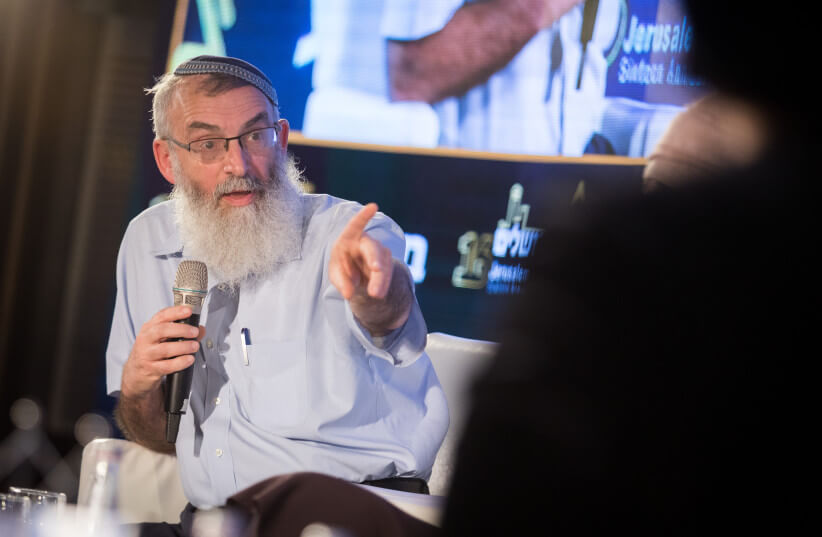
Schlossberg Pruwer speaks fondly about her day school in the provincial city, which had an impressive group of principals over the years, including Rabbi David Stav, the chief rabbi of Shoham and chairman of the Tzohar organization. “So many families made aliyah – we are victims of our own success.” As a result, she notes that “there is not much of a Jewish future” in Antwerp, which is primarily home to secular and hassidic Jews.
After high school, she spent a year studying at the Michlalah-Jerusalem College, officially made aliyah in 2005, and began pursuing political science and French literature studies at Bar-Ilan University. She had planned to draft into the IDF but was directed instead toward pursuing a master’s degree in government at IDC Herzliya (now known as Reichman University), where she would continue to make her mark on Israeli society. This afforded Schlossberg Pruwer the opportunity to volunteer in the field of policy with a Jerusalem think tank as well as to conduct research in marketing and public policy.
Schlossberg Pruwer’s interest in marketing continued to grow, and she worked in the field of advertising with Baumann Ber Rivnay, one of Israel’s leading advertising and public relations agencies and part of the Saatchi & Saatchi international advertising network. She helped international brands such as Amex and Google. “I learned so much behind the scenes.” Schlossberg Pruwer adds, “I was drawn to projects doing good,” and she got involved with corporate responsibility, including Google’s small-business initiative across Israel’s periphery and the World Health Organization’s International Hearing Loss Day.
While in this job, she married David Pruwer of London – whom she met in Israel in 2012 when he was doing research towards his PhD in philosophy and history. Pruwer, who made aliyah in 2016, is founder and CEO of a digital mental health start-up, OurRitual, a relationship support platform that offers a new approach to couples therapy.
The couple is now parents to Amalia, 8, and Judah, 5. When they began having children, Schlossberg Pruwer realized that the sometimes 12- to 14-hour days of her “demanding industry” – one which did not have many other mothers at the time – would be challenging. She looks back fondly on her years in the industry where she says she “learned about influence and the power of storytelling and telling stories about brands in impactful and emotional ways.”
While home with a much younger Amalia, Schlossberg Pruwer began getting what she describes as “feminist books” as gifts. “But they were lacking in Jewish stories,” she says. “I started looking for books and decided that, one day, I would start writing and reach out to publishers.”
Schlossberg Pruwer was delighted to receive a “random email” from Julie Silverstein, who lives in Israel – on the day Schlossberg Pruwer’s first child was about to start school. “We like to think of it as serendipitous! She had the same idea and vision for a book, and when researching to see if something similar already existed, came across a book proposal I had sent to a Jewish literary organization and got my contact info from them. It felt like divine providence.”
Schlossberg Pruwer and Silverstein started working on the book on September 1, 2019, the first day of school in Israel. “We reached out to a publisher who was excited,” Schlossberg Pruwer says.
Then Oct. 7 happened
The two were scheduled to sign a contract – then the country went into lockdown due to COVID, causing delays. The two authors continued researching and ultimately completing the book – but Schlossberg Pruwer concedes, “I was unsure if it would ever happen!”
Then Oct. 7 happened. “We understood it would be a pivotal moment.” The authors knew they would need to include women “to honor the impact of the day on the Jewish world and Israeli society.” They selected Inbal Lieberman (the Kibbutz Defender) and Rachel Edri (the Cookie Warrior). Lieberman, head of Nir Am’s security team, protected and defended her kibbutz valiantly on that fateful day. Edri famously treated terrorists in Ofakim to coffee, tea, and cookies and kept them calm while communicating with the police. “These stories remind the next generation of Jewish women that they have this superpower of resilience.”
The book, which features 100 original prints by 12 women artists, sold out its first printing in four days. The text is in the process of being adapted for theater and screens, and the portraits are traveling around the world where they are displayed in public libraries, synagogues, churches, and other places.
On occasion, well-meaning friends and colleagues wonder if Schlossberg Pruwer might consider leaving Israel for places they deem to be safer. She answers with an emphatic no. “In Israel, you can live openly and not hide your identity. You can raise your kids Jewish in a way you can’t find anywhere. Here, you can feel completely at home!”
She acknowledges challenges. “In Israel, everything operates on protexia,” the well-known concept of “having connections.” “It is more challenging to make these connections – you need to work harder here.” Schlossberg Pruwer is pleased with the way the olim community helps each other out. “You need to have chutzpah to not be afraid to ask!” She is pleased that, after 20 years here, “I have some relationships I can call on!”
Schlossberg Pruwer also shares concerns about the educational system. “The state of the education system is very concerning – both logistically and practically.” She notes that the school day ending at 1 p.m. is very challenging for two working parents. “And the Education Ministry is so bureaucratic – it makes daily life more challenging.” For now, the family has chosen to invest in supplementing their children’s education with extracurricular activities and tutoring.
With Schlossberg Pruwer’s chutzpah, smarts, charm, and ability to get things done, the protexia and educational systems better look out! ■
Tami Schlossberg Pruwer, 40
From Milan and Antwerp to Tel Aviv, 2005

