Originally appeared at JNS.org on July 6, 2026
Maccabiah Israel Chairman Asaf Goren tells JNS that memorial swims, commemorative pins and even favorite foods are helping athletes remember 18 fallen members of the Maccabi family.
For Asaf Goren, the theme of the 22nd Maccabiah—“More Than Ever”—is more than a slogan highlighting the power of Jewish unity and the bond between Israel and Jewish communities worldwide.
It has become the driving force behind a Maccabiah-wide initiative honoring 18 athletes with ties to the Maccabi movement who lost their lives in Israel’s wars. Through sporting events and educational programming across the country, organizers hope participants will return home as ambassadors carrying the stories of these fallen athletes to Jewish communities around the world.
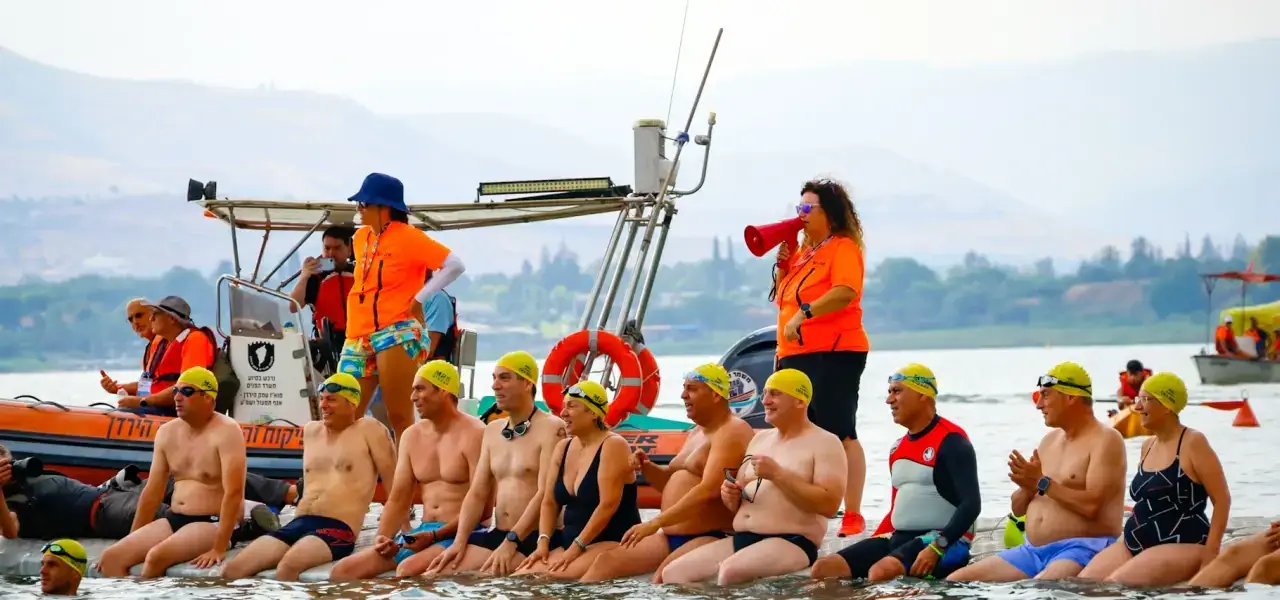
Goren, 49, who has held senior positions in Israel’s tourism industry, has spent much of his career working in various capacities for the Maccabiah, rising to his current position as chairman of Maccabiah Israel in September 2022. While he concedes that he is not an Olympic or Maccabiah-level athlete, he proudly noted that he hurried back to his office for an exclusive interview with JNS after taking part in an open-water swim in the Kinneret (Sea of Galilee) held in memory of fallen IDF Capt. Eden Nimri.
Nimri, 22, a team leader in the Artillery Corps’ “Sky Rider” drone unit and a competitive open-water swimmer, was killed on Oct. 7, 2023, at the IDF’s Nahal Oz outpost. By standing guard at the entrance to a shelter, she saved the lives of 17 unarmed soldiers. Before her military service, she represented Israel at the 2014 Mediterranean Cup, the International School Sport Federation’s 2017 World Championships and the 2018 European Junior Open Water Swimming Championships, where she finished 30th.
Sunday’s open-water competition featured 1.5- and 3-kilometer races, but also included a symbolic 170-meter swim—10 meters for each of the 17 soldiers Nimri saved. Her parents, Sharon Yael and Michael, attended the event.
Nimri is one of 18 athletes with ties to the Maccabi movement who lost their lives during Israel’s wars.
“After the 2022 Maccabiah, we decided the Maccabiah couldn’t be just a once-every-four-years event,” Goren said, noting that the Oct. 7 Hamas massacre occurred between the 2022 Games and the scheduled 2025 Maccabiah, which was postponed because of the war with Iran.
Goren, who spent seven months serving in the reserves during the war, said he was proud of the response by Kfar Maccabiah, the Maccabiah organization and the Maccabi World Union in helping those affected by the war.
Kfar Maccabiah, the hotel and conference center in Ramat Gan established by the Maccabi World Union in 1957, opened its doors to approximately 1,000 evacuees from Sderot and Ashkelon.
“We had schools, a nursery school, dogs, birds, and we even built glamping facilities for Nova festival survivors,” he said.
“We realized very quickly that we couldn’t celebrate sports as originally planned—we went back to the drawing board,” Goren said. “We needed to be together, tell the story, and emphasize Israel, Judaism and sport more than ever. We need the Maccabiah more than ever with antisemitism rising in the Diaspora.”
Those discussions took place while Israeli hostages were still being held in Gaza.
“We needed to find a way to make the stories of these athletes part of the Maccabiah without turning it into Memorial Day,” Goren said. “We wanted what happened here to have a lasting impact.”
Maccabiah Games organizers met repeatedly with the families of the fallen athletes, interviewed their friends and teammates, and sought to understand how each person should be remembered.
“We wanted athletes from around the world to connect with the experience and memory of each person who lost their life,” Goren said. “We want every athlete to leave knowing at least three of these stories in a meaningful and lasting way.”
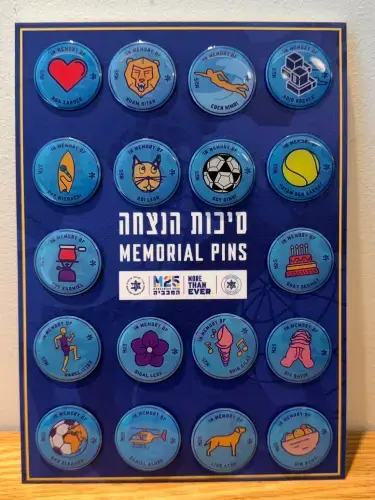
They created a series of round blue commemorative pins, each honoring one of the 18 athletes, continuing the long-standing Maccabiah tradition of athletes exchanging pins. Among them are a soccer ball for Guy Simhi, a surfboard with a microphone for Raz Mizrachi, a heart for Noa Zander and an orange swimmer for Eden Nimri.
Families also identified a favorite food or drink of their loved one—from Milki chocolate pudding to Danone yogurt—which organizers highlighted during the commemorative events.
“We had a story, a pin and a taste to make sure the impact goes on forever—that a light will glow forever,” Goren said.
Following Nimri’s memorial swim, participants toasted her memory with Limoncello and Danone Pro 25 vanilla, two of her favorite drinks.
Among those commemorated was Adi Leon, a Givati Brigade soldier who was killed on Oct. 31, 2023, when an anti-tank missile struck his Namer armored personnel carrier. A longtime member of the Maccabi Tzair youth movement, Leon was also an aspiring electronic music producer who left behind a notebook titled To Be Read After My Death, describing the values that guided his life and military service.
At the Maccabiah, participants listened to Leon’s original music, watched videos of his performances and gathered in a room decorated in the purple colors of the Givati Brigade.
Goren said he is especially proud that each tribute celebrates the athletes’ lives rather than focusing only on their deaths.
“No one can take part in one of these events and walk away unchanged,” he said. “Years from now they’ll still remember these stories. ‘More Than Ever’ won’t just be a slogan—it will stay with them.”