Roy Hessing

Originally appeared at JNS.org on July 14, 2026.

More than 3,000 athletes from over 40 countries took part in the “Jewish Olympics,” held a year after the Games were postponed due to the war with Iran.

One year after the Maccabiah Games were postponed because of Israel’s war with Iran, thousands of Jewish athletes gathered at Expo Tel Aviv on Monday night to celebrate the successful conclusion of the 2026 competition, capping nearly two weeks of athletic events and reaffirming the resilience of world Jewry.

The July 13 closing ceremony brought together athletes from more than 40 countries who competed in what is widely known as the “Jewish Olympics.” The Maccabiah was originally scheduled to open on July 8, 2025, with some 8,000 athletes from 55 countries, but was postponed following “Operation Rising Lion” and heightened tensions with Iran.

Announcing the postponement in June 2025, Israeli Culture and Sports Minister Miki Zohar had declared, “We will meet here next year with an Israel stronger and braver than ever.”

Addressing participants at the closing ceremony, Zohar said the successful completion of the games fulfilled that promise.

“The festive end of the Maccabiah tonight is particularly joyful,” he said. “Beyond sports, there was a real encounter here between Diaspora Jews and the State of Israel and the people here. The athletes return home with memories and experiences and a new connection with the State of Israel.”

Zohar thanked the Maccabi World Union, the Maccabiah organizers, Keren Kayemeth LeIsrael-Jewish National Fund, local authorities, volunteers, security forces and the athletes themselves, concluding, “Am Yisrael Chai! The people of Israel live!”
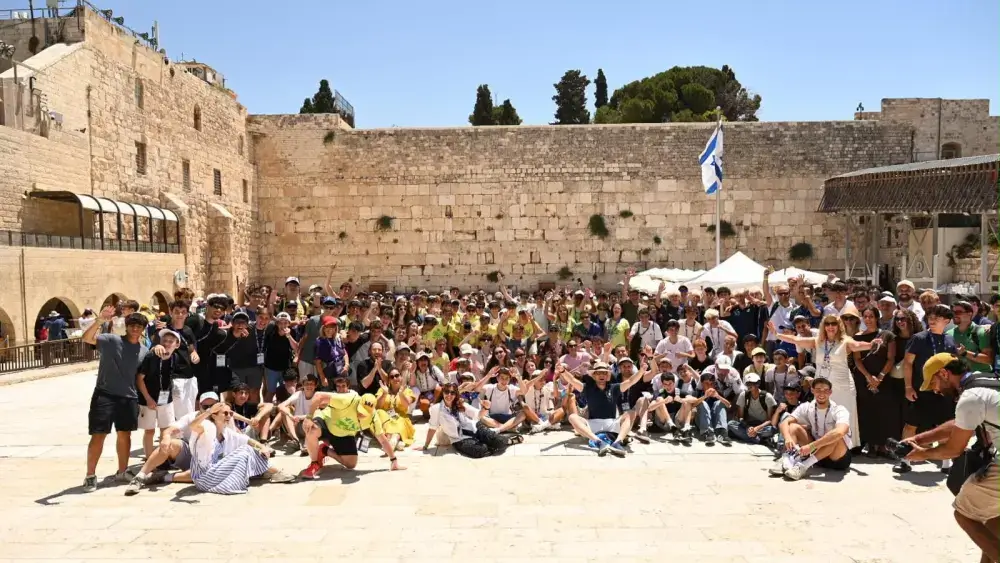
Some 1,200 Maccabiah participants celebrate their bar and bat mitzvahs at the Western Wall in Jerusalem on July 13, 2026. Credit: Courtesy of Maccabiah 2026.

Celebration beyond sport

More than 3,000 athletes from abroad competed alongside some 2,000 Israeli participants during the July 1-13 games. Organizers said approximately 1,000 youth athletes took part in the Maccabiah for the first time.

The closing ceremony featured medal presentations, the transfer of the Maccabiah Miracle Flag to the Jewish Sports Museum and a film honoring those murdered on and since Oct. 7, 2023. Olympic gymnastics medalist and Maccabiah ambassador Artem Dolgopyat extinguished the Maccabiah flame, marking the official end of the games until the next competition.

Earlier on July 13, approximately 1,200 Maccabiah participants celebrated their bar and bat mitzvahs at Jerusalem’s Western Wall in a ceremony organized by the Maccabiah, Keren Kayemeth LeIsrael-Jewish National Fund and the Western Wall Heritage Foundation.

Many of the participants, visiting Israel for the first time, toured Jerusalem’s Old City before taking part in the ceremony, which included prayer services and aliyot to the Torah at the Western Wall.

‘A clear message’

Roy Hessing, chief executive of Maccabi World Union and the Maccabiah, said staging the games this year carried significance well beyond athletics.

“The only time the Maccabiah was canceled was during the Holocaust,” Hessing told JNS. Holding the event this year, he said, was important “to send a clear message to our neighbors around the world that we are strong and united.”

Reflecting on the event, Hessing highlighted both its sporting and broader impact.

“More than 3,000 athletes arrived from around the world, joined by 2,000 members of the Israeli delegation and about 6,000 other guests,” he said. “The hotels were filled with tourists. I’m so proud and happy that we managed to hold a significant, exciting, powerful event, which is much more than just another sports competition. It is an event which connects the Jewish communities to the State of Israel and makes us all very proud.”

Founded in 1932, the Maccabiah Games are held every four years and are the world’s largest Jewish sporting event, bringing together thousands of athletes from across the globe to compete in Israel while strengthening their connection to the Jewish state.

Read more

Originally appeared at JNS.org on June 17, 2026

CEO Roy Hessing says “the Games must go on,” describing the event as an opportunity for young Jews from the Diaspora to experience the “real” Israel.

With just over two weeks until the opening ceremony of the 2026 Maccabiah, Roy Hessing, CEO of Maccabi World Union, is projecting confidence despite ongoing regional tensions and travel challenges facing some international delegations.

“It is 16 days until the opening ceremonies of the Maccabiah,” Hessing told JNS in an exclusive interview on Sunday. “We are very excited and happy that people want to come, and we are sure we will have a very meaningful Maccabiah.”

The Games, often referred to as the “Jewish Olympics,” are expected to bring approximately 3,100 athletes from abroad and 2,000 from Israel to compete in 45 sports from July 1 to 14 at venues across the country.

Hessing acknowledged that government travel advisories in countries including Australia, Austria, Britain and South Africa have complicated group participation.

“They are still coming as individuals and will have a great time,” he said. “Our message is very clear—we will give the opportunity to anyone who wants to come and celebrate. No one will be left out.”

For those still waiting to see developments involving Iran before committing to travel, organizers have extended the registration deadline.

“The only time the Maccabiah was ever cancelled was during the Holocaust,” Hessing said. “This is an important message for Israel, the Jewish community and our neighbors that it must go on.”

Founded in 1932 in Tel Aviv, the Maccabiah is held every four years and brings together Jewish athletes from around the world in Open, Junior, Masters and Paralympic competitions. Past participants have included Mark Spitz, Lenny Krayzelburg, Angela Buxton, Brad Gilbert, Dick Savitt and Mitch Gaylord.

This year’s sports include basketball, swimming, surfing, rugby, baseball, squash, table tennis, judo, football, pickleball, handball and padel.

Hessing said one of the most encouraging developments has been the age of this year’s participants.

“We were very surprised and happy that the majority of the athletes are under 19 years old,” he said. “We know what is happening in this generation. We will give them a great time and they will go back to their colleges and their lives and will have a better opinion of Israel.”

Beyond competition, participants will take part in educational and cultural programming designed to deepen their connection to Israel and Jewish identity.

“They are here for at least two weeks—even if they compete in six games of football or in two days of judo,” Hessing said. “They will visit the Nova festival site in the Gaza Envelope, participate in a festival with residents of the south, experience Kabbalat Shabbat and have a chance to celebrate bar and bat mitzvah. They will have a full program, which is very attractive.”

He described the Games as an opportunity to expose young Jews to the reality of Israel beyond the headlines and to strengthen their connection through sport and personal experience.

The Maccabiah is the flagship event of Maccabi World Union, whose roots date back to 1895, when Jewish gymnasts in Constantinople established their own sports club after being barred from joining a local organization because of antisemitism. The movement grew into a worldwide network that today encompasses hundreds of clubs and hundreds of thousands of members.

Its global headquarters at Kfar Maccabiah in Ramat Gan also houses a museum chronicling the organization’s history since its founding.

“It is a must-visit for people who love sports and Zionism,” Hessing said.

A former member of Israel’s national water polo team, Hessing has spent nearly three decades in Israeli sports administration. He previously served as CEO of the Israel Water Polo Association, sports director of the Maccabiah Games and CEO of the Games before being appointed CEO of Maccabi World Union in 2025.

The 2025 Maccabiah was postponed to 2026 because of the war. Despite continuing regional uncertainty, Hessing stressed that organizers are working closely with Israeli security authorities.

“Israel is a safe place to be,” he said. “Security is our first priority.”

He added that Maccabiah maintains close coordination with the army, police and other security bodies and expressed confidence that the event will send an important message to the international community.

“It is our biggest international event in Israel since Oct. 7,” Hessing said. “It sends an important message that Israel is a safe place and that we are happy to host all teams and performers—and that we are waiting for you to come to Israel.”

Read more