Lifestyle

Original Article in The JNS:

When Rabbi Shmuel Halpert, outgoing Knesset member of the haredi party Agudat Yisrael, invited Rabbi Isaac Schapira to a meeting in July 2011, Schapira’s life changed forever. He was convinced that he had to improve the situation for Jewish cemeteries worldwide, which were suffering from disrepair, neglect and vandalism from outside communities.

Schapira describes Halpert as a pioneer in fighting for the rescue of Jewish cemeteries. “I don’t know who will continue this fight. I think you and your connections are best-suited for it. Just dive in!” said Halpert.

And so, Schapira did just that. “It spoke to me. It broke my heart.”

He has used resources, connections, bridge-building skills, determination and values that he learned from late father, Rabbi Avraham Schapira (Knesset member from the Agudat Israel party and chairman of the Knesset Finance Committee) to found the European Jewish Cemeteries Initiative.

The ESJF was founded in 2015 to begin the process of physically protecting Jewish burial sites in Central and Eastern Europe, particularly in places where Jewish communities were wiped out during the Holocaust. ESJF has so far placed fences around 102 Jewish cemeteries in six European countries. In addition, it has conducted mass field surveys of sites with an impressive 1,500 reports published to date.

Project partners in Europe and Israel

Schapira is proud that his organization has built an infrastructure that European governments recognize as “professional and economically efficient.” For instance, ESJF has obtained governmental funding from the federal government of Germany.

In Israel, Schapira has managed to assemble an impressive coalition of supporters, including Yossi Beilin, scholar—former Knesset and senior Cabinet member, who has held such important government positions as Minister of Justice and Minister of Religious Affairs. Beilin has served as a board member since 2013. He is actively involved in working with international governments with helping secure financial resources.
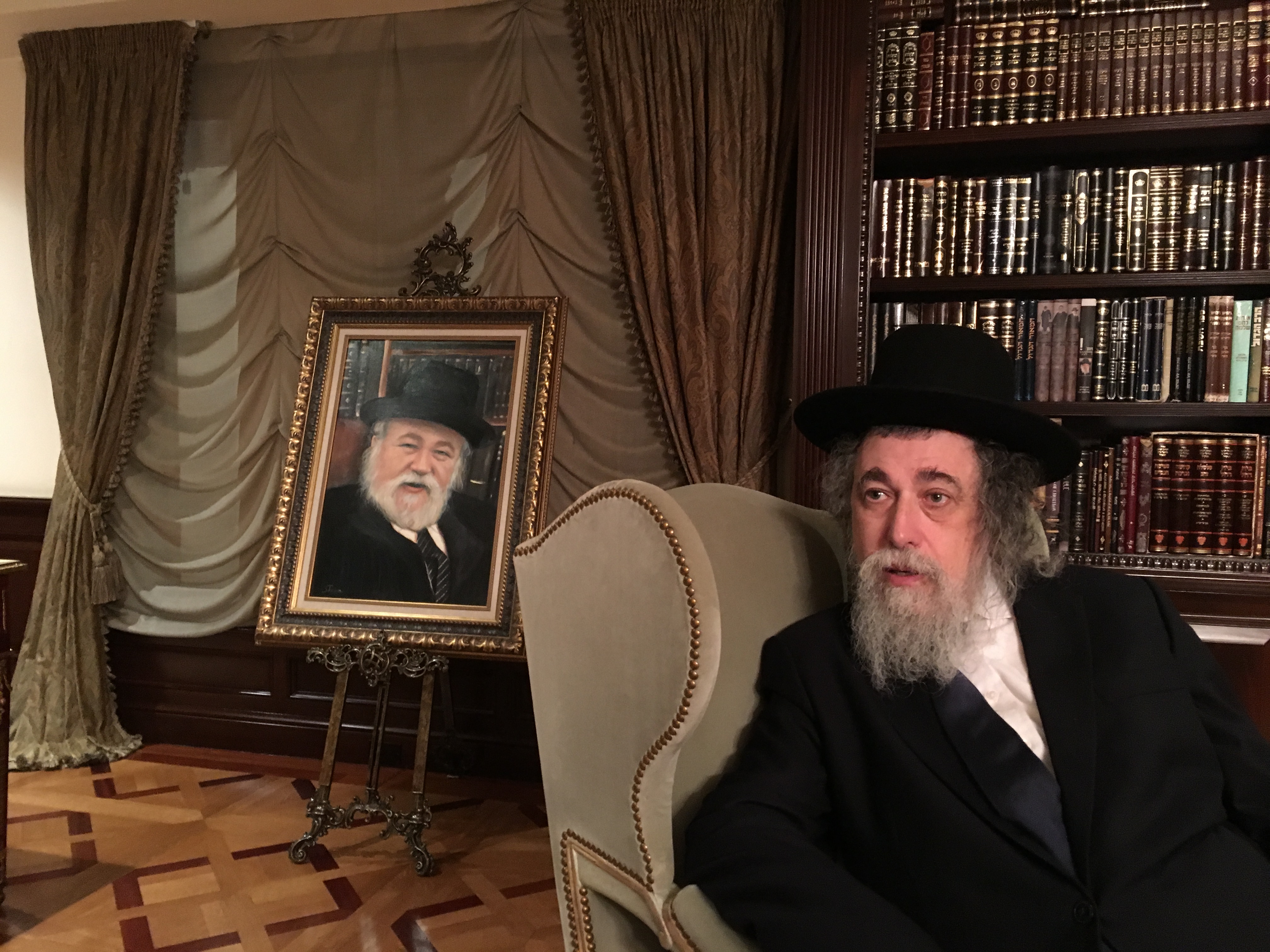

Rabbi Isaac Schapira, founder of the European Jewish Cemeteries Initiative, sitting with a portrait of his late father, Rabbi Avraham Schapira. Credit: Howard Blas.

Acknowledging the compelling nature of the work, he says: “It became a major issue for me. We found out in a short time that we are the only body on the ground doing the work of finding [and then funding] cemeteries in a systemic way. We are working with the map and creating a body of knowledge in order to prioritize and address the most endangered cemeteries first.”

Knesset members committed to the project include Ksenia Svetlova of the Zionist Union Party, and Rabbi Uri Maklev of the ultra-religious Agudath Yisrael Party. Schapira is proud that members of diverse parties have come together to address the issue of European cemeteries.

Maklev reports, “We got involved when Rabbi Yitzhak Schapira turned to us. He works with much devotion and donates time and money. There is a real danger in the old cemeteries in Europe when they are left unprotected. The issue has worsened over the years. Jewish cemeteries remain unguarded and in constant danger, as Jewish community members now live far from its cemeteries. In addition, anti-Semitism and vandalism exist. It is a right and duty to act for this important cause. We must not stand idly by!”

Svetlova first became aware of the issue of Jewish cemeteries on a trip abroad. Svetlova, who immigrated from Russia in 1991, and served as a journalist and Arab-affairs analyst for Channel 9, was in Libya in 2005 in the remote town of Zlitan when she discovered “the horrible picture of devastation—broken or absent gravestones” at Jewish cemeteries. “It made me very sad. All we have is a grave. We cannot allow us to forget our past. A person who forgets his past has no future.”

Svetlova is also a member of the Immigration, Absorption and Diaspora Committee, where she initiated the Knesset Caucus for the Preservation of Jewish Cemeteries Abroad. She says she is proud that the caucus includes people “from all sides of the aisle.”

On the ground in Europe

Beilin says “people are very worried that cemeteries are vanishing. If we don’t save them now, they won’t be there.”

He has seen a shift from the initial work of providing fencing to cemeteries, to “finding those in immediate danger and giving priority to them, even if they are not in the most convenient places.” He estimates that “we have already lost between 4,000 and 10,000 cemeteries.”

Schapira adds that “the Jewish world needs to know how many Jewish cemeteries are disappearing and are at risk of disappearing due to vandalism, and geological and other reasons.”

Beilin and Schapira shared many stories of cemeteries discovered by accident, including a non-Jewish girl riding her bike in a forest and taking a photo of what she thought was a tombstone. Or of local people providing unexpected assistance to the work of ESJF. “People must have seen us working on a cemetery. One week later, we arrived and saw tombstones there which one week earlier had been missing. They must have thought that, if this was so important, we will give back what was stolen,” reports Schapira.
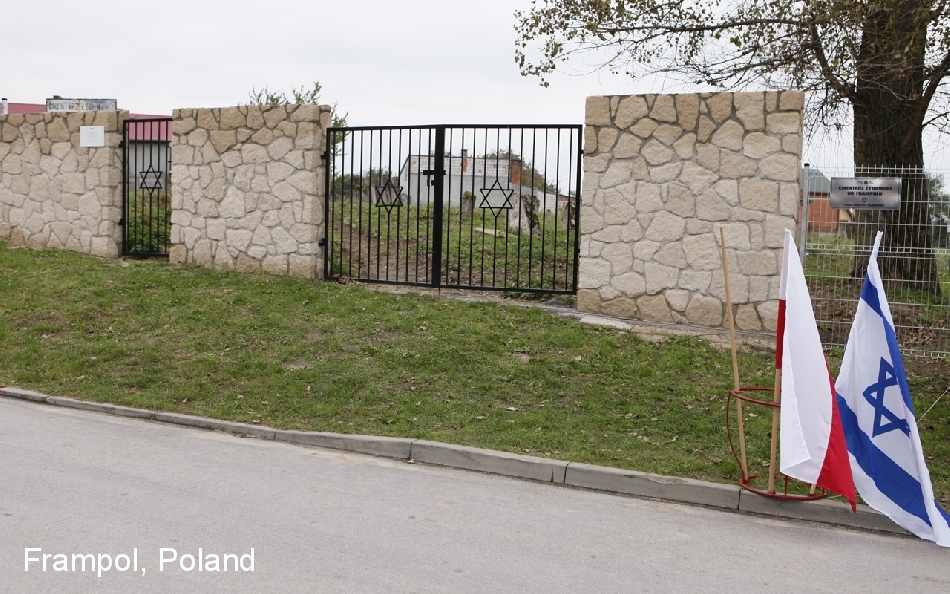

The restored and preserved Jewish cemetery in Frampol, Poland. Credit: Courtesy of ESJF.

The group’s CEO Philip Carmel praises such work. “Rabbi Schapira has succeeded in changing the way we address the issue of Jewish cemetery protection. … He has brought the issue to the level of national governments and pan-European institutions, so that [it] is dealt with not just as an issue of Jewish heritage, but one of Europe’s common heritage. He has achieved this by absolute strength of conviction and by deep personal commitment.”

Chief Rabbi of Poland Michael Schudrich also admires Schapira’s efforts and feels that he is “following the spirit of his father in understanding what it means to fight for Klal Yisrael.” He is impressed with his drive and ability to bring diverse groups of Jews together. “It is about bringing Jews together for kavod hamet, ‘honoring the dead.’ It is important to build a future.”

Even the Queen of England has recognized Schapira for his lifetime of service. In 2013, she bestowed on him the title “OBE,” Order of the British Empire, for, as Schapira humbly reports, “building bridges of friendship between the British government and the Orthodox communities in England and Israel.”

In our two in-person meetings in New York City, Schapira prefers to direct praise to members of his team, especially Carmel, for “his commitment to the project and his unusual capabilities to achieve so much and so efficiently.”

Beilin agrees, saying the CEO is “there on the ground. He is a very important player. He knows the material of cemeteries. He is so dedicated to the work.”

The lifting of the Iron Curtain

“For almost 73 years,” reports Carmel, “the Jewish world has not been able to deal with the protection of these sites for a number of reasons. Firstly, that the priority after the Shoah was rightly to rebuild Jewish life, communities and institutions, as well as a new Jewish state. Secondly, because for most of this time, these abandoned sites, which were home to thriving Jewish communities for hundreds of years, lay behind the [Soviet] Iron Curtain.

“But since that period, resources have tended to go to specific sites, where there is a particular family connection or where a famous personnage was buried. At such sites, one has found a situation where individual demand from the West and readily available resources has met cheap supply of labor and materials in the East. This has pushed up prices, making the overall task of cemetery protection more difficult. That is why the ESJF as a starting point has looked to change this whole methodology—to work in a professional manner under strict processes of contracts and tenders. To reach viable and legitimate costs, enabling the maximization of the amount of sites we can protect.

“The ESJF looks where possible to target sites which are beneath the radar. Some of these places had all their community wiped out; there are no descendants. So these sites are a priority for us, of course, because if we don’t fence them, nobody will. In the major countries where we work, in particular—Belarus, Ukraine, Moldova—probably 25 percent of the sites have already been destroyed. And they are being destroyed by the week. From our mass surveys, we are looking at some two-thirds of all the remaining sites requiring urgent fencing.”
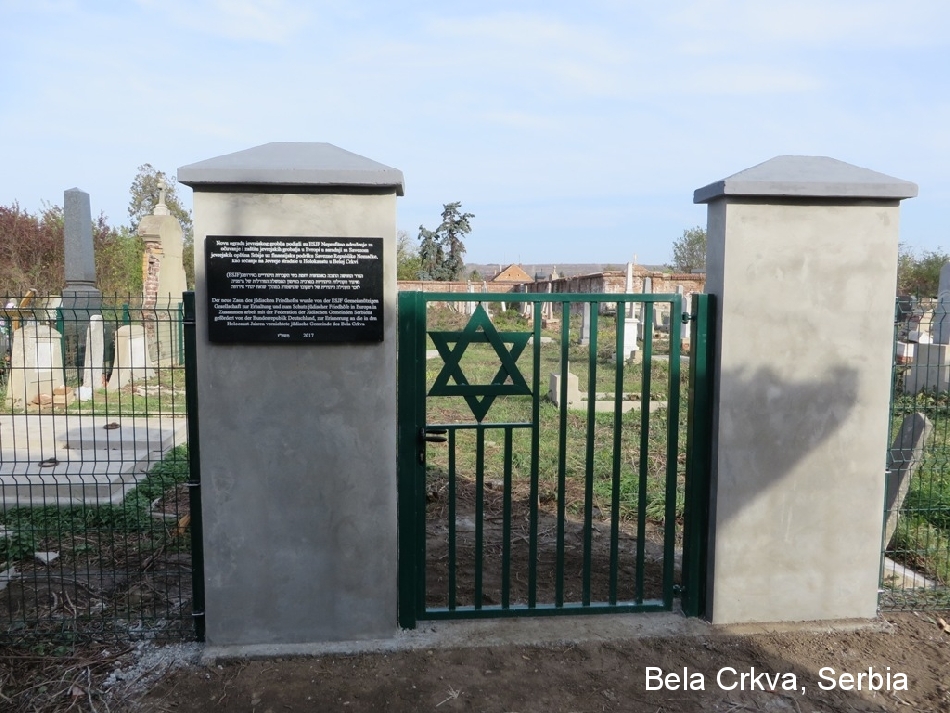

A restored Jewish cemetery in the Serbian town of Bela Crkva. Credit: Courtesy of ESJF.

Schudrich notes that “nothing was possible until 1989 and the fall of Communism. Then, we started working on mikvaot, kosher food, chedersminyanim . . . ”

A mission for the Jewish people

Svetalova relates that she is “very grateful for the work being done in Eastern Europe, and is hopeful Jews from the United States and other places will get involved as they learn more.

“Many American Jews come from Eastern Europe and will be able to relate to the importance of the project,” she says. “There must be cooperation between all sides of the Jewish world. We must try to use all connections in the U.S., Europe and Israel with governments in order to put this project on the map. Time is running out. If we don’t, we will find out it is too late!”

“Going forward,” notes Carmel, “we need to look at this as a mission for the Jewish people that is achievable. All peoples and governments protect their cemeteries. Any American can relate that just by driving up from the South to New York—of how the national government has protected graves in Civil War battlefields for more than 150 years ago. Or the graveyards in Normandy protected by the Allied governments from World War I from 100 years ago.

“As Jews,” he continues, “we have the same basic responsibility.”

Today, he notes, thanks to the work of the ESJF and many others, “we know the numbers, we know the areas of greatest risk, we know the costs, and we know the speed it can be done in. This is no longer a black hole. It can be achieved.”

Schapira reports proudly that “in 2017, we rescued our 102nd cemetery. We have the most wonderful, competent team and can do 300 a year.”

He continues to work tirelessly to make sure it’s not too late, that the work can be accomplished—but, he adds, “only if the Jewish nation worldwide develops a feeling of responsibility and partnership to allow this apparatus to continue operating.”

Read more

Original Article Published On The Chabad.ORG

Two young Israeli boys were riding their bikes along Manhattan’s East River Esplanade near Carl Schurz Park at 84th Street. They looked up, smiled, and called to their father in Hebrew: “Abba, look! A sukkah!

Inside, a young couple with daughters 2 and 4 years old were enjoying a late-afternoon Yom Tov snack as runners, bikers, families pushing strollers and pedestrians walking dogs enjoyed the esplanade outside. The sukkah offers an amazing view of the Triborough Bridge and Roosevelt Island.

In a neighborhood where an apartment with a balcony or private rooftop large enough to host a family sukkah costs about $4 million, public sukkahs are a must for just about anyone who wants to spend time and eat in a sukkah.

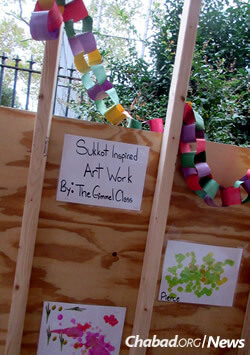
About a 10-minute walk from the esplanade—at the sukkah just outside the John Jay Playground and tennis practice wall at East 77th Street and Cherokee Place (East of York Avenue)—a curious mother, father and two kids peeked in, asking “What shul put this up?” They admired the paper chains and art crafted by a group of schoolchildren, and the hanging evergreens of the sechach—the roof, made of materials grown from the ground—and read the sign saying that it was a Chabad sukkah. They also recited the “Leshev” and “Shehecheyanu” blessings as a family, noting that it was their first time observing the mitzvah of sukkah this holiday season.

Chabad sukkahs in public spaces on Manhattan’s Upper East Side, including the ones along the Esplanade (East 84th Street), John Jay Playground (East 77th Street and Cherokee Place), Rupert Park Playground (91st Street and Second Avenue), Samuel Seabury Playground (96th Street and Lexington Avenue), as well as the five sukkahs on roofs and balconies at the Chabad House (419 East 77th St.), answer an issue all too familiar to Jewish urban-dwellers.

The Chabad school's gimmel class made paper chains and other decorations. (Photo: Howard Blas)

“We have a unique challenge here, where even the wealthiest can’t easily put up a sukkah since they don’t have spaces that look up to the sky,” Rabbi Ben Tzion Krasnianski, director of Chabad Lubavitch Upper East Side in New York City, tells Chabad.org. And so, he says, “it is more critical than ever to build sukkahs in public spaces.”

In Manhattan, few people live in homes with backyards, courtyards or porches with an unobstructed view of the sky. Residents wishing to fulfill the mitzvah of sitting and eating meals in a sukkah usually need to visit a local synagogue. While some shul sukkahs are open to the public, they are only accessible at certain hours.

The Chabad sukkahs and a special pedi-sukkah (attached to the back of a tricycle)—parked at 92nd Street and Lexington Avenue when not being used around the neighborhood—make it easier for Upper East Side residents to observe the mitzvah. Insists Krasnianski: “We need to make sure that no Jew is left behind!”

A pedi-sukkah meets neighborhood needs. (Photo: Howard Blas)

Chabad’s public sukkahs are not limited to Manhattan’s Upper East Side, of course. Dozens of public sukkahs dot New York City and thousands more are erected globally—in every city, town and country in the world with a Chabad center, as well as in small, remote Jewish communities where Chabad rabbinical students, known as “Roving Rabbis,” travel for the holidays.

Shaking Lulav: ‘A Positive Jolt’

Local rabbis say they appreciate Chabad’s efforts to bring the holiday of Sukkot to residents and visitors in the city.

Rabbi Ben Skydell of Congregation Orach Chaim, at 1459 Lexington Ave., near two Chabad sukkahs in the parks, notes: “In a city where people often feel that they have no spiritual home, these sukkahs provide a place not only for the holiday’s mitzvot, but also a place to call home.”

Rabbi Elie Weinstock of Congregation Kehilath Jeshurun, at 125 E. 85th St., says “having sukkahs available is a nice, friendly touch in a busy and often anonymous city. The phrase, ‘Let all who are hungry come and eat’ isn’t just for Pesach!”

Add to that 30 yeshivah students who walk the streets of the Upper East Side during Sukkot, giving people the opportunity to fulfill the mitzvah of lulav and etrog. Krasnianski says the Chabad sukkahs in the park are also staffed to help with the mitzvahs of Sukkot and to teach about the holiday.

“For some people, this is the first time in their life holding the lulav and etrog, and sitting in the sukkah,” he says. “Waving the lulav gives a positive jolt—to stand tall and erect with Jewish pride.”

While now in the midst of the intermediate days of Sukkot, Upper East Side rabbis are also looking forward to the annual Simchat Torah celebration on Oct. 12, held jointly with Kehillat Jeshurun.

“Thousands come to the fair, filling the streets,” says Krasnianski. “We bring the joy of the holiday right out to the people!”

Chabad Public Sukkahs in Manhattan, 5779 (2018)

Here is a list of public Sukkahs in Manhattan sponsored by Chabad-Lubavitchduring Sukkot 5779 (2018):

Chabad of Upper East Side

East River Esplanade (enter at E. 84th St.)

John Jay Park (E. 77th St. all the way east)

Chabad Israel Center of the Upper East Side

Ruppert Park (corner of E. 91st St. and 2nd Ave.)

Samuel Seabury Playground (corner of E. 96th St. and Lexington Ave.)

Chabad of Lower East Side:

104 Delancey St. (between Essex St. and Ludlow St.)

Chabad of Washington Heights:

Chabad of Washington Heights, 50 Overlook Terrace (side entrance)

Chabad of Harlem

JCC Harlem, 318 W. 118th St.

Chabad of Battery Park City

Museum of Jewish Heritage, 36 Battery Pl. (behind)

Chabad of Midtown Manhattan

New York Public Library Porch (corner of 5th Ave. and W. 42nd St.

Chabad of F.I.T.

340 8th Ave. (between W. 27th St. and W. 28th St.)

Chabad of Tribeca / SOHO

Chabad of Tribeca / SOHO, 54 Reade St. (between Church St. and Broadway)

Chabad of Beekman Sutton

Chabad of Beekman Sutton, 336 E. 53rd St. (between 1st Ave. and 2nd Ave.)

The Chabad Loft

Union Square Park (sukkah is located in SW area of Park, next to fountain – open daily from 10 a.m. to 6 p.m.)

Chabad at Columbia University

Chabad at Columbia University, 625 W. 113th St. (between Riverside Dr. and Broadway)

Chabad House Bowery (Serving NYU)

Chabad House Bowery, 353 Bowery (between E. 3rd St. and E. 4th St.)

Chabad of Hamilton Heights

Chabad of Hamilton Heights, 635 Riverside Dr. (corner of Riverside Dr. and W. 141st St.)

City College Quad (corner of W. 139th St. and Amsterdam Ave.)

3647 Broadway (between W. 150th St. and W. 151st St.)

The Chelsea Shul & Rohr Center for Jgrads

The Chelsea Shul & Rohr Center for Jgrads, 236 West 23rd Street (between 7th Ave. and 8th Ave.)

Chabad of Roosevelt Island

North of Firefighters Field, 405-425 Main St.

Chabad of the West Sixties

Chabad of the West Sixties, 310 West 75th Street (between Riverside Dr. and West End Ave.)

Chabad Center For Jewish Discovery

E. 20th St. between 1st. Ave. and 2nd. Ave.

Jewish Latin Center

South of E. 20th St. along East River

Chabad Young Professionals

Madison Square Park (at corner of E. 26th St. and 5th Ave.)

The sukkah in front of Chabad of the Upper East Side (Photo: Howard Blas)
The sukkah at the East River Esplanade at East 84th Street (Photo: Howard Blas)
Read more

The USTA Billie Jean King National Tennis Center in Queens, New York, home of the US Open, where more than 700,000 tennis fans will watch the top men’s and women’s players from around the world compete for a staggering $42,253,400 in prize money seems a very unlikely place for High Holiday inspiration. Yet, a non-Jewish player with a very Jewish neshama, has a lot to teach us about introspection and spiritual preparation-important lessons as the Yamim Noraim, the Days of Awe approach. While other players are giving post-match press conferences which focus on the match itself, Mardy Fish is speaking about the difficult road he has traveled these past three years.

Mardy Fish, 33, is an unlikely Elul inspiration though he happens to be married to Stacey Gardner, a Jewish lawyer, model and former host of Deal or No Deal. The two were married in 2008 under a chuppah with close friend, tennis player, James Blake serving as groomsman

Fish is best known for a successful tennis career where he won six tournaments on the main ATP Tour, he reached the finals in the 2004 Olympics, and was in the quarterfinals in the 2007 Australian Open, the 2008 US Open, and the 2011 Wimbledon Championships. In April 2011, Fish overtook fellow American and close friend, Andy Roddick to become the American No. 1 in the ATP rankings. Fish earned more than $7.3 million in prize money as a professional tennis player, and he reached a career high of 7th in the world.

Then, in 2012, everything began to change. Fish began to experience some health problems which impacted his tennis career. At first, Fish reported fatigue as the reason for not playing during the European clay court season. He also withdrew from the 2012 French Open. During the year, he was treated for sever cardiac arrhythmia and had cardiac catheter ablation to correct cardiac arrhythmia. Fish used a heart monitor regularly and experienced sleep difficulties.

Ranked 23rd for the US Open, Fish withdrew in the 4th round before his match with Roger Federer. As Fish and his wife were about to leave the gate to return to Los Angeles, his wife saw how Fish had panicked and his heart was racing. Gardner insisted they got off the plane, and they chartered a private jet five days later. Fish was afraid to leave the house for three months.

Fish continued to experience crippling anxiety and panic attack for thirty minutes each day. He was eventually diagnosed with anxiety disorder and panic attacks.

Fish hasn’t played much tennis since 2012. In 2013, he competed in 9 matches, took up golf, and spent a lot of time with his young son, Beckett. Fish recently decided to return to Queens to play in one last US Open; he will retire when he is no longer in the tournament.

In preparation for his retirement, Fish has played in some recent tournaments. He lost in the first round of a tournament this summer in Atlanta to Israeli Dudi Sela, and lost in the second round in Cincinnati to Andy Murray. He has also had some success in doubles this summer.

But most importantly, Fish has come a long way in these three years and is an inspiration to all who hear his story. Fish has become a spokesperson for anxiety and panic disorder and for mental illness. And Fish is an inspiration to sportswriters.

After US Open matches, players are required to speak to members of the media, if requested. Some players, especially in the early rounds, don’t attract much attention. And questions tend to focus on the match just played, on the upcoming opponent, etc. The Fish post-match conference was attended by 40 or 50 reporters and photographers. The transcript of the Mardy Fish press conference filled four typed pages, with most questions focusing on his anxiety disorder. The transcript could not adequately capture Fish’s calm, thoughtful demeanor.

Fish entered the interview room, freshly showered after his first round US Open match (Monday) on the Grandstand court. He had just defeated 102nd ranked Marco Cecchniato of Italy 6-7, 6-3, 6-1, 6-3. The crowd was clearly behind Fish “We love you Mardy Fish!” “All these years, we’ll appreciate you!”

One reporter asked what exactly anxiety disorder is. “Well, anxiety disorder is when your mind takes over and usually goes into the future and sort of predicts what you think is going to happen, and usually it’s bad stuff.”  Another reporter asked about other athletes with anxiety issues. Fish noted that several tennis players — men and women — have approached him confidentially, to speak about anxiety. He noted that he sought out roles models in the sports world with the same issue who had “beaten it” or who had success with it and were able to come back again.” But he wasn’t able to find those people.”

So HE has become that person. “It helps me personally to be open and talk about it.” When asked what he would want his legacy to be as a player and as a role model, he said, “I just hope to help people — it helps me to talk about it. Maybe it helps other people to talk about it.”

Fish’s introspection and honesty struck me as very appropriate and inspiring for the pre-Rosh HaShanah and Yom Kippur season. During Elul, the month before Rosh HaShanah, we examine how we have behaved during the past year, and we think about how we can improve our behavior in the coming year. We consider atonement, ask forgiveness, reconcile, and to seek closeness with God. Fish has clearly accepted who he is and he has made an action plan to heal — both himself, and the world. He helps others by speaking openly about mental illness, and he has been working with Athlete Ally, an organization which combats homophobia in sports.

As I watched Fish playing on the same courts where his difficulties started three short years ago, I thought of the Rambam, Moses Maimonides, in Hilchot Teshuva, Laws of Repentance. What is complete teshuva? When a person has the opportunity to commit the same sin and he possesses the ability to do it, but he separates and does not do it because of teshuva — and not out of fear or lack of strength. Fish did nothing wrong. He does not need to “do teshuva.” But I think he is taking Rambam’s advice — he is going back to the place where his troubles started, and he is gaining mastery. “I desperately wanted to come back and change that narrative,” Fish told reporters. “I feel really good.”

May we all work to achieve a level of honesty and comfort with ourselves and our lives and to write new narratives. And may we all get home safely (and in time) from the men’s finals on Erev Rosh Hashana. Shana Tova

(Source: http://blogs.timesofisrael.com)

Read more

Original Article Published On The Chabad.ORG

There are some topics people are happy to discuss with their friends and fellow congregants at kiddush after Shabbat services (and unfortunately, at times, even during services). Popular topics include local sports teams, the weather, the stock market, recent developments at local schools and politics. People might share reactions to the rabbi’s sermon, or express concern about a member of the community mentioned during the communal Mi Sheberach, the prayer for healing.

One topic that tends to be off limits is mental illness. We don’t generally discuss mental illness openly, and we often choose not to recite the Mi Sheberach for people dealing with issues of depression, anxiety, bipolar disorder, substance abuse, eating disorders, schizophrenia and other mental health issues. Some Jewish communities, mental health professionals and clergy members are working hard to change that. Mental illness and substance abuse do exist in all parts of the Jewish community.

In a poignant editorial in the New York Jewish Week, “Telling the Truth about Mental Illness,” Ruth Roth tells the story about dealing with her son’s first suicide attempt.1

He made it through that episode alive and with minimal impairment to his body. Once out of the hospital he appeared to be the same Jonathan he always was: kind, loving, caring, bright, engaging, witty. He begged us not to tell anyone what happened—not that he needed to. Of course we would keep this a secret, for so many reasons. We didn’t want to have our son labeled “crazy”; we didn’t want him to endure any comments or knowing glances from well-meaning people. We were private people who never revealed our innermost issues to anyone outside our family. And we certainly didn’t want our son to feel exposed.

Without realizing it, by keeping this secret, we validated Jonathan’s feeling of shame. Not only would he have to battle his illness, he would bear the burden of shame about it as well. From this point on, our family would have to present an outside face to the world that did not represent our inner reality. We didn’t comprehend the gargantuan weight we would assume with this decision.

Would we have acted the same way had Jonathan been diagnosed with cancer, gastrointestinal illness, severe cardiac illness, or diabetes? Absolutely not—we would never have hidden any of those illnesses. Ask me now and I will tell you that I wish I had shouted it from the rooftop, done anything, taken out an ad in The New York Times: “My son has a devastating mental illness. Can someone, anyone, offer me some advice to save his life?”

Sadly, five months later, Jonathan committed suicide.

Roth continues, “Having lived with the pain of isolation for the previous five months, we decided to be open about Jonathan’s taking his own life. This way, our friends could comfort us appropriately. More important, we would no longer have to bear the burden of living with a lie. It was the right decision for us.”

Dr. Esther Altmann, a New York-based clinical psychologist, says: “Mental illness is known as machalat hanefesh, illness of the soul. It doesn’t reflect our understanding of the brain, but it captures the essence of what it means to struggle with mental illness for the person or the family. It reminds us that psychological suffering happens to each of us at some junctures—just as we experience machalat haguf—illness of the body.”

Altmann shared the following data on mental illness in any given year in the United States:

  • Approximately one in five adults—20 percent—experiences some form of mental illness.
  • Approximately 4 percent experience a serious mental illness that substantially interferes with or limits their functioning in one or more major life activities.
  • 1 percent of adults live with schizophrenia.
  • 2.6 percent of adults live with bipolar disorder.
  • 7 percent of adults have had at least one major depressive episode in the past year.
  • 6 percent of the adult population reported heavy drinking.
  • Suicide is now the leading cause of death for young people ages 15–24.

The numbers and stories are alarming, in the general population and in the Jewish community. Articles in the Jewish press, presentations and conversations at Jewish conferences, programs at synagogues and at communal gatherings are starting to raise awareness and offer hope.

In August 2013, Times of Israel blogger Diane Weber Bederman wrote openly about her mental illness in a revealing piece, “Mental Illness and the Jews”:2

I write about mental illness because I have one. I am a third generation mental-health survivor. I am named for my paternal grandmother, Devorah, and she had depression, as did my father. I was diagnosed in my late 40s with chronic recurrent depression. That means that there are times when everything is “tickety-boo” and others that are very dark. I was diagnosed when I was suicidal.

Stephen Fried, author (with Patrick Kennedy) of the New York Times bestseller, A Common Struggle: A Personal Journey Through the Past and Future of Mental Illness and Addiction, suggests ways to make the issue more central in the Jewish world. Fried wrote a provocative article called, “Jews Must Take Mental Illness Out of the Shadows.” In it, he asks,

What messages do we send to our congregations every day about mental illness and addiction? Do we, for example, believe in prayers for healing diseases of the brain the same way we do for all other diseases? Do we believe in mourning deaths from the tragic outcomes of these illnesses—suicides, overdoses—the same way we do for all other diseases? Do we regularly include these diseases in the “health” and “wellness” that we pray for and wish for others? Do our rabbis and community members offer hospital or home medical visits for these illnesses?

Regarding the Mi Sheberach prayer, Fried suggests, “Imagine the incredible power of hearing a congregation ask, as prayers do, for compassion, for restoration, for strength, for healing of the soul and healing of the body—and knowing that they are talking about you and your illness, too.”

Synagogues can bring these topics into the open by creating opportunities for awareness, discussion and networking. Mental health support networks are an essential way to keep families feeling less isolated and ostracized. Possible supports might include discussions and committees to organize help for those with postpartum depression and anxiety, suicide prevention training, mental health first aid treatment, a briut hanefesh (spiritual health) support group, mental health awareness Shabbatons, sessions for teens on body image and eating disorders, and more.

Dr. Andres Martin, Professor of Psychiatry at Yale University, sees an important role for rabbis and Jewish communal professionals. He stresses that forging alliances with culturally competent and informed providers can be a huge help not only for those in need of support, but also for rabbis and leaders. Martin further suggests, “It behooves rabbis and other community leaders, who are held in such esteem and respect, to become familiar with common mental health issues, challenges and illnesses. Depression, anxiety and substance abuse are very common, and early identification and treatment can be key to long-term recovery.”

There are several initiatives and training programs geared specifically to clergy and those working with teenagers. Most curricula combine clinical knowledge and Jewish texts to help identify and build resources to support the psychological issues that leaders are likely to encounter in communal settings.

Additionally, there are programs working with youth groups to address the topic of mental health in children and teenagers, raising awareness around issues of mental health and working to end the stigma of mental illness.

While the issue of mental health and mental illness is still in the background in much of the Jewish community, there are reasons for hope as the topic comes to the forefront in conferences, community forums and rabbinic training programs. As the Jewish community continues to tackle this complex issue, lives will be enhanced and hopefully even saved.

Read more