Published Articles

Originally appeared in JNS.org June 11, 2026

Jewish National Fund-USA brought together 40 Israeli architectural firms to explore plans for a new hub for Zionist education, leadership and innovation in the Negev.

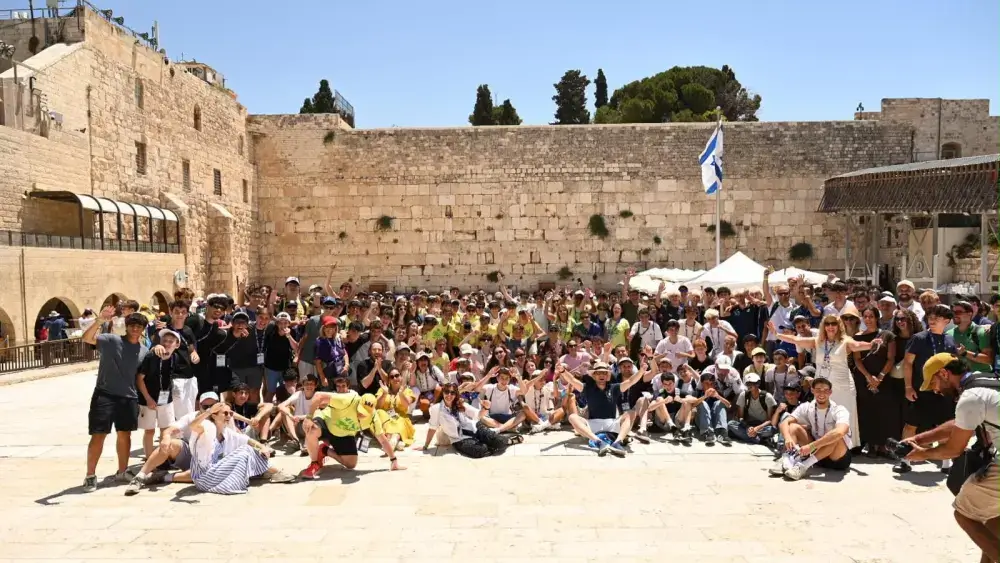
Top Israeli architects and planning teams spent five action-packed hours on Wednesday in Beersheva learning about the Jewish National Fund-USA’s ambitious plans for the World Zionist Village, a transformative center for Zionist education, leadership, innovation, community-building and lifelong engagement with the land and people of Israel.

When completed, the 48,000-square-meter global hub in the growing Negev city will host the Alexander Muss High School, an English-language high school for Israelis, a gap-year program, a pre-army mechina, apartments for interns and seniors and a guesthouse hotel.

Plans also include a Global Learning and Leadership Center, a Zionist Heritage Center, a Living Lab for Innovation showcasing Israeli breakthroughs in sustainability, agricultural technology, climate technology and desert survival technology, as well as cultural and wellness spaces.

Russell Robinson, CEO of Jewish National Fund-USA, welcomed the delegation at Beersheva River Park Lake, highlighting the 12,000-seat amphitheater, athletic fields, man-made lake and thousands of apartments that have sprung up nearby as a result of the park’s success.

Robinson reflected on the area’s transformation in recent years. “They used to dump cars and trash here,” he said, before sharing his vision for the future. “The last part of our plan is the World Zionist Village.”

He thanked the architects and planning teams for coming “to understand our vision.”

The delegation then traveled to the nearby Abraham’s Well International Visitors’ Center for refreshments and a guided tour tracing the history of Beersheva—and its tradition of hospitality—back to the time of the biblical patriarch Abraham.

Erez Ella, founder and partner at HQ Architects, presented a detailed overview of the vision and technical design plans for the World Zionist Village.

Beersheva Mayor Ruvik Danilovich, who has served in the role since 2008, expressed enthusiasm for the project, emphasizing the importance of further developing the Negev and praising Jewish National Fund-USA for initiating the effort.

“They are crazy! They came with the idea and got the State of Israel on board!” he said.

Danilovich added that “a strong Negev is a strong Israel and a solution for Israel.”

Russell Robinson, CEO of Jewish National Fund-USA, leads a golf-cart tour of Beersheva River Park Lake for a delegation of Israeli architects, June 10, 2026. Photo by Howard Blas.

Golf-cart tour

Guests then boarded buses for a golf-cart tour of Beersheva River Park Lake led by Robinson.

Shira Englander of Mosessco Architects drove from Tel Aviv to learn more about the project and explore the possibility of participating in its design. She said she was drawn to a project that “connects Jewish people in Israel and around the world and creates a place for education and culture.”

She also praised its emphasis on sustainability and noted that “something like this doesn’t exist in Israel.”

Yoel Rosby, director of the World Zionist Village, observed: “This is the first time that this many architects from around the country have gotten together for an initiative around world Zionism.”

He added: “This initiative will help open the eyes of society to what the future of Zionism can and should look like.”

Tali Tzour Avner, Jewish National Fund-USA’s chief Israel officer, said she envisions the center as a place “for all Zionists around the world to gather, speak, discuss and communicate with each other.”

She said she is proud that “JNF is leading in speaking about Zionism without hesitation” and emphasized that the center is intended for “Zionists—Jews and non-Jews of all ages, from all places.”

From the opening presentation at 9 a.m. through lunch and a question-and-answer session at Ivri restaurant overlooking the lake, the architects experienced firsthand the enthusiasm and investment that Jewish National Fund-USA, Beersheva and Israel are bringing to the World Zionist Village.

By participating in the site visit and presentations, the firms are now eligible to submit bids to help design the ambitious project.

Read more

Originally appeared in JNS.org on June 3, 2026

Israel’s Education Ministry recently approved the platform for its Summer 2026 catalog, encouraging youngsters to create with technology rather than simply consume it.

When IDF reservist and father of four Moti Malka returned home to Netanya for a much-needed 24-hour break from reserve duty, his wife had one request: Help their 10-year-old son prepare for an English exam the next day.

Realizing the task was daunting, Malka turned to a tool he knew well from his day job developing AI-based solutions for companies.

“I said to my son David, ‘Let’s create a game using AI to prepare for the exam,’” Malka recalled.

The result surprised them both.

“After two minutes, it created a website and a game,” he said. “When I saw his eyes, this was the moment I realized we needed to make AI accessible for kids.” That moment became the inspiration for Yuvi Lab.

Moti Malka, founder of Yuvi Lab, an innovative AI platform geared for children, 2026. Credit: Yuvi Lab.

The AI-powered platform is designed to move children away from passive gaming and toward creating their own applications, games and digital projects. Malka originally planned to name the startup “You Be,” but after discovering the name was unavailable, he settled on Yuvi.

Working alongside a close colleague and his son, Malka built Yuvi Lab as a shared father-and-son project.

“We combined creativity with education, building something we would genuinely want our own children to spend time on,” he said.

Since launching in March this year, the free platform has attracted more than 2,000 active users, who have collectively created more than 6,000 projects. Available in English, Hebrew, Russian and Arabic, the platform allows children to create educational games and interactive learning modules while earning rewards through daily challenges and long-term missions.

Yuvi Lab is designed to teach children how to create with technology rather than simply consume it.

“We wanted to create a new way of learning, what we call ‘Vibe Coding,’ that speaks the language of today’s generation,” Malka said. “Children aren’t just playing; they’re building, experimenting and thinking creatively.

“In an AI-driven world, children need real skills. They should know how to use these tools creatively, safely and confidently. Our vision is to help children become not just users of AI, but creators—giving them the tools to think long-term, solve problems and innovate.”

Partnering with teachers

The platform also supports educators. Teachers in Israel are currently piloting the technology as both an extracurricular and in-class learning tool. The system adapts to each child’s level, language and learning style, while a built-in “smart assistant” remembers preferences and interests over time.

“Yuvi is a co-pilot for teachers, not a substitute,” Malka said. “It helps educators turn learning into active practice and creation, making it easier to engage students and support those who struggle with independent learning.”

Teachers, he added, often lack the time to focus on each student individually. AI can help them create lessons and assignments tailored to each child.

Malka and his team are also helping teachers use the platform to teach critical thinking.

“We know AI isn’t 100% accurate because of the sources of information, which are usually public sources,” he said. “It is important that teachers teach children critical thinking, to cross-check and ask questions, so that we don’t take an answer for granted and instead keep thinking ahead.”

Parents are also encouraged to take an active role in their children’s learning experience. They can track progress across different subjects and receive assurances regarding the platform’s safety measures.

Built according to “Privacy by Design” principles, Yuvi Lab stores no personally identifiable information. All AI-generated content undergoes safety filtering before reaching users, and the platform operates under Microsoft’s ethical AI framework.

Malka recommends that new users begin with the 20-module Yuvi Lab Academy, which he describes as “a playful guided course that teaches kids how to think, ask, check and build with artificial intelligence in clear language for every age group.”

Each module includes both instructional and interactive gaming components.

Growing interest across Israel

Yuvi Lab was recently approved for inclusion in the Israeli Education Ministry’s “Summer Preparatory 2026” catalog as part of the national artificial-intelligence initiative known as “Realistic Israel.” The initiative is administered by the Israel Innovation Authority, the primary governmental arm responsible for promoting technological innovation in Israel.

Municipalities and educational organizations across Israel are now exploring broader use of the platform beyond the summer program.

Part of the interest may stem from concerns about student achievement. Results from the 2024 Program for International Student Assessment (PISA), the OECD’s global evaluation of 15-year-olds in reading, mathematics and science, showed declining performance among Israeli students, particularly in STEM subjects.

Malka, who taught himself coding, credits both his ultra-Orthodox upbringing and the IDF with helping shape the skills that led to Yuvi Lab’s creation.

“In Haredi yeshivas, you spend a lot of time learning Gemara, and you learn how to learn by yourself,” he said.

When he discovered an IDF program that offered Haredi recruits training in English, mathematics and computer skills, he eagerly joined.

“I have to give a big thank you to the army for everything,” Malka said.

Today, he continues to serve as a reserve officer in the IDF Home Front Command while working to equip the next generation with the tools to thrive in an AI-driven world.

Yuvi Lab can be accessed at https://yuvilab.ai/.

Read more

Originally appeared in JNS.org on May 26, 2026

Ticket sales opened this week for the July 1 opening ceremony, featuring leading Israeli and American performers, including pro-Israel advocate Montana Tucker.

The 2026 Maccabiah Games will officially kick off on July 1 with a star-studded opening ceremony at Teddy Stadium in Jerusalem, featuring leading Israeli and American performers, hundreds of dancers, spectacular pyrotechnics and the traditional parade of Jewish athletes from around the world.

Ticket sales for the ceremony opened this week, according to a press release issued on Monday. The theme of this year’s Maccabiah is “More Than Ever.”

“This year, in the spirit of the annual message ‘More Than Ever,’ the Maccabiah 2026 Opening Ceremony will accommodate its largest capacity yet,” the press release stated. “Sales have now opened, and due to the expected demand, it is recommended to secure seats in advance.”

Among the featured performers billed for the opening ceremony is popular American actress, social media personality and pro-Israel advocate Montana Tucker.

American actress and social-media influencer Montana Tucker addresses the audience before the screening of “The Children of Oct. 7” on April 21, 2025. Photo by Izzy Salant.

Tucker will perform an original song and co-host the athletes’ parade with American-Israeli musician and content creator Michael HarPaz. Together, they will welcome competitors from around the globe.

Yuval Raphael, Israel’s representative at the 2025 Eurovision Song Contest, will open the evening with a new musical arrangement. Netta Barzilai, who won the 2018 Eurovision Song Contest for Israel, is scheduled to perform a duet with Anna Zak, a Russian-Israeli singer, actress and social media personality.

Idan Raichel, one of Israel’s most accomplished musicians, will be joined on stage by former hostages Daniella Gilboa and Edan Alexander for a special performance of some of his best-known songs.

Hosted by Israeli TV personality Assi Azar and dancer Anna Aronov and directed by Eldar Gohar Grossman, the opening ceremony will include the lighting of the Maccabiah torch, large-scale multimedia displays on two giant LED screens and a procession of thousands of athletes representing Jewish communities worldwide.

Often referred to as the “Jewish Olympics,” the 22nd Maccabiah will take place from July 1-13 and is expected to bring together some 8,000 athletes from 55 countries competing in more than 30 sports.

Gates will open for the July 1 ceremony at 5 p.m., with the program beginning at 7:30 p.m. Israel time.

Tickets are available to the public starting at 99 shekels. JNS readers can receive a special 10% promotional discount on the price of Opening Ceremony tickets. Go to https://tickets.leaan.net/event/-25-bawho9 and type “JNS10″ when prompted to “Add Promo Code.”

Read more

The Lachsters made the move to Israel at the start of 2023, and it hasn’t always been easy.

Originally appeared in Jerusalem Post Magazine on May 15, 2026

Daniela Lachster, her husband, and two sons loved their thriving Buenos Aires Jewish community. But Argentina is also a country with a long history of economic and political uncertainty – two big reasons why Jews there consider aliyah.
The Lachsters made the move to Israel at the start of 2023, and needless to say, it hasn’t always been easy. They have dealt with Oct. 7, the Iran wars, job searches, and settling two children, ages 23 and 16, into a new country. “It is a process. If you ask in five years, I will be speaking in a different manner,” says Lachster.

Lachster’s candor and heartfelt descriptions of their experiences searching for jobs, interacting with not always helpful government officials, and the lack of services for Spanish speakers as compared to English speakers are useful to those making aliyah from Spanish-speaking countries.

Lachster feels that the job search for those over 50 is fraught with challenges and perhaps age discrimination. She and her husband both had meaningful and fulfilling pre-aliyah careers. Lachster worked for the National Bank of Argentina for 20 years, then as a volunteer for the AMIA (Asociación Mutual Israelita Argentina) Jewish community institution, and briefly for a gold jewelry wholesaler.

Lachster’s husband came to Israel with very impressive credentials, which include degrees in business administration, language skills, and a five-year stint (2011-2016) with the multinational energy corporation Chevron. His work took the family from Buenos Aires, with 180,000 to 250,000 Jewish members, to Mandeville, Louisiana, and its small Jewish community – a 40-minute drive from New Orleans. The Lachsters enjoyed their time in the US – especially their frequent eight-hour trips to central Florida’s beaches.

The Lachsters returned to Argentina from 2016 to 2021, a period that coincided with the COVID pandemic and Argentina’s very restrictive regulations. “They were very strict. We couldn’t go out of our homes for six or seven months. They closed the whole country, and we were only allowed to go out 100 meters. We saw that other countries had a life,” Lachster said.

She noted the psychological toll that being confined to home was taking on her, the family, and the entire country, and began thinking seriously of moving. She conceded, “I never thought of aliyah because the US was the promised land.” Returning to the US wasn’t an option, as it would have required a special visa.

After moving to Israel, Lachster has found cultural differences to be “the hardest.” She cited service providers who “seem angry,” are not “speaking nicely,” and treat people “with no respect.” Lachster’s dry sense of humor comes through often. “It is easier to go to the moon than to go on aliyah.”

She also notes cultural differences in the areas of education and parenting. She is particularly attuned to such issues in her work as a preschool assistant. She has observed children in Israel frequently left alone and not properly supervised for many hours, and parents who do not set limits for their children. Lachster is taking classes in early childhood education through the David Yellin College of Education.

Another issue Lachster has faced is in accessing services for immigrants. She laughed as she described a visit with the Aliyah and Integration Ministry. She was assigned to a Russian speaker who was unclear about her benefits, and she ended up signing up for National Insurance Institute (NII – Bituah Leumi) benefits on her own.

Lachster observes that “all olim have problems” but feels it is even harder for olim from South America. She noted, “If you speak English, you have more organizations to help – like Nefesh B’Nefesh and ESRA. But they don’t help South Americans.”

The aliyah process has been challenging for her husband and for their two sons. Despite her husband’s impressive resume, it has been difficult to find what he is looking for. In the meantime, he has been working as a freelancer with computer systems. “The truth is, it is very hard to find work if you are over 50!”

Her older son spent six months on Kibbutz Ma’agan Michael after arriving. He’s now in the IDF. “He is good now and is acclimated to the army – but he didn’t learn any Hebrew on the kibbutz.”

Lachter explained that trying to understand the army is confusing and frustrating. Her son is looking forward to completing his army service and traveling before beginning his university studies in Israel.

Her younger son found it difficult to master Hebrew – despite attending Jewish day school in Argentina. He started school in Modi’in and benefited from a year and a half of ulpan.

Despite the challenges, Lachster keeps her perspective and remains positive. And she reminds herself of the challenges that made life uncertain in Argentina. “There were economic problems, and we had no idea who the next leader would be.”

The reality behind aliyah

Lachster feels lucky to have found such a lovely community. “We found our place in Modi’in, in a small, self-managed synagogue full of olim from all over the world. It’s our second home – a place where we pray, celebrate, and sometimes just share a meal and a laugh. There, amid the mix of languages and accents, I’ve learned that belonging is not about where you’re from but about where you choose to give your heart.”

Lachster has found another useful outlet for coping and settling into life in her new country. “A few days after arriving, I created @comer_alia, my Instagram page where I began sharing pieces of this new life. What started as a personal diary soon became a meeting point – a space to connect with other olim who, like me, were learning to walk, speak, and dream again in a new language and a new land.”
She uses her Spanish-language Instagram to chronicle “the good and bad things that happen to me.”
She uses the forum to write about trips she takes, shakshuka and other foods (“I love to eat”), and shopping experiences. And she uses it to describe and work through “the things I didn’t know.” She rattled off a long list, which includes NII and Terem Urgent Care. She also proudly uses her Instagram page as a tool for public diplomacy. “Christians in Argentina read it and like seeing their holy places.”

Lachster shared a thus far unpublished piece titled “My Aliyah Story: Finding Light in a New Beginning,” where she writes, “Making aliyah is more than a change of country – it’s a leap of faith. In January 2023, I left Argentina with my family, our suitcases full of dreams and our hearts full of questions. We didn’t know exactly what was waiting for us in Israel, but we believed in something bigger – in building a life filled with meaning.

“The path of integration is not always simple, especially for Latin American olim. There are moments of frustration, of longing, of doubt. But there is also growth. Every challenge brings a new lesson, and with time, patience, and openness, life begins to flow naturally. I often think of four Hebrew words that have guided me along the way: savlanut (patience), emunah (faith), bitachon (trust), and sovlanut (tolerance). They are not just ideas – they are daily acts of strength.”
Lachster reminds those considering aliyah that “it is a process. It is a hard process.” And she offers, “My hope is that every oleh who arrives with a dream finds not only challenges but also light – the light of connection, of faith, and of belonging. Because aliyah is not just a journey across continents – it’s a journey toward the heart.” ■
Daniela Lachster, 52
From Buenos Aires
to Modi’in, January 2023
Read more