Sport

Original Article Published On The Jewish Philanthropy

It is rare that two of my favorite topics – tennis and Judaism – have much to teach each other. A few nights ago, as I watched the New York Empire battle the Washington Kastle on Opening Night of the World Team Tennis season at the legendary West Side Tennis club in Forest Hills, New York, I realized that this action-packed, colorful, fast-paced, family-friendly sport has a lot to teach our synagogues and prayer services.

Mylan World Team Tennis (WTT), co-founded in 1974 by tennis legend Billie Jean King, is tennis with a twist. Players (many ranked in the top 200 in the world) are drafted to six teams and compete in twelve matches, from July 31-August 13th.

This tennis format is family friendly – instead of the traditional “first player to 6 games” set, the first player to win five games wins the set. And there is only one set – no best 2 of 3 (or 3 of 5) like in traditional tennis. Scoring is no ad, so the games end quickly. And team points are cumulative and tallied at the end. If the matches are tied at the end of five sets, there is a supertiebreaker. Fans watch five matches (men’s and women’s singles and doubles and mixed doubles), played back to back on one very colorful court, they can cheer as loud as they want, and everyone goes him in under three hours!

These slight modifications to the traditional game preserve the essence of the sport, while adding excitement. Here are some lessons synagogues across the denominations can take from World Team Tennis and apply:

Give the court a makeover: courts are painted a very colorful purple, green red and blue – a far cry from traditional, monochromatic green or blue. It is amazing what a little fresh paint, polish, and color can do. Paint and freshen up that old shul building. And consider some new lighting as well.

Mix up the order of play: Each night, the home team coach determines the order of play for the five matches. Some nights, women’s singles leads off, while other nights, it is mixed doubles. It keeps the fans engaged and on their toes. While the matbeah tefillah – the order of prayers – is important, there is room for “mixing it up.” Experiment with new tunes. Consider adding or even “skipping” certain prayers some evenings or mornings.

Time limits get us out of here faster! In WTT, the clock is ticking. As soon as a point ends, the clock counts down from 25 seconds. Consider time limits to your synagogue service. Does a service really need to be 3 or more hours? A traditional service with a full torah reading in Israel takes no more than 90 minutes! (Basketball and even baseball are using clocks to keep the action moving). We have an important principle in Judaism of tircha d’ziburah – “paining” the community. Long services feel like torture!

Team consists of regular team members and special guests and is diverse: The core team, consisting of players from around the world, is on the roster all season, but several times a season, special guest players join the team. It is nice when the rabbi delivers the weekly sermon and the cantor leads the davening (prayer service), but guest d’var torahs – by congregants, visiting guests, other rabbis or educators in the community – add new perspectives. And lay leaders with the skills to lead the congregation in prayer add a lot to the team.

Make the players accessible to the fans: Following the match, all kids 16 and under are invited to the court. Players are seated at tables where they sign autographs and schmooze with the fans. Rabbis, cantors and members of the shul leadership should be accessible, reachable and relatable to community members of all ages.

Players are real people and model that no job is beneath them: The players come across to the fans as “real people” – they cheer for their teammates, and bring them towels, water and power drinks during the match. When rabbis and cantors relate to congregants as “fellow travelers” – parents, community members and citizens of the world, congregants can relate to them better.

Friendly staff do wonders for the franchise: Ticket takers, ushers, volunteers and on-court announcers are gregarious, friendly and helpful and help the guests feel good about being here. While ushers and volunteers smile and engage you as they walk you to your seat, playful announcers encourage audience participation. Helpful, friendly, welcoming synagogue staff who come over to introduce themselves to guests, bring over a siddur or Chumash and show guests the proper page make people feel welcomed – and inclined to come back again in the future.

The World Team Tennis season runs through August 13th with the finals taking place in New York City on August 26th. If you live in New York City, Washington, DC, Philadelphia, PA, Springfield, MO, San Diego, CA or Orange County, CA, come watch a match – and consider what this exciting tennis format can do to spice things up in your shul!
Read more

Original Article Published at The Jerusalem Post

As the tennis world gears up for the Miami Open (March 21-April 3), often considered the “Fifth Grand Slam,” on par with such tennis events as Wimbledon and the US Open, Israel is preparing to welcome local and international talent to the similarly timed Israel Open.

The Israel Open, a $125,000 ATP men’s Challenger tennis tournament, attracts some big names to the Ra’anana Tennis Center March 27 to April 4.

Shlomo Glickstein, President of the Israel Tennis Association and former 22nd ranked player in the world, is proud and excited.

“It is very important for Israel to host such competitions and we love to host large events. It attracts sponsors, media and role models for our young players.”

Glickstein is also practical. “Tournaments like ours offer young tennis players the chance to earn ATP points.”

The Israel Open is part of the ATP Challenger Tour, a series of international professional men’s tennis tournaments.

Players who earn sufficient ranking points become eligible for qualifying or main draw entry at such ATP World Tour tournaments as the recent BNP Paribas Open at Indian Wells or the Miami Open. Future events, like the three $10,000 tournaments recently held in Israel, are the third tier of international tennis competition.

The Israel Open attracts such well-known Israeli players as Dudi Sela, who climbed this week from No. 88 to 84 in the rankings, and Amir Weintraub (197). They are joined in the main singles draw of 32 by top 100 players Mikhail Youzhny (76th, Russia), Evgeny Donskoy (81st, Russia), and Ricardis Berankis (85th, Lithuania). Lukas Lacko (98th, Slovakia), who lost in a three-set final last year to Nikoloz Basilashvili, returns to Israel to play in this year’s Israel Open.

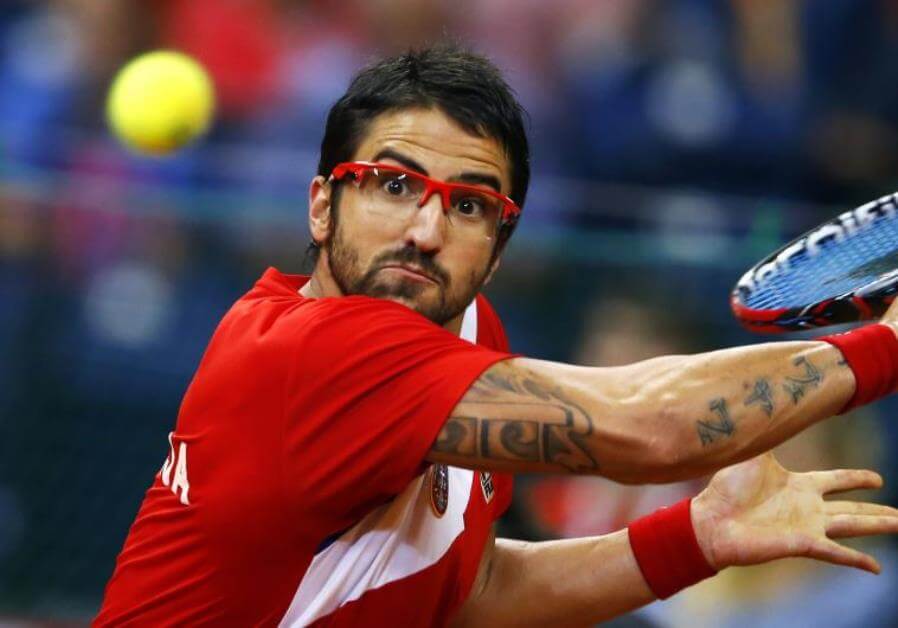
Other top players include Janko Tipsarevic of Serbia, currently ranked 401. Tipsarevic received a wild card and is making his tennis comeback following foot surgery and a 17 month absence from tennis.

Israeli Yoni Erlich will enter the Israel open doubles tournament.

Erlich had a distinguished doubles career playing with Andy Ram, and continues competing in international tournaments, many with partner Colin Fleming of Great Britain.

Sixteen teams will also compete in doubles.

Youzhny is no stranger to Israel.

“I have been to Israel several times with my family for vacations. I love Israel and look forward to coming to Israel again.”

Berankis is looking forward to making his first trip to Israel.

“I have many friends in Israel and heard so many good things about Israel. I’m really excited to come and play this big Challenger tournament.”

Israel has become an increasingly popular destination for professional tennis tournaments.

In early February, Israel hosted 14 countries in the Fed Cup Europe/Africa Zone Group I women’s tennis event. Top players, including Heather Watson (55th, Great Britain), Tsvetana Prionkova (59th, Bulgaria) and Jelena Ostapenko (84th, Latvia), competed at the Municipal Tennis Club in Eilat. The Israel team, anchored by Julia Glushko and Shahar Peer, finished in the top 4 of the event.

And Israel hosted three Futures tennis events in January and February.

Israeli Davis Cup team member, Edan Leshem and 16-year-old future star, Yshai Oliel, competed in some of the $10,000 Future events.at the Kfar Maccabiah Tennis Center.

Glickstein notes that , “We have some promising young players including Ben Patael, Tal Goldengorn, Yshai Oliel – they are eager to play and get results.”

Israel recently lost to Hungary in the Davis Cup.

The Israel Open was held in Ramat Hasharon from 2008-2010, was not held from 2011-2014, and was also played in Ra’anana last year.

Read more

Original Article Published on The Jerusalem Post

Israel will play in Fed Cup Europe/Africa Zone Group I for an eighth straight year in 2017 after losing 3-0 to Ukraine in Eilat on Saturday.

A 2-1 win over Croatia on Friday wrapped up first place in Pool C for Israel, but Julia Glushko and Shahar Pe’er ran out of steam on Saturday and couldn’t beat the strong Ukrainians to advance to the World Group II playoffs.

Pe’er, ranked No. 189 in the world, lost 6-1, 6-1 to Kateryna Bondarenko (73) before Glushko (126) fell 7-6 (1), 7-6 (2) to Lesia Tsurenko (35).

Shelly Krolitzky and Alona Pushkarevsky lost 6-2, 6-2 to Bondarenko and Olga Savchuk in the meaningless doubles rubber.

“This was a very long week and I woke up feeling completely exhausted,” said Glushko.

“Even though I feel a little sad now, I will try and take the positives from this week.”

Pe’er was also hopeful of building on her performances in Eilat over recent days.

“I end this week feeling much stronger and I’m going all the way in 2016,” said Pe’er. “I will give my all and hopefully the coming weeks will go well. There is no doubt in my mind that I’m a good enough player to be ranked in the top 100.”

Pe’er kicked off the action for Team Israel on Center Court in Saturday afternoon’s match against Ukraine’s Bondarenko.

This time, the hard-hitting Pe’er’s unforced errors, six double faults and generally weak serve made it impossible to recover from a 6-1 deficit in the first set. Pe’er went on to lose the match in 64 minutes.

Glushko faced off against Tsurenko in a hard fought, back and forth, two hours singles marathon. Glushko went up 1-0, and quickly fell behind 4-1 before going up 5-4. Glushko lost in the first set tie-breaker, only winning two points. In a heartbreaker second set, Glushko fell in a tiebreaker despite being up 3-0 and 5-3. Following the last point, Glushko pointed a finger at the chair umpire, said “no, no, no,” threw her racket and appeared teary in protest of what she thought was a bad call.

Belgium joined Ukraine in the playoffs, with Israel and Great Britain finishing in 3rd and 4th place.

Friday’s matches started late due to the long Belgium versus Bulgaria doubles match on Center Court. Pe’er battled back from a 6-3, 1-0 deficit to defeat Tena Lukas in two hours.

Pe’er hit hard from the baseline, moving Lukas from corner to corner and winning many long rallies. In the second match, Glushko went down to Ana Konjuh in straight sets, 7-6, 6-1.

Pe’er brought Glushko back to life in the doubles match versus Konjuh and Darija Jurak.

The Croatian team got off to a 4-1 lead before the Israeli team fought back with five straight games, to win 6-4, 7-6.

Read more

Original Article Published on The Jerusalem Post

Israel enters Friday’s Fed Cup Europe/ Africa Zone Group I tie against Croatia in Eilat still in contention to advance to the World Group II playoffs after defeating Estonia 3-0 on Thursday.

After falling 2-1 to Turkey in its opening Pool C tie, the blue-and-white bounced back with an emphatic victory, with Shahar Pe’er and Julia Glushko triumphing in their singles rubbers before teaming up to complete the whitewash with a win in the doubles.

Pe’er, ranked No. 189 in the world, easily defeated Valeria Gorlats (1,008) 6-0, 6-3, while Glushko (126) beat Anett Kontaveit (80) 6-3, 6-3. She returned to court less than an hour later and together with Pe’er claimed a 6-3, 6-2 win over Gorlats and Maileen Nuudi.

Israel faces Croatia in its final Pool C tie on Friday.

The group winner will face the winner of Pool A on Saturday for a place in the World Group II playoffs, while the bottom-placed nations will play to determine relegation to Europe/Africa Zone Group II in 2017.

Pe’er quickly and smoothly knocked off Gorlats, with the bright sun barely having time to duck behind the grandstand during the 65-minute match. Pe’er made few unforced errors, won 80% of points on first serve, and won 66% of break points – to Goralts’s 16%.

Excessive cheering and chanting of the crowd, which consisted of many school children who seemed to stop by on the way home from school, contributed to the upbeat, festive mood. In somewhat uncharacteristic fashion, a smiling Pe’er signed autographs and posed for selfies.

Glushko battled Kontaveit in a slugfest, coming out on top in straight sets.

Captain Tzipi Obziler used each changeover for coaching and words of encouragement to a worn Glushko.

“She was a little tense, and was under a lot of pressure,” observed Israel coach Sandra Wasserman, describing the hour and eight minute match.

The crowd, which required several warnings from the chair to quiet down, helped both players.

Team Israel has spent long days at the Eilat Tennis Center.

Wednesday’s doubles match against Turkey ended just before 11 p.m.

Among the die-hard fans who stayed until the end to cheer on the Israeli doubles team were a group of 8-14 year old female athletes from Athena, Israel’s project for the promotion of women’s sports in Israel.

Mary Pierce, a former third-ranked Grand Slam champion and recently elected board member of the International Tennis Federation, presented a clinic, shared her personal story, and entertained questions Thursday morning at Eilat’s Isrotel Tennis Club.

The Israel team took a break from an early afternoon practice on Center Court on Thursday to participate in the Fed Cup official Opening Ceremony. Each team filed in to Center Court behind country flags. Players, captains and coaches were all introduced by name.

Read more