Other

Though baseball is a ‘Jewish sport’, its roots in Israel are still taking hold. Team Israel is taking to the baseball diamond this week in South Florida in a bid to participate in the March 2013 World Baseball Classic. How did the blue and white players get there, and what are their chances?

Former Major Leaguer Brad Ausmus in Israel as part of his new post as coach of the Israeli team for the World Baseball Classic tournament. (photo credit: Michal Shmulovich)

In the baseball world, South Florida is associated with Major League Baseball’s spring training. And September is traditionally the season of pennant races and league championships. But starting this September 19, Roger Dean Stadium in Jupiter, Florida [90 minutes north of Miami and half an hour south of where the New York Yankees train each March] will host teams from France, Spain, South Africa and Israel — all part of the World Baseball Classic (WBC) qualifying round. There, a handful of well-known Jewish former Major League players will on hand as they help Israel qualify for a spot in the March 2013 World Baseball Classic.

Shlomo Lipetz, pitcher. (photo credit: courtesy)

While not as well known as Major League Baseball’s World Series or even the Little League Baseball World Series, the World Baseball Classic is considered to be the premier international baseball tournament. It is run by WBCI (World Baseball Classic, Inc.) and is sanctioned by the International Baseball Federation. Major League Baseball and the Major League Baseball Player’s Association together created the event, which has thus far been held twice. Team Japan, the reigning World Baseball Classic Champion, won the tournament in both 2006 and 2009. More than 1.5 million fans from all over the world have attended the tournament to date.

Between September and November, four qualifying tournaments will be held in various locations around the world. Host cities include Jupiter, FL (USA), Regensberg, Germany, Panama City, Panama, and New Taipei City, Taiwan. Six games will be played at each location, following a modified double elimination format. Teams competing include Canada, Great Britain, Czech Republic, Panama, Brazil, Colombia, Nicaragua, Philippines, Thailand, New Zealand and China Taipei.

In March 2013, the first round of the main tournament will get underway in Phoenix, Arizona. The second round will take place in Miami, Florida, and the championship round will be held at AT &T Park in San Francisco, California.

Israel is participating in its first WBC. The pool of potential players expands beyond actual citizens of the State of Israel since, according to WBC tournament rules, countries are allowed to field players who are eligible for citizenship in a given country. In Israel’s case, anyone eligible for citizenship under the Law of Return is permitted to try out for Israel’s team. This may be good news for the Jewish State — given the overall weak popularity of baseball in Israel, and Israel’s relatively poor record of producing homegrown baseball standouts.

While an article on the Israel Baseball League website, “Baseball in the Times of Our Forefathers,” satirically suggests that baseball has been played in Israel since biblical times, baseball was likely introduced to Israel on July 4, 1927, at the Sephardic Orphanage in Jerusalem when the governess of the orphanage handed out baseball equipment to her charges. Later, in the 1970s, immigrants from North America began playing baseball upon their arrival in Israel.

Baseball has been slow to catch on in Israel. Between 1,000 and 3,000 people currently play in baseball and softball leagues in Israel, though few regulation sized fields exist

Baseball has, nonetheless, been slow to catch on in Israel. Between 1,000 and 3,000 people currently play in baseball and softball leagues in Israel, though few regulation sized fields exist.

In December 1986, the Israel Association of Baseball was formed to create an infrastructure and promote baseball in Israel. In July 2005, the Israel Baseball League was formed, and in June 2007, six teams kicked off the inaugural season of the IBL.

The IBL existed as a league for only one season. The Israel Association of Baseball (IAB) currently exists to promote baseball in Israel. There are currently five leagues with teams playing in sixteen centers from Tel Aviv to Beit Shemesh, Ra’anana, Jerusalem and Even Yehuda. The IAB trains coaches and umpires, hosts coaches and teams from overseas, and sends youth teams to tournaments around the world.

Haim Katz, the IAB President, is passionate about baseball, a game he calls “the most Jewish sport in North America.” Katz, 59, moved from Pittsburgh, Pennsylvania to Israel in 1978. His love of baseball was “handed down from my father,” reports Katz; he traces his interest in baseball to 1960, the year he attended the World Series. He attended Game 2 when his Pittsburgh Pirates lost to the New York Yankees, 16-3. He playfully notes that he is still a Pirates fan.

Katz says he and the IAB seek to increase awareness of Israel baseball in the US and Israel, try to engage North American Jews in Israel baseball, and build bridges with the US and Israel.

“We like to put Israel in a more positive light — not just to talk about nuclear bombs, but to show positive things about Israel — we have pretty much achieved our objective so far.”

Katz was extremely proud and excited when he was approached by the World Baseball Classic to “present motivation and a potential roster” for a team to potentially participate in the 2012 qualifiers. “Somewhat to our surprise, they accepted us!” notes Katz half jokingly. “We would have preferred to play the tournament in Israel, but we have no field; we are working on it!” (Katz is referring to an initiative to build a $5 million field/ballpark in Ra’anana. The city has reportedly agreed to provide land and the Israel Sports Authority will pay $1.5 million; the IAB would be responsible for the rest of the funds.)

In assembling the team for the WBC tournament in Florida, Katz has tried to offer opportunities to up and coming Israeli players, while also including well-known, Jewish former Major Leaguers.

Brad Ausmus, 43, who spent 18 years as a major league catcher and who currently works in the San Diego Padres organization, will serve as manager. While the official roster has not yet been announced, former major leaguers Shawn Green and Gabe Kapler have, according to Ausmus, “agreed to serve in some type of player/coach capacity.”

The 39-year-old Green, who played for four major league teams and hit 328 home runs in his 15 year career, will likely serve as the team’s hitting coach. Kapler, 36, played for 12 years and won a World Series with the 2004 Boston Red Sox; he retired in 2010.

Kevin Youkilis of the Chicago White Sox (photo credit: CC BY Joe Bielawa/WIkipedia)

Other players rumored to be considering roles with the team (either for the qualifiers, or in March 2013, should Israel advance to the tournament) include: Milwaukee Brewers outfielder Ryan Braun, Chicago White Sox third baseman Kevin Youkilis, Texas Rangers second baseman Ian Kinsler, New York Mets first baseman Ike Davis, San Diego Padres right-handed pitcher Jason Marquis, Boston Red Sox Catcher Ryan Lavarnway, and New York Mets infielder Josh Satin. There has recently been some online talk about granting a spot to Adam Greenberg, 31, who, in 2005 as a member of the Chicago Cubs was hit in the head by the first pitch of his only major league appearance. Former Major Leaguer Art Shamsky, who played for the 1969 “Miracle Mets,” will serve as Israel’s ambassador to the World Baseball Classic Qualifiers.

Manager Ausmus, who grew up in a not very Jewishly connected family in Connecticut (USA), was contacted by Haim Katz over a year ago, via an email to the San Diego Padres organization. He, Peter Kurz, the Secretary General of the IAB, Green and Kapler met. Ausmus soon after agreed to be part of Team Israel.

“When I was appointed manager, it became very clear that I needed to visit Israel, since I never had. At the end of May, my wife and I spent about a week in Israel, traveling to tourist sites, seeing baseball facilities, meeting some of Israel’s baseball players. I loved floating in the Dead Sea, surfing in the Mediterranean Sea at Tel Aviv (and bragging about it to my surfer friends in Tel Aviv), and going to Jerusalem.
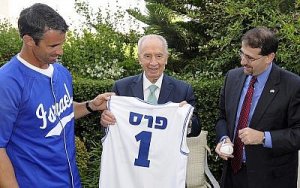
Brad Ausmus, President Shimon Peres and US Ambassador Daniel Shapiro. (photo credit: courtesy of US Embassy)

“Jerusalem just amazed me — the history, the ruins, the vitality of the people in Jerusalem is phenomenal — you don’t feel this type of energy anywhere else in the world. I was awestruck by my visit there. And my meeting with President Peres, arranged by the US Ambassador, Daniel Shapiro, was amazing — he is an impressive man — I get the feeling he could slide in to any situation with people of any background and make them feel comfortable.”

“We are extremely fortunate to have someone of Brad’s caliber to manage the team. His skills and knowledge of baseball are top rank — and the team has top talent. Brad sees the bigger picture here, he is a pleasure to work with, and he is a mensch!” observes Katz.

Some 18 members of the team coming from Israel are playing several exhibition games in the Miami area on September 11 and 12. The rest of the team will join on September 13 and play several more exhibition games in South Florida. Team Israel’s first tournament game will be on September 19 against South Africa and it will play a second game on Friday, September 21, against either France or Spain, with possible games on Saturday or Sunday if it advances.

(Source: http://www.timesofisrael.com

Read more

Original Article Published on The Jerusalem Post

Israeli counselors share their experiences serving at a Conservative Movement summer camp.

For a special group of Israelis, serving their country continues after their army service ends in North America. A diverse group of Israeli twenty somethings representing different cities and towns, ethnic and religious backgrounds, and political viewpoints, have a unique opportunity to spend two intense, rewarding months serving as shlichim (emissaries or representatives) at various summer camps throughout North America. Shlichim serve at various movement camps as well as JCC, B’nai Brith, independent and unaffiliated camps.

The visiting Israelis serve as bunk counselors and teach art, woodworking, singing and dancing, sports, swimming, boating, ropes, and even cartooning. The shlichim share their Israel with campers and staff, and, in the process, learn a great deal about North American Jewish life and Judaism.

Being selected to be a shaliach is very selective. According to Lianne Novak, the Jewish Agency for Israel’s summer camp coordinator to Ramah camps (Conservative Movement), 5,000 talented Israelis start the process. After an initial phone screening, the number is reduced to 1,100. Approximately 250 are chosen to serve as shlichim to the eight Ramah camps. The shlichim you will meet all served this past summer at the 500 camper, Camp Ramah in New England.

Eyal Chirurg, 23, a second year emissary from Maalot in the north of Israel, teaches comics and cartooning to 8- to 16-year-olds. The soft spoken, very talented Chirurg has already illustrated a children’s book, Illustrated Curiosity, and his sketches and artwork appear on signs and T-shirts everywhere around camp. Camp is a small society and an alternate reality for the campers,” observes Chirurg, who notes that there is no comparable summer camp experience in Israel.

Chirurg enjoys being part of a delegation with such a diverse group of Israelis. It doesn’t matter where you come from in Israeli society: all are accepted, and all are quality, amazing people with the motivation to do good things. This summer, Chirurg lives in a bunk with campers from the Tikvah Program, the 43-year-old program for adolescents with a range of special needs. The special needs program is the most amazing part of camp and the reason I came back!

Sahar Ben Or, 23, a third year emissary from Rishon LeZion, worked for two years as a sports teacher and soccer coach. This summer he worked first as a bunk counselor to twelve-year-olds, and then to fourteen-year-olds. Sahar, perhaps ironically, comes to a summer camp in America for the Jewish experience!”

Here, at camp, we feel more Jewish. When I am at home, I miss the Jewish atmosphere of camp. He enjoys interacting with Israelis he might not otherwise meet in Israel, and he loves bringing Israel to his campers. “The oldest campers learned about such important issues in Israel as immigration, cost of living, and the status of non-Orthodox Jews and they held protests. In addition, I have brought my campers to pray at the andarta, a monument to fallen soldiers, and I enjoy teaching about our Israeli traditions like foods and birthday party games!

Eliana Farber, 21, of Ra’anana, comes from an observant family. She is serving as a counselor with thirteen-year-old girls. She and several distinguished soldiers are permitted to use these two months toward their army service. Farber is somewhat unique among the 50 shlichim; her English is perfect and unaccented since she made aliyah with her parents (from New York) when she was five years old; I like the fact that we made aliyah. I teach my campers that we are a medina olim a country of immigrants. Farber observes, I represent Israel in my daily conversations and interactions with campers, and by just being who I am.

Farber’s experience at a Conservative Movement summer camp has proven both eye opening and challenging. When Rabbi Mitch Cohen (the National Ramah director) told the shlichim that there is more than one way to be Jewish, it gave me the chills! I never heard anyone say it out loud that’s so great. I am so happy to be in a place where that is okay. It is has also gotten me conflicted.

Water front head, Rotem Ad- Epsztein, an eleven year veteran of the mishlochot, which she now heads, views camp as a chance to learn more about Jewish religious practice. She and her husband, Uri, who came from secular Israeli backgrounds, can now share this experience with their nearly three- year-old daughter, Lotem. “At camp she gets Jewish life, Jewish experience, social experience, nature and more….

Rotem is proud of her shlichim. They all come from the rainbow of Judaism and this is great! They present the real situation in Israel. The fact that they all come from different religious they can connect with different shichimi.

Why would a camp invest so much money, time, and effort in bringing shlichim? Rabbi Ed Gelb, Director, Camp Ramah New England proudly reports, We bring Israeli shlichim to camp because the personal connection between Israeli staff and the campers begins a positive life- long relationship with Israel. When our campers journey to Israel, they will often meet up with the Israeli staff and share the experience. Camp also has an incredible impact on the Israelis. For many, the idea of Conservative Judaism was unknown to them and by spending at least one summer at camp they find a Judaism that is accessible and compelling to them. It is hard to say who impacts whom more. Rabbi Mitch Cohen adds, As wonderful as most shlichim are as educators, counselors or sports instructors, by far the greatest impact of their presence in camp is the friendships they create with campers and staff. Having Israelis as good friends makes the connection with Israel very personal and is the most effective way of building strong identification with and support for the State of Israel.

We look forward to the arrival of another exciting group of Israelis next year!


Read more

Despite a first-round loss at the US Open, up-and-comer Julia Glushko says she’s proud to represent her adopted country – and looks forward to better results in the future.

For many of the women in the main draw of the US Open, the path to the two-week tournament was straightforward. For Julia Glushko, an Israeli ranked 160th in the world, the road to her first-ever Grand Slam started many months ago — and ended triumphantly last week, with victories in three tough qualifying matches.

Once at the Open, the 22-year-old’s experience proved a bit of an anticlimax — the Ukrainian-born player put up a tough fight Monday, but lost 7-5, 6-2 in her first-round match against the No. 25 seed, Yanina Wickmayer of Belgium.

Despite the disappointing result, Glushko views her participation as a reason for celebration, capping off an extraordinary year of growth for the Modiin resident. In December, Julia (pronounced “Yulia”) won the Israeli national title by defeating Shahar Pe’er, ending the latter’s five-year reign as champion. The victory kicked off a 2012 of tournaments around the world, including the biggest singles title of Glushko’s career: a July win at an International Tennis Federation tournament in Louisville, Ky.

I pay for my travel, mostly from my prize money.  This time, I raised enough money for my coach, Liran Kling, to come.”

Glushko’s US Open appearance was scheduled as the third match of the day, but due to a 2½ -hour rain delay, she didn’t set foot on the court until 7 p.m., when spectators were arriving for a night session featuring Kim Clijsters, Roger Federer and a music performance by “American Idol” winner Jordin Sparks.

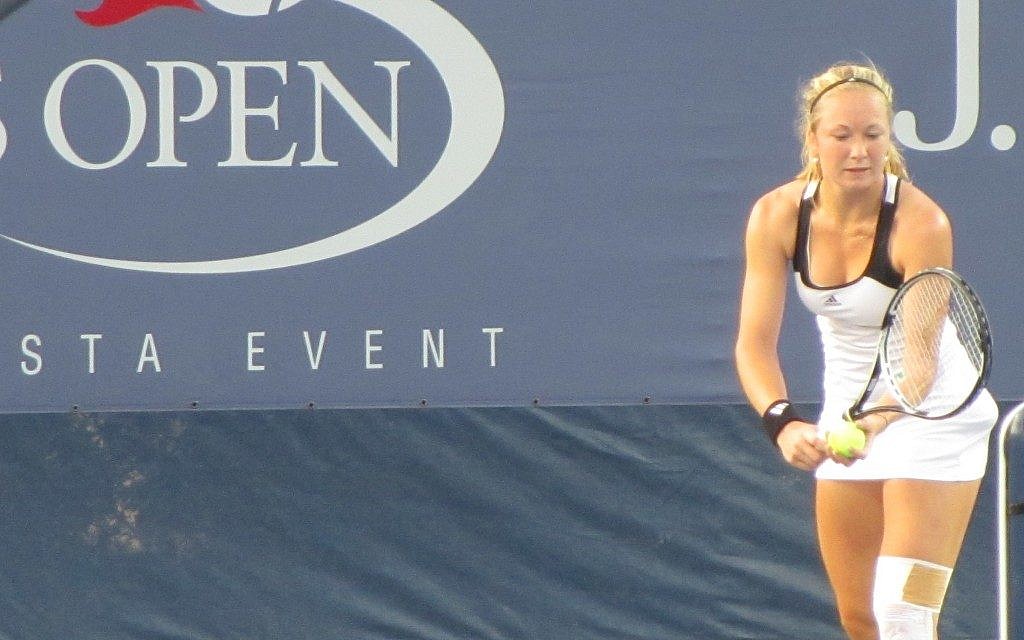
Wearing tennis whites and a bandage on her left knee, Glushko hit strongly off both her forehand and backhand. Even with her relatively low ranking, members of the crowd clearly knew who she was, chanting words of encouragement — “yallah” (let’s go) and “kadima” (come on) — familiar to any Israeli.

“I am so thankful that people came out—there were a lot of Jewish and Israeli people cheering for me,” said Glushko, who’s fluent in Hebrew, Russian and English.

Despite her loss, Glushko wasn’t disappointed. “It was a tough draw, but I think I did pretty well,” she reflected. “I was ready to play, [and] can learn a lot for the next time.”

Beyond her first Grand Slam experience — following a failed January attempt to qualify for the Australian Open — Glushko’s trip to New York also meant a chance to reunite with her former doubles partner, the Israeli-Arab player Nadine Fahoum. Now a development associate in New York for the Israel Tennis Center, Fahoum, who recently wrapped up her college career at Duke University, sees a promising future for her old  partner.

“Qualifying for the US Open main draw is the first big step to becoming one of the top players in the world,” Fahoum said. “I wish her much success.”

But while Glushko, who ranked as high as No. 10 in the world as a junior, appears to be on her way, challenges lie ahead — particularly financial ones.

Following her match, the 5-foot-7 player spoke with the Times of Israel. An condensed excerpt appears below.

What is it like representing Israel and Jewish people around the world?

It is probably one of the most special things. There are not many athletes from Israel. I am thankful to be able to represent Israel at the US Open.  For the women, it is only me and Shahar in the main draw.

Do you think Israel can produce more top players? What are some of the challenges facing Israel?

There are a lot of Israel Tennis Centers, and a lot of people who play, but it is hard because everyone goes to the army at age 18.  Also, tennis is an expensive sport. The tennis centers work hard to raise money, but it is expensive — traveling overseas, a coach, etc. I pay for my travel, mostly from my prize money.  This time, I raised enough money for my coach, Liran Kling, to come.

There are ups and downs to playing tennis. You are away all the time. It is hard on your body —  I have pain in my knees all the time. It is a hard life, but I love it. I feel lucky. I try not to think about [match results] or money — I just think about working hard and keeping healthy.

“The country gives so much to me, so whatever I can give back, I want to give back.”

What was your experience growing up?  How did you get into tennis?

I was born in the Ukraine and moved to Israel when I was 8. I feel so Israeli! I am happy [my parents] moved, because life in Israel is so much better. We lived in Jerusalem for three years, in [the Katamon neighborhood], near the tennis center, where both of my parents are teachers. I remember so clearly the first time I went to the Israel Tennis Center: It was at night, the lights were on and they let me play — and they coached me –for free. We moved again, to Ramat Hasharon, so I could play tennis there.  I was home-schooled for the last few years of high school, then went to the army.

Can you describe your army service?

I served for more than two years.  I was a sports mitstayen [an elite athlete allowed to continue her career as she completed her army service].  I did three weeks of basic training where I stayed on the base, learned how to shoot a gun and slept in a room with nine other girls. After that, I was able to come to my base whenever I was [not playing tennis]. Serving in the army is important to me: It is one of the basic things of the country — it is special. The country gives so much to me, so whatever I can give back, I want to give back.

(Source: http://www.timesofisrael.com)

Read more

Yidstock: The Festival of New Yiddish Music, running in Amherst, focuses on klezmer tradition – and innovationWoodstock 1969, meet Yidstock 2012.

Back in the day, the Woodstock Music and Arts Fair in Bethel, New York, may have featured such acts as Jimi Hendrix, Jefferson Airplane and the Grateful Dead, but today’s Yidstock: The Festival of New Yiddish Music, running July 11-15 in Amherst, Massachusetts, will present a who’s who of musicians from the klezmer and Yiddish music worlds, on the grounds of the National Yiddish Book Center.

“The idea behind the festival is to build on what the Yiddish Book Center has been doing and take it to a whole new level — to program a festival of contemporary Yiddish and klezmer music that draws upon both tradition and innovation,’says festival programmer, Seth Rogovoy, music critic and author “The Essential Klezmer: A Music Lover’s Guide to Jewish Roots and Soul Music” and “Bob Dylan: Prophet, Mystic, Poet.”

Priceless Yiddish books that had survived Hitler and Stalin were being discarded and destroyed

The Yiddish Book Center grew out of the work of Aaron Lansky, a 24-year-old graduate student in Yiddish literature who, in 1980, learned that thousands of priceless Yiddish books that had survived Hitler and Stalin were being discarded and destroyed. American-born Jews were unable to read the language once spoken by their parents and grandparents. Lansky organized a national network of zamlers, volunteer book collectors, to save the world’s remaining Yiddish books.

“We weren’t collecting books for too long before we realized it was just the tip of the iceberg,” recounts Lansky, the founder and president of the Yiddish Book Center and the editor of its magazine, PaknTreger. “We didn’t just lose books, but we lost the constellation of Jewish life — language, literature, music, film and theater.”

The Yiddish Book Center has helped ensure the preservation and rebirth of Yiddish language and culture. The 49,000 square foot center is home to more than 1,500,000 volumes of Yiddish books. More than 11,000 Yiddish titles are now available free of charge online through the Center’s Steven Spielberg Digital Yiddish Library, and undergraduate students interested in becoming the next generation of Yiddish language speakers and translators spend their summer learning Yiddish language, culture and history.

‘Through the course of the festival you get a picture of where the music has been, where it is now, and where it is headed’

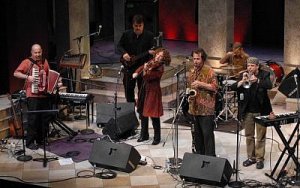
Yidstock, a more popular front of the center’s activities, will feature such top names in klezmer and Yiddish music as Hankus Netsky and the Hebrew National Salvage, Grammy Award winners the Klezmatics, Josh Dolgin aka “Socalled,” Frank London’s Klezmer Brass Allstars with Eleanor Reissa, and the Michael Winograd Trio. Yidstock will also include a film festival, a klezmer instrumental workshop and a klezmer brunch. Rogovoy will deliver a talk entitled “Rockin’ the Shtetl: The Essential Klezmer.”

“Through the course of the festival,” notes Rogovoy, “you get a picture of where the music has been, where it is now, and where it is headed.”

Hankus Netsky, scion of a klezmer dynasty, one of the original klezmer revivalists, and founder of the Klezmer Conservatory Band, shares Rogovoy’s appreciation for the Yiddish Book Center.

“The Yiddish Book Center exists because the mainstream world neglected, then discarded, Yiddish literature and everything else too. The revival and revitalization is a major triumph of the last 30 years — this festival celebrates that.” Netsky, who holds a PhD in ethnomusicology and is director of the Itzhak Perlman “Eternal Echoes: Songs and Dances for the Soul” Project (to be released in the Fall of 2012 on Sony), speaks passionately about the themes of “salvage,” rescue and revitalization (he will be performing with a group known as Hebrew National Salvage).

The Klezmatics (photo credit: courtesy)

“We found Jewish culture discarded in the dumpster and are doing what Jewish business people have always done — we are finding a new use for it. My father was in the rag business so I am familiar! We are putting it back into circulation. We are reclaiming it.”

Netsky refers to his work as “salvage ethnography.”

He adds, “Jewish music is the same as Jewish literature — it builds on what came before it and is eminently creative.”

Netsky relates that the entry for klezmer in the 1975 Dictionary of Jewish Music read, “The klezmer tradition died out in the 19th century.”

“Huh?” asks Netsky, “That’s interesting! All my grandfathers and uncles were klezmer musicians!”

In a summer, 2011, PaknTreger article entitled, “But Is It Klezmer?” Rogovoy explores this latest wave of Jewish music, which continues to borrow from many sources. He playfully reports on the types of comments he hears when he exits concerts by performers like the ones who will play at Yidstock.

‘Klezmer has always spoken in the idiom of its time. And that time is now, and the fusion of hip-hop, funk, and jazz is our musical currency’

“If I had a dollar for every time I hear someone saying ‘I don’t know what you call that, but that’s not klezmer,’ I’d be, as the saying goes, a rich man,” says Rogovoy. “I hate to disappoint you, but yes, it is klezmer. And not only is it klezmer, it is part and parcel of the klezmer tradition. Indeed, it is traditional klezmer, because klezmer has always spoken in the idiom of its time. And that time is now, and the fusion of hip-hop, funk, and jazz is our musical currency.”

(Source: http://www.timesofisrael.com)

Read more