Other

Original Article Published On The Times Of Israel

Mixed marriages, special needs kids, Russian immigrants, Israelis: How inclusive is your child’s Jewish camp?

NEW YORK (JTA) — Is there a more enthusiastic camper in the world than Ezra Fields-Meyer, a 17-year-old with high-functioning autism and a regular at Camp Ramah in Southern California?

Not if you ask his father.

Tom Fields-Meyer says his son’s annual visit to the rural retreat in Ojai, 80 miles northwest of Los Angeles, is a much-anticipated opportunity for Ezra to spend time with all kinds of children in a fun and nurturing environment.

“The four weeks he goes to Ramah and is away from us are really the four best weeks of his year, which is a little bit hard for a parent to say,” Fields-Meyer said. “The kids in his program are almost celebrities. I think camp is great for all kids, but especially for those like Ezra.”

A summer camp experience can be transformative for kids like Ezra, but many Jewish camps believe that special-needs kids — along with other minority Jewish populations, like Russian Americans, Israeli Americans and the children of interfaith marriages — are severely underrepresented in the Jewish camp system.

“Break down the percentage of kids from various backgrounds who attend and the numbers are not where we want them to be to reflect the broader Jewish community,” said Abby Knopp, vice president of program and strategy at the Foundation for Jewish Camp, a group that seeks to expand access to the Jewish camping experience.

In a conscious effort to promote diversity, Jewish summer camps are working to boost the participation of minority communities in the camp experience.

According to FJC, of the estimated 72,000 youths who attend nonprofit Jewish camps each year, approximately 1,000 are special needs — a blanket term for children and adolescents with a range of disabilities including Down syndrome, autism, paraplegics and visual impairment.

Only 3 percent to 4 percent of children from the Russian Jewish community attend camp, though they represent 15 percent to 20 percent of Jewish children overall, the FJC said. The percentage of Israeli-American kids who attend camp is about the same. Interfaith children comprise about 18 percent of Jewish campers, though their fraction of the larger Jewish youth population surely is much higher.

Camps have taken a number of approaches to integrate special-needs children, ranging from full-immersion programs in general camps to creating specific facilities uniquely for them.

Ezra Fields-Meyer attended a mixed program at Ramah. During the day he took part in the same activities as the wider camp population; at night he stayed in separate sleeping quarters.

“[Ezra] can go go the same camp with his two brothers, be part of the same community, but also acknowledge he has different needs,” Tom Fields-Meyer said.

Some camps have taken inclusivity a step further. At Camp Ramah in New England, special-needs kids have the option of a full immersion program that includes shared accommodations.

“About 12 years ago, families asked if we would consider an inclusion program,” said Howard Blas, the head of the Tikvah program at Ramah New England, in Palmer, Mass. “What they meant is to take the kids and have them be part of the program with the mainstream kids.”

In response, the camp invited Spencer Salend, an expert on inclusive classrooms at the State University of New York at New Paltz, to draw up a curriculum for the joint program. Two kids — one with Down syndrome and one with autism — took part in the pilot eight years go. Now, as many as 12 disabled youths participate each year.

“The idea was that if we started younger, their bond [with the other campers] would be greater,” Blas explained. “We had some very different outcomes. Some have come through the whole program having a great experience. We’ve had some that have been difficult.”

Despite some disappointments, Blas says the initiative on the whole has been positive and productive. But Rabbi Allan Smith, the former head of Union for Reform Judaism’s camp network and now the director of a Jewish camp for special-needs kids in Pennsylvania, says special needs kids who spend summers with peers with similar disabilities come out much more confident and better prepared to interact with mainstream children.

“My position is don’t play games,” Smith said. “Don’t do tokensim and put kids into an environment where they are doomed to fail.”

Another priority has been bringing more Jews from the former Soviet Union and their offspring into the camp fold. Part of the challenge there is introducing the camp idea to a community that doesn’t fully understand it.

“If you look at most of the kids who go to camps, their parents went to camp, too,” said Knopp. “There is a 100-year-old tradition here in America that Russian-speaking Jews are unfamiliar with. Families in the Former Soviet Union sent their children to camp, but they don’t understand the importance of sending their kids to Jewish camps.”

Israeli-American parents also shy away from sending their children to overnight summer camps for similar reasons, the FJC said. Many of them go back to Israel for the summer to visit relatives.

Jewish camps have had more success attracting the children of intermarried families. Though the FJC pegs the percentage of Jewish campers with only one Jewish parent at about 18 percent, Paul Reichenbach, the director of camp and Israel programs at the Union for Reform Judaism, says that up to 40 percent of children at some URJ camps have at least one non-Jewish parent.

Reichenbach says camp curriculums must be sensitive toward children of mixed faiths or they risk becoming alienated from the community. He says the language in some brochures and the content of some programs were adapted to reflect this change.

“While we are all for Jewish values,” Reichenbach said, “we have to recognize we are dealing with kids that are far more pluralistic than they used to be 20 to 30 years ago.”

Read more

NEW JERSEY — From Pierre Mevy Azaria’s calm demeanor as we sipped cappuccino in the lobby of his New Jersey hotel on Thursday, you would never guess that he is ultimately responsible for every aspect of the Israel versus Honduras soccer exhibition at New York’s Citi Field on Sunday — and that he’s getting married in Israel in two weeks’ time.

The well-dressed, bespectacled Mevy Azaria, CEO of the Geneva-based MCI Sport, seems comfortable in a range of countries and languages, and discussing a wide range of topics. He speaks openly and thoughtfully of his journey from childhood in Tel Aviv, to schooling in Toulouse, internships and jobs in Barcelona, and his current Geneva-based world of organizing and promoting soccer matches around the globe. And he discuses an upcoming move to New York City for his bride-to-be Laura’s law studies at Columbia University.

As we speak, he also deals with here-and-now questions and problems in a relaxed, efficient fashion. One member of the Israel national team approaches our table to inquire of the van driver’s whereabouts; the player is eager to go clothes shopping at a nearby mall.

An earlier mini crisis involves the room of coach Eli Guttman. “He usually gets a suite — to differentiate himself from the players, and so he has a meeting space. We arrived at the hotel and found out the room was given to another guest.”

How this matter was resolved? Mevy Azaria told the hotel manager, “You change the room, or we will change hotels.” He felt justified in making such a threat. “We came two months ago, looked at different hotels, worked out all of the details and signed a contract at this hotel.” Guttman quickly got his room back.

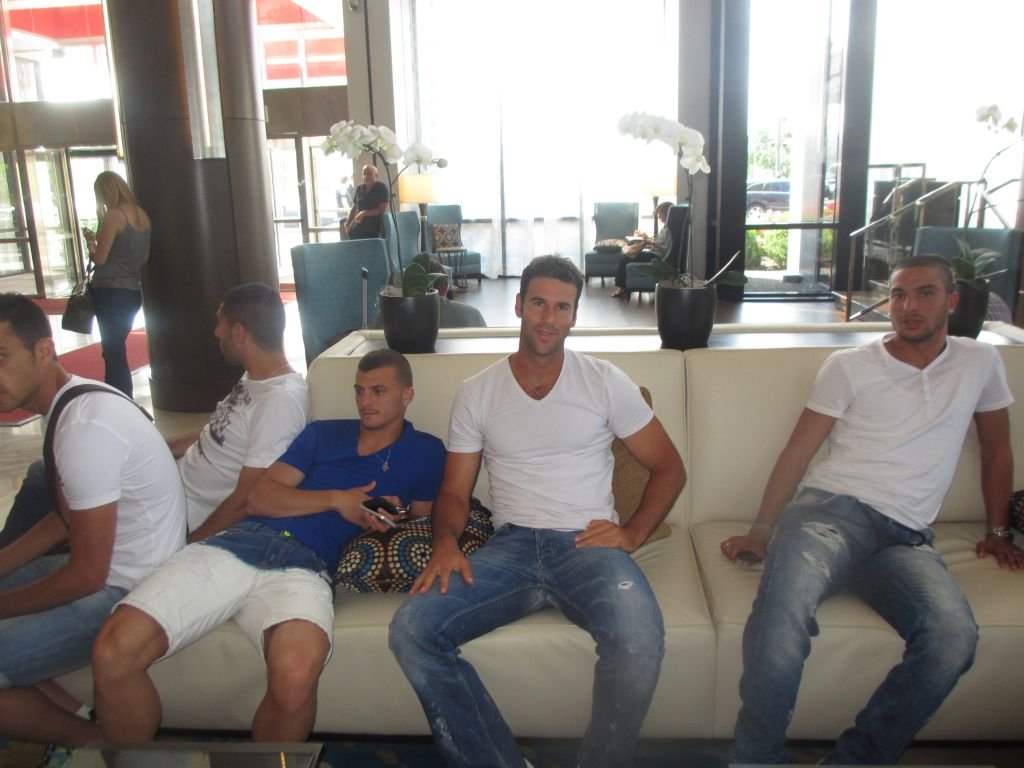
Israeli soccer players lounging at their hotel in New Jersey ahead of a match against Honduras. (photo credit: Howard Blas/Times of Israel staff)

I ask Mevy Azaria why the Israel team has not played in the United States in 35 years. “For lack of interest,” he reports unhesitatingly, but then explains why the timing is right, now, to stage what he refers to as “ethnic matches.”

“In the last two to four years, there has been a real development of soccer in the US — due to demographic reasons. There are a lot of South and Central Americans living here.” In addition, Mevy Azaria notes, the number of spectators watching the European Champions league games on TV “doubled in four years.”

Mevy Azaria is responsible for every aspect of Sunday’s soccer fest. “I rent the stadium, I pay the teams, hotels, and flights — for both teams, and I market the event.”

He says he found the management team at Citi Field “extremely nice to deal with” and felt it is “a Jewish-friendly stadium — like no other place in the world.”

Mevy Azaria was particularly taken by the kosher food stands. “This simply doesn’t exist in Europe.”

In addition, the Citi Field organization is particularly knowledgeable about the synagogues and Jewish communities in the area — a real help in promoting the event. “And the date was a total coincidence—we got two dates which worked for both teams. The Mets just finished up a series with the Yankees and are on the West Coast. And the date, June 2, just happened to be the date of the Celebrate Israel Parade!”

Mevy Azaria discovered football during a business school exchange program, where he had the opportunity to work for Barcelona, one of Europe’s very best teams. He began by selling tickets to Israeli companies for Spanish soccer games. Then, after a year and a half, the owner of MCI Sports approached him, looking for a ticket to a game. He then went to work for MCI.

“A company from Qatar wanted to buy the company, but I was given the chance to buy and develop it — which I did.”

MCI promotes “soccer friendly matches” in Europe — and is now hoping to expand to America. If the New York event is successful, Mevy Azaria envisions similar exhibition matches in such Jewish and Israeli-heavy cities as Los Angeles and Miami.

For now, Mevy Azaria is focused on Sunday’s event — and his wedding. “The game will be a great event, like a party,” he predicts. “The action doesn’t stop for 90 minutes, and it is a chance to cheer on and show support for Israel.”

Unlike the Israeli players who will enjoy vacation and travel time in the States in the week following the match, Mevy Azaria needs to get home to Switzerland, and then on to Israel for his wedding. “Laura has been very understanding.” She’d need to be.

(Source: http://www.timesofisrael.com)

Read more

Jewish state’s elite squad is relaxed, ready and eager for Sunday’s exhibition game against Honduras

NEW JERSEY — The Israel national soccer team touched down at Newark Airport at 5:30 Thursday morning. By 9 a.m., the freshly showered guys were lounging on the white leather sofas of their New Jersey hotel — calling girlfriends, Skyping mothers, and playfully bantering with teammates, some of whom they hadn’t seen since their impressive 2-0 March 26 World Cup qualifier victory over Northern Ireland in Belfast.

The team came to New York for an exhibition game against Honduras Sunday at Citi Field, home of the New York Mets baseball team. The game — the national team’s first here for 35 years — is the final event of “Celebrate Israel NY” which also includes a Celebrate Israel Run in Central Park and the Celebrate Israel Parade.

While willing to give exclusive-on-arrival interviews to The Times of Israel, most players — many in the United States for the first time — were admittedly more interested in the van, soon to arrive to take them to a nearby shopping mall. Three of the adventuresome players hired a driver to take them straight to Manhattan. Thursday was a free day. A late-afternoon practice was set for Friday at New Jersey’s Montclair State University.

Israeli soccer players (facing camera) Elad Gabai, Dekel Keinan, and Shimon Abuhatzira (photo credit: Howard Blas/Times of Israel staff)

Midfielder Sheran Yeini was excited to be in New York, “one of the best cities in the world.” The Maccabi Tel Aviv player said, “I can’t wait to see the stadium — I know it is a baseball stadium!” It takes 48 hours to convert Queens’ Citi Field for soccer.

Yeini and teammate Elyaniv Barda, a forward originally from Beersheba, and a sixth-year member of the Belgian Racing Genk soccer club, take turns rattling off positive comments about the game and the national team: “We want to represent Israel. We need you! Come to the game and show your support!”

Both made reference to the Celebrate Israel Parade on June 2, on Manhattan’s Fifth Avenue.

“Two or three players will be on a float at the parade — then they will rush to the game,” Yeini said.

Defender Dekel Keinan of Haifa felt both the game and his time in the States “will be an adventure.” Fellow defender, Rami Gershon, originally from Rishon Letzion, was similarly enthusiastic in describing his first trip to the US. “We are looking forward to all of our supporters coming out to the game. We hope families will come.”

“Kol Yisrael Achim,” he then shouted. “All Jews are brothers!”

Gershon, who has played soccer for a Belgium team in Antwerp and currently plays for Scottish Premier League champions, Celtic, reported that he has never experienced anti-Semitism or anti-Israel sentiment overseas. “People are supportive and helpful.”

Midfielder Maor Melikson of Yavneh, a player on France’s Valenciennes club, said much the same. “There is no anti-Semitism — the other way around. People bring Israeli flags to the game.” Melikson was in the States six months ago with his wife, who is not accompanying him on this trip. He will travel to Las Vegas for four days following Sunday’s game. “I am looking forward to all the Jews coming out to cheer for us!”

Israeli midfielder Maor Melikson (photo credit: Howard Blas/Times of Israel staff)

Eli Guttman, coach of Israel’s National team (who with players Tel Ben Haim and Rami Gershon gave an online interview May 29, as part of “Hangout on Air with Israel’s National Team”) was not hanging out in the lobby with his players. He was reportedly resting. Guttman was no doubt pleased that Pierre Mevy Azaria, CEO of MCI Sport, the event organizer, promoter and chief logistical officer, had recently “rescued” Guttman’s hotel suite, which had been “reassigned” to another hotel guest.

In the online interview, Guttman acknowledged that Sunday’s game “is an important game for us — every game for the National Team is important.” But he conceded that it has greater significance for Honduras. “On [June 7] Honduras plays against Costa Rica in the 2014 World Cup Qualification. For them, they must be on a high level. We, after the game, will be on our vacation.” Still, he said of the game, “We are serious, and we want to be proud.”

According to Mevy Azaria, more than half of the players will be staying in the States from three days to a week, to relax and travel.

In the days leading up to the game, there is still work to be done. Sharon Eyny, director of GIDNY (getitdoneny), seemed relieved when the players boarded the bus for their shopping excursion. She could get back to selling tickets and coordinating logistics.

In the Jewish and Israeli communities, she and her team have reached out to synagogues, restaurants, venues hosting performances by Israeli musicians and more.

And while unwilling to disclose the number of tickets sold to date, she noted that “The Hondurans are passionate about soccer.”

(Source: http://www.timesofisrael.com)

Read more

Summer camp – both day camps and overnight camps – offer opportunities for children to learn new skills, form friendships, experiment with new interests, and learn new things about themselves. Children with intellectual disabilities are increasingly participating in these programs. But truly succeeding in a camp requires parents to be good consumers, advocates and partners.

Be a Smart Consumer

In considering a camp for your child, do your research. There are many types of camps: day and overnight, specialty camps (sports, horseback riding and drama), separate camps for children with various special needs, and camps with inclusion programs for which The Arc advocates.

Ask how the day is structured. What activities are offered? Are campers required to participate in all activities or can they opt out of some? Is there a “free choice” period? What about children who need breaks? What are the background and ages of staff? Is English their first language or are they proficient in English? How are meals run and supervised? How is medication administered and monitored?

Be a Good Advocate/Be a Good Partner

Build on the countless hours you have spent advocating for your child in the school system and use these advocacy skills on behalf of your camper. What modifications is the camp willing to make for your child? Explain the types of programs where he/she has been successful. Speak to the inclusion specialist, division head or head counsellor.

Provide school evaluations, therapist reports, occupational therapy and physical therapy reports. This will help the camp assess whether they are a good fit for your child and assure the camp truly understands your child as they strive to meet his/her unique needs.

Challenges and Opportunities for Success at Camp

Once your child is accepted, the opportunities for friendships and social growth are unparalleled: interactions and opportunities for verbal and nonverbal interactions and instant feedback, discovering other children with common interests and developing enduring friendships.

While your child will not be in an academic setting, some of the same issues experienced in school may surface perhaps from frustration with and difficulties in social situations. Living in a bunk with ten or more peers can also lead to misunderstandings. Being away from home can be an opportunity for growth, but it can also lead to periods of homesickness. Sharing tight quarters means little privacy and little personal space. Your child will have to keep his/her possessions contained, learn to shower, dress and undress modestly and quickly, and he/she will have to carefully navigate and negotiate many social situations.

Read more