Writing

As the Ledger went to press, the U.S. Open tennis tournament was in full swing at the USTA Billie Jean King National Tennis Center in Flushing Meadows, N.Y.  This year’s Open, which kicked off on August 25 and comes to a close on Sept. 8, features a number of Jewish players from around the world – as well as kosher food and a few “frum” (Orthodox) ball boys and girls.

According to kippah-wearing ball boys Eric Wietschner and Moshe Brum, “There are approximately 10 frum ball boys. The U.S. Open is very accommodating, both in terms of scheduling and about wearing kippot on the job.”  Which left one fan, Jeremy Posner of Manhattan, to playfully wonder, “Why aren’t they issued Ralph Lauren kippot?” The Ralph Lauren Polo logo is prominently displayed on shirts and shoes of all ball boys and girls.

This year’s singles and doubles men’s draw featured 18-year-old Noah Rubin of Merrick, Long Island in N.Y.  Rubin won the Wimbledon juniors tournament in July. He received a wild card to play in the U.S. Open main draw after winning the Boys Junior National Tennis Championship in Kalamazoo, Mich.

Despite losing his singles match to 66th ranked Frederico Delbonis of Argentina (6-4, 6-3, 6-0), and his doubles match, with partner Stephan Kozlov, to Jared Donaldson and Michael Russell (6-2, 6-7, 6-4), the good-natured Rubin remained proud and confident. In a post-match press conference, Rubin said, “I learned that I can definitely compete with these guys at the best level. I’m just getting used to the atmosphere, getting used to being out there with the top players in the world.”

Rubin, who attended religious school and celebrated his bar mitzvah at the Merrick Jewish Center, collected tennis rackets to donate to the Israel Tennis Center for his “mitzvah project.” “I want people to know I’m Jewish and I like to represent the Jewish people,” he told the Ledger. Though he has not yet been to Israel, “I will be going!” he says, noting that his sister, Jessie, who served as vice president of Hillel and captain of the tennis team during her student years at Binghamton University, has been to Israel twice – once on a Birthright trip, and once on a JNF service trip. Though he’s missed the first week of classes, Rubin will now head for Winston-Salem, N.C. to begin his freshman year at Wake Forest University.

Four days before the start of play, Rubin had the opportunity to go head to head with the world’s number one player, Novak Djokovic, at an exhibition match benefitting New York’s John McEnroe Tennis Academy, where Rubin previously trained. Likewise, Diego Schwartzman, 22, a Jewish tennis player from Buenos Aires, Argentina, ranked #79 in the world, faced Djokovic in the first round of the Open in Arthur Ashe Stadium. While Djokovic beat Schwartzman 6-1, 6-2, 6-4, he hugged the Argentinian following the match and offered him both a compliment and some advice. “Diego is a talented player; very quick on the court. He has to work on his serve a little bit more,” he said. “I just wish him all the best for the future, you know, to keep on working. He’s talented. He has good potential to be a higher-ranked player.”

For Canadian Sharon Fichman, 23, ranked #112 for singles and #76 for doubles, the road to the U.S. Open was a tough one. After injuring both her ankle and knee in the months leading up to the tournament, she recently underwent surgery to repair a meniscus tear. Still, she managed to play both singles and doubles matches – losing both in the first round. “I will get there.  It will just take time, effort and patience,” she said.
Israel’s Dudi Sela chats with fans after winning his first round match.

Israelis in the main draw for singles include Dudi Sela, Shahar Peer and Julia Glushko. In Sela’s first round match, the 83rd-ranked player battled back to defeat Argentina’s Carlos Berlocq. After losing the first set in 17 minutes, Sela came back to win 1-6, 6-3, 6-2, 7-5. He lost in the second round against seventh seed Grigor Dmitrov of Bulgaria, 6-1, 6-2, 6-2. Sela now turns his attention to the Davis Cup World Group play-offs against Argentina, to take place Sept. 12-14 in Sunrise, Fla. Israel’s Davis Cup team consists of Sela, Amir Weintraub, Andy Ram, Jonathan Erlich and alternates Tal Goldengoren and Bar Botzer. The match was scheduled to be hosted by Israel, but was moved to Florida given the recent situation in Israel.

Shahar Peer, ranked #155, defeated Amanda Konta in the first round, 6-2, 6-3, but lost in the second round to Mirjana Lucic-Baroni of Croatia, #121, 6-7 6-3, 6-2. Julia Glushko, ranked #101, lost her first round match to American Madison Brengle, 6-3, 6-2.

Sportswriter Sandra Harwitt, who has covered more than 70 Grand Slam tennis tournaments for such publications as espn.com, Tennis Magazine and The New York Times, was on hand to sign copies of her new book, The Greatest Jewish Tennis Players of All Time. Harwitt notes the presence of other Jewish players in this year’s U.S. Open, including American Scott Lipsky and Camila Giorgi of Italy.

Among those included in Harwitt’s book – and a spectator at this year’s Open – is British Jewish tennis star Angela Buxton, now 80. In 1956, Buxton reached the Wimbledon singles finals, and won the French Open and Wimbledon doubles championships, teaming up with Althea Gibson, who was the first African American to cross the color line of international tennis. The remarkable story of their partnership is recounted in the recent movie, Althea and Angela: A Perfect Match, and the book, The Match: Althea Gibson & Angela Buxton: How Two Outsiders – One Black, the Other Jewish – Forged a Friendship and Made Sports History.

Finally, tennis fans in search of a kosher hotdog, sausage, knish, pretzel, deli sandwich and the like need search no further than the Open’s Kosher Grill, located near court 17 and open for lunch and dinner every day but Friday night and Saturday.

(Source: http://www.jewishledger.com)

Read more

For Jerusalem resident Moshe Rosenbaum it is hard to believe that his Hungarian-born Holocaust survivor father, Pinchas, would have been 90 this year. He died 33 years ago – and, like many survivors, he did not share all of the details of his Holocaust experience. Fortunately, however, he shared enough information for his family to know that he was a true hero who risked his life to save hundreds of fellow Jews. Now the world will know too.

“Although our late father did not volunteer much information and would only respond to our questions, we learned as children about our father’s hatzala [saving] work,” Moshe Rosenbaum said recently in an interview with the Ledger. “Our late mother spoke to us about it and we also met many friends from those days, including people who were saved by our late father.”

Pinchas Rosenbaum was born in Hungary in 1923 and received his rabbinic ordination at the age of 18. When the Nazis occupied Hungary in 1944, the 21-year-old was sent to a labor camp, never again seeing his parents and siblings who were sent to their deaths at Auschwitz.

Pinchas escaped the labor camp and devised a scheme to save others by wearing the stolen uniforms of the Hungarian Arrow Cross Party, a nationalist socialist party responsible for deporting and murdering tens of thousands of Jews. Pinchas would learn which Jews were to be deported; seek them out, seize them, and pretend to arrest them. Instead of sending them off to their deaths, though, he brought them to a place known as the Glass House, the Swiss refuge in Budapest which was overseen by a Swiss diplomat named Carl Lutz. Lutz was the Swiss vice-consul in Budapest from 1942 until the end of World War II. He is credited with saving more than 62,000 Jews.

Fast forward to the 21st century. Film director Mark Schmidt came across the Rosenbaum story while viewing a History Channel documentary on World War II heroes. What he learned prompted him to make a film about a fictional character named Elek Cohen (played by Jonas Armstrong), based on Pinchas Rosenbaum. Set in Hungary during the final months of World War ll, the young Elek sets out to find his displaced family by stealing a Nazi uniform to pose as an officer. He undertakes extraordinary measures to reroute his family and other Jews to safety by disrupting the activities of the German occupiers.

When Moshe Rosenbaum read about the movie, he contacted the producers. “They invited my wife and I to see that first version. I really had nothing to do with the making of the movie, which in a way is better. I much prefer a fictional story inspired by my father than a distorted biography.”

Still, says Rosenbaum, “I was very moved to see that my late father’s deeds inspired Mark Schmidt and [producer] Randy Williams, who are both not Jewish, to such an extent they decided to make their first movie based on their vision of my father’s story. It was very intense to watch this film and feeling so connected to the main character. Elek does display great courage and total devotion to help and do whatever is necessary to save other Jews and that was my father.”

“Walking with the Enemy,” starring Ben Kingsley, is currently being shown in select theaters in New York, New Jersey, and other parts of the country.

The Ledger spoke recently with director Mark Schmidt about his new film.

JL: How did you come across this story in the first place?  

MS: I saw a documentary on World War II heroes on the History Channel – and one was Pinchas Rosenbaum. I did research; I read books. I went to visit Hungary and went to such towns as Budapest and Krivoda, his hometown, where I conducted interviews.

The film was shot in Eastern Europe. Some in Budapest, also Bucharest and Southern California. We chose the locations to duplicate what it looked like in the 1940s.

JL: Why did you feel this was an important film to make?

MS: Pinchas Rosenbaum was a true hero, he had no army or government behind him. He could have hid out, but he put his life on the line to save innocents. It shows the true hero spirit of one person. That he risked his life; he did the best he could; he adapted to his environment. It is about good versus evil; it makes you think of what happened there and that we in the United States are so lucky.

JL: Do you have any personal connection to the Holocaust?

MS: I have no personal connections. I just wish we would think about how our leadership sometimes goes down the wrong road and does things which can be evil and that the right leadership can offer practical solutions.

JL: You are donating money from the film to the Wounded Warriors project – what’s the connection?

MS: We felt that people who get injured protecting democracy deserve to be honored. We’re doing that by donating to Wounded Warriors.

(Source: http://www.jewishledger.com)

Read more

Several weeks ago, Hartford Courant commentator Colin McEnroe summed up the imminent demise of West Hartford’s Crown Supermarket in a brief Courant blog post entitled, “Nooooooo.” “The Crown is not just food. It’s culture,” he observed.

Of course, much to the community’s relief, the closing has been aborted by a group of local Jewish investors who have purchased the store. Nonetheless, the near announcement of the closing of Crown is serving as a reminder and wakeup call to Connecticut’s Jewish communities about the precarious nature of kosher establishments, not only in West Hartford but throughout the state.

In New Haven and in other parts of Southern Connecticut, Rabbi Fred Hyman, spiritual leader of the Westville Synagogue in New Haven and president of the Vaad HaKashrus* of Fairfield County, has been working tirelessly to promote kashrut and to help create a community kosher standard. “When I joined the Vaad HaKashrus in 2010, I tried to get an area heksher (kosher certification) to achieve community standards — each place under the Vaad would follow similar standards. It would bring kashrus under one roof,” says Hyman.

In many ways, Hyman’s efforts have paid off. One major achievement was working with Abel Caterers to come under the supervision of the Vaad HaKashrus. “After lots of discussion and work, we reached an understanding – that was a big achievement!” says Hyman, who also worked closely with members of the Chabad Lubavitch community to achieve his goal. “Six months ago, [Chabad] accepted Abel for fleishig (meat) catering, as well — that was an amazing thing. In one and a half years, Abel moved to be able to serve the entire community — from Reform to Lubavitch. I had always wanted to reach this goal!”

In addition to his Abel Catering ‘coup,’ in a recent letter to Westville Synagogue members, the rabbi shared other Southern Connecticut kashrut updates. Many of the changes, he noted, were in direct response to requests and concerns voiced by community members. The changes Hyman noted include:

Claire’s Cornercopia in New Haven, a vegetarian restaurant, is now certified by the Vaad, who will support Rabbi David Avigdor in his continued role of providing onsite supervision.

The restaurant formerly known as KOSH in Stamford has reopened under the name 613. The Vaad has partnered with the OU to give it a national hashgacha.

Navaratna, an Indian kosher restaurant in Stamford, has been under renovation since the beginning of the year and plans to reopen within the next couple of weeks.

Edge of the Woods Natural Market is taking over the Cafe at the JCC and will be under the Vaad’s supervision. The Vaad is also working with the company to provide pas yisrael products for the broader community.

In his letter, the rabbi urged the community to support the area’s kosher establishments. “I have worked extremely hard to maintain and develop kosher food in our area and the businesses require your support to survive,” he noted.

Sydney A. Perry, chief executive officer of the Jewish Federation of Greater New Haven, lauded Hyman for his efforts on behalf of the community. “Rabbi Hyman works two full time jobs as well as serving as the chair of the New Haven Board of Rabbis,” she pointed out. “He still finds time and commitment to ensure that the Jewish community of Greater New Haven has the best opportunities for kosher food in the entire State of Connecticut. We are fortunate that we have his leadership in kosher supervision as in all things.”

Perry, whose office shares space with the Jewish Community Center of Greater New Haven, added, “We are so excited to have Edge of the Woods coming to the JCC. They have a great reputation for smoothies, baked goods, and a wonderful assortment of salads and warm dishes. Healthy and delicious is just the combination we look for to the many people who will enjoy the food and companionship in the redesigned eating area.”

But will the valiant efforts by Rabbi Hyman and others and the supportive words of Perry be enough to save such New Haven kosher establishments like the Westville Kosher Market?

Rachel and Yuval Hamenachem, owners of Westville Kosher Market

Rachel Hamenachem and her husband Yuval opened Westville Kosher Market in 1985. For nearly 30 years, she says, the market has offered “everything ‘soup to nuts’ – groceries, catering, bris and kiddush food; we have a restaurant; we have a vegetarian section; we can do vegan and gluten free, we gear for allergies, we use no MSG, no margarine in our kitchen, we support farmers around us…”

Yet, despite offering “everything kosher” under one roof, Hamenachem observes that many customers “only come before Rosh Hashanah and Passover,” and many will only buy certain items (deli, for example) at the kosher market, while buying such items as chickens or meats at less expensive supermarkets or chain stores. Hamenachem strikes a cautionary note: “If you want to have it, you need to support it,” she says. “This is my mantra. You need to support the places in your town!”

Perry agrees. “The near closure of Crown Supermarket is an object lesson for New Haven. If we do not buy kosher meat at our local market, and import everything from New

York and Monsey, we too will lose not just our kosher bakery [referring to the closure of the Westville Kosher Bakery in 2006] but also our kosher butcher.”

*A vaad hakashrut is a rabbinical council that oversees the community’s supervision.

(Source: http://www.jewishledger.com)

Read more

Survivors, liberators, diplomats and March of the Living alum gather for remembrance event.

Neshama Carlebach and Eli Rubenstein remember exactly where they were standing in 1998 when Judy Weissenberg Cohen uttered a moving address to a large group of teenagers from Canada attending the 11th March of the Living in Poland. A line in Weissenberg Cohen’s speech describing her Nazi experience in Hungary, which poignantly became known as “The Last Time I Saw My Mother,” painfully notes, “I never had a chance to say goodbye to my mother. We didn’t know we had to say goodbye. And I am an old woman today and I have never made peace with the fact I never had that last hug and kiss. They say when you listen to a witness, you become a witness.”

Carlebach and Rubenstein have both become witnesses. Singer Carlebach, about to attend and sing at her second March of the Living, recalls her first visit to Poland and the march from Auschwitz to Birkenau in memory of Nazi victims.

“I was decimated…I was so completely destroyed by what I was seeing…” In the Rama Synagogue in Krakow, Carlebach “finally understood” and spontaneously stood up to sing the well-known Krakow Niggun, composed by her late father, Rabbi Shlomo Carlebach. The niggun (wordless melody), which moves from slow and mournful to upbeat and celebratory, was inspired by a dream Carlebach had on a visit to Auschwitz. He was reportedly so sad that he fell asleep and had a dream in which naked Jewish prisoners were going to their deaths—and were suddenly transformed into people wearing white clothes, with big smiles on their faces. “Until then, I didn’t take my work as a healer seriously. You become a witness. I was there. I feel it even now speaking to you!”

Rubenstein, National Director of March of the Living Canada, is also co-curator of the March of the Living exhibit which premiered at the United Nations in New York City on January 28 —one day after International Holocaust Remembrance Day, an annual day of commemoration established by the United Nations.

The title of the exhibit, “When you Listen to a Witness, You Become a Witness,” comes from Weissenberg Cohen’s poem of 1998.

Sara Jaskiel, a Brooklyn-based graphic artist and designer, found the work of assembling and curating the exhibit “moving, overwhelming and meaningful.”

She recounts, “You think of each person and what happened, and you want to raise sensitivities.”

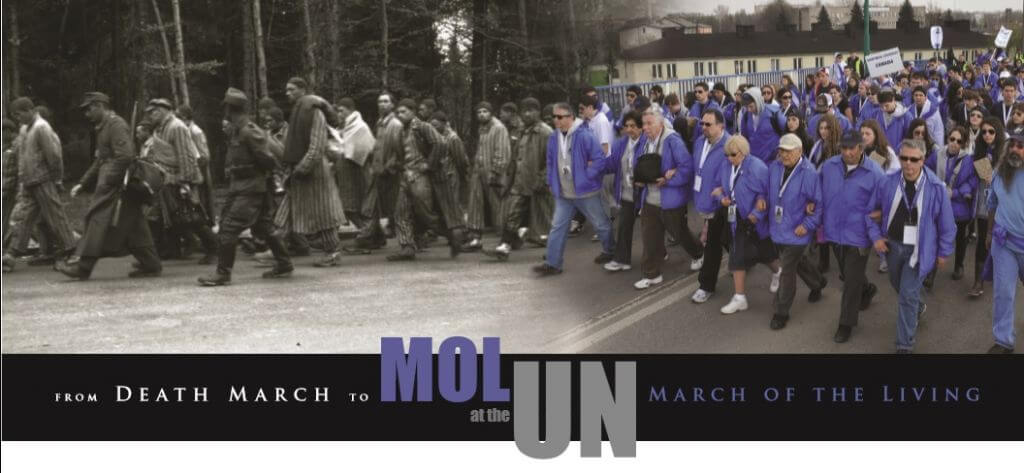
Jaskiel is particularly pleased with the “Death March” photograph she was able to assemble, which served as the backdrop for the musical performances and speeches at the January 28 ceremony.

“I did research and found photographs—from the Death March and from a March of the Living—taken at the same angle. It is as if they are parallel—in a row.. I was able to synthesize the photos.”

The moving photo, which all attendees received in the form of poster, depicts a black and white photo of Jews during the Holocaust and a color photo of Jews on the March of the Living walking “together” from Auschwitz to Birkenau.

Rubenstein, Carlebach, survivors, liberators and dignitaries participated in the January 28 premiere. The evening began with guests viewing the exhibit of photos and poems and socializing over wine and kosher hor d’oeuvres.

What initially seemed like an unusual start to an evening devoted to the Holocaust actually nicely fit with both the theme which each speaker echoed—memory and hope. The formal program began with 2012 March of the Living alumna, Sara Diamond, singing “Eli Eli.”

Peter Launsky-Tieffenthal, the UN’s Under Secretary-General for Communications and Public Information welcomed the guests, noting, “We at the United Nations feel privileged to host this exhibit at UN headquarters as part of our Holocaust Remembrance activities.”

The speakers included Ron Prosor, Israel’s ambassador to the United Nations, Dr. Shmuel Rosenman, chairman of March of the Living International, Shlomo Grofman, vice chair, Dr. Naomi Azrieli, chair and CEO of the Azrieli Foundation, which publishes survivor memoirs, and Max Glauben, survivor.

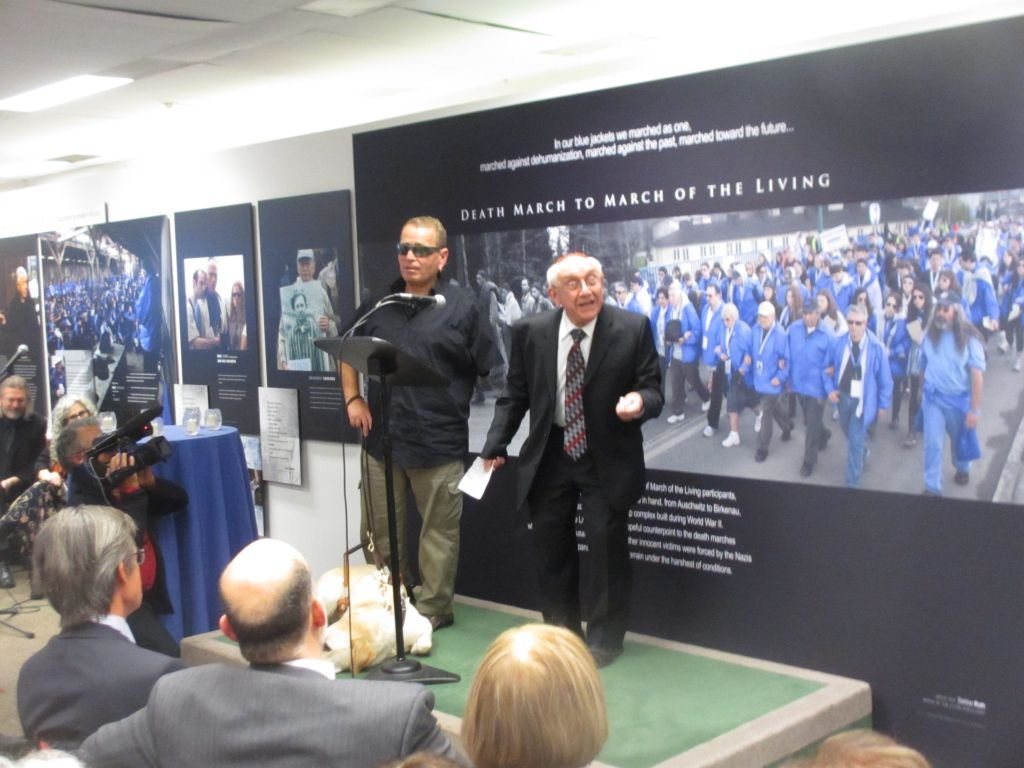
Max Glauben tells his story of survival (photo credit: Howard Blas)

The particularly upbeat Glauben, born in Warsaw in 1928, spoke to the Times of Israel before the ceremony, described the exhibit as “a wonderful display” and said he was pleased that it is being housed at the United Nations.

In his public remarks, he recounted his personal story of survival and thanked the liberators in the audience. He also singled out attendee, Israeli Eli Yablonek, and his guide dog, Glen. Yablonek is blind and does not have a left arm. “Eli came on the March of the Living in 2012—with his dog. It shows that the same animals Nazis used to attack people could be used to do good.”

Rick Carrier, liberator 

One liberator of Buchenwald, Army Combat Engineer Frederick (Rick) Carrier, dressed in his World War II uniform, recounted in a pre-ceremony interview, “I saw prisoners trying to squeeze through a small gap at the bottom of a fence and I reached for my wire cutters. I cut a big hole in the barbed wire fence.” Carrier, now 90, notes that he didn’t realize the people were Jewish Holocaust survivors.

“We were fighting a war—they never told us anything. We didn’t have any knowledge. They were just awful looking when we discovered them.” Carrier proudly showed off the medals he received when he attended last year’s March of the Living.

Following the address by Prosor, where he commented that “The March of the Living is to remind us as much about life as about loss, and triumph as much as tragedy,” Carrier’s voice could be heard shouting out, “Yeah!”

In an interview with the Times of Israel following the ceremony, Prosor highlighted the significance of the evening’s event.

“This all takes place at the UN—a place where, most days of the year, people don’t unite. But [International Holocaust Remembrance Day on] January 27 brings people from all counties, backgrounds and religions together in understanding.”

Prosor elaborated, “Education about tolerance and acceptance of others is absolutely crucial to creating a different and better society for the future.” When asked who the ambassador would like to bring to see the exhibit, he replied, “school students, the younger generation — so they can be more tolerant.”

Asked which world leaders and countries should attend the exhibit, Prosor noted proudly, “Several ambassadors — perhaps four or five — have come so far. They were touched and will educate others.” He concluded, “It is no coincidence that the Hungarian ambassador attended. He came out publicly to take responsibility for what Hungary did to Jews during the Holocaust.”

On January 23, several days after the Hungarian Jewish community accused the government of Hungary of engaging in Holocaust revisionism, Hungary’s United Nations Ambassador Csaba Korosi, at an event sponsored by the UN Department of Public Information for NGOs, reported, “We owe an apology to the victims because the Hungarian state was guilty for the Holocaust.”

Hungary has come a long way since the day one Hungarian Jew, Judy Weissenberg Cohen, last saw her mother.

(Source: http://www.timesofisrael.com)

Read more