Writing

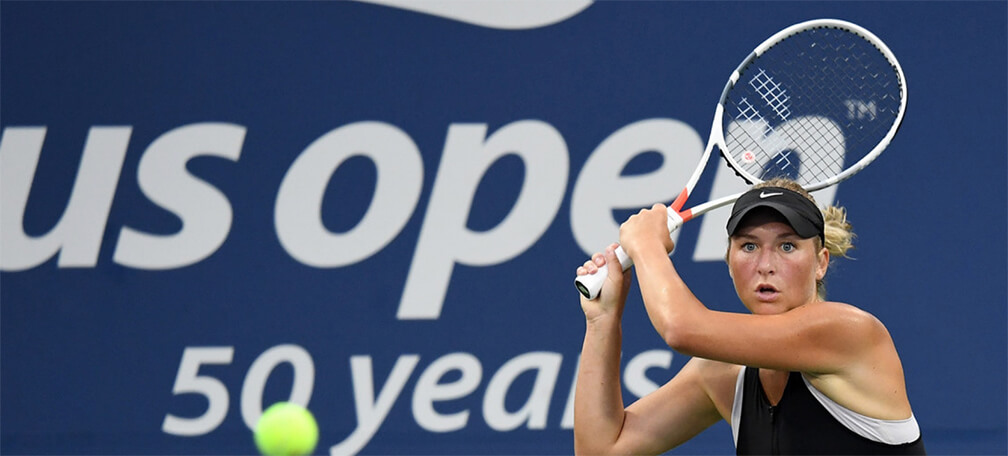
Freelance writer Howard Blasreports on the Pilot Pen Tennis Tournie in New Haven – from a Jewish perspective. The tournament was still in full swing as the Ledger went to press.
Ezra Academy makes a night of it
Ezra Academy of Woodbridge joined thousands of fans at the Pilot Pen Tennis tournament that kicked off at the Connecticut Tennis Center at Yale on August 23 and will run through August 29. According to Head of School, Rabbi Amanda Brodie, “This year at Ezra, we are highlighting health and fitness for life. Ezra parents, Jody Ellant and Howard Reiter, responded to an offer for $1 Pilot Pen tickets and purchased 180 for the evening session on Monday, August 24, which they made available to the Ezra community.” Ellant notes, “We, as a family, have attended the Pilot Pen tournament since its inception. The Pilot Pen tournament is a fabulous opportunity to see world class athletes perform right here in our community. It is a wonderful way to begin the school year.”

Israelis in the Pilot Pen Draw…almost
Ezra also came out to celebrate an historic year for Israel’s tennis professionals. Israel’s Dudi Sela, currently ranked 34th in the world, was invited to play in the Pilot Pen but pulled out after dropping out of last week’s Western and Southern Financial Group tournament in Cincinnati, Oh. The 24-year old Sela, who played in last year’s Pilot Pen, aggravated a groin injury and dropped out in the second set of his first round match. He hopes to recover in time for the upcoming U.S. Open in New York. 

Shahar Peer, ranked 58th in the world, and recovering from a stress fracture earlier in the summer, came to New Haven after reaching the third round of the Rogers Cup in Toronto. Peer was not given an automatic invitation to the tournament; such invitations were only issued to the top 44 ranked females. The 22-year old Peer played late in the afternoon of August 21 versus Italy’s Tathiana Garbin in the first round of the qualifiers. She was down 7-5, 2-2 in Friday’s qualifying match before a rainstorm suspended the match. Several hours later, and after eight ball kids used high powered blowers to dry the court, Garbin and Peer resumed their match in an empty stadium. Garbin defeated Peer 7-5, 6-4. Peer left New Haven early Monday morning for New York where she will prepare for the U.S. Open.
Israel doubles specialists, Andy Ram and Jonathan Erlich, familiar faces in New Haven after appearing in several recent Pilot Pens, did not play this year.

This has been a year of successes and stressful moments for Israeli tennis. In July, Israel stunned the tennis world when it clinched a berth in the semifinal of the 2009 Davis Cup. A capacity crowd of 11,000 fans witnessed the doubles team of Andy Ram and Jonathan Erlich, as they defeated Russians Marat Safin and Igor Kunitsyn, 6-3, 6-4, 6-7(3), 4-6, 6-4. One day earlier, Harel Levy, ranked 210 in the world, defeated Igor Andreev in the opening match of the Davis Cup and 33rd ranked Dudi Sela defeated Russian Mikhail Youzhny.

Four months earlier, the Israeli tennis team competed against host Sweden in Malmo, Sweden. Due to concerns that violent protests would erupt over Israel’s actions in Gaza, the indoor arena was left empty. In that tournament, Dudi Sela defeated former Australian Open Champion,Thomas Johansson, 3-6, 6-1, 4-6, 6-4, 6-2, and Harel Levy outlasted Swede, Andreas Vinciguerra, 6-4, 4-6, 6-4, 3-6, 8-6, in a three and a half hour match.

In February, Shahar Peer made headlines when the United Arab Emirates denied her a visa, making it impossible for her to play in the Dubai championship. In response, the Sony Ericsson WTA Tour levied an unprecedented series of fines, penalties and warnings against the tournament. Peer received $44,245, an average of the prize-money she received for singles and doubles at events last year; the tournament was fined a record $300,000 for a breach of tour rules and the event will have to post a $2 million financial performance guarantee by July 1 for a number of conditions it must meet to stage the event in 2010, including the guarantee of a wild card for Peer if her ranking is not high enough for a place in the main draw.

The response from the women’s game marks a watershed. Larry Scott, the tour’s chief executive officer, said: “These actions send a clear message that we will not tolerate discrimination and we will not allow this situation to happen again.”

The United Arab Emirates then gave “special permission” for Andy Ram, then the number 11 ranked doubles player in the world, to be granted a visa so that he could play in an event in Dubai the following week.

Young Jewish players in the Pilot Pen qualifiers
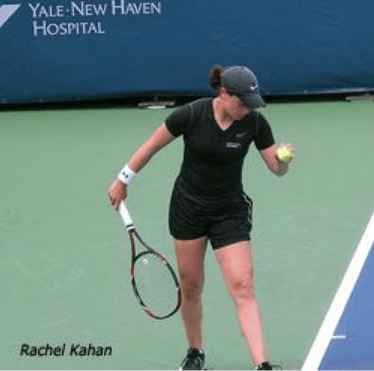
Three of the 32 players in the female qualifying singles tournament are Jewish. In addition to Shahar Peer, Rachel Kahan and Gail Brodsky vied for spots in the main draw. Kahan, a home-schooled high school senior from Unionville, received a wild card into the qualifying tournament of the Pilot Pen after winning the Prequalifier-Yale Summer Championships. After losing the first four games to Romanian Monica Niculescu, Kahan, dressed in black shorts, shirt and cap, battled back to lose the first set 6-4. Niculescu ultimately won 6-4, 6-0.

Gail Brodsky, 18, who was born in the Ukraine and moved with her parents to Brooklyn, N.Y. 12 years ago, fought hard in her qualifying match, but lost to Italy’s Roberta Vinci, 6-0, 6-1. The home-schooled Brodsky has been training at the Weil Tennis Academy in California. She tells the Ledger that this is her first time in New Haven, and that she will soon move to Melbourne, Fla. Brodsky notes that the Jewish players are “friendly with each other.”

Jesse Levine, who lost in last year’s fourth round to Pilot Pen finalist, Mardy Fish, lost in the first round of qualifier singles and therefore is not in the main draw. Scott Lipsky made it to the main draw for men’s doubles with partner, Robert Kendrick.
Read more

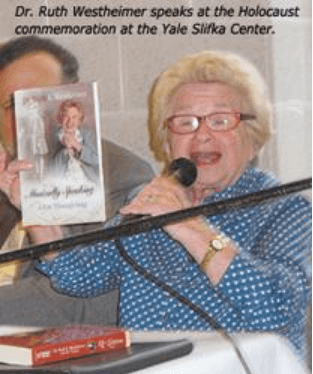
NEW HAVEN — Dr. Ruth Westheimer shared her experience as part of the Holocaust’s Kindertransport at “Orphans of the Holocaust,” the opening event of the Yom Hashoah-HolocaustRemembrance Day commemoration at Yale University’s Joseph Slifka Center for Jewish Life. Westheimer is co-teaching a course on “The Family and the Jewish Tradition” at Yale this semester with the university’s Jewish chaplain, Rabbi James Ponet.

Dr. Ruth Westheimer was born in 1928 in Frankfurt, an only child in a lower middle class Orthodox family. When her father was taken by the Nazis, her mother and grandmother thought it would be safest for her to be evacuated from Germany.

“They closed the Samson Raphael Hirsch Orthodox school, and I was told I had to join a group of children going to Switzerland or my father couldn’t return.” Wertheimer boarded the kindertransport to Heiden, Switzerland on Jan. 5, 1939. She waved to her mother for what would be the last time.

In Switzerland, Westheimer, then only ten years old, lived in a children’s home overlooking Lake Constance. “We could see Germany,” she recalls. She was enrolled in vocational training, where she learned to care for Swiss children (bathing them, doing their laundry and cleaning their toilets). Westheimer wasn’t permitted to attend school, though she had dreamed of studying medicine. She communicated with her parents and hoped she would see them again. The letters stopped suddenly in September of 1941; she later learned that her parents had been taken to the Lodz Ghetto, where her father was a cemetery gardener, and most likely killed in Auschwitz.

At the conclusion of the war, Westheimer was 17 years old. She decided to go to Palestine, where she lived on a kibbutz picking olives and tomatoes. She also served in the Haganah, a precursor to the Israel Defense Forces, where she became a sharpshooter. She was badly injured on her twentieth birthday, while doing guard duty; an Arab shell exploded at her feet. Luckily, she recovered and was able to walk.

Westheimer moved to France in 1950. Eventually, she resettled in New York, and received a doctorate in education from Teachers College of Columbia University. Affectionately known as “Dr. Ruth,” Westheimer is best known for her radio program, “Sexually Speaking,” which began in Sept. 1980. Westheimer spoke movingly of her parents and grandparents and of the importance of early childhood socialization. She spoke of how the orphans “created a community to have a family again,” and of how “many boys and girls went in to the helping professions.”

Sharing the stage with Westheimer at the Holocaust commemoration was a local Kindertransport survivor, Irm (Irmgard) Wessel. A social worker, Wessel is a long-time resident of New Haven and a member of Congregation B’nai Jacob in Woodbridge. During the war, she was sent to England from her home in Kassel, Germany. Unlike Westheimer, Wessel was eventually reunited with her parents in America.

Describing her family as “German first and Jewish second,” Wessel said her businessman father, the vice president of a steel factory, held positions of importance in the synagogue and in the Jewish community. His position of importance, and his role as a mediator between the Jews and the Nazis would prove useful in getting Irm on the Kindertransport to England.

The audience listened intently as Wessel shared the details of her story, including the actual date of Krystallnacht. While most histories report Krystallnacht to have taken place in Germany on Nov. 9 and 10, Wessel notes, “The Nazis practiced in Kassel on Nov. 7, 1938.”

Kessel also spoke about being forced to add the name “Sarah” to her name (all girls were forced to add “Sarah” and males, “Israel”), seeing her father cry for the first time, the train ride to England, and life in her English foster home.

Upon arriving in New York at age 14, Kessel was forced to throw her stamp collection overboard as she was told she could not enter the U.S. with “anything of value.” Following her reunification with her parents and resettling in Iowa and later Illinois (partially assisted by the American Friends/Quakers), Wessel eventually settled in Connecticut where she is a member of the therapeutic community, and an activist.

Read more

NEW HAVEN — The Jewish Community School of New Haven (JCS) is moving ahead rapidly with plans to open its doors in Sept. 2009.

Founded by Rachel Light and Rebecca Silvera Sasson, the trans-denominational day school will offer a pluralistic Jewish envionment for children in kindergarten through fifth grade.

Light, the schools’ president and treasurer, is a physician and author, with extensive experience teaching high school at such institutions as the Ramaz Middle School in New York City and SAR Academy in Riverdale, N.Y.

“Young families in New Haven are looking for a Jewish educational experience that combines serious Jewish study with a progressive, child-centered approach,” says Light. “In today’s climate of high stakes testing, the joy in learning and discovering is harder to achieve. JCS is committed to cultivating a learning community where children’s questions and interests become the basis for meaningful, authentic learning.”

Rebecca Silvera Sasson, the school’s vice president, is a former Wexner Graduate Fellow. She has taught in both public schools and Jewish schools, and is currently co-leader of DeLeT, a teacher education program at Brandeis University that specializes in preparing teachers for Jewish day schools. Sasson shares Light’s excitement.
“We believe that Jewish families who have never considered Jewish day schools in the past, will be compelled by the mission of a pluralistic day school,” says Sasson.

Light and Sasson describe the school as resting on three core values, including education of the whole child – intellectual, emotional and physical — dedication to Jewish values, texts and traditions, and a commitment to tikkun olam (repairing the world).

The school will began with a combined kindergarten and first grade class and will expand by one grade each year. Students will spend two years in each two-grade classroom.

“The mixed-age classroom is central to our mission because it creates an environment where students of different abilities and interests can interact as part of a complex community of learners and teachers, and where students can progress at their own pace as they work individually, in small groups, and in full-class contexts,” explains Light. “Over the course of their time at JCS, students will be grouped in varying ways according to age, skill level and interests.”

Sasson adds, “The JCS experience will be infused with arts experiences and education such that the study and practice of visual, musical, movement, and performance art will be integrated across the curriculum.”

Acknowledging that there are area day schools for Jewish parents to choose from, Light and Sasson say there is always room for one more.

“JCS has a very different philosophy from other schools in the area,” they note.

For more information, about the Jewish Community School call (203) 397-0327 or email jcsnewhaven@gmail.com

Read more

NEW HAVEN — While kosher consumers are enjoying a slice of pizza, a few Oreos or some kosher wine from Australia, “mashgichim” (kosher supervisors) around the globe are checking, blow-torching, and “toveling” (koshering utensils) in the mikvah.

In China, Japan, Korea, Taiwan and Vietnam, the Star K certifies products in more than 200 factories. In Northern California, Rabbi Ben-TzionWelton wakes up at 5:30am, and then runs around inspecting vegetables at a salad packaging plant in Monterey County, checking a Kirspy Kreme donut outlet, a kosher restaurant, and some 50 kosher-certified food processing plants.

And in New Haven, Rabbi Jay Lapidus starts off the morning unlocking the doors of the Westville Kosher Market.

Rabbi Lapidus explains that Westville Kosher is the only free-standingglatt kosher butcher in Connecticut, is under the kosher supervision of two cooperating agencies-the Vaad Hakashrus for Connecticut, and the Connecticut K (under the leadership of Rabbi Jesse Fink). The “teudah,” or certification of kashrut certification, is usually posted in the window of kosher restaurants and stores.

As a “mashgiach temidi” (on premises at all times), Lapidus has many different responsibilities. He must unlock the meat cooler and main freezer first thing in the morning, and he must lock it at the end of the day. In this way, kosher consumers are assured that no non-kosher meat enters the store.

Lapidus checks shipments to make sure that only kosher-certifiedproducts are entering the market. And he inspects vegetables for the possible presence of bugs. While all fruit and vegetables are considered pareve (suitable to eat with either meat or dairy), the presence of bugs would render them unkosher. Lapidus uses a modified bug-checkingprotocol devised by the Star-K kosher supervising agency.

Lapidus, who notes that most mashgichim “do other work in the store, including serving customers, computer labeling of products, and general inventory control,” is very familiar with the daily operations of the market. He observes, “The higher the quality of the produce, the less chance one has of finding bugs.” He cites cabbage as an example where higher quality means fewer bugs.

Lapidus, who appears to have a good working relationship with owners, employees and customers of the Westville Market, notes that it is not always easy to enter and have the immediate trust of an establishment.

“My job as mashgiach is to teach,” reports Lapidus. “When I make rounds, I’m not looking for a ‘Gotcha!’-but I am looking for potential problems-andto provide beady eyes and ears of the observant community.” For example, if Lapidus notes that the red or green coloring (denoting a utensil being fleishig or pareve) is wearing off, he must bring it to the attention of workers who will reapply the correct color.

In the walk-in refrigerator, Lapidus shows a box of chickens, in the original cardboard container, with four separate hashgachas (kosher certifications). Lapidus explains that he is a “mashgiach temidi,” a full-time, on premises mashgiach, as opposed to a “nichnas v’yotzeh,” the Hebrew word for “enters and leaves,” the term used to a describe a mashgiach at an establishment who does spot checks.

While Lapidus is the mashgiach temidi at the Westville Market, he explains that other mashgichim serve other functions in other settings. For example, some supervise catering establishments, where they actually kasher the kitchen and see that only kosher products enter the building.

Rabbi Jesse Fink of the Connecticut K elaborates: “Some mashgichim have to kasher equipment at the plant. In some plants, like those producing cakes or chips, they may do different runs on the lines-the mashgiach must make sure it is koshered in between. Some oversee the koshering of trucks–if a truck, like a tanker truck, is carrying a liquid like hot oil, he must oversee the truck and hoses undergoing a ‘kosher wash’ with water above 180 degrees Fahrenheit. And mashgichim working with caterers over Shabbat have to make sure no fires are lit, no food is cooked, no equipment is moved, and that no outside food is brought in.”

Mashgichim around the world supervise production of wine, aluminum foil, spices, cleaning products and numerous other kosher-certified items.

Kosher consumers around the world have come to rely on mashgichim and hashgacha (kosher supervision) agencies, the unsung heroes of the kosher food industry, to assure that packaged goods, restaurants and markets are kosher. Kosher is big business.

According to Menachem Lubinsky, editor of “Kosher Today” and owner of Lubicon Marketing and Consulting, there are 10.5 million kosher consumers in the United States, 10,650 companies in the United States whose products are under kosher supervision, and 98,000 kosher certified products. Not to mention bakeries, restaurants and kosher markets in many cities and towns throughout the country. And it is the “mashgiach” who has the important job of “watching over” factories, caterers, restaurants, butchers and kosher stores to make sure “everything is kosher.”

According to Lubinsky of Lubicon, “The dollar value of the kosher market is $10.5 billion.”

Read more