Originally appeared in jns.org, January 9, 2026
Supported trips quietly expand access, dignity and belonging without changing the essence of the Birthright Israel journey.
As Israel’s streets once again fill with the voices and laughter of Birthright Israel participants from around the world, a quieter but no less meaningful story is unfolding alongside the program’s better-known classic trips.
Since its founding in 2000, Taglit-Birthright Israel has brought more than 900,000 young Jews to Israel. Far less widely known is the organization’s long-standing commitment to making that experience accessible to young adults with disabilities and other special needs—through customized, fully supported trips offered at no additional cost.
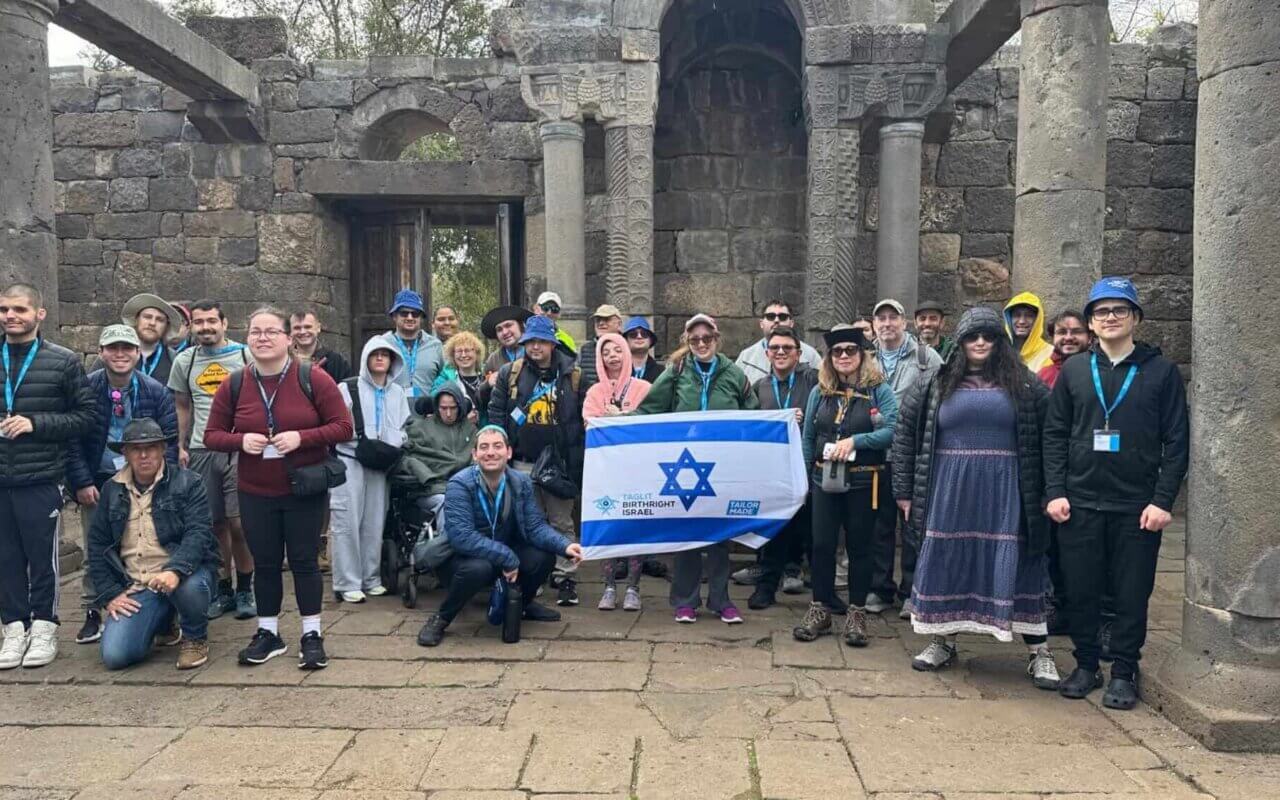
The most recent Birthright trip, from Jan. 4-15, for young adults aged 18 to 25 with autism spectrum disorder, was titled “Israel All Together.”
For Elizabeth Sokolsky, executive vice president of Birthright Israel, the rationale is both simple and deeply Jewish. Citing the Talmudic principle that “All Israel is responsible for one another,” she explained that inclusion is not an add-on but a core value.
“Taglit-Birthright Israel believes that every eligible young adult should be able to travel to Israel to experience their birthright,” she told JNS. “Guided by our Jewish values, we aim to be inclusive of all individuals with disabilities, special requirements, limitations or challenges.”
Birthright currently offers both classic 10-day and volunteer trips tailored for participants on the autism spectrum, those with vision or hearing impairments, mobility challenges, intellectual and developmental disabilities, individuals in recovery, and others with medical, cognitive or physical conditions. These trips feature higher staff-to-participant ratios, adjusted pacing and, when necessary, one-to-one aides—without sacrificing the richness or rigor of the itinerary.
I write this not only as a journalist, but as someone who has led more than a dozen such trips. In December and January, I guided back-to-back Birthright programs: one for alumni of Camp Ramah’s Tikvah Program for people with disabilities, and another for the participants on the autism spectrum. Both were organized by Tailor Made, a leading provider of accessibility-focused travel in Israel.
“This mission is our flagship and our honor—to ensure that everyone has the opportunity to experience Israel with dignity, independence, and equal access,” said Tatiana Hasson-Katz, Tailor Made’s director of programming and outreach. “We are deeply passionate about serving this community and are proud to continue our commitment to creating meaningful, inclusive travel experiences for all.”
On a bus winding from Tiberias to the Golan Heights, 23 Birthright participants on the autism spectrum chatted easily with one another, listening intently as tour guide Duby Langberg narrated Israel’s landscapes and history. They had arrived just a day earlier on an Arkia flight from New York, quickly bonding in the airport chapel as connections arrived from across the United States and Canada.
The days that followed were filled with the kinds of experiences familiar to any Birthright alumnus—only thoughtfully adapted. At Ein Kshatot, the group explored an ancient synagogue. On the Golan, a musical workshop invited participants to tap rhythms, sing and engage multiple senses.
At Agamon Hahuleh, small groups toured the wetlands by golf cart, observing hundreds of thousands of migrating cranes. One participant took 600 photographs, later curating and sharing her favorite 50 with the group.
Accessible hikes at Ein Afek and Nahal Shofet, a nighttime boat ride on the Kinneret, volunteering with therapy horses, visits to Tsfat (Safed), Tel Aviv, Jaffa and Jerusalem—all were part of the journey. The group was also scheduled to meet Israeli soldiers, attend a geopolitics lecture and visit Yad Vashem, the Western Wall and the Dead Sea.
For Brad Levitt, 30, from Manhattan’s Upper West Side, this January trip was his second Birthright experience in four months. “The reason I chose this trip is that I struggle with organization, so changing hotels every three days doesn’t suit me so well,” he said with a laugh. “Changing hotels only three times is perfect.”
Levitt, a professional headhunter, said the appeal went beyond logistics. “It is hard to argue with a free trip and also—how often do you get an opportunity to see Israel with fresh eyes, meet locals, and have powerful programs on identity like we had last night?!”
Langberg, who has guided similar groups before, said the experience is transformative for staff as well as participants. “Being here with these amazing, sensitive, kind people is a privilege,” he said. “They see so much, and most of the time in society, they are misunderstood. It is amazing to see Israel through their eyes.”
Levitt hopes the program continues to grow. “These trips are important and need to continue,” he said, “because they serve a specific population that wouldn’t otherwise have the opportunity to go on an organized trip.”
In doing so, Birthright Israel is quietly affirming a powerful truth: that belonging, connection and peoplehood are not limited by disability—and that Israel, like the Jewish people themselves, is strongest when everyone has a place on the journey.