Israel Baseball

Originally appeared at jns.org on July 8, 2026.

From Cuba to Estonia, immigrants to Israel proudly compete under their former homelands’ flags while celebrating their shared Jewish identity.

The Maccabiah Games bring together thousands of Jewish athletes from across the globe to compete under the flags of their home countries. But among this year’s competitors is a unique group of athletes who now call Israel home while proudly representing the countries they left behind.

At last week’s opening ceremony in Jerusalem’s Teddy Stadium, delegations from Finland to South Africa and Taiwan marched into the arena before the largest delegation of all—Israel’s 2,200 athletes.

For some Israeli olim (immigrants), however, the Games offer a rare opportunity to compete for the countries where they were born while living permanently in the Jewish state.

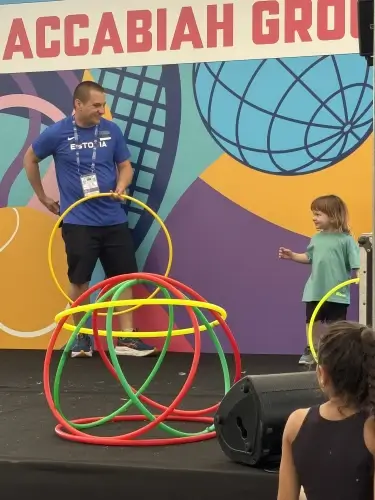
Michael Raichman lives in Haifa and proudly represents Estonia in the Maccabiah Games, July 7, 2026. Photo by Howard Blas.

For Michael Raichman, who made aliyah years ago and now lives in Haifa, representing Estonia is both a privilege and a responsibility.

Wearing a “Maccabi Estonia” shirt while attending a hip-hop dance workshop with his 4-year-old daughter at Maccabiah City in Expo Tel Aviv, the fencer smiled as he explained why he continues to compete under Estonia’s flag.

“I have been here for a long time—since before she was born,” he told JNS. “I represent Estonia and the Jewish community. If not me, no one!”

Raichman said he is the only Estonian competitor at this year’s Games.

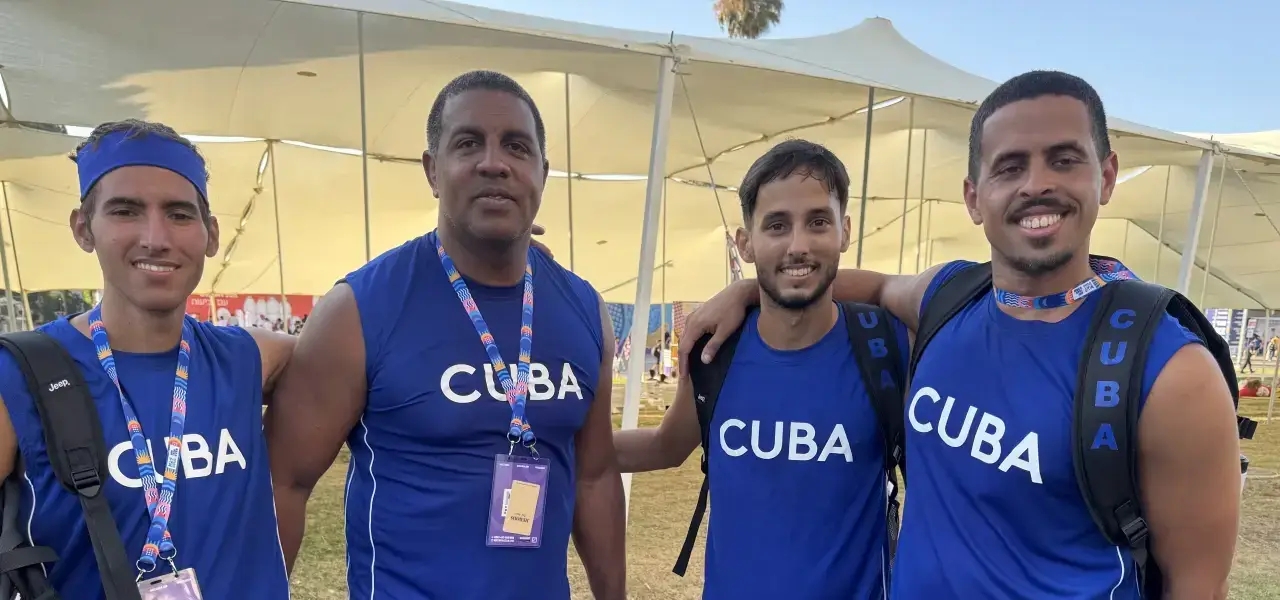
A few pavilions away, Alexis Chavez wore a dark blue Cuba T-shirt alongside four teenage teammates who had just finished competing in the 3-on-3 basketball tournament.

Chavez, who has lived in Hadera for the past 15 years while the younger players still reside in Cuba, said the Maccabiah represents something much larger than sport.

“It brings all Jews together—like brothers,” he said. “It is all sababa.”

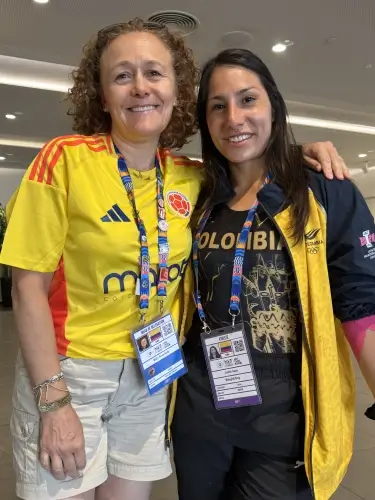
Bela Himelfarb (left), who leads the Colombian delegation to Maccabiah 2026, splits her time between Bogota, Colombia and Harish, Israel, while weightlifter Judith Gaon (right) lives in Jerusalem and represents Colombia, July 7, 2026. Photo by Howard Blas.

Remembering where they came from

For Colombian weightlifter Judith Gaon, representing her birthplace is deeply personal.

The 27-year-old second-year medical student at the Hebrew University of Jerusalem made aliyah in 2012 and is a three-time Israeli national champion. Yet at the Maccabiah she chose to wear Colombia’s colors.

Speaking to JNS after advancing to the next round with a successful 50-kilogram lift, Gaon said the crowd’s encouragement helped her recover after two failed attempts.

“I heard lots of cheering,” she said.

Gaon first discovered weightlifting seven years ago at the Jerusalem CrossFit center, where she works. She credits the sport with helping her overcome insecurities while coping with a medical condition.

Although proud to represent Israel internationally, she said competing for Colombia at the Maccabiah allows her to honor her roots.

“It is amazing to represent Colombia,” she said. “So I don’t forget my roots and what our amazing people went through.”

Drawing a parallel to the Passover story, she added: “It is like Pesach. We always remember our roots and where we are from and where we are headed. I like to remember where we came from.”

Her father and many other relatives still live in Colombia.

Nearby, Colombian delegation manager Bela Himelfarb reflected on the shrinking size of her country’s team.

Unlike previous Maccabiah Games, when Colombia sent delegations of 150 athletes in 2022 and 80 in 2025, only five competitors arrived this year, most of them juniors.

She attributed the smaller delegation partly to scheduling conflicts with school trips to Israel and the FIFA World Cup.

Himelfarb, who divides her time between Bogotá and Harish, said Colombia’s Jewish community continues to view Israel as a refuge during periods of uncertainty.

“People want to come to Israel when they feel in danger,” she said.

She believes the election of Colombia’s new president, who is viewed as more supportive of Israel, has temporarily eased those concerns.

“Maybe there will be no necessity for now,” she said, while acknowledging that “most of the young people are trying to move and make aliyah.”

Representing Israel from abroad

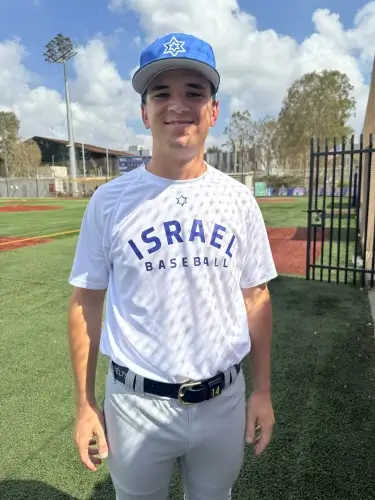
U.S. resident Jonah Weissmann and his family spent four years in Israel and returned to represent its U19 baseball team in Maccabiah 2026. Photo by Howard Blas.

Not every athlete’s story follows the same path.

Jonah Weissmann, 18, now lives in Miami but returned to Israel to play for Team Israel’s baseball squad.

His family moved from Boulder, Colo., to Israel in 2018 intending to stay for one year.

“We planned to stay for one year and stayed for four,” Weissmann told JNS before Team Israel’s game against the United States at Ezra Schwartz Memorial Field in Ra’anana. “Our parents wanted us to have a stronger Jewish identification and get out of our bubble.”

After returning to the United States in 2022, Weissmann assumed his opportunities to represent Israel had ended.

“When they were putting a team together, one of my teammates asked Freddie [manager Freddie Bain] if I could play,” he said. “They invited me to join. I am so happy to be playing with the guys on the team.”

More than a sporting event

Before Tuesday’s game, players from both Israel and the United States gathered to hear Yoav Schwartz speak about his nephew, Ezra Schwartz, the 18-year-old American who was murdered in a terrorist attack on Nov. 19, 2015, while volunteering in Israel during his gap year.

Schwartz told the players that just one day before he was killed, Ezra had emailed the Israel Association of Baseball asking whether he could join a local team. Today, the field where the Maccabiah baseball tournament is being played bears his name.

The teams had also heard the previous day from Debbie Ziering, who shared the story of her son Aryeh, among the first Israeli soldiers killed defending southern Israel during the Hamas massacre on Oct. 7, 2023.

Moments like those underscore how the Maccabiah extends well beyond athletic competition.

For nearly two weeks, athletes compete in more than 40 sports while forging friendships across continents, sharing experiences of Jewish life in vastly different countries and strengthening their connection to Israel.

For competitors like Raichman, Chavez and Gaon, the Maccabiah Games also provide something increasingly rare: the opportunity to celebrate both the countries that shaped them and the country they now call home.

Read more

Original Article Published On The JNS

For 24-year-old, Minor League pitcher Daniel Federman, the trip via Uber and airplane from the Baltimore Orioles spring training camp in Sarasota, Fla., to Team Israel’s facility in Jupiter three hours east across the state provided much more than just a chance to play baseball in another Florida city. It affords him the opportunity to reconnect with his Jewish roots and with fond memories of his paternal Jewish grandparents.

Federman, who grew up in the backdrop of Chanukah, Passover and Christmas, had two paternal Jewish grandparents and his mother Amy’s father is Jewish.

“My father’s Jewish side was not extremely religious, but holidays were family times. We got together as part of our heritage,” he told JNS.

The family’s Jewish connection “died out” largely when Federman’s grandparents died. “My father wishes he could but didn’t know how to do it, so it’s been a while,” the pitcher said of his father’s connection to Jewish ritual.

Federman’s father was kicked out of Hebrew school, so he opted not to subject his son to it, and Federman did not celebrate his bar mitzvah. His parents let him decide about his own religious affiliation and supported his decisions.

He played baseball and basketball at his local JCC in Davie, Fla., and almost played Maccabiah basketball before baseball took priority.

Federman said that he first learned about Israel’s World Baseball Classic team as a student at the University of Miami. His fellow baseball teammate at the university, Ben Wanger, pushed him to go on Birthright and to live a more Jewish life, and told him about the Israeli team. Federman has not been able to visit Israel yet, as he has been busy with college, the baseball draft and then his signing.

“I spoke to my mother, and she has been dying to go,” he said of an Israel trip. Ironically, they had decided to go before he got involved with Team Israel. He anticipates that they will make the trip after the baseball season.

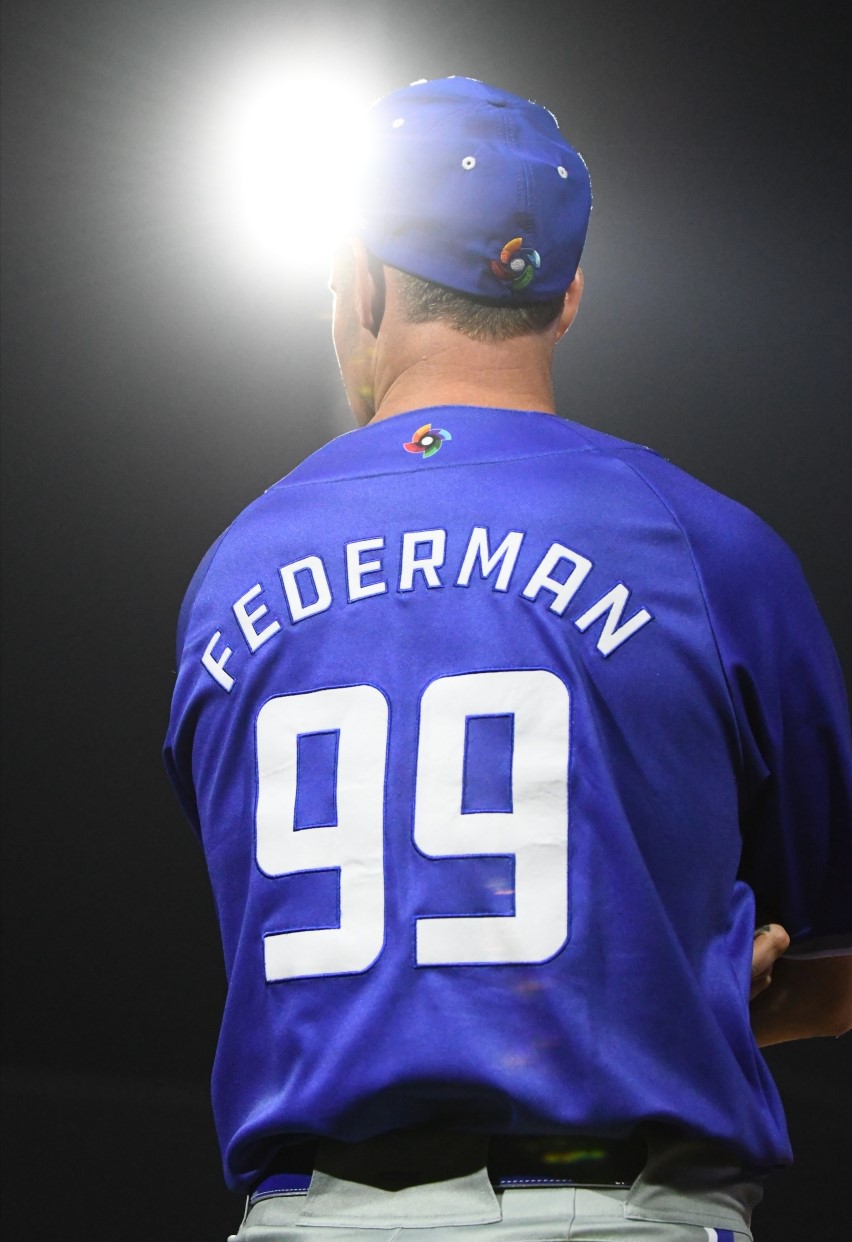
Federman, No. 99. Credit: Team Israel.

‘Oh man, you are actually doing it!’

Peter Kurz, general manager of the Israeli team, told JNS that Federman is “definitely a pitcher with potential.”

Wanger’s recommendation of Federman to the team is the sort of thing that has been happening more after the team’s success at the last World Baseball Classic and at the 2020 Olympics.

“Many players came to us upon recommendations of others,” said Kurz. “That’s a major source of our players—simply word of mouth and recruitment by ex-players.”

Federman found out on Feb. 7 that Team Israel invited him to join the 30-member roster for the World Baseball Classic. The team’s first game is on March 11.

“It hit me: Oh man, you are actually doing it!” he said.

He has already had a chance to reaffirm his Jewish identity. The day after arriving at the team’s training center, Federman joined teammates to hear the Megillah on Purim.

With the blessing of the Orioles, he will spend two weeks with Team Israel before joining his Baltimore teammates for spring training.

“There are lots of great guys out there, and I am excited to meet them,” he said of his Team Israel colleagues. The teammates had communicated via group chat, which is par for the course in baseball. When Federman joined the Orioles organization, he also didn’t know anyone.

“The good thing about the baseball community is that there are a lot of mutual connections. You will always know guys you grew up with, and we are all there to play baseball,” he said.

He obviously hopes that he will make it to the major leagues someday, but even if he doesn’t, he thinks what he is experiencing with coreligionists is more than enough.

“Millions would trade with me. It will be unbelievable!” he practically gushed, adding that the World Baseball Classic is “the highest level of competition most will play in front of.”

Read more

Original article published in the JNS

“It was the moment you dream about for so long,” said the 27-year-old of being told by Marlins manager and Major League Baseball legend Don Mattingly that he was being activated. “You know you are forever a big leaguer—whether you ever pitch or not.”

The Miami Marlins baseball team has a good sense of humor and loves a good fish story. When Jewish player Jake Fishman was called up to the majors from the triple-A Jacksonville Jumbo Shrimp organization, the Marlins tweeted, “Last name says it all. Newest FISHman,” with a photo and caption “Jake Fishman: Welcome to the Show.”

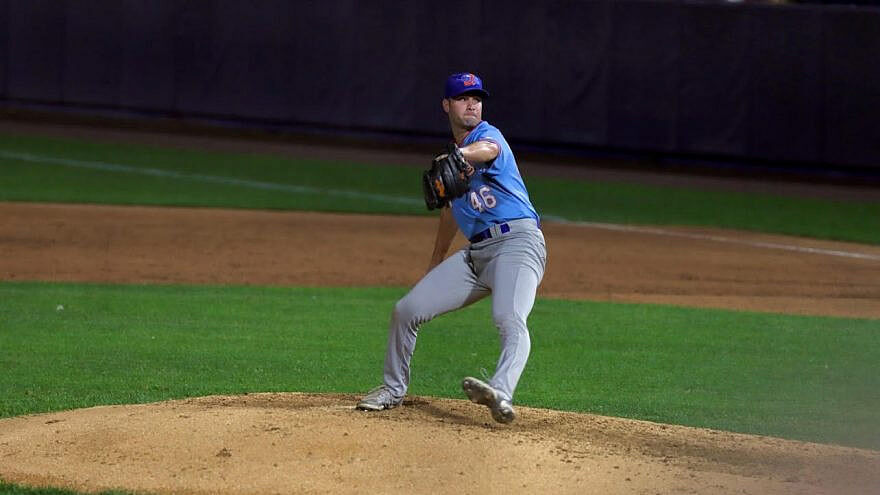
The 27-year-old left-hander from Sharon, Mass., known for his sidearm delivery, threw mostly sinkers and sliders in his recent three-and-one-third-inning debut against the first-place New York Mets on July 31. While most of the pitches came in under 90 miles per hour, Fishman threw 33 strikes in his 49 pitches. Yet despite his successful appearance, Fishman was designated for assignment the next day to make room for lefty pitcher Jesus Luzardo, who returned to the team as he came off the 60-day injured list.

When self-described “huge Miami Marlins fan” Michele Lobovits heard that Fishman was sent down to the minors, she was disappointed. Lobovits said that she and other Jewish members of a diverse baseball chat group “were so excited for Fishman. Unfortunately, he was kind of a pawn. He pitched in one game and was DfA’d. That means another team could pick him up. Or we could get him back.”

Fishman spoke by phone with JNS while relaxing at his parents’ home in Sharon. He doesn’t share Lobovits’s disappointment and is relentlessly positive as he recounts the story of his Major League debut and shares tales of his baseball career to date.

“It was the moment you dream about for so long,” said Fishman of being told by Marlins manager and Major League Baseball legend Don Mattingly that he was being activated. “You know you are forever a big leaguer—whether you ever pitch or not.”

Jake Fishman as a young pitcher. Credit: Courtesy.

‘My first pitch was a strike’

Fishman recalled that he got called to the manager’s office while on the road in Georgia. “It really happened quickly. He told Nick Neidert and me that we were going to the Marlins, but didn’t know [at the time] if we’d be activated. The next day, we flew to Miami and spoke with Mattingly, and he told us he’d keep us posted.”

Fishman called his parents, Hutch and Cindy, at 10:30 p.m. on July 29 and told them: “I may get called up.” His parents began searching for flights to Miami. They were not successful but did manage to get one to West Palm Beach and then drove two hours, arriving just in time for the Friday-night game.

Cindy gave a television interview as she watched from the stands along with a small entourage that included Jake’s girlfriend, a lifelong friend and his trainer. She recounted that “we had to really scramble to get a flight down here. All the flights were booked; we had to fly into West Palm Beach. You know all the airports are crazy and the car-rental places are crazy, but we managed to get here. And ever since, we’ve been here [at the ballpark] every day, and it has been great!”

Fishman, who wore No. 94, didn’t play that night. He says he watched the games on Friday and Saturday from the Marlins bullpen.

On Sunday, he was following pitcher Pablo Lopez closely as the Marlins trailed 6-0 in the third inning. “His pitch count was going up, and I was getting ready. In the third inning, they called down to the bullpen and said, ‘Get red hot,’ ” a sign that he might be called in to pitch. When he finally got the nod, Fishman ran out to the pitcher’s mound.

“It was a surreal feeling!” he recalled.

Mattingly tried to put Fishman at ease. “He told me there were guys on first and second, and two out, and said, ‘Go get ’em!’ He made it feel like a regular baseball game.”

Fishman came on with the Marlins trailing the Mets 6-0 in the third inning. He had to come to terms with the fact that he would be facing Mets shortstop and four-time all-star Francisco Lindor. “I didn’t imagine I’d be going up against Lindor as my first batter. I was freaking out a bit! My first pitch was a strike, and I said, ‘I think we got this.’ ”

“He grounded out to third on a sinker, and it helped me calm down and know I’d be fine,” said Fishman, who faced each batter in the Mets lineup at least once and gave up one run on four hits in the Marlins 9-3 loss at Loan Depot Park.

He learned that his time at home with his parents would soon come to an end. He cleared waivers and flew to Jacksonville to rejoin the Jumbo Shrimp, but remains upbeat.

Hutch Fishman said his son was born into a baseball family: “What helped his baseball enormously was that his brother, who is four-and-a-half years older, let Jake play with him and his friends. … He was 8 playing with 12-year-olds.”

Fishman attended Hebrew school and celebrated his bar mitzvah at Congregation Klal Yisrael in Sharon. “It was a lot of work learning to read from the Torah, but it felt rewarding,” he said. Fishman acknowledged that his Hebrew-school attendance and temple involvement “tapered off” a bit after his bar mitzvah so he could focus on baseball.

Despite a successful high school baseball career, he was not recruited by Division 1 schools for college baseball. Hutch said, “He was 5 feet tall when he was a freshman in high school. … He grew late, so no D1 schools were interested.” Fishman was reportedly 5’7” until he had a seven-inch growth spurt in his junior year. He now stands 6’3” and weighs 215 pounds!

Fishman went on to pitch at Union College in Schenectady, N.Y., where he led all of college baseball with a 0.41 earned run average. He was selected in the 30th round of the 2016 Major League Baseball draft by the Toronto Blue Jays. As he was still in college, he negotiated a contract that would include paying his tuition. Fishman returned to Union in 2018 to complete his degree in managerial economics with a minor in digital media. He spent six years in the minors with the Blue Jays organization before being selected by the Marlins in 2020.

Win against Mexico ‘a very special moment’

Fishman was also on the roster for Team Israel at the 2017 World Baseball Classic.

Peter Kurz, general manager of Israel’s Olympic and national teams, noted that “Jake Fishman was on our extended pitching roster in the 2017 WBC, but unfortunately, was not needed by the team. He has come a long way since then, and making his debut in MLB this past week was wonderful to see. He played for us in the Olympics and is a big side-armed lefty who pitched in three critical games for us. He was a wonderful teammate and really loved to be around the guys. He fit in perfectly with the team, and I hope that he’ll be on our 2023 WBC team as well.”

In order to play on Israel’s Olympic team, Fishman needed to obtain Israeli citizenship by formally making aliyah in 2019. “Traveling the country and competing in the Olympics were definitely highlights,” he reported. He was struck by the “amazing food” in Israel and was surprised by just how modern Tel Aviv was, saying with gusto: “I want to go back!”

Fishman observed that “competing in the Olympics is different than regular professional baseball—in Minor League Baseball, the team is focused on development. In the Olympics, all that matters is winning and getting the job done!”

In 2021, Israel defeated Mexico 12-5 in the double round-robin phase of the Olympic baseball tournament. Fishman said that “winning versus Mexico was a very special moment.”

The Fishman parents were proud of Jake for playing for Team Israel in the Olympics. “We woke up early and stayed up late to watch all of the games. Watching Jake play with former Major League players with good careers was cool,” said Hutch.

After years in the minors and a stint with Team Israel, Fishman finally saw Major League action. While his stint with the MLB Marlins was short-lived for now, he said he is pleased to remain in the Marlins’ system. He may even get the second chance that will make Lobovits and other fans happy.

Jake Fishman and his parents, Hutch and Cindy Fishman. Credit: Courtesy.
Read more

Original Article Published On The Jewish News Syndicate

His career has included nearly 3,000 at bats, 795 hits, 95 home runs, 397 runs batted in and a lifetime batting average of .268. He now adds member of Team Israel, Israeli citizen and Olympian to his list of accomplishments.

For most parents, having a son play on a Major League Baseball team would be a dream come true. For Danny Valencia’s parents, it isn’t quite enough.

Though proud of his baseball career, which has included playing on eight Major League teams and Team Israel, they also want him to finish his college degree—and to join them for Rosh Hashanah dinner one year. The Valencias are almost batting three for three.

Danny Valencia is well known to baseball fans in the United States and in Israel. The 35-year-old—drafted in the 19th round by the Minnesota Twins in 2006—made his Major League debut with the Twins in 2010 and then played for them, the Boston Red Sox, Baltimore Orioles (twice!), Kansas City Royals, Toronto Blue Jays, Oakland Athletics and Seattle Mariners.

His impressive career has included nearly 3,000 at bats, 795 hits, 95 home runs, 397 runs batted in and a lifetime batting average of .268.

Valencia can now add member of Team Israel, Israeli citizen and Tokyo 2020 Olympian to his list of accomplishments.

But he cannot (at least, not yet) add college graduate to his credentials.

Valencia began his studies at the University of North Carolina at Greensboro, where he was Southern Conference Freshman of the Year and second-team all-conference. He transferred to the University of Miami, which was closer to his home and family in Boca Raton, Fla. He took a leave from college when he was drafted by the Twins in 2006.

“I promised my parents I would finish my degree—that was 14 years ago,” says the 35-year-old.

Danny Valencia, Baltimore Orioles vs. Kansas Royals, May 9, 2018. Credit: Keith Allison via Wikimedia Commons.

Valencia has been making good on his promise. He is taking four online courses this semester and has seven more courses to complete before earning a degree from the University of Miami.

While he has had a lot on his mind these past five weeks, including making aliyah and traveling with Team Israel to Germany and Italy, he managed to devote time to his online courses. “My family can’t believe it. I have his work ethic!” he jokes, adding that, as he has gotten older, he has gotten better at managing his time and schedule.

‘Playing for more than ourselves’

The move towards permanent Israeli residency has also taught Valencia to be better at managing bureaucracy.

“It was a long process and a lot of hoops to jump through, but it makes sense,” reports Valencia, who along teammates Ty Kelly, Nick Rickles and Ben Wanger became Israeli citizens under Israel’s Law of Return. “There was paperwork, interviews, FBI checks, marriage certificates, postiles, rabbi letters and more. It was a tedious process, but without that, there would be no passport, and we wouldn’t be Israeli citizens. I am happy I did it.”

In between trips to the Interior Ministry, Valencia and his fellow teammates toured their new homeland. They traveled to Jerusalem and to the Dead Sea; they went to Yad Vashem. Valencia makes it a point to say that he was struck by Israel in general, which was followed days later by a trip to Germany.

“It was my first trip to both,” he says. “Yad Vashem was really emotional for all of us. In Germany, we realized it [the Holocaust] all originated here.” Valencia felt the experience taught that “we are playing for more than ourselves.”

With the Boston Red Sox vs. the Baltimore Orioles, Sept. 28, 2012. Credit: Keith Allison via Wikimedia Commons.

He and his teammates feel that an important part of their mission is to “inspire Israeli kids and to inspire a generation of Jewish athletes. “There are not so many Jewish athletes,” he acknowledges. In Israel, they have led baseball clinics for young ballplayers and found time to work out, even getting “a guy to pitch batting practice.”

Their hard work paid off.

Team Israel stunned the world with their performance, finishing in the top five in the 2019 European Baseball Championship and earning the right to participate in the 2020 Olympics qualifiers. As the winner of that tournament, Israel qualified for the first of the six spots in teams to compete in the 2020 Summer Olympics in Tokyo. Valencia batted .375 in the Olympic qualifying tournament, leading the tournament in runs (7), home runs (3), RBIs (9), walks (5) and slugging percentage (1.000). He also hit a three-run homer in his final at-bat at the tournament in Parma, Italy. That wound up giving Israel a 10-run lead over South Africa.

In assessing his family’s reaction to his decision to become an Israeli citizen and play for Team Israel, Valencia reports: “My family was shocked, but they were supportive. They thought it was cool. They were blown away by my effort.”

‘Electricity in the air’

He had been following Team Israel for years, but his Major League responsibilities always precluded his participation on the team. When he realized that he would not be with a Major League team in the summer of 2019, playing for Team Israel became a possibility.

“I had been staying in good shape, and I reached out [to team president Peter Kurz] and said I would be interested in taking part,” he relates. “I joke that it was the best front-office decision he had ever made.”

Seriously, Valencia reports, “I loved it. It was a great group of guys, and I am grateful for the experience.”

And he enjoys the Jewish and Israel touches. “On Friday nights, we had Shabbat dinner with prayers, toasts and breaking bread with the boys.” He is also moved by the pre-game playing of “Hatikvah,” Israel’s national anthem. “We kept our hats on for our national anthem—to show that God is above. We took our hats off for the national anthems of the other countries.”

With the Oakland Athletics vs. the Baltimore Orioles, Aug. 17, 2015. Credit: Keith Allison via Wikimedia Commons.

Valencia is no stranger to Jewish holidays and traditions.

“I had a normal Jewish upbringing,” he says. “We went to synagogue on the High Holidays; my mother fasted on Yom Kippur. I was around Judaism.” Valencia was born to a Jewish mother and a Cuban father who converted to Judaism. He attended Hebrew school and celebrated his bar mitzvah, recalling being sick during the occasion, saying “I was sniffling the whole time.”

Nevertheless, he notes that it was “a proud moment for both sides of the family.”

Valencia says the hardest part of being on the road for nearly six weeks with Team Israel was being away from 16-month old son, Oliver, and his wife. “We did FaceTime. I am not sure what he understands, but he saw a video of me hitting and got excited!”

Due to the late September ending date of the Olympic qualifiers and the late falling Jewish holidays, Valencia was able to be home for Rosh Hashanah.

“It is the first time ever—home with family,” reports Valencia, happy to celebrate the holiday with parents, aunts and uncles, his wife and son. He admits that “baseball was a major topic of conversation at dinner. They were all ecstatic, and they are trying to find accommodations in Tokyo for the Olympics. It could be the last time I play baseball on that level.”

Kurz, president of the Israel Association of Baseball and the team’s general manager, notes Valencia’s performance on and off the field. “He is a proven Major Leaguer, with nine years of experience. When he joined the team, there was electricity in the air, as he was our anchor and leading hitter. He hit home runs in five straight games, and led by example on the field and off. He is now the leading advocate and spokesperson for the team, and is working hard to get us sponsorships, donations and commercial deals so that the IAB can use those funds to develop the game of baseball in Israel, and we can also provide the team with better conditions to train and practice under.”

He details the many needs still facing the team as they prepare for the Olympics, including bringing some additional players to Israel, bringing all of the players to Israel in the winter, having a two-week pre-Olympic mini-camp in the United States, holding exhibition games against Japanese teams in Japan, purchasing equipment, bringing coaches to Israel and sending scouts look for Olympic opponents. Kurz reports anticipated costs are more than $500,000, and that they are trying to raise needed funds by donations and sponsorships.

In the meantime, Danny Valencia is home with his family in South Florida. He is staying in shape, thinking a lot about the Olympics, spreading the word about fundraising for the team and working to fulfill that “three-parter” his parents wanted … getting closer every day.

Team Israel, now headed to the 2020 Tokyo Olympics, at the quarter finals. Photo by Margo Sugarman.
Read more