Israel

In a special guest post for Covenant Classroom, Covenant Award recipient and Director of the National Ramah Tikvah Network Howard Blas shares some of the latest and greatest creative and original educational programming from Israel and reminds us yet again how the land of our ancestors is truly the original Covenant classroom.

Making the Most of Any Ability and Increasing Self-Confidence, too

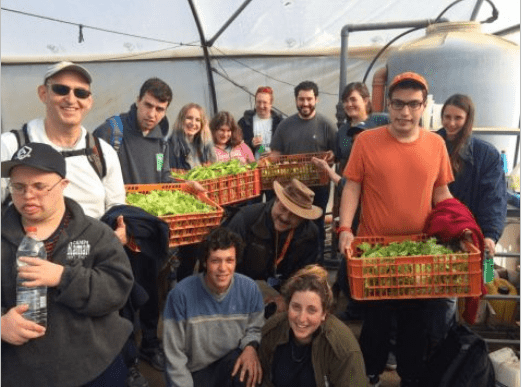
At Kibbutz Tzuba in the Judean Hills, 15 minutes from the center of Jerusalem, teens who are struggling academically can now participate in a farming program where they learn skills and enjoy the feeling of success beyond the classroom walls. The founder of the program, Alon Greenboim (everyone calls him “Jumba,”) knows first-hand how traditional classrooms may not the learning environment of choice for everyone–but that everyone can learn by doing.

When he was a young boy, Jumba was assigned to work in the kibbutz apple orchard. There, he needed a ladder to reach the apples. He told himself then that if he were ever in charge, he would figure out a way to get the trees to grow horizontally so that shorter people would not need to climb a ladder to pick apples off the trees. Sure enough, today the entire apple orchard at Kibbutz Tzuba is made up of trees that grow out, not up.

It is this type of ingenuity that has allowed Jumba to grow a multi-million dollar agricultural business and also help young people who haven’t found their footing in traditional school, to accomplish and achieve in ways they never thought possible.

Thanks to a new program, Gdolim Bemadim, Special in Uniform, people with a wide range of disabilities can now serve in the IDF. In areas such as logistics, printing, supply rooms, food service, computers and more, this program allows soldiers with disabilities to build self-esteem, and the typical soldiers benefit as well. Yossi Kahana, Director of JNF (Jewish National Fund) Task Force on Disabilities and co-founder of the program, believes strongly that “if every soldier in the IDF had the opportunity to work side by side with people with disabilities, the potential to change attitudes in Israeli society [would be] tremendous.”

Learning Sensitivity and Compassion in the Dark
It is hard to give people a sense of what it might be like to experience life with a disability. But now, thanks to the Dialogue in the Dark program at the Israel Children’s Museum in Holon, visitors can experience a taste of what it’s like to be blind. Guides who are either visually impaired or blind lead visitors through the exhibit (which includes a port, market, pub and noisy pedestrian crossing)–and engage them in conversation about disability, coping and life in general. To cap off the experience, Nalagaat Blackout Restaurant (at The Na Laga’at Center, Ratzif HaAliya Hashnia, Jaffa Port), a short 3.5 miles (6 km) away, offers an opportunity to experience and enjoy a delicious kosher dinner in total darkness, served and guided by blind wait staff.

Teaching Peace… One Serve at a Time

Can coexistence be taught on the tennis court? Since the 1970’s, the Israel Tennis Center has been doing just that, through its Israel Tennis Centers (ITC) Coexistence Tennis Programs. The ITC aims to alter negative perceptions while instilling positive ones, through joint sporting activities held for Jewish, Arab, Druze and Bedouin children. Twinned kindergarten classes organized through the ITC bring together 60 children from an Arab kindergarten and a Jewish kindergarten weekly on one court, where they learn motor skills development and participate in sports activities at the ITC centers in Jerusalem, Jaffa and Akko.

Another ITC program, called “Doubles Coexistence,” pairs Arab and Jewish children as partners on the tennis court and encourages them to interact on and off the court, thereby building a bridge between the different cultures.

Read more

Original Article Published on The Jerusalem Post

Israel got Fed Cup Europe/Africa Zone Group I action in Eilat off to a losing start on Wednesday, falling 2-1 to Turkey.

Shahar Pe’er and Julia Glushko lost their singles matches to open the day before teaming up to win the doubles encounter.

Israel will be back in action on Thursday when it faces Estonia before coming up against Croatia in its final Pool C tie on Friday.

The group winner will play-off against the winner of Pool C for a place in the World Group II playoffs in Eilat on Saturday, while the bottom-placed nation will play-off to determine relegation to Europe/ Africa Zone Group II in 2017.

The stars seemed aligned and the script already written by the time Pe’er, ranked 189th in the world, took Center Court on a sunny, warm, slightly breezy Wednesday for her evening session match against Turkey’s Ipek Soylu.

Despite Soylu’s slightly better ranking of 161, Pe’er is nine years older, has Fed Cup experience, and reached a career high of 11th in the world.

Pe’er also had the crowd on her side, with school children from Eilat filling the stands and cheering, “Let’s go Shahar, let’s go.”

Soylu got off to a quick 3-0 lead until Pe’er hit her groove, regained composure and won the first set in 50 minutes, 7-5. However, Soylu went on to win the second set 6-3 and the decisive set 6-2 to claim the match.

Israel’s No. 1 Glushko (No. 126) took the court under the lights versus Caglia Buyukackcay (142). Shouts of “El, el Yisrael” and “Let’s go Julia, let’s go!” helped Glushko get off to a 3-2 lead, but she could not sustain the rhythm in falling 7-5, 6-3.

The evening ended with the Pool C doubles match between Turkey and Israel, with Pe’er and Glushko partnering to take on Buyukakcay and Basak Eraydin.

After trading back-and-forth 7-5 sets, Israel clinched the win with 6-4 in the decisive set.

The Arkia Airlines gate and flight attendants at Ben Gurion Airport hardly realized there was a major international tennis tournament taking place in Eilat this week.

Yet, professional women tennis players from 14 countries, as well as coaches, umpires, members of the media and International Tennis Federation staff members have all congregated at the Municipal Tennis Center in Eilat, home of the Fed Cup 2016 Europe/ Africa Zone Group I tournament.

Tzipi Obziler, the Israeli captain, is a former Fed Cup player, representing Israel from 1994 to 2009. Israel’s team is coached by Sandra Wasserman, a former member of the Belgium Fed Cup team who reached a high of 48 in the WTA rankings as a player.

Obziler acknowledged that “it’s been a while, but to be a part of the Fed Cup team for the 17th year and first time as a captain means a lot to me. To hear again the national anthem, to wear again the Israeli flag on the back are very emotional things for me and I can only think about doing the best we can on and off court at any time.”

The tournament features two daily sessions through Saturday.

Read more

by Aaron Herman

How do you you create a meaningful Israel experience for young adults with special needs? Video blogger Aaron Herman spoke with Covenant Award winner Howard Blass, Director of the Tikvah Program at Camp Ramah in New England, Tali Cohen, Director of Tikvah Vocational Services and participants about their unique Israel experience.

The Tikvah Program at Camp Ramah in New England is an eight-week overnight camping program for 60 campers with special needs that is integrated within a summer camp for 800 typically developing children. As Director, Howard manages four separate special needs programs, including a full-time overnight camp, a Vocational Training Program, a Camp Employment Program, and an Inclusion Program.

Read more

Original Article Published On The New York Jewish Week

On a recent visit to a Pikud HaOref, Home Front Command base in Ramle, 14 miles southeast of Tel Aviv, a soldier tells me a very animated story about his role in Operation Protective Edge, Israel’s military operation in Gaza: My job was to copy the papers for our soldiers to drop from planes over Gaza this summer! The soldier, in uniform with his bright orange beret on his shoulder, happens to have Down Syndrome.

He is very excited about his job in the base print shop. Another soldier with a visible disability proudly recounts the visit to the base the previous day by IDF Chief of Staff, Benny Ganz. We saluted him and gave him a present olive oil that we made on the base!

Twenty five other soldiers with disabilities perform similarly important jobs each day on the base. If Tiran Attia and other visionaries have their way, Tzahal, or the IDF (Israel Defense Forces), may become a “game changer” in Israel for inclusion and for shaping attitudes about people with disabilities.

Tiran Attia, who served for 30 years in the IDF and was a commander of Sar-El, the IDF National Project for Volunteers, serves as head manager of Yad Layeled HaMeuchad (Lend a Hand to a Special Child), an amuta (non-profit organization) which consists of two programs, Magshimim Chalom Fulfilling a Dream and Shaveh Madim-Equal in Uniform.

I have had the privilege of visiting two such army bases during recent trips to Israel the home front command base in Ramle, and a logistics base near Kiryat Malachi. During our tour, Attia takes me to visit soldiers from the program at various job sites including the supply room, dining room and print shop. Attia emphasizes several times during our visit, It should be noted that in Israel, army service is the gateway to successful integration into society and the work force. The nearby Chevrat Chashmal (electric company) already employs 260 workers with special needs.”

The program is already impacting the other soldiers through what Attia describes as “the ripple effect. Other soldiers on the base think less of their own problems, they think of the soldiers with disabilities as role models, and discipline problems on the base have gone down.

Arianna Goldsmith, an American olah (immigrant to Israel) works with the soldiers with disabilities as her army service: The other soldiers see these soldiers come to work and it teaches them, it changes their attitudes.

Tiran, who admits to being skeptical of the program at first, notes, One mother of a soldier in our program told me, You have made a miracle! Tiran was injured during the Second Lebanon War and was visited in the hospital by people with disabilities. I saw the love and sympathy they gave to the injured soldiers and I realized they have so much to give so I started to advocate for them to join the program.

The program was founded to enable youth with disabilities to realize their dream and serve in the IDF like most young Israelis, for whom service in the IDF is a normal part of life in the years between high school and college. At the same time, the program promotes a more inclusive society and fosters the attitude that people with disabilities can more fully participate in and contribute to society.

I share with Attia our 45 years of experience successfully including campers with disabilities in our eight Ramah overnight camps and three day camps in the United States and Canada. And I stress how both anecdotally and through research, we know that inclusion benefits everyone. For example, a 2013 study, The Impact of Ramah Programs for Children, Teens, and Young Adults with Disabilities: A Strategic Planning Survey of Special Needs Education Professionals, Ramah Special Needs Staff, Staff Alumni and Parents, conducted by Dr. Ezra Kopelowitz, shows quite clearly that “Staff and camper alumni who had contact with a Ramah special needs program report major impact on their personal and professional lives. At Ramah, this happens on a massive scale, as each summer, 7,500 campers-some in each camp with both visible and invisible disabilities–and over 2,500 university aged staff members, populate our camps.

Attia and his colleagues don’t need to be convince and they see the potential for inclusion and shaping of attitudes on a massive scale. Yossi Kahana, Director of Development for Aleh Negev-USA and co-founder of the program, believes strongly that If every soldier in the IDF has the opportunity to work side by side with people with disabilities, the potential to change attitudes in Israeli society is tremendous. Kahana now has a personal as well as a professional connection to disabilities. “I’m the father of a child with special needs. My older son is serving in the army and my younger son, Gershon, who is nine years old, is autistic. My dream is that my younger son will one day join his brother in the army.

As the IDF continues to include soldiers with disabilities on an even larger scale, they will no doubt shape the attitudes of an entire society!

Read more