Jonathan Erlich

Originally appeared in jns.org, March 24, 2026

Although players will not compete in the Billie Jean King Cup event in Bosnia, they will retain their ranking level for next year.

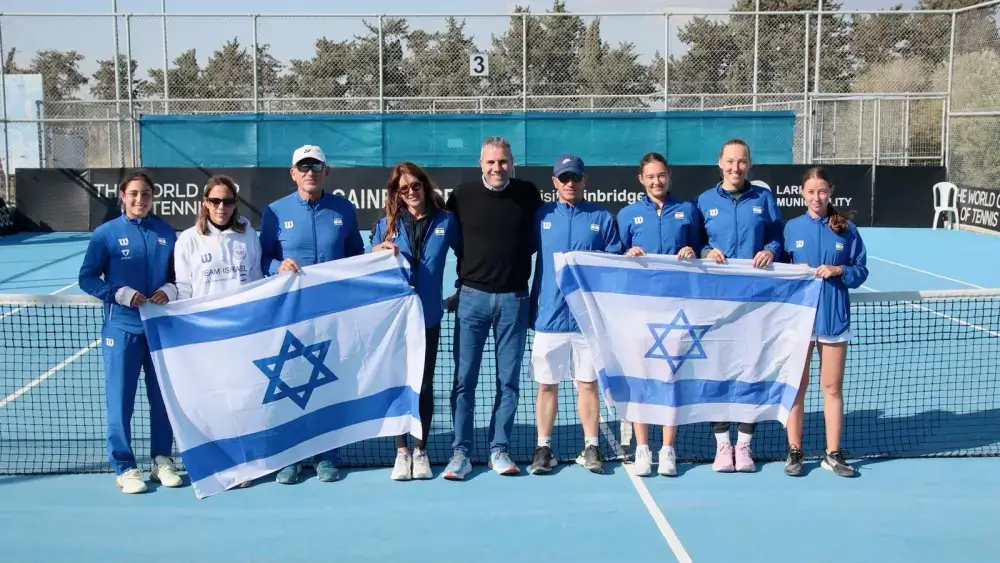
The Israel Tennis Association (ITA) has announced that Israel’s women’s national team will not participate in the Billie Jean King Cup tournament in April, citing security concerns related to travel and the current regional situation.

Israel had been scheduled to compete against Bosnia in the Europe/Africa Group II event. According to the ITA, concerns centered on both the security situation in Israel and the players’ safety while traveling abroad. Officials also noted sensitivities about competing in a destination perceived as less friendly toward Israel at this time, as well as the participation of teams from several Muslim-majority countries, including Egypt and Morocco.

The Billie Jean King Cup, formerly known as the Fed Cup, is the premier international team competition in women’s tennis and is often referred to as the “World Cup of Tennis.” This year’s competition features a record 148 nations competing across four regions: Africa, the Americas, Asia/Oceania and Europe.

Israel previously hosted the Fed Cup Europe/Africa Zone Group I tournament in Eilat in 2012, 2013 and 2016.

The ITA said it considered hosting this year’s event in Israel but determined it was not feasible given the current security circumstances.

Ronen Morali, captain of Israel’s team, said, “This was the right and wisest decision under the current circumstances. Following the concerns expressed by the players, most of whom are very young, and due to the understanding that we will not be harmed professionally by the move, we decided to submit an official request to the ITF not to participate in the tournament.”

The International Tennis Federation accepted the ITA’s formal request to withdraw.

Morali noted that, if the trip had been scheduled to take place now, “The Israeli security authorities would not have authorized us to go.”

He added, “Our responsibility is first and foremost to protect the players’ safety and security.”

Jonathan Erlich, captain of Israel’s Davis Cup team and a former Israeli doubles player, faced similar security challenges in September 2025, when Israel competed against Canada in a Davis Cup World Group I tie in Halifax, Nova Scotia. The matches were played without spectators at the Scotiabank Centre due to security concerns.

Erlich supported the women’s team’s decision. “I think they made the right decision. Going to a country that in normal days we not been loved so now will be too risky.”

David Wiseman, founder of the Facebook page Follow Team Israel, which highlights stories about Israeli and Jewish athletes and has more than 160,000 followers, said security considerations increasingly affect Israeli participation in international competitions.

“The unfortunate reality is that this is the world we live in. There are too many geopolitical considerations when an Israeli sports team competes around the world,” Wiseman said.

He cited recent examples in which Israeli athletes were unable to participate in international events.

In January 2024, Israel’s rock-climbing team and its top climber, Ayala Kerem, were barred from competing in the Dock Masters 2024 competition in Utrecht, Netherlands, due to concerns about potential security threats.

In October 2025, Israeli gymnasts, including Olympic medalist Artem Dolgopyat, were denied entry visas to the World Artistic Gymnastics Championships in Jakarta, Indonesia.
Read more

Originally appeared in In Jewish News Syndicate in www.jns.org, February 3, 2026

On Feb. 6-7, Israel will host Lithuania in World Group I Davis Cup action at the 2,000-seat Netanya Arena. 

The multi-tiered international tennis tournament returns to Israel after a two-and-a-half-year absence. Israel’s Davis Cup team last hosted a tie in September 2023, when it defeated Japan 3-2.

Israel’s team comes to this weekend’s tournament after a loss to Canada last September, while Lithuania arrives after a victory over Benin. This is the first-ever meeting between the two teams. The competition, which takes place indoors on hard courts, will determine which team will survive in Group 1 of the World Cup.

“All ties are new and exciting. I still get butterflies in my stomach before each Davis Cup!” reported team captain Jonathan Erlich, a former Israeli doubles player and veteran of many Davis Cup games.

Erlich is looking forward to playing in front of a home crowd, noting, “The spectators are always so warm and patriotic.”

The road to hosting the tournament wasn’t smooth. The Israel Tennis Association had to assure the International Tennis Federation (ITF) of the safety of playing the tournament in Israel.

Even with the ITF’s go-ahead, the threat of a changing situation in the region remains a possibility. “After two and a half years, hopefully it will happen,” Ehrich told JNS in a phone interview. 

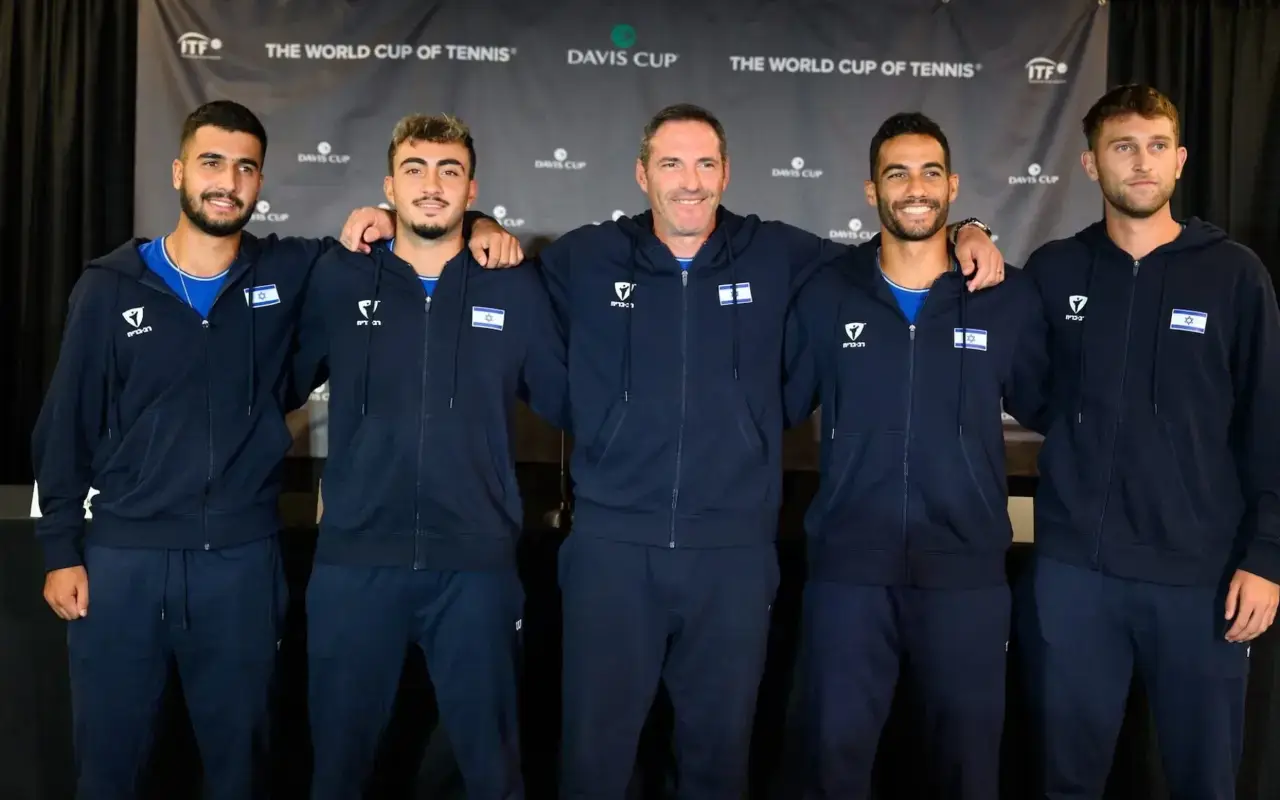
Erlich observed that, unlike in his playing days, where he teamed up with doubles partner Andy Ram and the team included such top-ranked players as Ram, Dudi Sela and Amir Weintraub, this year’s team includes players ranked no higher than 873 in the world, with most currently playing for college teams in the United States. 

“It feels a bit different than the past few Davis Cups,” Erlich said. “Fifty percent of the team is in college now, so I can’t track their matches. I have at least been in touch with their coaches and know they are coming in good shape.”

The team includes Amit Vales (20 years old; #873), Orel Kimhi (22, #1194), Ofek Shimanov (20, #1212), Daniel Cukierman (30, #1213 singles; #137 doubles) and Jordan Hasson (26, career high of 912). Kimhi plays at the University of Oklahoma and Shimanov plays at Arizona State University.

Cukierman has played professionally since graduating from the University of Southern California, and last month won the Nonthaburi 2 ATP Challenger tournament in Thailand.

Cukierman, the veteran of the Israeli team, told JNS that he expects to be playing doubles for Team Israel this weekend. He playfully offered, “I will let the younger guys focus on getting singles points.”

“We come to this match with a lot of responsibility and pride to represent Israel. There is a lot of meaning. We are very excited to host,” added Erlich. 

“It is also important for the future of Israeli tennis since fans get to see high-level tennis right here in Israel. And there should be about 200 kids coming to watch in a very small arena, which is sold out! 

“After two and a half years in which we were forced to play away, the excitement of finally returning to Israel and playing in front of Israeli fans is immense and gives us additional strength,” he said.

The Lithuanian team, captained by former ATP doubles player Laurynas Grigelis, includes Vilius Gaubas (# 129), Edas Butvilas (#277), Pijus Vaitiekunas (#1471) and Dovas Dersonas (19 years old; no rank). 

Friday’s two singles matches kick off at noon. Saturday’s doubles match and potential additional singles matches start at 11 am.

Read more

Original Article Published On The Jerusalem Post

Jonathan Erlich, Israel’s 44-years-old Davis Cup captain, is the oldest player in the US open that is full of up-and-coming youngsters.

In a US Open filled with young, up-and-coming surprise superstars, let’s not forget about the older men and women in the tournament – including Israel’s Jonathan Erlich.

Several stars of this year’s US Open were not even born 20 years ago when the Twin Towers were attacked on September 11, 2001.

The two women’s finalists – Canada’s Leylah Fernandez, 19, and Britain’s Emma Raducanu, 18 – were both teenagers. Carlos Alcaraz of Spain, who retired in the men’s quarterfinals with a leg injury, is 18.

The media couldn’t stop asking these young players about being so young.  When asked if they had less pressure because they were up-and-comers, Radacanu replied: “I think honestly being young, there is an element of you do play completely free. But I’m sure that when I’m older or have more experience, yeah, the same will happen to me. I think the tables will turn. Some younger players will come through.”

Fernandez, who had four consecutive upsets of seeded players – all in a three-setters – before losing to Radacanu in the finals, had always imagined playing Grand Slams.

“When I was younger, since I used Justine Henin as a great example, I would imagine myself playing against her. I would also imagine myself playing against Serena and Venus [Williams], and the past few years playing against Osaka in a big tournament.  When I was younger, I’ve always seen myself being in a big stadium in front of so many people and just having fun on the court.”

ANDY RAM (right) and Jonathan Erlich of Israel react as they win a point during their Davis Cup’s doubles playoff tennis match in Tel Aviv in 2010. (credit: NIR ELIAS / REUTERS)

The tennis world is likely to hear from Fernandez, Radacanu, Alcaraz and other young players for quite some time.

The youngest player in the entire US Open this year was Robin Montgomery, who just turned 17.  She competed in the women’s doubles, where she made it to the second round, and won the girls’ US Open tournament.  Montgomery is six months younger than phenom Coco Gauff, who was born in September 2004.  Gauff lost her second-round singles match but played in Sunday’s women’s doubles finals with fellow teen, 19-year-old Catherine McNally.

The duo, affectionately known as “McCoco,” took on the veteran team of Samantha Stosur, 37, and Shuai Zhang, 32, who won the 2019 Australian Open doubles crown.

Stosur, who competed in her first Grand Slam events in 2002, represents the older group of players also experiencing success at this year’s US Open.  American Rajeev Ram, 37 and partner Joe Salisbury, 29, will share the $660,000 prize for winning the men’s doubles championship.

Mandy Minella of Luxembourg, 35, lost in her first-round women’s’ doubles and first-round singles qualifiers matches. Vera Zvonareva, 37, lost in her first-round women’s’ singles match to No. 1 seed Ash Barty.

Qualifier Ivo Karlovic, 42, the second oldest player in this year’s US Open, battled through three qualifying rounds to gain a spot in the men’s singles draw. He lost to No. 5 seed Andrey Rublev in the first round.

And the oldest player in the US Open was none other than the good-natured Israeli, Jonathan Erlich, clocking a ripe 44 years of age.

Erlich, Israel’s Davis Cup captain, has had a long and distinguished tennis career, mostly with now-retired Andy Ram. Erlich has been teaming up for doubles in some recent tournaments with 24-year-old South African Lloyd Harris.

Erlich and Harris defeated Oliver Marach and Philipp Oswald in the first round, 6-2, 6-7, 6-2 before losing in the second round 7-6, 6-4 to John Peers of Australia and Filip Polasek of Poland. The youthful Harris went on to the singles quarterfinals where he lost to No. 4 Alexander Zverev.

Erlich playfully notes that he is old by tennis standards, but that playing with a player like Harris keeps him young.

“Forty-four is pretty old, but I try staying in there and playing with the young guys,” said Erlich. “I am playing with a partner who is on the rise and playing great tennis. Playing with Harris actually gives me a lot of energy and motivation to keep going.”Erlich enjoys Harris on and off the court.

“I am great friends with Lloyd and we enjoy playing together.”

Playing with Harris after so many years with fellow countryman Ram represents a second chance for Erlich.

“I think it gives me a second wind and overall, I am feeling very well.  As long as my body holds on, it is good.”

Ehrlich and various doubles partners enjoyed a successful season in 2021, which included reaching the quarterfinals in Los Cabos, the semifinals in Newport, the round-of-64 at Wimbledon and the quarterfinals in Mallorca.

Erlich came to the US Open after five weeks off.

“I was a little rusty in the beginning of the first-round match.  It took me a while to get into it, but I finished strong.”Erlich looks back fondly on his 15 years spent with Ram, many of them ranked in the top 10. The pair won the 2008 Australian Open doubles title together.

“It was a different era.  Now, [my] priorities are different – family, kids…”  He feels he is in a “happy place” and “grateful to be playing Grand Slams at 44.”

He has not lost touch with his old friend, Ram, who now owns an ice cream store in Dizengoff Square in Tel Aviv and is reportedly opening a second store soon in Kiryat Ono.

“I was his first client.  I had black vanilla, which is amazing, and I love going for pistachio.  Erlich playfully added: “This bastard didn’t even give me a discount!”

Perhaps Ram will treat Erlich to a free scoop after he wins his next Grand Slam title.

Read more

Original Article Published On The JNS

When Diego Schwartzman outlasted Kevin Anderson in Wednesday night’s rain-drenched match—requiring relocation from Louis Armstrong to Arthur Ashe Stadium mid-game—he became the identified Jewish player who is guaranteed to go deepest in this year’s US Open singles draw. The prestigious Grand Slam tennis event is taking place from Aug. 24 to Sept. 12 in New York.

The proudly Jewish Argentinian started his match against the 2017 US Open runner-up at 7:30 p.m. at Louis Armstrong—a stadium with a retractable roof, but with ventilation openings that allowed rain on to the courts—but then was put on hold at 5-5 in the first set. The court was dried and play resumed, even though large puddles continued to form. The match was relocated to Ashe with the 11th-seeded Schwartzman completed his 7-6 (4), 6-3, 6-4 win at 1:30 a.m.

Two days earlier, on the sunny first day of the tournament, Schwartzman (#14 in the world) defeated hard-hitting Ričardas Berankis in straight sets 75-63-63. Following the match, Schwarzman put on a mask and patiently signed tennis balls, iPhone cases and even baseballs for dozens of fans—several wearing yarmulkes and many unfurling Argentine flags and chanting “Diego” repeatedly.

Schwartzman, known as “El Peque” for his short stature, is proud of his Jewish heritage. He grew up playing tennis at Club Náutico Hacoaj, the Jewish club in Buenos Aires, and he has spoken about his Polish maternal great-grandfather who crammed with others into a cattle car en route to a concentration camp during the World War II. The coupling broke apart, leaving his car behind at a station as others went to their deaths. He jumped off the train and fled, eventually traveling by ship with his family to Argentina.

Schwartzman reached the US Open quarterfinals in 2017 and 2019. He is now on to the third round, where he will face Alex Molčan of Slovakia.

Denis Shapovalov, #10 in the world and the tournament’s #7 seed, doesn’t openly identify as Jewish, though he was born in Tel Aviv to a Ukrainian Jewish mother and a Russian Orthodox Christian father. The 22-year-old Canadian easily defeated Roberta Carballés Baena 7-6 (9-7), 6-3, 6-0 in a little more than two hours in their second-round match on Thursday night.

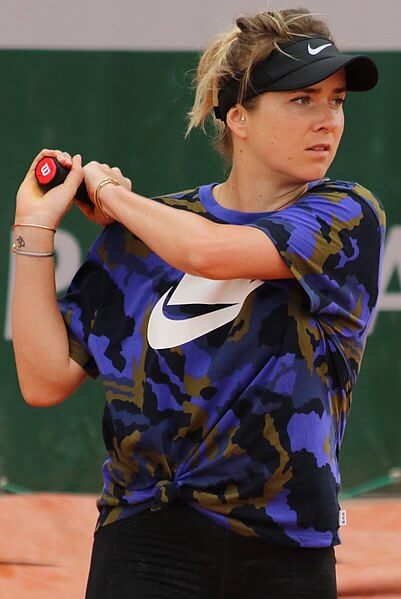
Elina Svitolina, May 9, 2019. Credit: si.robi via Wikimedia Commons.

There were four Jewish women in the main draw: Jamie Loeb (#194), from Ossining, N.Y.; Madison Brengle (#77); Camila Giorgi; and unconfirmed Jewish player Elina Svitolina. Loeb, who won three matches in the qualifying tournament to gain a spot in the main draw, lost her first-round match. Brengle, a 31-year-old from Dover, Del., lost her first-round singles and doubles matches. This was her ninth appearance in the US Open.

Camila Giorgi (#36) of Italy lost her first-round match to #12 seed Simona Halep (# 13) of Romania 6-4, 7-6 (3). Giorgi, who has had seven top 20 wins this season and won the National Bank Open this summer, recently confirmed to a reporter that she is proudly Jewish, that her parents are Argentines who immigrated to Italy, and that Anne Frank is her favorite book. “The book moved me because I am Jewish, but also because she was such a good person who saw the good in people,” she said.

World #5 Elina Svitolina has unconfirmed Jewish family history. She has won her first two matches in straight sets and will face Russian Daria Kasatkina in the third round.

Doubling down on Israeli players

Others Jewish players in the main draw include 44-year-old doubles specialist Jonathan Erlich. He and South African Lloyd Harris faced Austrians Oliver Marach and Philipp Oswald on Friday in their first-round match. They advanced to the second round after winning 62, 67 (73), 62  in an hour and 46 minutes. Israeli Dudi Sela, currently #322, was scheduled to compete in the qualifying tournament but reportedly tested positive for COVID-19 before it began.

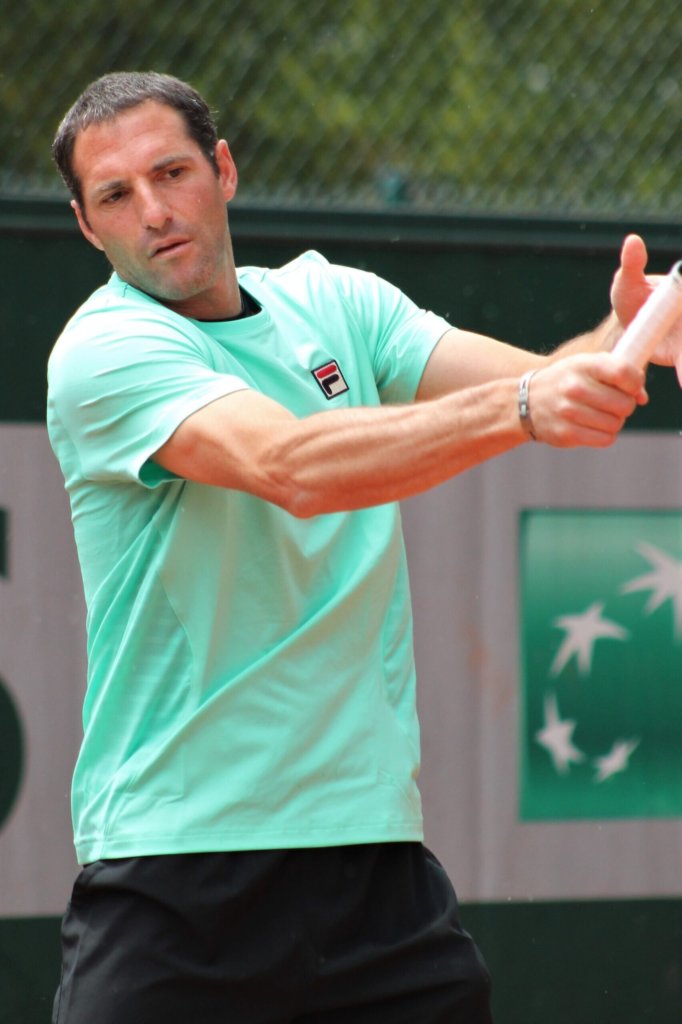
Jonathan Ehrlich, May 28, 2016, Credit: si.robi via Wikimedia Commons.

Fans keeping score of the numbers—or rather, the percent—of Jews in the men’s and women’s singles draws and in the men’s doubles draw may be pleasantly surprised.

According to most estimates, Jews make up .2 percent of the world’s population. To put it more specifically, there are 14.7 Jews in a world populated by 7.89 billion people. The percentage of Jews in men’s and women’s singles draws (if you consider Shapovalov as well as Svitolina) and men’s doubles draw are way ahead of percentages of Jews in the world.

Jewish players make up two of 128 or 1.56 percent of the men’s draw, 3.12 percent of the women’s draw (four of out of 128) and 1.56 percent of the men’s doubles draw (one team member out of 64 teams).

And while Israel’s one representative in the tournament seems low, especially when compared to such countries as Australia (26 players) and Argentina (20), they only lag slightly behind Finland (3) and Ecuador (2). They are right at home with North African and Mideast neighbors Tunisia (1) and Egypt (1).

Fans of Israel tennis remember not so many years ago when they could regularly see Israelis Shahar Peer, Julia Glushko, David (“Dudi”) Sela and Andy Ram in action at the US Open.

While few such pros or juniors remain in action this year, Hans Felius, the director of Tennis and Social Impact Programs at the ITEC (Israel Tennis Educational Centers), and the professional staff of Israel’s David Squad are systematically training Israeli children with great potential to one day play in the US Open and other major junior and adult tournaments around the world. When their efforts come to fruition, it will surely help the Jewish and Israeli tournament numbers and percentages.

Read more