Originally appeared in In Jewish News Syndicate in www.jns.org, January 25, 2026
The new Nelech initiative offers a high school program with Israeli students as an immersive introduction to the realities of life in the Jewish state.
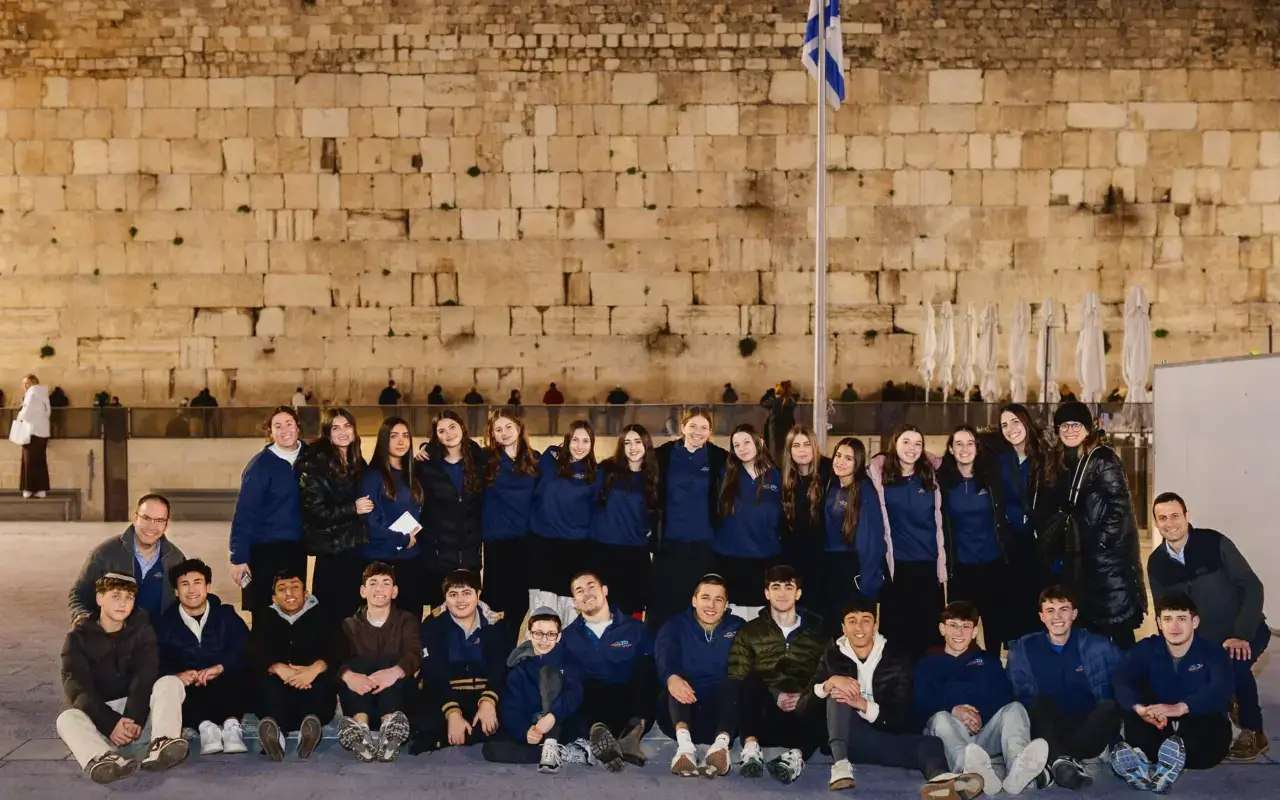
When 25 10th-graders from Orthodox Jewish day schools across the United States and Canada arrived in Israel on Jan. 20 to begin their semester of studies alongside their Israeli peers at two schools in Gush Etzion in Judea, they embarked on an initiative that aims to change how American Jews understand and relate to Israel.
These pioneers, here to participate in the new Nelech program, will spend six months learning, going on trips and eating pizza, playing basketball, and spending Shabbats with Israeli peers and their families.
The 13 girls and 12 boys—from Phoenix, Nashville, Dallas, Philadelphia, Toronto, and various communities in New York and New Jersey—will then return to their schools and communities in North America to complete their high school studies and serve as ambassadors for the Jewish state they experienced up close.
Their Hebrew fluency and nuanced understanding of Israel will serve as a base for their future relationship with Israel, which may or may not include future aliyah.
Tamar Krieger Kalev, executive director of Tzemach David, a foundation supported by funder David Magerman, explained that the idea for the program grew out of discussions by focus groups with heads of religious schools.
“They were looking for out-of-the-box solutions for people who wanted to stay in Israel after their gap year,” she said.
By the time they complete their post-high school year in Israel, they have often committed to universities in the United States, she said. “One crazy idea came up (in our focus groups)—come to Israel earlier and experience it earlier.”
Krieger Kalev observed that “so much of the American high school experience is focused on resume building, taking AP (Advanced Placement) courses and getting into college.”
Participating in the Nelech program, which will run for a semester in its pilot year and ultimately operate as a year-long program, may expand the thinking of students and families about post-high school and ultimately future options. These may include studying in Israeli universities, serving in the army and ultimately making aliyah.
The name for the program, Nelech, which means “Let’s go” in Hebrew, comes from the first chapter of the biblical book of Joshua. The Israelites ask Moses if they could remain on the other side of the Jordan River. He told them they had to first be chalutzim, or pioneers, and only go back after the rest of the nation settled in Israel. They never went back—they kept their promise to Moses and said, “Wherever you send us, nelech; we will go!”
‘Taking the big idea, applying it to the real world’
The program is headed by Rabbi Rick Schindelheim, a recent American immigrant with extensive experience in Jewish education, Jewish camping and school psychology.
Before moving to Israel with his wife and four children in August 2024, Schindelheim said he was considering jobs in education but “was not totally sure what to do.” Many colleagues had cautioned that, as an Orthodox Jewish educator, he would “need to choose between aliyah and staying in Jewish education in America.”
He noted that, unlike his dentist wife, for whom career options in Israel were clear cut, he was committed to Jewish education and said, “Let me see what I can do.”
He began teaching English as a second language in an Israeli school and teaching classes for the Tikvah Fund. While Schindelheim admitted that teaching English “was not my passion,” the experience taught him that he could connect with Israeli students.
Before he knew it, he said, “An opportunity to run a program came my way. David Magerman had a dream of American kids becoming more rooted in Israel.”
Schindelheim said he was excited about the job, which involves “taking the big idea and applying it to the real world.”
In addition to arranging top-notch speakers, planning trips and creating opportunities to interact with Israeli peers, he will be responsible for such day-to-day tasks as making sure the dorms and meals run smoothly and that there is a plan in place when school is cancelled on short notice.
He added: “My job is to take 25 mid-year students and figure out how to get credit for school and continue without missing a beat.”
Schindelheim and Tzemach David are partnering with Ohr Torah Stone, a network of 32 educational institutions headed by Rabbi Kenneth Brander, who serves as its president and rosh yeshiva. The formal learning for the Nelech students takes place at two schools that are part of the Ohr Torah Stone network.
The girls are studying at Ulpanat Neve Channah in Givah Tzehuba, near Alon Shvut, while the boys are learning at Yeshivat Neve Shmuel in Efrat. Both schools are ranked as top 10 high schools in the country.
Brander said he was pleased that more than 100 youngsters applied for the inaugural year of the Nelech program. He foresees an impact of the North Americans on their Israeli peers as well as on their schools.
“Our young people in the two schools and the faculty will be influenced by seeing a larger swath of the Jewish people,” he told JNS. “In a world in which there are so many challenges, to have young people go back with firsthand experience and serve as ambassadors will help us in Israel. I hope they will look at Israel to continue their post-high school experience!”
Choosing Nelech
The students and parents who accompanied them were visibly excited and a bit nervous about starting their pioneering experience.
Amalia Strosberg, 15, from Nashville and a student at the Ida Crown Jewish Academy in Chicago, shared, “I chose Nelech because it will allow me to be part of the Israeli high school experience and challenge me academically. I’m really excited to meet the other girls and to build meaningful friendships. Most of all, I hope this year helps me grow in my learning and strengthen my connection to Hashem and the land of Israel.”
Saul Strosberg was pleased that his daughter “gets to join this cohort of Jewishly motivated high schoolers for what promises to be a once-in-a-lifetime opportunity to immerse in an Israeli-Zionist school in the Gush.”
Laeya Zaila, 15, of Phoenix and a student at Shearim Torah Academy, said she chose Nelech “because there aren’t many programs that integrate you into Israeli society as this one does.”
She said she was looking forward to forming relationships with Israeli peers, growing Jewishly and becoming more independent, though she acknowledged that she was “slightly nervous about living away from my family and friends.”
But, she added, “I know that as much as I will miss them. I’m going to be having an incredible six-month experience in the Land of Israel, and I’ll see them when it’s over.”
Her mother, Randi Zaila, shared Laeya’s enthusiasm, saying that the “perspective is exactly who our family is, which in our educational community of Phoenix has been difficult to find a perfect match for in high schools. We are so excited for this experience for her and how it will direct her future.”
Her father, Sam Zaila, added, “We are genuinely looking forward to the next six months as she grows in her connection to Israel, deepens her spirituality and matures through this incredible experience.”
‘I am hopeful they will be like rock stars’
For Magerman, the funder of the initiative, the key to the program is to expose participants to Israel in a meaningful way before they have committed to universities, when it can be difficult to change course.
In an interview with JNS, Magerman said, “People are getting turned on to Israel as a destination late in their thought process—when they are already accepted and ethically bound to attend college.”
He cautioned that those who stay in Israel after already accepting college offers for American universities would hurt the day schools.
“Universities will be less likely to accept future students if current students don’t honor their commitments. I want to get parents and day schools on board at the middle school level,” he said.
Magerman suggested that the students who return to North America afterwards, deeply committed to Israel, would have a positive impact both on their peers and their schools.
“If the social leaders in day schools are the basketball players or love Gemara, their peers notice,” he said. “I want to create a set of advocates for Israel. I am hopeful they will be like rock stars. They will go into their junior years and talk about it and influence this generation of high school graduates, and it will trickle down.”
Meanwhile, the pioneering cohort of Nelech students is off and running. The group went straight from Ben-Gurion International Airport to the Western Wall in Jerusalem’s Old City, and is already immersed in their semester of learning and experiencing Israel.