US Open

Despite a tough quarterfinal exit, Kaylan Bigun’s tennis journey is marked by family support, connections to Israel, and excitement for his upcoming college career at UCLA.

View the original article on The Jerusalem Post
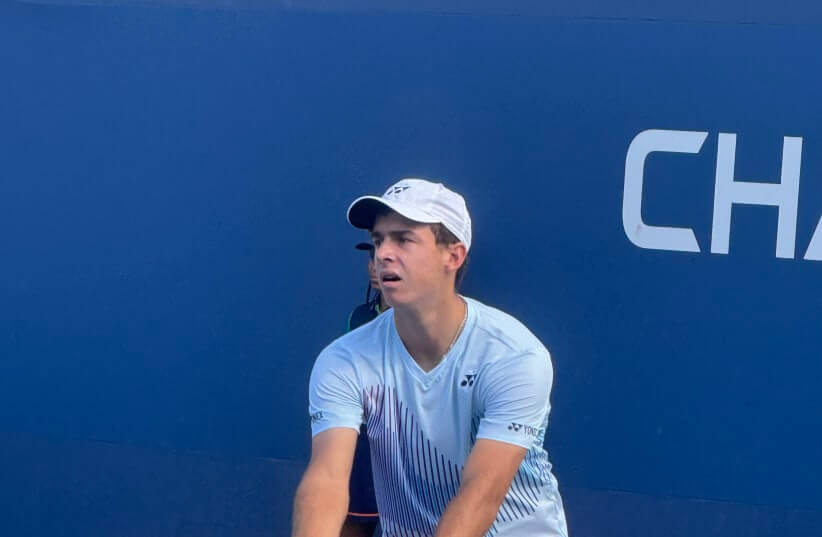
CALIFORNIA NATIVE Kaylan Bigun was a strong contender to win the US Open Junior Tournament, coming in as the second seed, but he fell in the quarterfinals.(photo credit: HOWARD BLAS)

For 18-year-old tennis player Kaylan Bigun, the US Open was one to remember. Even before the French Open juniors champion and former world No. 1 junior kicked off a quarterfinal run in the US Open junior boys’ tournament – where he was the second seed – he had already spent nearly three weeks on the grounds of the USTA Billie Jean King National Tennis Center.

Bigun had seen action in both the US Open men’s qualifying tournament and the mixed doubles tournament. The Los Angeles native was one of nine men to receive a wild card in the men’s qualifying tournament, where he lost in the first round to Valentin Vacherot of Monaco 7-6, 6-4. He also received a wild card into the mixed doubles main draw with fellow teen standout, 16-year-old Iva Jovic. They won their first-round match against Dayana Yastremska and Max Purcell, 6-4, 6-4, but lost in the second round 6-2, 6-3 to fourth seeds Barbora Krejcikova and Matthew Ebden.

Bigun began his bid to win the boys’ juniors championship with a 6-4, 6-2 win in just over an hour against Andreas Timini of Cyprus. He advanced with a similarly straightforward second-round hour-and-seven-minute straight-sets win against Karim Bennani of Morocco, 6-2, 6-2. In the round of 16, Kaylan beat fellow American Matthew Forbes 6-2, 6-4. However, the quarterfinals presented a super-tough opponent in Spain’s Rafael Jodar – a far cry from another Spanish Rafael, but still a stiff challenge.

Jodar took the first set 6-4, but Bigun rallied for a 7-6 second-set win to equalize. However, the Spaniard prevailed 7-5 in the decider to spell the end for Bigun’s title hopes after a valiant effort.

In the days between the men’s qualifiers and the start of the juniors’ tournament, Bigun practiced with his Princeton-bound tennis-playing twin brother, Meecah, and his father, Dmitry. Bigun would undoubtedly have some great stories to share with his college classmates when he began his studies and college tennis career at UCLA in January. Kaylan and Meecah spoke with The Jerusalem Post in the junior player’s dining room after a practice session; their father spoke with the Post separately outside of Stadium Court 17 at the US Open. The brothers spoke openly about their incredible tennis journeys, which included a healthy dose of Jewish and Israeli experiences.

 Daniil Medvedev of Russia celebrates after his match against Novak Djokovic of Serbia (not pictured) in the men's singles final on day fourteen of the 2021 US Open tennis tournament at USTA Billie Jean King National Tennis Center, in Flushing, New York, on September 12, 2021. (credit: DANIELLE PARHIZKARAN-USA TODAY SPORTS)
Daniil Medvedev of Russia celebrates after his match against Novak Djokovic of Serbia (not pictured) in the men’s singles final on day fourteen of the 2021 US Open tennis tournament at USTA Billie Jean King National Tennis Center, in Flushing, New York, on September 12, 2021. (credit: DANIELLE PARHIZKARAN-USA TODAY SPORTS)

Bigun enjoyed his first experience playing at the US Open in the men’s qualifying tournament.

“Playing your first pro US Open, I guess I was a little nervous, and those emotions can be stressful before matches, but I tried to stay focused on what I could control and how I wanted to play.”

Waiting for many hours for his match to start was also a challenge; it was the fifth match of five.

“Obviously it wasn’t easy waiting all day for the match, but when I came out there it was cool. Some of my cousins and other family members came, so it was really nice to play in front of them and see how proud they were. Also, the crowd was pretty good, so that was fun.”

Given Bigun’s success in the juniors over the past year, where he rose to the No. 1 ranking after winning at Roland Garros – in addition to appearing at each of the junior Grand Slam events and making it to the semifinals of the prestigious Orange Bowl International Championship – he had grown accustomed to winning. However, playing against professional players was a new and different experience.

“Obviously, losing was not the fun part. I felt I could have played better in some parts, but overall it definitely was a good experience. I was where I wanted to be and was kind of taking every point and trying to keep going forward and really just enjoying the moment, smiling out there.”

After exiting the qualifying tournament, Kaylan and Meecah spent a lot of time practicing on court together. Both brothers have aspirations of becoming professional tennis players. Meecah felt it may take him a bit longer, given the academic rigor he anticipated at Princeton. Meecah didn’t participate in the US Open tournament, though he stayed with his brother “trying to help out in any way possible” until he left for college orientation the day after the interview.

The brothers, who bantered and finished each other’s sentences during the interview, appeared to enjoy each other’s company a great deal. The twins grew up together, both at home and on the road, at tournaments and tennis academies, while fishing together, homeschooling with their teacher mother, and with the Seton Home Study School.

While their university classes would essentially be their first formal group-learning experience since third grade, they were quick to point out that their social skills did not suffer as a result of homeschooling and online learning, noting that playing tennis in an academy and competing in tournaments meant constantly being around other children.

Kaylan felt their years on the road balancing sports and academics would serve them well in college and in life.

“Players are used to the hustle and bustle of traveling.”

On court, the brothers helped each other improve.

“We compete against each other, but we also help each other out on the court,” noted Meecah.

Kaylan appreciated Meecah’s contributions.

“He is obviously a very vital part of my tennis… mentally and just in general. I love having him around. It’s like your best friend with you wherever you are.”

Their father, Dmitry, a pharmacist by training who immigrated to Los Angeles from Ukraine 35 years ago, brought them to the courts—in a stroller—from the age of one. He also introduced them to a range of sports, including swimming, basketball, and soccer. They also spent a lot of time on the playground.

A tennis player himself, Dmitry enlisted friends to hit balls with his boys, and Dmitry hit balls with their children in return.

“Our dad played tennis, and he introduced us at a really young age,” Kaylan recounted. “I have been playing and holding a racket for as long as I can remember; it has been a part of my life for as long as I have lived.

“At first, it started off with just the three of us having fun on the court, then we played a few tournaments. Next thing you know, we got a little more serious. And a little more serious. I think what’s important is that when the three of us are on the court, we still have the same fun that started it all.”

Dmitry recalled the boys starting to get serious about tennis at age 10. “We met a coach from JTCC (Junior Tennis Champions Center in College Park, Maryland). The coach said, ‘I like your kids’ and invited them to train there.” Dmitry reported that he became a “full-time tennis parent,” and the family relocated to College Park, Maryland, from Los Angeles, California, where the boys trained for four years until the COVID-19 pandemic.

“We really hit it off with Asaf Yamin [the Israeli former director of high performance and current director of international operations at JTCC]. He has a good knowledge of tennis, he is a good person to go to with questions, the guys loved him, and he is a good family guy.”

Kaylan added: “My brother, my parents, and I would go to Asaf’s house for some Jewish holidays and Shabbat. It would always be fun. And we would stay at his house when he ran the tournament at College Park – so it was always a lot of fun. It felt nice that we were connected to the Jewish and Israeli community outside of LA in DC, so that was a good feeling. It was awesome.”

Yamin was pleased with the growth and progress he had seen with the Bigun boys and knew how excited they both were about the possibility of eventually playing on the pro tour.

Yamin described Kaylan as “very aggressive but also creative” and as someone who liked to be “a big stage player” who “shined at big events. He is very easy, fun, curious, serious, and a really good boy with a good heart.”

While the boys had played doubles together before, they both aspired to “make it” as professional singles players. They playfully dismissed the suggestion that they might one day follow in the footsteps of the very accomplished tennis-playing Bryan Brothers twins.

“We like playing doubles. I feel like both of us are pretty good, but we haven’t really gotten into playing doubles with each other too much yet, but maybe that’s something in the future we will do.”

The twins had several opportunities to travel to Israel in the past and proudly recounted what they described as a “full-circle moment” on one of their family trips to Israel.

At the Israel Tennis Education Centers in Ramat Hasharon, they had the chance to meet and train with Dmitri Romanovitch, the coach who taught their dad the game decades earlier in Kiev.

“It was fun,” exclaimed Kaylan. “We got to play with some of the kids our age and some of the older guys. The guy who coached my dad would run these fun sessions. He was so energetic. We would have a bunch of games and drills back to back. It was intense, but we had a lot of fun at the same time.”

They also traveled throughout the country.

“We really got to see a good amount of the country, which was awesome,” said Meecah. “We went to the Dead Sea and Jerusalem, and we have family in Haifa and in Tel Aviv as well.”

“The food is obviously unbelievable,” added Kaylan. “The people are hospitable. Honestly, it is like one big family over there. Everywhere we went, we felt welcomed. It was definitely a good family feeling. My favorite was pomegranate juice you get on the street. Obviously, the hummus there is next level. The beaches are nice. There is so much to do there. I loved every part of it.”

While the boys hoped to get back to Israel, they had to turn their full attention to their tennis and university studies.

“I am super stoked about heading to UCLA,” said Kaylan. “It is pretty close to where we live. And I have a lot of friends who go there. I am really excited. The coaches are great and the people, so I can’t wait.”
Read more

Original article was published on The Jerusalem Post

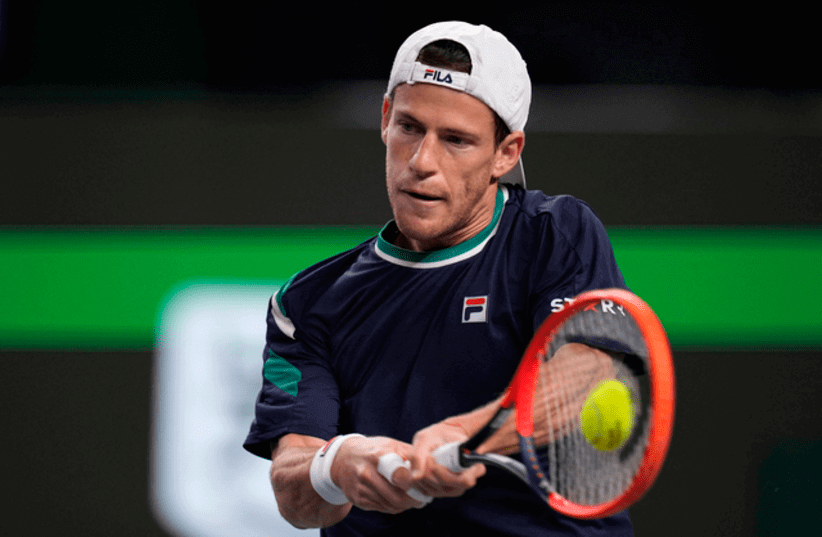
Diego Schwartzman played his last Grand Slam match at the 2024 US Open, receiving a heartfelt send-off from fans as he prepares to retire in 2025.

It was a long and emotional Monday on and off the court for beloved Argentinian Jewish tennis player Diego Schwartzman at the US Open.

First, Schwartzman battled Gael Monfils of France for 2 hours and 42 minutes in a late afternoon opening-round match on the packed Grandstand court. Schwartzman took the 62-minute first set 7-6(2) in a tiebreaker, before losing the next three sets by large margins – 6-2, 6-2, 6-1.

With his loss to Monfils, it was game, set, and match for Schwartzman’s career playing in prestigious Grand Slam tournaments.

In May 2024, Schwartzman, 32, announced that he will retire from professional tennis after the February 2025 Argentina Open – and that the 2024 US Open, taking place in New York from August 26 to September 8, will be his final Grand Slam event.

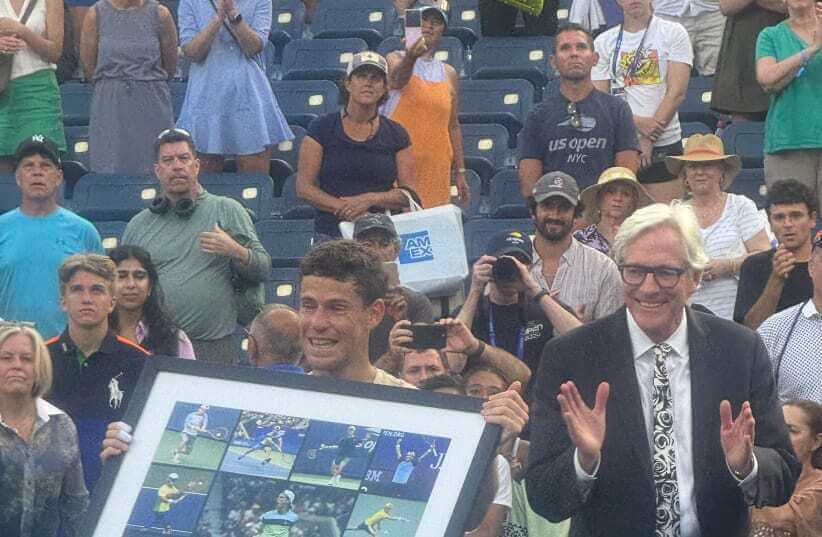
As Schwartzman hugged Monfils, 38, he put his rackets down before being invited back to the court. The crowd cheered and shouted, “We love you, Diego” as they watched a video highlighting Schwartzman’s US Open career, followed by an on-court interview and the presentation of a collage featuring his US Open appearances.

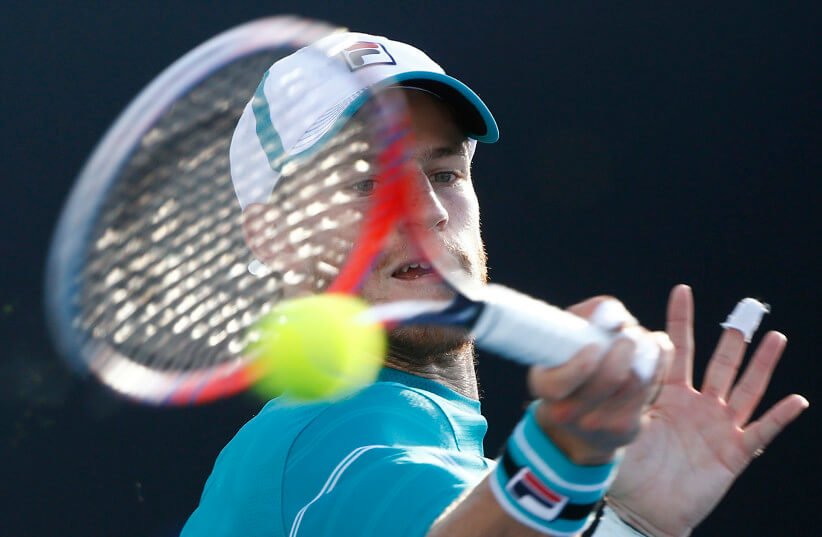
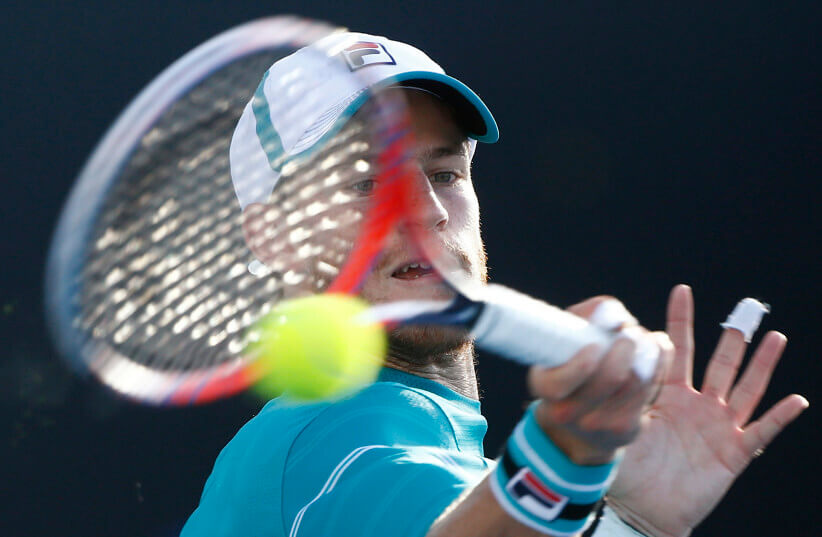
Tennis – Australian Open – Diego Schwartzman of Argentina v Dusan Lajovic of Serbia – Melbourne, Australia, January 15, 2018. Schwartzman hits a shot. (credit: REUTERS/THOMAS PETER)

Schwartzman fought back tears as he addressed the crowd.

Emotional farewell speech
“I’m sorry,” he said, crying as the crowd cheered. “Special moments like you see before on the screens at the US Opens where I played here 11 times – I did great, the crowds today and the years before, they took care of me. I am really grateful for all of these years, to all the people here and watching on TV, and to [USTA Chief Executive, Professional Tennis & US Open Tournament Director] Stacey [Allaster] – you are great. Thank you very much. I never dreamed of these kinds of moments, but I am happy to have them. I will enjoy every single moment from now on.”

In Monfils’s post-match on-court interview, he reflected on Schwartzman and his career.

“He is an amazing player. He played unbelievably; he is a good friend and a nice guy. He represents the spirit of the ATP and we are going to miss him a lot.”

Monfils also liked the match.

“I knew he would play hard, and he was very solid.”

The players held serve throughout the first set, with each player having one service break. The ninth game of the set featured a 21-shot rally.

In the second set, Monfils began changing pace and Schwartzman started committing errors, with some shots barely missing the lines. Schwartzman appeared tired and was unable to mount a comeback.

“I played well,” reports Monfils. “I felt good, I knew it would be a long match. Eventually, I won.”

“In the end, I was struggling,” Schwartzman acknowledged.

Schwartzman offered his final post-match media conference – first in English, then in Spanish. Reflecting on his career and his time at the US Open, Schwartzman said, “Yeah, it was great. Many years – time passed very, very quickly. I’m very happy with how I did here and also how the crowd treated me all these years. I think this journey here at the US Open was great – every single moment was great, and I really enjoyed it.”

Schwartzman reflected on some of his fondest US Open memories, where he twice made it to the quarterfinals.

“I think the US Open 2017 was the first time that I felt like I was a great player, and I became top 30, I think in 2017 for the very first time after beating Cilic and Pouille, losing in the quarterfinals against Carreno Busta. I think the US Open gave me a lot of victories, good ones, and a lot of confidence in my career.”

While disappointed by the result of the match, Schwartzman could not have asked for a better way to end his US Open and Grand Slam career.

“It was an end that I always dreamed of, you know, on a big court against a big opponent like Gael – enjoying a few moments in the match.”

How is Schwartzman feeling at this moment, as he exits his final Grand Slam event and as his career winds down?

“Yeah, I think it’s crazy how the people treat me. I never dreamed of this kind of thing – playing in the US Open on a big court, first round for the very last time. You know, having all the crowd there, the tournament director, everyone there just giving me thank-yous for coming. I don’t know. It’s crazy for me. Since I was young, I never dreamed of this. I finished my career this way; it’s very special and very emotional.”

Read more

Original article was published on The Jerusalem Post

Schwartzman saved enough energy in the hour and 39-minute match for an on-court interview with ESPN.

It is not every day that tennis fans can see a former top-ten player in action – for free. Jewish Argentinian and longtime fan-favorite Diego Schwartzman, formerly No. 8 in the world, faced off against Italian Andrea Pellegrino on the first day of this week’s 2024 US Open Tournament.

Schwartzman, 32, affectionately known as “El Peque” (the short one) due to his 5-foot-7 size, trailed Pellegrino 3-1 in the first set and came back to win the set 7-5. 

Schwartzman, now ranked No. 230, got off to a 3-0 lead in the second set, dropped the next three, then closed out the second set 6-3.

Schwartzman saved enough energy in the hour and 39-minute match for an on-court interview with ESPN, signing large green tennis balls, and taking selfies with cheering fans who hope he will land a spot in next week’s main draw.

The qualifying tournament is scheduled from Monday through Thursday at the USTA Billie Jean King Tennis Center in Queens, New York.

Tennis – Australian Open – Diego Schwartzman of Argentina v Dusan Lajovic of Serbia – Melbourne, Australia, January 15, 2018. Schwartzman hits a shot. (credit: REUTERS/THOMAS PETER)

All matches during the week, also known as Fan Week, are free. If Schwartzman can win three matches this week, he will secure one of the 16 coveted main-draw places. 

The US Open runs from August 26 to September 9.

This year’s US Open is particularly significant for Schwartzman, who announced in May 2024 that he plans to retire from tennis after the Argentina Open in February 2025.

“It is my last Grand Slam,” Schwartzman told The Jerusalem Post in the Media Center of the US Open following his match. “One more time trying to enjoy – but this time, it is different. Every time I miss, I want to do better.”

A performance to be proud of 

Schwartzman is proud of his performance in his first match.

“I think I did very well today. It was a good match.”

Schwartzman has experienced a great deal of success at the US Open over the years.

“My first time here was in 2013,” noted Schwartzman, who advanced to the third round of the qualifying tournament that year. “This is my second time playing qualies.”

Schwartzman has not missed a US Open since he made his main-draw debut in 2014. In both 2017 and 2019, Schwartzman reached the US Open quarterfinals. Last year, he lost to Arthur Rinderknech in the first round.

Schwartzman’s streak of 36 consecutive main-draw appearances came to an end last year when he did not play in the 2024 Australian Open. 

In addition, he has lost in the qualifiers at the previous three Grand Slam tournaments this season.

Schwartzman attributes much of his upcoming retirement to the toll tennis takes on a player physically and mentally.

“The routine, how much time per day, how much time I gave to tennis – I gave everything. There is no more inside. No more energy. The tank is empty. The last few years, I was trying hard – changing teams, coaches, trainers, you know, everything, trying to find a way to improve my tennis. But in the end, it was inside me. So far, I am pretty happy with the decision. Let’s see after a few months without the racket.”

While Schwartzman says he will “go slow” in making decisions about what comes next, one certainty is that he will get married. In June, he announced his engagement to longtime partner Eugenia De Martino. 

Schwartzman posted a picture of the two of them in front of the Eiffel Tower in Paris. She was wearing an engagement ring.

A satisfying career

Looking back on his career, Schwartzman is satisfied. “The career was great. I am very happy with how I did.”

He has won four ATP (Association of Tennis Professionals) titles to date, including the 2016 Istanbul Open, the 2018 Rio Open, the 2019 Los Cabos Open, and the 2021 Argentina Open. He also reached the 2020 French Open semifinals. Schwartzman has earned $14 million (USD).

Other memorable tennis-related accomplishments include the dedication of a tennis court at the HaCoaj club in Buenos Aires where he got his start in tennis. Center court at the club’s new tennis complex is named after Schwartzman.

“It is emotional. It is where I grew up. And they already made a lot of Challenger tournaments there. It is great to have my name when they are giving the trophy to the champion. You can go to the ATP App to see the scores and there is a Diego Schwartzman court! It is at the same time funny and it is a great honor.”

Another tennis-related milestone was visiting Israel for the first time to compete in the 2022 Tel Aviv Watergen Open. While tournament demands left little time for travel in Israel, Schwartzman shared in an earlier interview with the Post.

“I was surprised by Tel Aviv in a good way. I didn’t expect it to be so amazing. It is for sure one of my top-three best cities in the world.”

Schwartzman hopes to one day return to Israel. For now, he was turning his attention to his second-round match on Wednesday versus fellow Argentine, the qualifying tournament’s No. 1 seed, Thiago Agustin Tirante. 

The winner will be on course to potentially face fellow former top-10 player Richard Gasquet.

Read more

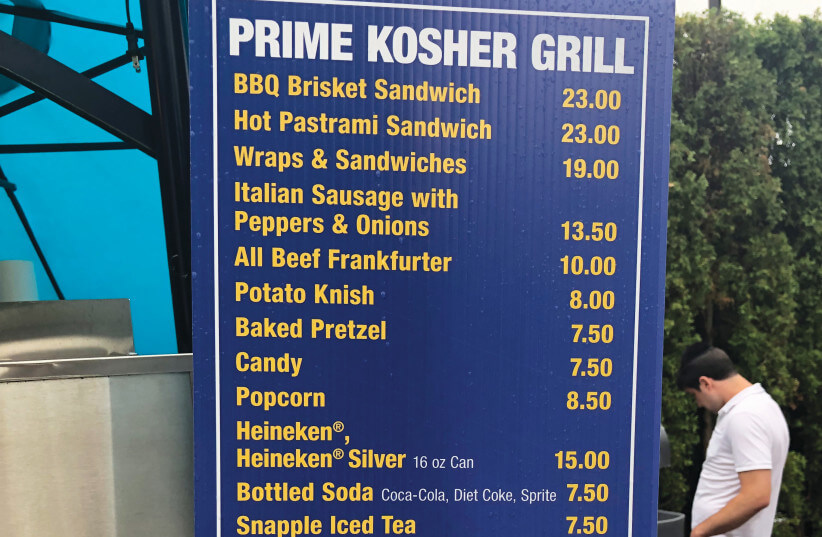
‘KNISHES FOR sale!’ Prime Kosher Sports offerings. (photo credit: HOWARD BLAS)

Original Article On The Jerusalem Post

The US Open Tennis Championships in Queens, New York, is as well known for its dining options as for its world-class tennis.

With names like Eataly; Fare by Chef Alex Guarnaschelli; Franks and Fries; King Souvlaki; Crabby Shack; and Korilla BBQ, tennis fans enjoyed a variety of foods at the recently concluded (August 22-September 10) Grand Slam event, while sipping drinks from Baseline Cocktails; Aperol Spritz Bar; and Heinekin Bar. The US Open even had an official drink, the Honey Deuce (Grey Goose vodka, lemonade, and raspberry liqueur).

Thanks to PKS’s (Prime Kosher Sports) Kosher Grill, kosher-food-loving tennis fans enjoyed an assortment of hot and cold kosher foods, located in close proximity to non-kosher food, as well as great tennis. If their timing was right, observant fans were also able to participate in a Mincha and Maariv minyan.

“Having kosher food at the US Open means you don’t feel excluded. You are part of the crowd,” reported Eli Feit of Brooklyn, who was attending with two grandsons and their friend Chaim Fruchter of Passaic, New Jersey.

Feit, who enjoyed the brisket sandwich, was helping count to make sure there were enough men for Mincha, which was to take place at the exit to Court 12 as a four-hour, seven-minute five-set men’s singles match was letting out. Fruchter raved about his hot dog.

AT THE US Open: Tommy Paul (US) returns a shot against Roman Safiullin (Russia) during their Men’s Singles Second Round match, in Queens, New York, Aug. 30. (credit: Matthew Stockman/Getty Images)

Steven Davidson of Stamford, Connecticut, carefully held two hot dogs (one dressed in sauerkraut), wrapped in US Open monogrammed paper, as he participated in the minyan.

“Having kosher food at sporting events is pretty standard. It is nice to have a minyan when you have to say Kaddish,” he added.

Israeli David Danino, who lives in Karnei Shomron and is in the US through Sukkot as part of his job with Sukkot Depot, approached when he saw the crowd gathering for Mincha. He was racing to Court 17 to see No. 14 Tommy Paul in action versus Roman Saflullin. He planned to return to the kosher stand later in the evening for dinner. While excited about having kosher food at his first US Open, he enjoyed a kosher hot dog a few years back at a New York Knicks pre-season basketball game.

Julie Feinberg of Woodmere, New York, spoke with The Jerusalem Post as she balanced two cardboard containers of kosher sausage with peppers and onions, as well as a brisket sandwich, which she noted was “new this year.”

“I know we are spoiled New Yorkers [since kosher food is so plentiful], but having kosher food here makes the whole day easier and more enjoyable, – and you don’t get jealous of others [who don’t keep kosher] who have hundreds of choices.”

She was excited to sit and enjoy dinner before watching more tennis. “My daughter and I are starving!”

While the kosher items were tasty, they came at a price. A BBQ brisket sandwich or a hot pastrami sandwich set fans back $23, while wraps and sandwiches cost $19; Italian sausage with peppers and onions were $13.50; and a potato knish – $8.

Kosher food, and affordable too!

But for the first time in most kosher consumers’ lives, the kosher food prices were actually comparable to the prices of non-kosher food at the Open: Crispy chicken sandwich at Crown Say was $19.50; a gyro sandwich at King Soulvaki was $20, and spanakopita cost $18. The signature chicken and eggnog waffle cone at Melba’s American Comfort was a whopping $26; a single scoop of ice cream at Van Leeuwen was $9.50; and a Heineken or Amstel Light draught beer was $15. The US Open’s signature Honey Deuce was $22 – keep the glass!

ELI ARJE, in his second year operating Kosher Grill at the US Open (though there was a kosher vendor for several years before he took over), loves the opportunity to provide kosher food at this and other sports venues. “The experience is amazing. To see how many people are in and out of the venue all day is remarkable. Our line is always consistent. We serve over 2,500 products per day.”

Arje believes that all stadiums should offer kosher options, and noted that he is currently located in Maimonides Park (Brooklyn Cyclones), Citi Field (New York Mets), Yankee Stadium (New York Yankees), and Prudential Center (New Jersey Devils). “Baruch Hashem, we have [Jewsih] communities everywhere, and I think it’s so important to follow the laws of kashrut and give the Jewish fan an outlet to enjoy the full ballpark experience. We have a passion for sports, food, and seeing smiles on faces enjoying. I feel blessed that I am able to make a dream into reality. Every time I walk into a stadium, I feel like I’m a kid again, and I’m in awe of everything around me.”

Kosher consumers not willing to pay the steep prices for prepared food were able bring in sandwiches and other food items in a single-compartment drawstring knapsack or bag or they were able to enjoy small containers of kosher-certified yogurt, given out as free samples by Fage, a US Open sponsor.

Other kosher-certified, though pricey, items available throughout the grounds included bags of potato chips, popcorn, and bars of Van Leeuwen ice cream. Lavazza coffee was also on hand, along with soda and water.  

Read more