US Open

Original Article Published On The JP

The US Open Junior competition draws less attention than the seniors but provides a look into the future of tennis.

Tennis fans and those who just love a good sports story have been focused on the US Open.

Amid all of the deserved excitement for the pro players, juniors are often overlooked. At the US Open, crowds are always small for junior matches – sometimes attracting only 25-50 fans.

At Sunday’s first-round match, for example, 15-year-old Valerie Glozman from Bellevue, Washington, beat Yaroslava Bartashevic of France 7-5, 6-3. The American teenager has been in New York – without her parents – for two weeks as she received a wildcard in the women’s qualifying draw as a result of her good showing as runner-up at the national juniors tournament. In the ensuing round, Glozman got off to a promising start against the No. 1 seed, Sofia Costlulas of Belgium, before losing 3-6, 6-2, 6-2.

“I never expected to be here, Being here was the biggest thing. I am excited to play. My strategy was to mix it up and break her rhythm.”

Valerie Glozman

“I never expected to be here,” said Glozman. “Being here was the biggest thing. I am excited to play. My strategy was to mix it up and break her rhythm.”

Glozman, the daughter of a Ukrainian Jewish father and a Taiwanese mother, regularly trains with hard-hitting male players in Washington due to the lack of available female partners.

Tennis (credit: Wikimedia Commons)

Starting at an early age

Some fans (and writers) even find advantages to start following players when they are juniors.

“For me, the big advantage is that very few people pay any attention to juniors, so they are so happy when you cover them and you get to know them,” noted Sandra Harwitt, an experienced tennis writer covering the US Open this year for the Miami Herald.

“They always remember you,” added Harwitt, who has been in touch with Andy Roddick, Stefanos Tsitsipas and Sasha Zverev since they were juniors. The author of The Greatest Jewish Tennis Players of All, Harwitt is keenly aware of the fact that few successful juniors will rise to the ranks of the professional world. She notes, however, that some will “play their entire career in the Futures and Challengers [second and third tier] league.”

Matt Durno of Sharon, MA, was part of the small group watching the Glozman match.

“I am a player and new at it – it is fun to see the level you can achieve in a short time.”

Durno enjoyed watching Glozman and looked forward to sharing his observations with his tennis-playing children.

Other juniors to watch in this year’s tournament include boys No. 1 seed Daniel Vallejo of Paraguay, and Sofia Costoulas of Belgium, the girls’ top seed. Vallejo reached the boys’ doubles final at the 2022 Australian Open alongside partner Alex Michelsen of the United States, while Costoulas reached the girls’ singles final at the same Grand Slam. Both have reached career-highs of world No. 2 in their respective junior rankings.

Where are the Israelis?

There are junior boys and girls to watch from dozens of countries in the world – however, notably not from Israel. But, according to Eyal Taoz, director of Strategy and Projects at Israel Tennis and Education Centers, the wait may soon be over.

In past years, Israeli boys and girls have qualified to play at the US Open. Fans may recall such names as Leria Patiuk, Or Ram Harel, Bar Botzer and Yshai Oliel. But it has been quite a few years since they have been here.

“No one made it this year, but we have juniors ranked around 200 in the world or so, They are making nice progress and getting results.”

Eyal Taoz, director of Strategy and Projects at Israel Tennis and Education Centers

“No one made it this year, but we have juniors ranked around 200 in the world or so,” reported Taoz. “They are making nice progress and getting results.”

Taoz has eyes on such up-and-coming players including Ron Ellouck, Ofek Simanov, Volvo Basilevsky, Mika Buchnik and Karin Altori.

“Hopefully in the next three or four months, some will play in the Grand Slams.”

Some of these players will automatically move up 40 or 50 ranking points when the current 18-year-olds “age out” and are no longer able to play as juniors.

Ellouck, currently No. 1,239 in the world, played in the Wimbledon qualifiers but lost in the first round. He will turn 18 in November and no longer be eligible to play in the juniors.

Simanov, 17, is currently ranked 356 after reaching a career high of No. 272.

Buchnik may be the Israeli with the best shot at qualifying for a major tournament. The 15-year-old female phenom is ranked No. 143. She has been playing tennis since age four and the Tel Aviv native’s impressive accomplishments include a second-place finish in the 2021 U14 World Championship in France and the 2021 U14 Israeli Champion

Altori is a 16-year-old girl with unique family background and great potential. She is currently ranked No. 225 after reaching a high of No. 187. The Bedouin Israeli grew up in Rahat in the south and was inspired by her older brothers, Shadi and Samer, to pick up a racket, which she did at age five. Her family recently moved to Ramat Hasharon so they could train at the Israel Tennis Center there.

With or without Israelis in the US Open this year, the final week promises to be exciting.

And Israeli fans who still want to see more can attend or follow the Israel vs Czech Republic Davis Cup World Group I first-round matches in Tel Aviv on September 16-17, as well as the ATP 250 series Watergen Tel Aviv Open between September 25 and October 2.

Read more

The Original Article Published In The Jerusalem Post

Sela entered the qualifiers at the US Open thanks to his protective ranking. He came to New York hoping to advance past the first round of the qualifiers

When Israeli tennis icon Dudi Sela walked onto Court 4 for his first-round qualifying match at the US Open, he had the cool demeanor of someone meeting friends for dinner on Tel Aviv’s Dizengoff Street.

Sela, 37, arrived five minutes before his opponent, 28-year-old Kaicha Uchida (ranked No. 169) of Japan. Jewish and Israeli fans sent regards from various common friends and wished him luck. Sela sat with a white towel over his head to block the sun on this bright New York day.

It was likely his last day ever playing on these hallowed courts.

Who is Dudi Sela?

Sela entered the qualifiers at the US Open thanks to his protective ranking. He came to New York hoping to advance past the first round of the qualifiers, a feat he failed to accomplish at this year’s other three Grand Slam events – the Australian Open, the French Open and Wimbledon.

Sela suggested that retirement from playing was imminent when he announced to a group of Australian Jewish tennis fans: “I think it is going to be my last year. But for sure, I’m going to come back – as a coach or something else. And I just want to say a big thank you.”

Here’s what happened at the match:

Sela’s match opened with chants of “Dudi, Dudi” and “Yallah” (onwards). Uchida broke Sela in the first game. Still, 20 years of experience on the tour helped the Sela keep his younger opponent guessing and the Israeli went up 3-2.

Then, Uchida caught on. He began hitting Sela’s short balls down the line or cross court, often out of reach. Uchida closed out the first set 6-3 in 37 minutes.

Uchida continued to dominate the second set. He served to go up 3-0. At 5-2, when Uchida appeared ready to close out the match Sela broke Uchida without a point. Uchida easily closed out the second set 6-3 in 32 minutes.

The hour-and-nine-minute match may have taken less time than a Tel Aviv dinner with friends. But those in attendance stayed for some additional time with their beloved Sela. Many knew this was likely his last time playing at the US Open. Sela patiently signed autographs and took selfie photos with each fan who asked.

On the way to the locker room, he stopped for additional autographs, photos and conversation.

“Thank you for cheering for me” Sela told two girls posing for a photo.

Sela acknowledged, “It is my last time playing here.”

Brother Nir Sela added: “It is sad for me. I want him to keep playing!”

Sela conceded that physically it is difficult for him to compete at this stage and at this level.

 “After a few games I got very tired and had some problems with my hip. I enjoyed it.”

 Then, Sela shockingly offered, “But in Australia I can win the last one!”

Sela’s many fans around the world may just get that one last chance to see their hero play in a Grand Slam match after all.

Read more

Original Article Published On The Jerusalem Post

Jonathan Erlich, Israel’s 44-years-old Davis Cup captain, is the oldest player in the US open that is full of up-and-coming youngsters.

In a US Open filled with young, up-and-coming surprise superstars, let’s not forget about the older men and women in the tournament – including Israel’s Jonathan Erlich.

Several stars of this year’s US Open were not even born 20 years ago when the Twin Towers were attacked on September 11, 2001.

The two women’s finalists – Canada’s Leylah Fernandez, 19, and Britain’s Emma Raducanu, 18 – were both teenagers. Carlos Alcaraz of Spain, who retired in the men’s quarterfinals with a leg injury, is 18.

The media couldn’t stop asking these young players about being so young.  When asked if they had less pressure because they were up-and-comers, Radacanu replied: “I think honestly being young, there is an element of you do play completely free. But I’m sure that when I’m older or have more experience, yeah, the same will happen to me. I think the tables will turn. Some younger players will come through.”

Fernandez, who had four consecutive upsets of seeded players – all in a three-setters – before losing to Radacanu in the finals, had always imagined playing Grand Slams.

“When I was younger, since I used Justine Henin as a great example, I would imagine myself playing against her. I would also imagine myself playing against Serena and Venus [Williams], and the past few years playing against Osaka in a big tournament.  When I was younger, I’ve always seen myself being in a big stadium in front of so many people and just having fun on the court.”

ANDY RAM (right) and Jonathan Erlich of Israel react as they win a point during their Davis Cup’s doubles playoff tennis match in Tel Aviv in 2010. (credit: NIR ELIAS / REUTERS)

The tennis world is likely to hear from Fernandez, Radacanu, Alcaraz and other young players for quite some time.

The youngest player in the entire US Open this year was Robin Montgomery, who just turned 17.  She competed in the women’s doubles, where she made it to the second round, and won the girls’ US Open tournament.  Montgomery is six months younger than phenom Coco Gauff, who was born in September 2004.  Gauff lost her second-round singles match but played in Sunday’s women’s doubles finals with fellow teen, 19-year-old Catherine McNally.

The duo, affectionately known as “McCoco,” took on the veteran team of Samantha Stosur, 37, and Shuai Zhang, 32, who won the 2019 Australian Open doubles crown.

Stosur, who competed in her first Grand Slam events in 2002, represents the older group of players also experiencing success at this year’s US Open.  American Rajeev Ram, 37 and partner Joe Salisbury, 29, will share the $660,000 prize for winning the men’s doubles championship.

Mandy Minella of Luxembourg, 35, lost in her first-round women’s’ doubles and first-round singles qualifiers matches. Vera Zvonareva, 37, lost in her first-round women’s’ singles match to No. 1 seed Ash Barty.

Qualifier Ivo Karlovic, 42, the second oldest player in this year’s US Open, battled through three qualifying rounds to gain a spot in the men’s singles draw. He lost to No. 5 seed Andrey Rublev in the first round.

And the oldest player in the US Open was none other than the good-natured Israeli, Jonathan Erlich, clocking a ripe 44 years of age.

Erlich, Israel’s Davis Cup captain, has had a long and distinguished tennis career, mostly with now-retired Andy Ram. Erlich has been teaming up for doubles in some recent tournaments with 24-year-old South African Lloyd Harris.

Erlich and Harris defeated Oliver Marach and Philipp Oswald in the first round, 6-2, 6-7, 6-2 before losing in the second round 7-6, 6-4 to John Peers of Australia and Filip Polasek of Poland. The youthful Harris went on to the singles quarterfinals where he lost to No. 4 Alexander Zverev.

Erlich playfully notes that he is old by tennis standards, but that playing with a player like Harris keeps him young.

“Forty-four is pretty old, but I try staying in there and playing with the young guys,” said Erlich. “I am playing with a partner who is on the rise and playing great tennis. Playing with Harris actually gives me a lot of energy and motivation to keep going.”Erlich enjoys Harris on and off the court.

“I am great friends with Lloyd and we enjoy playing together.”

Playing with Harris after so many years with fellow countryman Ram represents a second chance for Erlich.

“I think it gives me a second wind and overall, I am feeling very well.  As long as my body holds on, it is good.”

Ehrlich and various doubles partners enjoyed a successful season in 2021, which included reaching the quarterfinals in Los Cabos, the semifinals in Newport, the round-of-64 at Wimbledon and the quarterfinals in Mallorca.

Erlich came to the US Open after five weeks off.

“I was a little rusty in the beginning of the first-round match.  It took me a while to get into it, but I finished strong.”Erlich looks back fondly on his 15 years spent with Ram, many of them ranked in the top 10. The pair won the 2008 Australian Open doubles title together.

“It was a different era.  Now, [my] priorities are different – family, kids…”  He feels he is in a “happy place” and “grateful to be playing Grand Slams at 44.”

He has not lost touch with his old friend, Ram, who now owns an ice cream store in Dizengoff Square in Tel Aviv and is reportedly opening a second store soon in Kiryat Ono.

“I was his first client.  I had black vanilla, which is amazing, and I love going for pistachio.  Erlich playfully added: “This bastard didn’t even give me a discount!”

Perhaps Ram will treat Erlich to a free scoop after he wins his next Grand Slam title.

Read more

Original Article Published On The JNS

When Diego Schwartzman outlasted Kevin Anderson in Wednesday night’s rain-drenched match—requiring relocation from Louis Armstrong to Arthur Ashe Stadium mid-game—he became the identified Jewish player who is guaranteed to go deepest in this year’s US Open singles draw. The prestigious Grand Slam tennis event is taking place from Aug. 24 to Sept. 12 in New York.

The proudly Jewish Argentinian started his match against the 2017 US Open runner-up at 7:30 p.m. at Louis Armstrong—a stadium with a retractable roof, but with ventilation openings that allowed rain on to the courts—but then was put on hold at 5-5 in the first set. The court was dried and play resumed, even though large puddles continued to form. The match was relocated to Ashe with the 11th-seeded Schwartzman completed his 7-6 (4), 6-3, 6-4 win at 1:30 a.m.

Two days earlier, on the sunny first day of the tournament, Schwartzman (#14 in the world) defeated hard-hitting Ričardas Berankis in straight sets 75-63-63. Following the match, Schwarzman put on a mask and patiently signed tennis balls, iPhone cases and even baseballs for dozens of fans—several wearing yarmulkes and many unfurling Argentine flags and chanting “Diego” repeatedly.

Schwartzman, known as “El Peque” for his short stature, is proud of his Jewish heritage. He grew up playing tennis at Club Náutico Hacoaj, the Jewish club in Buenos Aires, and he has spoken about his Polish maternal great-grandfather who crammed with others into a cattle car en route to a concentration camp during the World War II. The coupling broke apart, leaving his car behind at a station as others went to their deaths. He jumped off the train and fled, eventually traveling by ship with his family to Argentina.

Schwartzman reached the US Open quarterfinals in 2017 and 2019. He is now on to the third round, where he will face Alex Molčan of Slovakia.

Denis Shapovalov, #10 in the world and the tournament’s #7 seed, doesn’t openly identify as Jewish, though he was born in Tel Aviv to a Ukrainian Jewish mother and a Russian Orthodox Christian father. The 22-year-old Canadian easily defeated Roberta Carballés Baena 7-6 (9-7), 6-3, 6-0 in a little more than two hours in their second-round match on Thursday night.

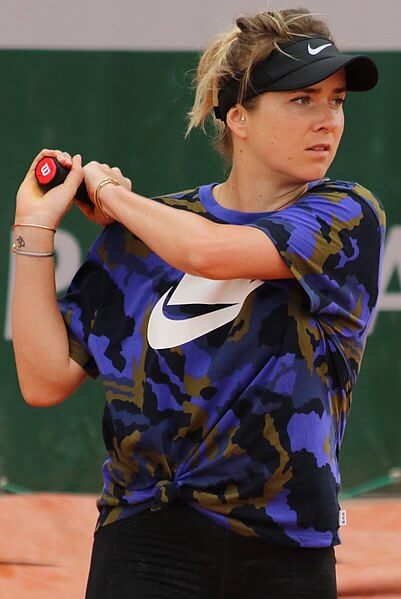
Elina Svitolina, May 9, 2019. Credit: si.robi via Wikimedia Commons.

There were four Jewish women in the main draw: Jamie Loeb (#194), from Ossining, N.Y.; Madison Brengle (#77); Camila Giorgi; and unconfirmed Jewish player Elina Svitolina. Loeb, who won three matches in the qualifying tournament to gain a spot in the main draw, lost her first-round match. Brengle, a 31-year-old from Dover, Del., lost her first-round singles and doubles matches. This was her ninth appearance in the US Open.

Camila Giorgi (#36) of Italy lost her first-round match to #12 seed Simona Halep (# 13) of Romania 6-4, 7-6 (3). Giorgi, who has had seven top 20 wins this season and won the National Bank Open this summer, recently confirmed to a reporter that she is proudly Jewish, that her parents are Argentines who immigrated to Italy, and that Anne Frank is her favorite book. “The book moved me because I am Jewish, but also because she was such a good person who saw the good in people,” she said.

World #5 Elina Svitolina has unconfirmed Jewish family history. She has won her first two matches in straight sets and will face Russian Daria Kasatkina in the third round.

Doubling down on Israeli players

Others Jewish players in the main draw include 44-year-old doubles specialist Jonathan Erlich. He and South African Lloyd Harris faced Austrians Oliver Marach and Philipp Oswald on Friday in their first-round match. They advanced to the second round after winning 62, 67 (73), 62  in an hour and 46 minutes. Israeli Dudi Sela, currently #322, was scheduled to compete in the qualifying tournament but reportedly tested positive for COVID-19 before it began.

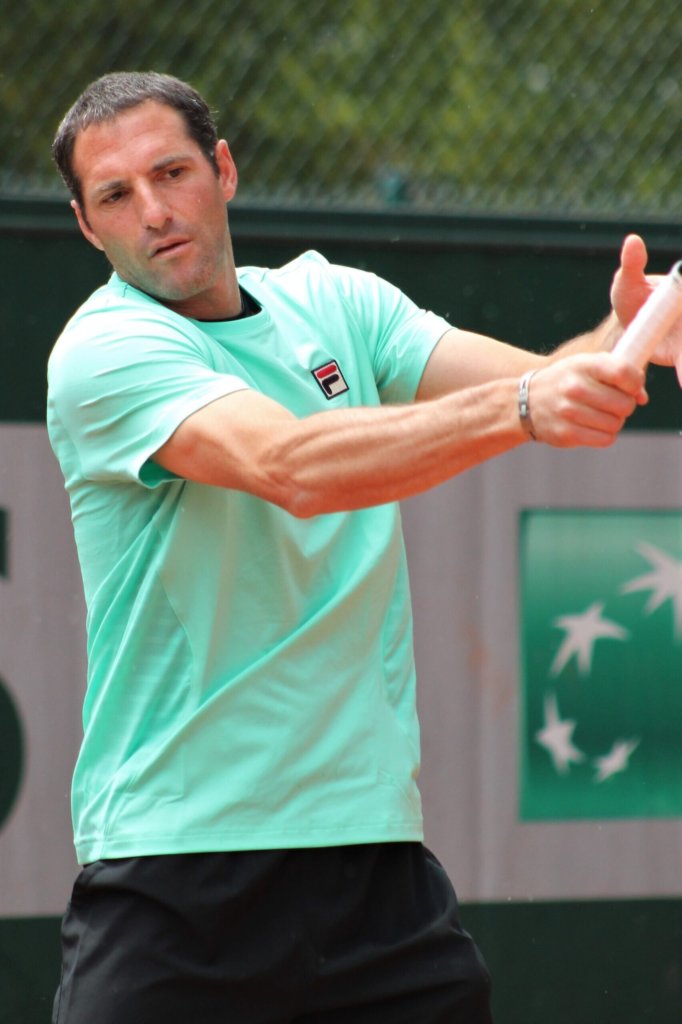
Jonathan Ehrlich, May 28, 2016, Credit: si.robi via Wikimedia Commons.

Fans keeping score of the numbers—or rather, the percent—of Jews in the men’s and women’s singles draws and in the men’s doubles draw may be pleasantly surprised.

According to most estimates, Jews make up .2 percent of the world’s population. To put it more specifically, there are 14.7 Jews in a world populated by 7.89 billion people. The percentage of Jews in men’s and women’s singles draws (if you consider Shapovalov as well as Svitolina) and men’s doubles draw are way ahead of percentages of Jews in the world.

Jewish players make up two of 128 or 1.56 percent of the men’s draw, 3.12 percent of the women’s draw (four of out of 128) and 1.56 percent of the men’s doubles draw (one team member out of 64 teams).

And while Israel’s one representative in the tournament seems low, especially when compared to such countries as Australia (26 players) and Argentina (20), they only lag slightly behind Finland (3) and Ecuador (2). They are right at home with North African and Mideast neighbors Tunisia (1) and Egypt (1).

Fans of Israel tennis remember not so many years ago when they could regularly see Israelis Shahar Peer, Julia Glushko, David (“Dudi”) Sela and Andy Ram in action at the US Open.

While few such pros or juniors remain in action this year, Hans Felius, the director of Tennis and Social Impact Programs at the ITEC (Israel Tennis Educational Centers), and the professional staff of Israel’s David Squad are systematically training Israeli children with great potential to one day play in the US Open and other major junior and adult tournaments around the world. When their efforts come to fruition, it will surely help the Jewish and Israeli tournament numbers and percentages.

Read more