Originally appeared in Jewish News Syndicate, December 12 2025
While many people use artificial intelligence tools such as ChatGPT to write papers, pick movies or streamline business tasks, Israel’s medical community is pushing AI far beyond convenience.
At Tel Aviv University this week, researchers, entrepreneurs and investors demonstrated how AI is already being used to make complex clinical decisions—and, in some cases, save lives.
The Fifth Annual IDSAI (International Data Science and AI Initiative) AI and Health Day conference, part of Cyber Week, brought together several hundred participants for a fast-paced, 10-hour program focused on real-world medical applications. The audience filling the Bar Shira Auditorium included representatives from academia, industry, government, the military and the financial sector.
On Tuesday, the morning sessions offered a broad overview of AI in health care, explored data challenges and featured lightning talks from health-tech startups and venture-capital firms. Afternoon sessions shifted to accelerating product development, academic research on agents and machine learning, a panel on computational oncology and deep-learning applications.
Opening the conference, Professor Saharon Rosset, chair in modern statistics and data science in Tel Aviv University’s Department of Statistics and Operations Research, set the tone.
“It is clear AI will become more central as we move ahead,” he said, noting efforts to “foster academic and medical institutions with the challenge of data sharing.”
Ziv Katzir, head of the TELEM (National Infrastructure Forum for Research and Development) program for artificial intelligence at the Israel Innovation Authority, described AI as “finding new answers to very old challenges” and said it has gotten “much better in the last five years.”
He highlighted advances in predictive analytics, treatment optimization, risk scoring and personalized care, pointing to dozens of Israeli companies already active in the rapidly expanding AI-health ecosystem.
‘Complexity of the health-care system’
One of the most compelling presentations came from Prof. Ron Balicer, chief innovation officer and deputy director-general of Clalit Health Services, Israel’s largest health-care provider. Opening his talk on “AI-Driven Health Care,” Balicer said that “we are no longer in a place where we are the sole decision-makers and know what is best for the patient.”
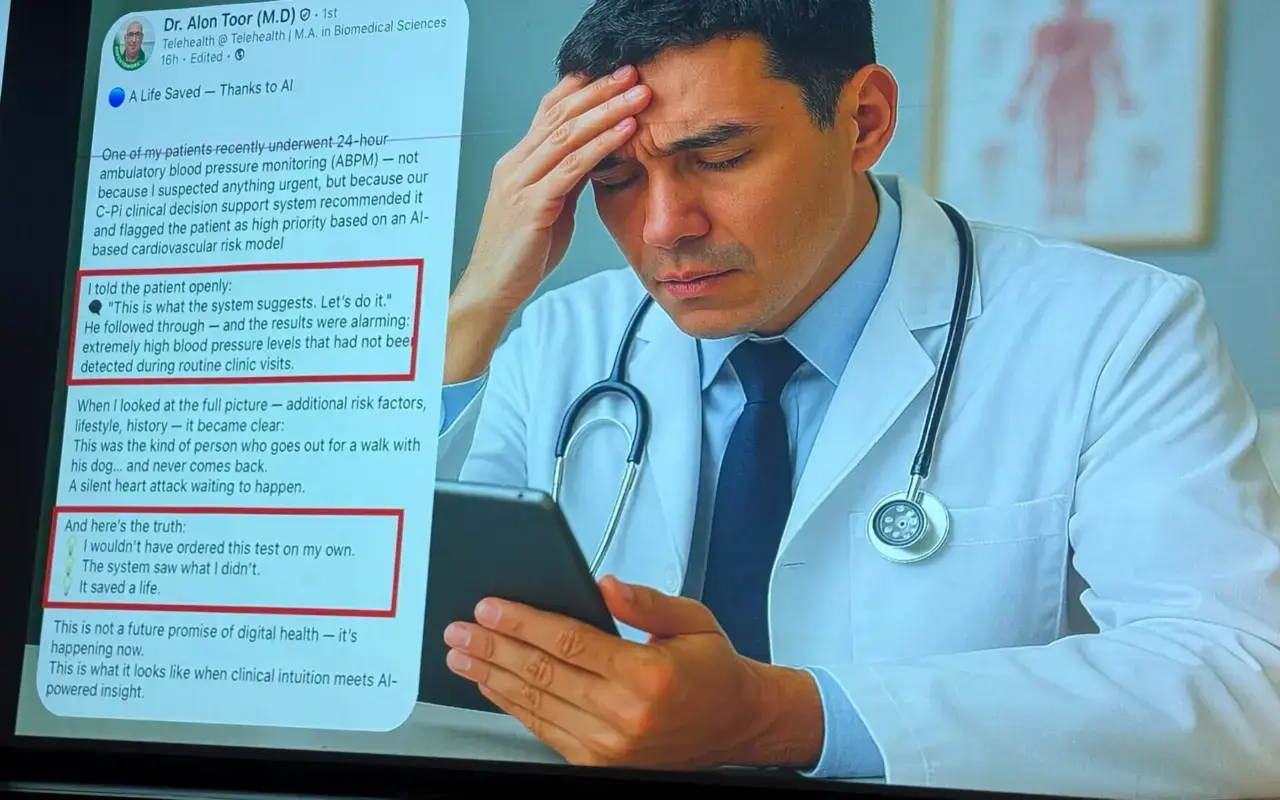
Balicer shared a post by Dr. Alon Toor titled “A Life Saved—Thanks to AI,” describing how an AI-based clinical decision-support system flagged a patient for urgent testing. “I told the patient openly: This is what the system suggests. Let’s do it,” Toor wrote.
The test revealed dangerously high blood pressure that routine visits had missed. “Here’s the truth. I wouldn’t have ordered this test on my own. The system saw what I didn’t. It saved a life.”
Balicer said AI is already guiding decision-making in Clalit clinics. “We can look at the future, see something bad will happen and take it out of harm’s way,” he said, adding that AI may soon warn patients directly. “Our data suggest you may have a heart attack in the next few weeks.” He went further, predicting that “in the not too distant future, non-AI-guided diagnosis may become substandard medical conduct.’”
At the same time, Balicer cautioned against overreliance. Just as drivers can lose navigation skills by depending too heavily on Waze, physicians risk excessive dependence on algorithms.
Medical-school curricula, he pointed out, will “have to take into account” AI tools, ensuring doctors continue to work collaboratively with technology. Still, he expressed optimism: “The future will allow AI to heal health care of its current ailments.”
Professor Noam Shomron, head of Tel Aviv University’s Digital Medicine Research Team, urged the field to become “proactive and not reactive.” He described how AI-driven analysis of DNA can help determine therapies and noted applications particularly relevant to Israel’s post-war reality. AI, he said, can help predict which soldiers are most likely to experience PTSD, enabling early intervention that could be critical to recovery.
Data challenges were a recurring theme. Dr. Steven Labkoff, a physician executive and collaborating scientist at Beth Israel Deaconess Medical Center, addressed the difficulty of building reliable AI models.
“How do we create data foundations that allow AI to understand patient journeys, treat effects and disease trajectories?” he asked. “We are entering the era where the most valuable asset in healthcare is not the algorithm; it’s the data foundation that makes algorithms meaningful. But we can only get there by working together.”
Collaboration across sectors emerged as a key takeaway. Startups such as Viritis, Agado, Taracyte, Path-Keeper and NucleAI presented their technologies, while investors offered their perspectives on scaling innovation.
Marc Greuter, general partner at Planven in Zurich, shared what he called “The European VC Perspective,” joking that he was “not smart enough to become a scientist, so I became an investor.”
He said Israel’s challenges in health-tech are less about technology and more about the “complexity of the health-care system.”
Bruce Taragin, managing director at Blumberg Capital, drew sustained applause when he opened his remarks by saying, “We are Zionists; we have been here for 3,000 years. We have never left, and we never will!”
Taragin said he was in Israel on Oct. 7, 2023, and praised Israelis for their “grit, resilience and tenacity.” Blumberg Capital, he said, prefers to “get in early and be supportive however we can.” Calling Israel a global leader with “more AI development than any country on the planet per capita,” he concluded, “I have one message: You are not alone. Am Yisrael Chai. We are with you.”
After nearly four hours without a break, a long line still formed to speak with Taragin, an indication that Israel’s AI-driven health-tech sector, even amid war and uncertainty, remains vibrant and determined to turn innovation into impact.