Projects

Members of a Birthright group talk about the joys of seeing the country with people just like themselves

More than 20,000 Birthright participants will have spent 10 days in Israel by the end of the 2012-2013 winter season, including 20 participants with Asperger’s Syndrome, now known as the “Mishpocha,” or Bus No. 195.

It’s not the first time that Birthright has included an Asperger’s bus — this one is a project of Shorashim/KOACH, the college organization run by the Conservative Movement — but for many of the participants, who range in age from late teens to mid-20s, it’s been a while since they’ve spent so much time with their own “population.”

“It’s an interesting dynamic — very enlightening to connect with one’s roots,” said Jason Shatz, who is studying at Wesleyan University in Connecticut and had a tough time deciding whether to go on Birthright with the Asperger’s group or with the Wesleyan bus. “In some ways it’s quite nice to be with such a population, even though I’ve developed socially in a significant way ever since I went to college.”

Birthrighter Jason Shatz (right) praying at the Western Wall (photo credit: Courtesy Birthright Bus No. 195)

For the bus’s “other” Jason, Jason Cohen, a 21-year-old sports management major at Ithaca College, the trip felt like an opportunity to return to his “Asperger’s roots,” something he hasn’t done since his high school days.

Funny, smart and personable, and sometimes amusingly out of context, the Birthrighters and one of the three soldiers traveling with them sat in the lobby of their hotel on the last day of the trip last week, speaking about the “quirks” of fellow Asperger’s sufferers, favorite highlights of the trip and what it will be like to say goodbye at the end of their journey.

“It was great to be around other people I can identify with,” said Lauren Katz, a 19-year-old from Eureka, California, who is studying art at College of the Redwoods. “I’ve always been the kind of person who’s never really fit in; I never interacted with people I could really communicate with on the same level.”
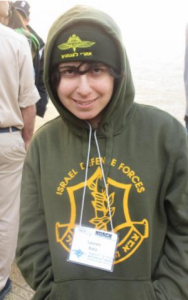
Lauren Katz hails from Eureka, CA, where she has never had a large group of friends (Courtesy Birthright Bus #195)

Gathering together a sizable group of young people with Asperger Syndrome was one of the ideas of the trip, said group leader Howard Blas, who has run similar Birthright trips in the past. Despite the high-functioning level of many of the Asperger’s participants, they often feel socially bereft back in their home settings; this was one place where they could experience a particular social bond.

“It’s not common for me to meet other people with Asperger’s or higher-functioning special needs people in Albany,” said Beth Katzer, 25, who works as a teacher’s assistant and part-time administrative assistant. “This trip was so important for me, to make friends I could see myself being friends with for the rest of my life. Even though we all have challenges, we could all come together.”

The Birthright trip was much like any other, including camel rides and orange-picking, trying out Israeli snack foods, floating in the Dead Sea and jeep rides in the Golan Heights. But they also met with Israelis with Asperger’s at Shekel, an umbrella organization for Israelis with special needs. The two groups bonded over favorite television shows and the Birthrighters’ first tastes of peanut-flavored Bamba and chocolate-covered marshmallow Krembos, and there was comfort in the ingathering of fellow Asperger’s sufferers, agreed the Birthrighters.

“There are kindred spirits in this population, and we share the same zeal for sharing the things in which we have expertise and same enthusiasm,” said Shatz. “Regular life has been good to me and my experience with Asperger’s is somewhat of a moot point although I do visit it now and then…. I struggle socially more than other people, but I think I’m getting there.”
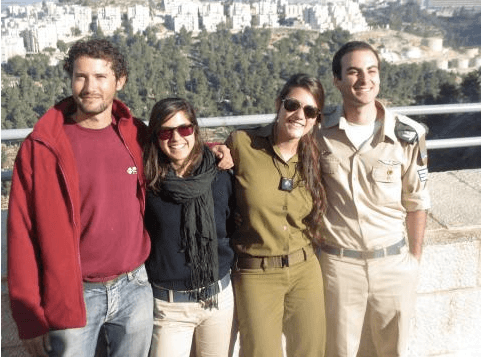
Tomer Daloomi (far right), was amazed by the forthright outlook and conversation on the bus (Courtesy Birthright Bus No. 195)

It was that kind of disarming honesty that charmed and humbled Tomer Daloomi, one of the three soldiers who joined Bus No. 195. Told just four days before the trip that he would be placed on a Birthright bus, he didn’t know what to expect, but has unexpectedly found himself seeing Israel through a very different prism.

“I’m usually cynical, like most Israelis, but these guys are just not sarcastic,” he said. “They were saying how they felt with no masks on at all. They’re just always themselves.”

 (Source: http://www.timesofisrael.com)

Read more

Flat Stanley is the beloved “flat” character from the 1964 children’s book of the same title, written by Jeff Brown and illustrated by Tomi Ungerer.  Every teacher and parent of young children know the story of Stanley Lambchop, who gets “flattened” in his sleep when a big bulletin board falls on him.  He survives and discovers the advantages of being “flat.”  For one, he can visit friends by being mailed in envelopes.

On a recent trip to Florida, I saw a man on the beach, dressed in a white button down shirt and khaki pants—with a camera in one hand and Flat Stanley in the other!  He had obviously promised his young son or daughter a photograph of Stanley at the Atlantic Ocean.  And on a trip to Israel, a day care director in our tour group must have snapped 100 pictures of Stan—from Zichron Yaakov to The Sea of Galilee.

It seems other “Stanleys” have also visited the Holy Land. A tour guide in Israel writes of the day a Flat Stanley arrived in the mail from Los Angeles.  He had recently guided the family on a bat mitzvah tour.  Now, the younger sister was writing with a special request—to take Stanley with him on his tours of Israel.   “At first I did not understand what I was supposed to do with this weird thing. It could easily be thought of as a joke, but after reading the “manual” I became quite enthusiastic… We fed him traditional Israeli salad, put him in a Succah we built in Kiryat Yovel neighborhood in Jerusalem.”  Flat Stanley was even photographed with Jerusalem Mayor Nir Barkat!

Apparently, Flat Stanley had had similar adventures all around the world.  The Flat Stanley Project encompasses more than 6000 schools registered in 88 countries.

All of the Flat Stanley hype, coupled with a TV commercial a few years back for Travelocity–with a talking gnome-gave Rachel Kirschbaum, a Jewish Day school teacher in New York City, an idea—Chayim Yerushalayim!!  According to Kirschbaum, the chair of the Tanach department at the prestigious Ramaz School in Manhattan, “Chayim Yerushalayim” has followed her from teaching positions in several New York area Jewish day schools.  “He started with SAR 2nd graders, continued with Heschel 5th graders and after a brief hiatus, took up travel again with 8th graders (or their parents) at Ramaz.”  Kirschbaum currently teaches 6,7 and 8th grades at Ramaz.

Chayim has been to Jerusalem many times. He has been to the Dead Sea and, Kirschbaum reports, “His skin should be soft and supple by now”—thanks to all of the Dead Sea mud smeared all over his body.   He has been to the Tayelet in Tel Aviv, to Caesaria, and to  Masada.  “The kids love it.  They think it is the cutest thing.  I usually do it with younger students but even the 8th  graders were ecstatic to see the pictures and so excited…it works every time!”

Next time you are in Israel, keep your eyes open for Flat Stanley or Chayim Yerushalayim. Both are great travelers and can be useful in teaching all ages about Israel! [full disclosure: Chayim recently accompanied me and I group I led on a trip to Israel!  See photo below]

(Source: http://blogs.timesofisrael.com)

Read more

RIDGEFIELD — The Idan Raichel Project, one of Israel’s most unique and popular musical groups, kicks off its 2009 World Tour with a March 22 appearance at the Ridgefield Playhouse in Ridgefield. The “Project” is so much more than its namesake, the dreadlocked, 31-year old keyboardist, composer and producer, Idan Raichel.

According to Dalit Katz, adjunct assistant professor in the Religion Department at Wesleyan University, and coordinator of both the Contemporary Israeli Voices and the Israeli Film Festival, “Idan Raichel’s music, an innovative blend of Ethiopian, Middle Eastern and Caribbean elements, resonates with messages of peace, hope and tolerance. … His spectacular live shows combined with sophisticated production techniques contribute to Idan Raichel’s great popularity – especially among young audiences.”

The Idan Raichel Project first appeared on the Israeli music scene in 2002. The group’s music is intended to appeal to audiences of all ages, cultures, religions and backgrounds.

Raichel, born to Ashkenazic parents and raised in Kfar Saba, Israel, was always interested in music. He started playing the accordion at the age of nine, and later picked up the keyboard. He studied jazz in high school, where he learned improvisation. In the Israel Defense Forces (IDF), Raichel toured military bases where he produced live shows and performed Israeli and European popular songs. His musical interests continued after his discharge, and Raichel worked as a backup musician and recording session player for some of Israel’s most popular musicians.

When Raichel took a job as a counselor in a boarding school for immigrants and troubled youth, he interacted extensively with Jews from Ethiopia and became interested in their music and culture. He set up a small recording studio in his parents’ basement and invited over 70 of his friends and colleagues from Israel’s diverse music scene to participate.

Released in 2002, the group’s first album, “The Idan Raichel Project,” featuring its hit song “Bo’ee” (Come With Me), sold more than 150,000 copies. Their 2005 album, “Mi’ma’amakim,” topped sales of 120,000. 

In January 2006, The Project traveled to Ethiopia, where the group opened the Fifth Ethiopian Music Festival in Addis Ababa. It was the first time any Israeli artist performed in Ethiopia. It was also the first time two of the Project’s lead vocalists had returned to Ethiopia since making aliyah. The trip is chronicled in the documentary, “Black Over White.”

In November 2008, The Idan Raichel Project released the album “Bein Kirot Beiti” (Within My Walls). The album which is now available in the United States on the Cumbancha label, presents artists to the wider public. The album was recorded while the group was on tour, with recording sessions taking place in such diverse settings as dressing rooms, backstage, and hotel rooms. The new album features lyrics in Hebrew, Moroccan Arabic, Spanish, Cape Verdean Creole and Swahili.

From the beginning, Raichel never wanted his group and their work to be known simply as “Idan Raichel.”

“If I had called the album just ‘Idan Raichel,’ people would have thought that Raichel is the main voice on all the songs. I wrote the songs and I arranged and produced them, but I perform them together with other vocalists and musicians. On the other hand, we are not a group. It’s something in between,” he notes. In concerts, Raichel plays keyboard from the side of the stage.

The Idan Raichel Project has headlined at the prestigious Central Park Summer Stage in New York City, the Kodak Theater in Los Angeles, and the Sydney Opera House. The group has also performed across Europe as well as in Mexico City, Hong Kong, New Delhi, Singapore, and Mumbai.

“We try to introduce the community to all aspects of the arts, including world music. We’re excited when we can get a world musician of this caliber, who usually plays such venues as Radio City Music Hall, into our intimate theater,” says Allison Stockel, executive director of the Ridgefield Playhouse where Idan Raichel Project will begin its 2009 world tour. “We hope the community will take advantage of seeing this great performer in a small intimate venue such as The Ridgefield Playhouse.”

The Ridgefield Playhouse is located at 80 East Ridge in Ridgefield, CT. For ticket information call (203) 438-5795.

Read more