Published Articles

Original Post Published On Foundation for the Jewish Camp

While doctors, lawyers, investment bankers, and so many others were working from home and not always feeling very “essential” during the pandemic, Austin, Tiffany, and other people with disabilities were teaching what it means to be and feel truly essential.

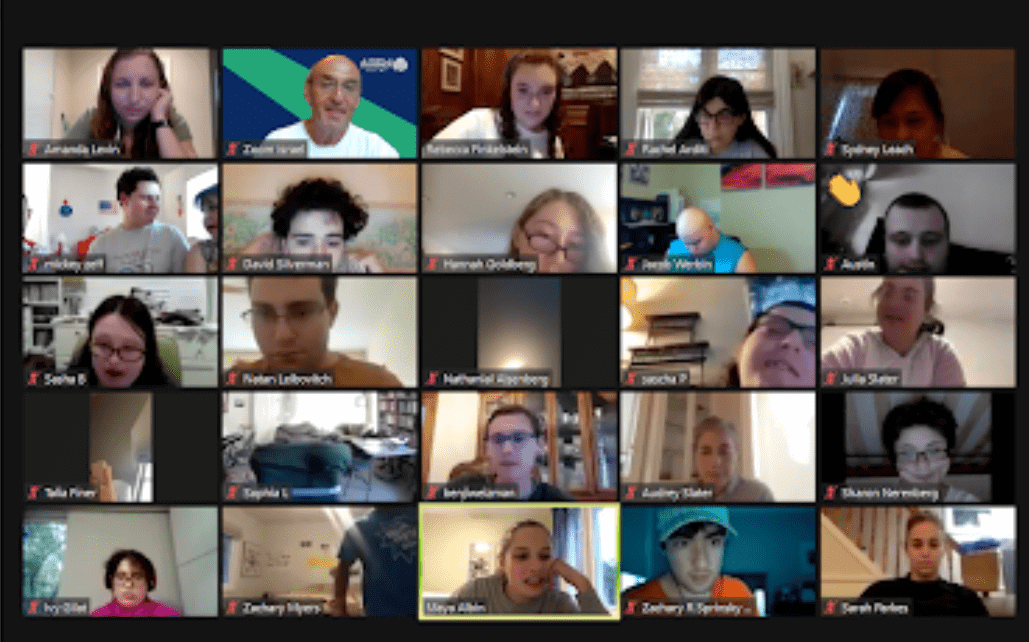
When the pandemic hit and it became clear that camp would not take place this summer in the same way it had in previous summers, Ramah campers across North America were deeply disappointed. In the months leading up to summer, campers with and without disabilities enjoyed dozens of quality programs offered by each individual camp and by National Ramah. Even with the availability of these programs, current members of our vocational training programs and alumni—many who found themselves out of work or no longer at in-person internships—expressed concerns that without a summer at camp, they would lose the opportunity to work on important vocational and social skills. We quickly mobilized to create TikvahNet, a series of 75-minute Zoom meetings facilitated by Ramah Tikvah staff, focusing on both job skills and socialization.
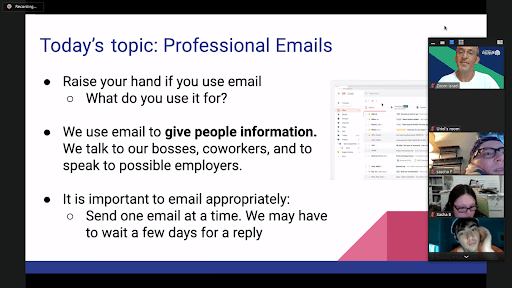
We recently kicked off our third 8-week series of TikvahNet programming. To date, over 80 current or former Tikvah voc ed program members have participated. For each session, the program coordinator and four staff members prepare PowerPoint slides, enabling participants with a wide range of intellectual and developmental disabilities and verbal abilities to fully participate in the program. Slides were shared with participants and families prior to each session so they could prepare in advance. We have learned about money management, workplace behavior, the elections and our right to vote, proper precautions to take during the pandemic, resumes, and self-advocacy. We have also cooked, danced, enjoyed a virtual tour of Israel and a Chanukah party, and made cards of appreciation to frontline workers. The level of dedication of the staff members truly led to the success of the program. They developed, individualized, and expanded the concept of TikvahNet so that it will continue even beyond the pandemic.

One of the great benefits of TikvahNet has been watching participants from Toronto socializing with old and new friends from Chicago, Seattle, Washington, Miami, and Los Angeles—across three time zones! Participants enjoy sharing stories of one very special thing they have in common—camp! They compare notes on similarities and differences between camps–special Shabbat foods, whether they have a pool or a lake, and where they pray on Shabbat. They look forward to ending each session with the Ramah-wide nighttime song, Rad Hayom.

Perhaps most inspiring has been listening to Austin and Tiffany tell the group about their jobs. Austin spoke about his job at a hospital in St. Louis, where he delivers food trays to patients in their rooms. “I am an essential worker!” he tells the group. Tiffany of Los Angeles adds, “I’m an essential worker, too! I work in a grocery store.” Austin and Tiffany are performing essential work and more importantly, are feeling like the essential workers that they are.

We hope to continue helping people with disabilities feel more essential and ultimately find meaningful employment. In the current phase of TikvahNet, we are inviting businesses who employ people with disabilities to describe what it takes to be hired by their companies. We have already heard from Blue Star Recyclers (computer and electronic recycling), and will soon hear from Luv Michael, a granola company. Two current TikahNet participants and their parents will soon join to share the story of Shred Support, the DC-area shredding company they started during the pandemic. These two young men with Down Syndrome, Uriel and Jacob, are doing essential work and teaching the community what it feels like to be essential.
Read more

Original Article Published On The Jewish News Syndicate

The baseball 12-and-under set is preparing to compete for the Unity Cup in March, featuring Israel, the United Arab Emirates and potentially teams from other Gulf states.

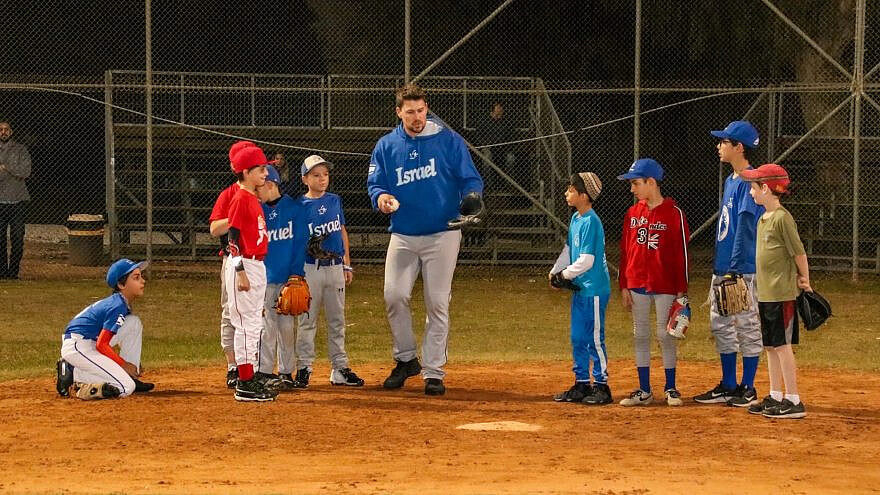
In America’s Northeast, where the snow continues to fall, spring and baseball seem like distant dreams. But in Israel, spring is in full bloom, and baseball season is already underway. The dedicated members of the 12-and-under National Team of Israel are hard at work on the fields at Baptist Village in Petach Tikvah. They are preparing for the “Field of Peace” baseball tournament in March, which will feature Israel, the United Arab Emirates and potentially teams from other Gulf states.

Competing for the Unity Cup, players will begin their series of games March 21-25 at none other than the Dubai Little League Park next to Al Quoz Pond Park. The teams will meet again in Tel Aviv in the fall of 2021.

Baseball has come a long way since team manager Louie Miller made aliyah with his family in 1998 at age 14. His parents hoped to share their love of baseball with youth in Israel. They somehow came to Israel with five children in tow, all of their possessions and managed to donate bats, catchers’ gear and other baseball equipment they had secured from the JCC Little League in Pittsburgh, Pa.

Miller played on the JCC travel team in Pittsburgh as a boy and continued to play as a teen in Israel. “There were no great options for high school baseball,” notes Miller, who also worked as a volunteer coach. “After the army, there were no options to become a coach and make a living. Everyone had a day job and coached on Fridays.”

Yaniv Rosenfeld, Israel Association of Baseball’s (IAB) Operations Manager, helped change that.

Rosenfeld, who lives in Misgav in the Galilee and established the Misgav Baseball club in 2013, was looking to change the image of baseball in Israel and to create opportunities for young Israelis to make a living in baseball. Now, Miller playfully reports, “I am one of the first people in Israel who makes a living by coaching baseball!” The trained social worker moved up north five years ago to start a youth program. They started with 35 participants and have grown to 225. It is Miller’s seventh year coaching the under-12 team.

The members of the 12-and-under National Team of Israel. Source: Screenshot.

‘The next generation of Israeli baseball’

While the team managed to travel to Italy last summer, this has been a quiet year due to the coronavirus pandemic. Then, Jordy Alter, the IAB vice president and Peter Kurz, IAB president and general manager of Team Israel, had an idea—organize a tournament with a team in the UAE, thanks in part to the recently signed Abraham Accords.

Miller notes, “I jumped at the opportunity to go to a place where only a few months ago we couldn’t go.”

Kurz adds that “this is the IAB’s own contribution to co-existence with our neighbors. We began reaching out to the Israeli-Arab population with our program, ‘Baseball for All,’ and now with the ‘Field of Peace’ tournament, we are reaching out to our surrounding neighbors. We hope this competition will become a regional one, with Kuwait, Saudi Arabia and others taking part as well, and we look forward to hosting our partners in Israel in the fall.”

Dubai Little League president Roger Duthie and his IAB counterpart, Jordy Alter, said in a joint statement: “We are excited to enter a new era of cooperation between our organizations and countries. We strive together to develop the game of baseball in Israel and Dubai as a basis for peace and cooperation between our countries. We see this as a major step forward in both areas and are excited to jointly hold the first team sports tournament between our countries. We hope these games lead to further regional cooperation.”

The players are similarly elated about the upcoming trip. Miller says “they are excited just to play ball. They understand that it is glamorous—that the field and facilities are amazing and the Little League program there is top-notch.”

Dubai Little League has more than 400 kids playing baseball and softball in Dubai, United Arab Emirates. Founded in 1998, Dubai Little League has seven divisions ranging from ages 4 to 18.

As part of the expansion of baseball activities in Israel, the IAB is building new fields and looks forward to the completion of the new Bet Shemesh complex, which will host international tournaments, as well as the Ra’anana field, which will be a joint baseball-soccer facility, both slated for 2021.

Miller can’t be happier. “We are seeing the next generation of Israeli baseball,” he states.

Proof of this is the fact that more than 60 kids tried out for the national team, which Miller calls “unprecedented.” While the majority are still new olim or children of American immigrants, Miller reports that they are now seeing native-born Israelis playing as well.

“In my opinion, the main goal of under-12 baseball is to have these kids who often haven’t seen high-level baseball experience what top level baseball is like and turn them in to ballplayers,” he explains. “This is exactly what the tournament will do for these 28 players—our largest delegation ever. These are the ones who will want to become ball players and stick with it!”

Read more

Original Article Published on The eJP

[This is the second article in a 4-part series sponsored by The Covenant Foundation and written by Covenant Foundation Award recipients and grantees.]

In my work with young adults with disabilities and their families, I constantly hear the expression “falling off the cliff” to describe the lack of adequate job opportunities for people with disabilities once they complete high school.

The unemployment rate for people with disabilities – both during the pandemic and in general – is higher than for the general population. As of March 2019, 1 in 5 workers with disabilities had been dismissed from employment, compared with 1 in 7 in the general population, according to the U.S. Bureau of Labor Statistics. According to the United Nations, in developing countries, 80% to 90% of persons with disabilities of working age are unemployed, whereas in industrialized countries the figure is between 50% and 70%. Further, in most developed countries the official unemployment rate for persons with disabilities of working age is at least twice that for those who have no disability.

Addressing this problem will take years of legislation, education and awareness – a real sea change. But there is a trend that gives me hope: community support of small businesses that are owned and operated by people with disabilities. During this month of Jewish Disabilities Awareness, Acceptance and Inclusion, the Jewish community can and should make a stronger commitment to supporting disability owned and run and disability-friendly businesses.

There are many Jewish individuals with disabilities around the country who are starting and running such businesses. Jacob Werbin and Uriel Levitt, two Washington, DC-area young men with Down Syndrome recently started Shred Support, a shredding business in Silver Spring, MD. Alexa Chalup runs Truly Scrumptious by Alexa, custom chocolate covered cookies, right out of her home on Long Island, NY. The Sunflower Bakery and Bake Shop of Rockville, MD provides skilled job training and employment opportunities in the baking and hospitality industries.

In my work, I have traveled the country and searched the Internet for similar businesses and have already identified more than 200. They include hydroponic farming, car washes, bakeries, computer recycling, cybersecurity, mammogram reading, dog treat companies and more. You can find many of these types of business listed here.

Businesses like Shred Support, Truly Scrumptous By Alexa and Sunflower Bakery all provide unprecedented opportunities for the Jewish community to be supportive while attaining what Maimonides would consider to be the highest level of tzedakah (which I prefer to translate as “righteous action” and not “charity”). The Rambam writes, “the highest form of tzedakah is to help sustain a person before they become impoverished … by helping them find employment or establish themselves in business so as to make it unnecessary for them to become dependent on others.”

Many Jewish organizations have already begun to undertake this righteous action. Synagogues and Jewish schools in the DC-area regularly order from Sunflower Bakery. Camp Ramah Darom recently ordered “early registration gifts” from John’s Crazy Socks – a sock company owned by a father and his son with Down Syndrome. When FAISR (Friends of Access Israel) organized a Kilimanjaro climb which included four people with paraplegia, it made perfect sense to order sweatshirts from Spectrum Designs in Port Washington, NY, a custom apparel and promotional items business, which, along with their Spectrum Bakes and Spectrum Suds (laundry business) has a social mission – to help individuals with autism obtain employment.

When a person with or without a disability works, there are obvious financial rewards. But there are also social, physical and mental health benefits. Employment provides a sense of accomplishment, pride and self-confidence. When a Jewish organization supports businesses which value people with disabilities, we are acknowledging that we are all created B’tzelem Elohim, in God’s Image.

During JDAIM, ask yourself two questions: Could I order those t-shirts, cookies or gift boxes from a business run by people with disabilities? And might my place of employment benefit from the often unique skills of a person with disabilities? If the answer is yes to either question and you take action, you are supporting a disability-run business while also attaining the highest level of tzedakah.

Read more

Original Article published in the Jerusalem Post

“For Friends of Access Israel and our collaborative partners Access Israel, disability awareness and inclusion is our daily calling,” said executive director Jaime Lassner.

An online series featuring an array of impressive individuals who are involved in the field of disability access is taking place this month to mark Jewish Disabilities Awareness, Acceptance and Inclusion Month (JDAIM).The series is the brainchild of Jamie Lassner, executive director of Friends of Access Israel (FAISR) who, when he first learned about JDAIM, began thinking of creative ways to share stories with the wider world of the strengths and accomplishments of people with disabilities. Lassner created and is hosting a month-long interactive Zoom series every Monday through Thursday in February (8 p.m. Israel time) featuring an all-star cast of speakers with disabilities and people connected to the disabilities’ community.

The series, titled, Access Is-Real features Richard Bernstein, a blind judge; Stephen Shore, an autistic professor; SpaceIL founder Yariv Bash; business owners Mark and John Cronin (John’s Crazy Socks) and Bill Morris (Blue Star Recyclers), who are noted for impressive practices of training and hiring people with disabilities; Omer and Shmulik Zur, creators of Paratrek; and other similarly impressive personalities. Lassner has reached out to schools around the world to participate and learn from the speakers and enjoy a break from the traditional day of in-person or virtual learning. FAISR will offer prizes to three winners who write poems or essays reflecting on what they have learned from the speaker series and on actions they will take to be more inclusive in their own lives.“For Friends of Access Israel and our collaborative partners Access Israel, disability awareness and inclusion is our daily calling. We hope that Access Is-Real is a catalyst for all to become more aware, involved and inclusive of all,” said Lassner.In the first session, Lassner interviewed Pascale Bercovitch, a paralympian who has participated in three Olympics in three different sports. She shared the story of losing both legs at age 17, making aliyah from France, and competing in swimming, hand-biking and currently in kayaking. She is proud of how far Israel has come in the area of accessibility.“Thirty-six years ago, I didn’t even know how to say ‘accessible’ in Hebrew! Nothing was accessible.” Thanks to the efforts of Access Israel, she reports that she is  now able to go to the beach, take buses and move around fairly freely. “Israel is now one of the more advanced countries when it comes to accessibility.”

The series is co-sponsored by the Consulate of Israel in New York, which has shared the event widely on social media.Access Israel regularly hosts an international conference in Israel each year, and recently hosted its seventh international online webinar, titled “Accessible Future: Innovation in Web and App Accessibility.” The webinar was attended by 800 people from 80 countries. Access Israel founder Yuval Wagner and CEO Michal Rimon were Access Is-Real guests on February 2nd.According to Shelly Christensen, CEO of Inclusion Innovations and co-founder of JDAIM in 2009, February has long been known in the Jewish world as Jewish Disability Awareness and Inclusion Month and is “a unified effort among Jewish organizations worldwide to raise awareness and foster acceptance and inclusion of people with disabilities and mental health conditions and those who love them. JDAIM is a call to action for all of us to act in accordance with our Jewish values, honoring the gifts and strengths that we each possess.”During the month of February, the Jewish Federations of North America sponsors the similarly named Jewish Disability Advocacy Month, which they describe as “a month of education, solidarity-building, and empowerment in support of people with disabilities.” The theme for their month-long series of programs is “From Empowerment to Advocacy.”JDAIM events around the world, mostly virtual this year, are an important initiative to raise awareness about disabilities, inclusion and belonging in the Jewish world and in the larger society.

Read more