Writing

For Boyd “Rainmaker” Melson, life at the United States Military Academy at West Point was not easy. West Point demands physical and academic discipline, and even periodic “white glove” room inspections. Lucky for Melson, it also requires a semester-long class in boxing.

“The goal of the course is to teach you to face your fears with no one to lean on. It teaches you to stand up for yourself. You are really exposed and naked when alone in the ring,” says Melson, 32, now a professional light middleweight boxer with a career record of 12 wins, one loss and one draw with four knockouts. He is a 2013 inductee to the Jewish Sports Hall of Fame

“I started to knock out opponents. And I won the school championship as a freshman,” says Melson, who soon found himself practicing at both 5:30 am and 4:30 pm, while carrying a difficult academic load.

“If you are not an engineering major, you must have an engineering minor. I majored in psychology and minored in nuclear engineering,” says Melson.

An army brat, Melson was born in Brooklyn, New York to a Creole father, Nolan, born in Louisiana, and a Jewish mother, Annette, born in Israel to Polish Holocaust survivors.

“Her mother fled to Uzbekistan and spent a year in prison; her father was conscripted by the Russian army, and their four children were all born in different places — Uzbekistan, Austria, Canada and Israel,” says Melson.

How did Annette and Nolan Melson decide to bring up the children Jewish?

“There was no negotiation,” says Boyd laughing, “You know Jewish moms. She said, ‘I am Jewish and our household is Jewish!’”

Boyd attended yeshiva for kindergarten (“I hated it”) and Hebrew school three days a week at Temple Beth El in Manhattan Beach, Brooklyn. Melson celebrated his bar mitzvah in Brooklyn and “was taken to Israel as a bar mitzvah present.”

West Point was his father’s choice of school, but one night during his junior year, Melson’s sense of purpose and mission in life changed abruptly. He was visiting his folks in White Plains, NY, and went out with friends to The Thirsty Turtle, a dance club and lounge.

“I saw a girl who was out with her friends, dancing and a little tipsy,” he recalls. Melson was immediately interested in her and started dancing with Christan Zaccagnino — who was in a wheelchair.

“I crouched down low and we danced,” says Melson, matter of factly. The two began dating soon after.

Boyd Melson and Christan Zaccagnino, currently not dating, but still great friends. (photo credit: courtesy)

Zaccagnino had broken her neck and become a quadriplegic in 1993 at the age of ten after jumping in to a pool. She became Melson’s inspiration, in and out of the ring.

Melson continued to study (he graduated West Point in 2003 and earned an MBA at Touro College) and box — he was a three time All American, a four time West Point Brigade Open Boxing champion, and earned a spot as an alternate on the 2008 US Olympic boxing team.

Before going pro in 2010, Melson worked as a medical devices representative for Johnson and Johnson.

Since 2010, when Melson and Zaccagnino, still great friends, though no longer dating, founded Team Fight to Walk to raise awareness of spinal cord injuries, he has devoted his time to training full-time as a boxer for charity. He donates every penny of his boxing earnings tojustadollarplease.org, in support of a clinical trial to test promising treatments for spinal cord injuries.

Zaccagnino says, “I knew Boyd loved boxing and he loved to help people, so I helped him find his passion.”

“In the US alone, where a spinal cord injury occurs every 43 minutes, there are 300,000 people living with the tragic after-effects. And 40,000 of them are US Armed forces Veterans,” says Melson.

“The field of regenerative medicine is exploding and holds great promise for the treatment of these injuries,” says Melson.

JustADollarPlease.org is the fundraising project of SCINetUSA, the clinical trial network launched to test promising treatments for spinal cord injury in the United States. SCINetUSA is a partner with ChinaSCINet, the 25 center clinical trial network in China, Hong Kong and Taiwan, where clinical trials have already started.

SCINetUSA supports the work of Dr. Wise Young, the director of the W.M. Keck Center for Collaborative Neuroscience at Rutgers University in New Jersey.

Young’s clinical trials in China have already begun to show promise, says Melson, who has observed successes there after umbilical cells are injected to the spinal cord, and a patient is given six months of walking therapy. Young hopes to bring similar clinical trials to 40 patients in the US by 2014.

‘If five million people each give $1, then we will have a cure. We potentially have the winning lottery ticket without the money to buy a ticket!’

“If five million people each give $1, then we will have a cure. We potentially have the winning lottery ticket without the money to buy a ticket!” says Melson.

Melson reports, “I have experienced firsthand how adult stem cells can improve quality of life. I live to help Christan and others like her.”

The two have traveled the world together in search of an intervention which will get Zaccagnino up and walking.

“Boyd and I are relentless,” says Zaccagnino. “And he takes relentless to a whole new level.”

Melson is currently deep in training for his December 4 bout at BB King Blues Club and Grill where he faces Gundrick King in the eight round main event.

In and out of the ring, Melson is committed to “the cause.” Even his jewelry, clothing and nickname tell the story of his current passions, commitments and causes.

A black bracelet on his left wrist with gold writing says “Team Fight to Walk.” A blue bracelet on his right wrist says “Clinical Trials Now.” He wears a necklace with both a chai pendant and boxing gloves. And his boxing trunks feature symbols he chose in the summer of 2010, leading up to his professional career: a Star of David and a camoflauged wheelchair and West Point ’03 (his graduating class).

The Star of David, says Melson, is to honor his Holocaust survivor grandparents.

“Judaism influences my choices by reminding me of the hardships that our people endure as a race in order to merely survive, and how the idea of loving humanity is the backbone of our religion,” says Melson.

The camouflage wheelchair, he says, is for wounded warriors, Fight To Walk, for Team Fight To Walk, and “Christan’s battle along with the rest of the spinal cord injured world’s battles to get up out of their chairs.”

In the ring, Melson is known as “Rainmaker,” a name is taken from the movie, “The Power of One.”

“The Rainmaker was the nickname given to the main character because he brings hope. The Rainmaker brings hope and that’s my goal for a cure for spinal cure injuries,” says Melson.
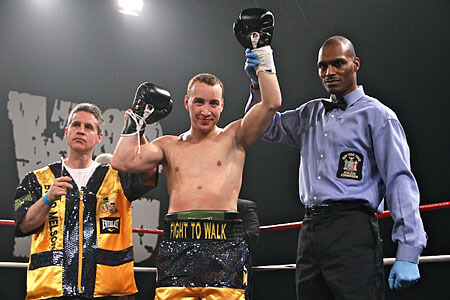
A win for Boyd Melson means a purse for Team Fight to Walk. (photo credit: courtesy)

(Source: http://www.timesofisrael.com)

Read more

Major League Baseball veteran’s gig as coach in the Holy Land last year is one of the more important lines on his resume

BALTIMORE – Almost from the moment they met him, several officials and players with Israel’s national baseball team said they saw manager Brad Ausmus headed for the major leagues.

They cited his communication skills, command of the game and preparation — not to mention his 18-year playing career as a catcher that included winning three Gold Gloves and reaching the 2005 World Series with the Houston Astros.

“We knew that even though he’d never had any managerial experience, he’d go and be a major league manager,” said Nate Fish, the bullpen catcher for an Israeli squad that came up short in its bid for the World Baseball Classic. “The overall chemistry was at a very, very high level, and Brad was very professional. He created a very good environment in the clubhouse.”

Fish and the others proved prophetic: Ausmus, 44, was introduced Sunday as the manager of the Detroit Tigers, succeeding Jim Leyland.

“I’m very excited about the opportunity to manage the Tigers. This is a very good team, and new managers rarely are handed the reins,” said Ausmus this week to the Times of Israel.

Ausmus joins a short roster of Jews who have managed major league teams, which includes current Oakland Athletics manager Bob Melvin — both have Jewish mothers and non-Jewish fathers. The first was one of the earliest Jewish players, Lipman Pike, an outfielder-infielder who managed the Cincinnati Red Stockings in 1877.

In the WBC qualifiers, Israel won its first two games before being eliminated by Spain in a 10-inning loss.

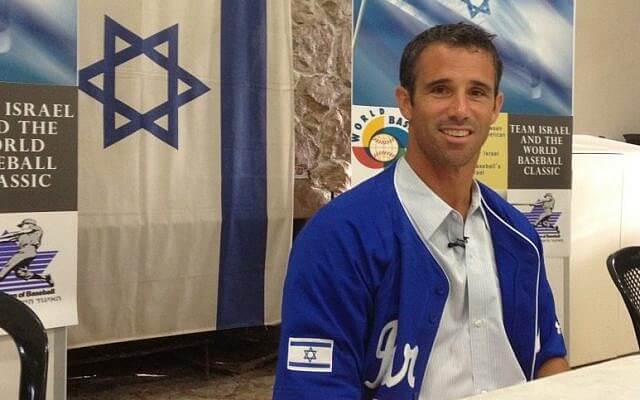
Former Major Leaguer Brad Ausmus in Israel as part of his post as coach of the Israeli team for the World Baseball Classic tournament. (photo credit: Michal Shmulovich)

“Brad did a great job of managing the entire tournament, especially the [elimination] loss, which he handled with dignity and class,” said Gabe Kapler, who coached for Team Israel alongside Ausmus, his former Tigers teammate, and now is a Tampa Bay Rays consultant.

His age and long playing career helped Ausmus earn respect from the Team Israel players, officials and players said.

Ausmus was so refined in his attention to detail, said Peter Kurz, president of the Israel Association of Baseball, that the team practiced keeping on its caps for the playing of “Hatikvah,’ the Israeli national anthem, following Israeli custom.

In assembling the club, Ausmus compiled information on prospective players on his iPad and index cards. His recruiting effort also included calls to scores of candidates, as well as their parents.

His work not only before but during the WBC qualifying “made our team legitimate,” Kurz said. The experience apparently assured Ausmus that his post-playing career inclination was accurate.

“He told me he felt that he was not just the manager, but the general manager — that it was a lot of fun choosing his own players. It gave him the feeling he could do it,” Kurz said.

Though there has been some talk in the media about Ausmus’s lack of experience, the veteran catcher disagrees.


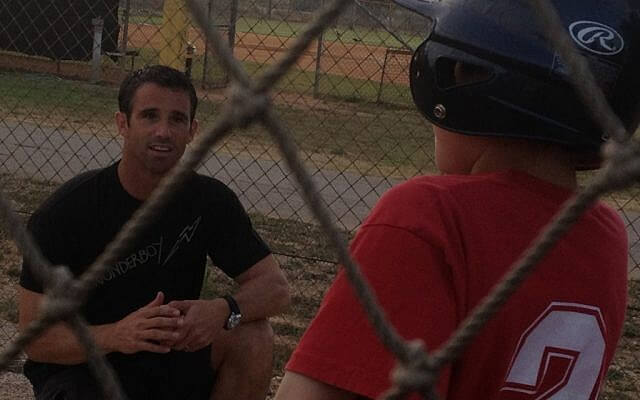
Former All-Star catcher Brad Ausmus gives some pointers to a young Israeli baseball enthusiast (photo credit: Michal Shmulovich)

“There’s many levels of qualification to manage a MLB team. I suppose we will find out a year from now if I was qualified or not. In the meantime I have a veteran bench and pitching coach standing beside me in the dugout that I can lean on if necessary,” Ausmus told the Times of Israel this week.

Last year, prior to taking on Israeli baseball, Ausmus had said, “I have experience coaching on the field at both the major and minor league level, and I have done front office work. To be a manager is not a huge shift.”

Ausmus is replacing a successful manager in Leyland, who at 68 was the oldest skipper in baseball. Leyland guided the Tigers to two American League championships in his eight seasons. In 1997, he had managed the Florida Marlins to the World Series crown.

Several members of Leyland’s staff will be staying on with Ausmus, including bench coach Gene Lamont. With Team Israel, Ausmus leaned on Kapler and Shawn Green, both former major league outfielders. It was an arrangement that developed unusually.

At a November 2011 meeting in Cypress, Calif., Kapler peppered team officials with questions, while Green and Ausmus “were very quiet,” Kurz recalled. The three ex-players were offered playing and field leadership roles and asked to select their preferred jobs.

“I thought for sure Gabe would be the manager because he’d managed one year in the minors,” Kurz said.

In a February 2012 conference call, the trio revealed to Israeli baseball officials their division of labor: Ausmus, manager; Green and Kapler, player-coaches.

“From then on, Brad came into his own” on the job, Kurz said.

That May, Ausmus and his wife, Liz, visited Israel, where the new manager ran baseball clinics for children, held a news conference, donned tefillin for the first time and went surfing in Tel Aviv.


Brad Ausmus, President Shimon Peres and US Ambassador Dan Shapiro. (photo credit: courtesy of US Embassy)

Ausmus took great pride in meeting Israeli President Shimon Peres, said the U.S. ambassador to Israel, Dan Shapiro, who accompanied Ausmus to the meeting.

“Peres is an impressive man. I get the feeling he could slide in to any situation with people of any background and make them feel comfortable,” Ausmus told the Times of Israel last year.

“The opportunity to lead the team struck him as fun and also novel,” Shapiro said of his conversation with Ausmus, who wracked up 1,579 hits — fifth among Jewish players — while playing for four teams in the majors.

Ausmus has stayed in touch with his Team Israel players. He helped pitcher Alon Leichman deal with some mound struggles at California’s Cypress College and wrote letters of recommendation on his behalf when Leichman was transferring to the University of California, San Diego.

“It meant so much that … he really helped me,” said Leichman, one of three Israel-born players on the team – he was raised on Kibbutz Gezer – and now a pitcher at UCSD. “He owed me nothing, so I’m really humbled by it.”

One player on the Israeli team might even rejoin Ausmus in Detroit: Ben Guez, an outfielder for the Tigers’ AAA Toledo club. Three Team Israel members played in the major leagues in 2013: Nate Freiman of the Athletics, the Astros’ Josh Zeid and Josh Satin of the New York Mets.

Leichman already was a Detroit fan because his mother, Rabbi Miri Gold, is a native. But with Ausmus as the Tigers manager, “I’m rooting for them even more,” he said. “Every baseball fan in Israel is now a Tigers fan.”

 (Source: http://www.timesofisrael.com)
Read more

NEW JERSEY — From Pierre Mevy Azaria’s calm demeanor as we sipped cappuccino in the lobby of his New Jersey hotel on Thursday, you would never guess that he is ultimately responsible for every aspect of the Israel versus Honduras soccer exhibition at New York’s Citi Field on Sunday — and that he’s getting married in Israel in two weeks’ time.

The well-dressed, bespectacled Mevy Azaria, CEO of the Geneva-based MCI Sport, seems comfortable in a range of countries and languages, and discussing a wide range of topics. He speaks openly and thoughtfully of his journey from childhood in Tel Aviv, to schooling in Toulouse, internships and jobs in Barcelona, and his current Geneva-based world of organizing and promoting soccer matches around the globe. And he discuses an upcoming move to New York City for his bride-to-be Laura’s law studies at Columbia University.

As we speak, he also deals with here-and-now questions and problems in a relaxed, efficient fashion. One member of the Israel national team approaches our table to inquire of the van driver’s whereabouts; the player is eager to go clothes shopping at a nearby mall.

An earlier mini crisis involves the room of coach Eli Guttman. “He usually gets a suite — to differentiate himself from the players, and so he has a meeting space. We arrived at the hotel and found out the room was given to another guest.”

How this matter was resolved? Mevy Azaria told the hotel manager, “You change the room, or we will change hotels.” He felt justified in making such a threat. “We came two months ago, looked at different hotels, worked out all of the details and signed a contract at this hotel.” Guttman quickly got his room back.

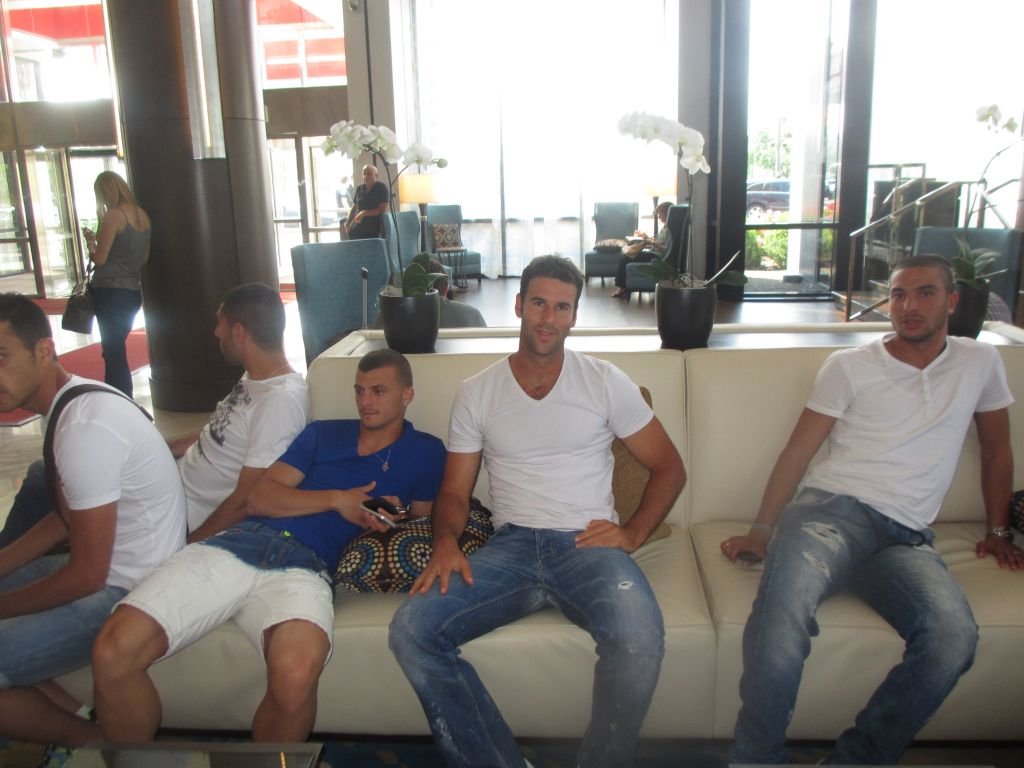
Israeli soccer players lounging at their hotel in New Jersey ahead of a match against Honduras. (photo credit: Howard Blas/Times of Israel staff)

I ask Mevy Azaria why the Israel team has not played in the United States in 35 years. “For lack of interest,” he reports unhesitatingly, but then explains why the timing is right, now, to stage what he refers to as “ethnic matches.”

“In the last two to four years, there has been a real development of soccer in the US — due to demographic reasons. There are a lot of South and Central Americans living here.” In addition, Mevy Azaria notes, the number of spectators watching the European Champions league games on TV “doubled in four years.”

Mevy Azaria is responsible for every aspect of Sunday’s soccer fest. “I rent the stadium, I pay the teams, hotels, and flights — for both teams, and I market the event.”

He says he found the management team at Citi Field “extremely nice to deal with” and felt it is “a Jewish-friendly stadium — like no other place in the world.”

Mevy Azaria was particularly taken by the kosher food stands. “This simply doesn’t exist in Europe.”

In addition, the Citi Field organization is particularly knowledgeable about the synagogues and Jewish communities in the area — a real help in promoting the event. “And the date was a total coincidence—we got two dates which worked for both teams. The Mets just finished up a series with the Yankees and are on the West Coast. And the date, June 2, just happened to be the date of the Celebrate Israel Parade!”

Mevy Azaria discovered football during a business school exchange program, where he had the opportunity to work for Barcelona, one of Europe’s very best teams. He began by selling tickets to Israeli companies for Spanish soccer games. Then, after a year and a half, the owner of MCI Sports approached him, looking for a ticket to a game. He then went to work for MCI.

“A company from Qatar wanted to buy the company, but I was given the chance to buy and develop it — which I did.”

MCI promotes “soccer friendly matches” in Europe — and is now hoping to expand to America. If the New York event is successful, Mevy Azaria envisions similar exhibition matches in such Jewish and Israeli-heavy cities as Los Angeles and Miami.

For now, Mevy Azaria is focused on Sunday’s event — and his wedding. “The game will be a great event, like a party,” he predicts. “The action doesn’t stop for 90 minutes, and it is a chance to cheer on and show support for Israel.”

Unlike the Israeli players who will enjoy vacation and travel time in the States in the week following the match, Mevy Azaria needs to get home to Switzerland, and then on to Israel for his wedding. “Laura has been very understanding.” She’d need to be.

(Source: http://www.timesofisrael.com)
Read more

Jewish state’s elite squad is relaxed, ready and eager for Sunday’s exhibition game against Honduras

NEW JERSEY — The Israel national soccer team touched down at Newark Airport at 5:30 Thursday morning. By 9 a.m., the freshly showered guys were lounging on the white leather sofas of their New Jersey hotel — calling girlfriends, Skyping mothers, and playfully bantering with teammates, some of whom they hadn’t seen since their impressive 2-0 March 26 World Cup qualifier victory over Northern Ireland in Belfast.

The team came to New York for an exhibition game against Honduras Sunday at Citi Field, home of the New York Mets baseball team. The game — the national team’s first here for 35 years — is the final event of “Celebrate Israel NY” which also includes a Celebrate Israel Run in Central Park and the Celebrate Israel Parade.

While willing to give exclusive-on-arrival interviews to The Times of Israel, most players — many in the United States for the first time — were admittedly more interested in the van, soon to arrive to take them to a nearby shopping mall. Three of the adventuresome players hired a driver to take them straight to Manhattan. Thursday was a free day. A late-afternoon practice was set for Friday at New Jersey’s Montclair State University.

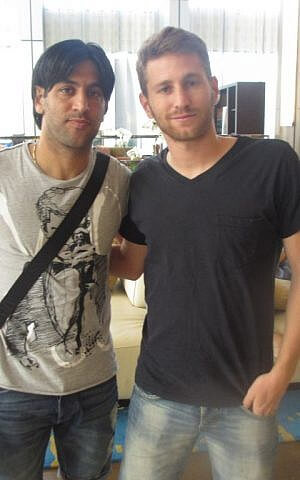
Israeli soccer players (facing camera) Elad Gabai, Dekel Keinan, and Shimon Abuhatzira (photo credit: Howard Blas/Times of Israel staff)

Midfielder Sheran Yeini was excited to be in New York, “one of the best cities in the world.” The Maccabi Tel Aviv player said, “I can’t wait to see the stadium — I know it is a baseball stadium!” It takes 48 hours to convert Queens’ Citi Field for soccer.

Yeini and teammate Elyaniv Barda, a forward originally from Beersheba, and a sixth-year member of the Belgian Racing Genk soccer club, take turns rattling off positive comments about the game and the national team: “We want to represent Israel. We need you! Come to the game and show your support!”

Both made reference to the Celebrate Israel Parade on June 2, on Manhattan’s Fifth Avenue.

“Two or three players will be on a float at the parade — then they will rush to the game,” Yeini said.

Defender Dekel Keinan of Haifa felt both the game and his time in the States “will be an adventure.” Fellow defender, Rami Gershon, originally from Rishon Letzion, was similarly enthusiastic in describing his first trip to the US. “We are looking forward to all of our supporters coming out to the game. We hope families will come.”

Kol Yisrael Achim,” he then shouted. “All Jews are brothers!”

Gershon, who has played soccer for a Belgium team in Antwerp and currently plays for Scottish Premier League champions, Celtic, reported that he has never experienced anti-Semitism or anti-Israel sentiment overseas. “People are supportive and helpful.”

Midfielder Maor Melikson of Yavneh, a player on France’s Valenciennes club, said much the same. “There is no anti-Semitism — the other way around. People bring Israeli flags to the game.” Melikson was in the States six months ago with his wife, who is not accompanying him on this trip. He will travel to Las Vegas for four days following Sunday’s game. “I am looking forward to all the Jews coming out to cheer for us!”

Israeli midfielder Maor Melikson (photo credit: Howard Blas/Times of Israel staff)

Eli Guttman, coach of Israel’s National team (who with players Tel Ben Haim and Rami Gershon gave an online interview May 29, as part of “Hangout on Air with Israel’s National Team”) was not hanging out in the lobby with his players. He was reportedly resting. Guttman was no doubt pleased that Pierre Mevy Azaria, CEO of MCI Sport, the event organizer, promoter and chief logistical officer, had recently “rescued” Guttman’s hotel suite, which had been “reassigned” to another hotel guest.

In the online interview, Guttman acknowledged that Sunday’s game “is an important game for us — every game for the National Team is important.” But he conceded that it has greater significance for Honduras. “On [June 7] Honduras plays against Costa Rica in the 2014 World Cup Qualification. For them, they must be on a high level. We, after the game, will be on our vacation.” Still, he said of the game, “We are serious, and we want to be proud.”

According to Mevy Azaria, more than half of the players will be staying in the States from three days to a week, to relax and travel.

In the days leading up to the game, there is still work to be done. Sharon Eyny, director of GIDNY (getitdoneny), seemed relieved when the players boarded the bus for their shopping excursion. She could get back to selling tickets and coordinating logistics.

In the Jewish and Israeli communities, she and her team have reached out to synagogues, restaurants, venues hosting performances by Israeli musicians and more.

And while unwilling to disclose the number of tickets sold to date, she noted that “The Hondurans are passionate about soccer.”

(Source: http://www.timesofisrael.com)

Read more