Originally appeared in JNS.org on April 14, 2026
“As prime minister of Israel, I have promised: ‘There will not be a second Holocaust.’ This year, we turned that promise into reality,” Netanyahu said.
Due to security considerations, Israel’s opening ceremony for Yom Hashoah (Holocaust Remembrance Martyrs’ and Heroes’ Remembrance Day) at Yad Vashem in Jerusalem did not take place live this year. Instead, audiences across the globe were invited to participate via a prerecorded broadcast aired at 8 p.m. Monday Israel time on Israeli television channels.
Viewers paused to reflect and take part in a shared act of memory, hearing directly from survivors and Israeli leaders while honoring the six million Jews murdered in the Holocaust.
This year’s theme, “The Jewish Family During the Holocaust,” highlighted the family as a source of identity, strength and human connection even in the face of unimaginable loss. In ghettos, concentration camps and hiding places, families preserved dignity and hope under the harshest conditions, Yad Vashem said, noting that many survivors went on to rebuild their lives in Israel.
The Jewish state is home to some 111,000 survivors, according to government estimates released ahead of Holocaust Remembrance Day 2026.
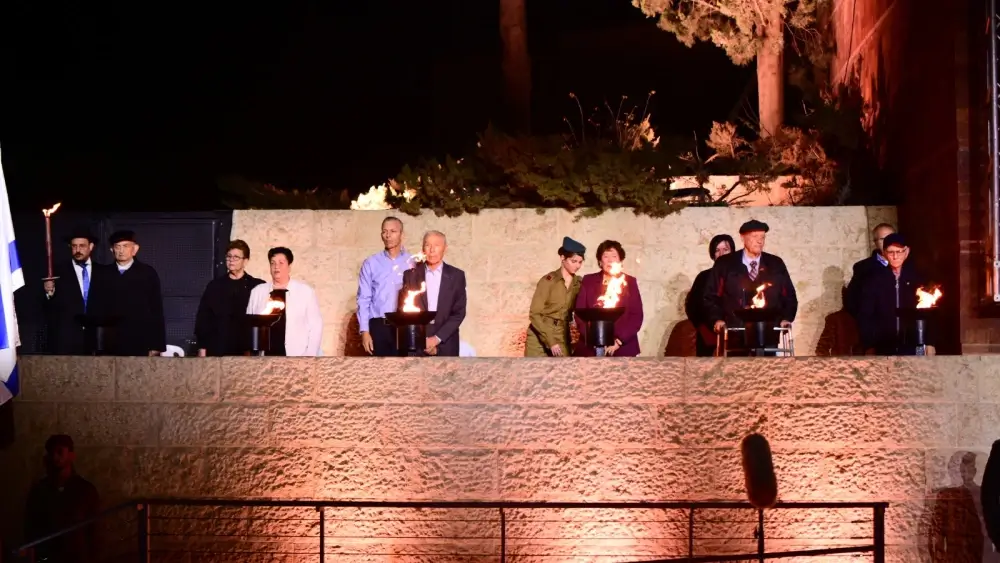
Following the lowering of the national flag, Rabbi Yisrael (Israel) Meir Lau, 88, a Holocaust survivor and former chief rabbi of Tel Aviv and Israel who now serves as chairman of the Yad Vashem Council, lit a memorial torch.
Netanyahu’s address
In his address, Prime Minister Benjamin Netanyahu drew a direct line between the lessons of the Holocaust and Israel’s war against Iran and its regional proxies, declaring that the Jewish state today possesses the strength that was absent during the darkest chapter of Jewish history.
“In the Holocaust, the poet Uri Zvi Greenberg wrote: ‘We were an extinct people like a wild beast in a hunt,’” Netanyahu said. “In contrast, today our people fight back against our oppressors. During the Holocaust, we were like an abused animal crying in agony. Today, however, we have a state which is stronger than ever, which roars with power.”
Netanyahu stressed the importance of Israel’s military campaign against Iran, saying that through “Operation Rising Lion” and “Operation Roaring Lion,” Israel, together with the United States, had significantly weakened Tehran’s capabilities.
“Together, we crushed the evil regime in Iran to dust,” he said, adding that the ayatollahs had sought nuclear weapons and tens of thousands of ballistic missiles “intended to annihilate us,” while funding terror proxies aimed at encircling Israel in a “ring of fire.”
Reaffirming a longstanding commitment, Netanyahu said: “Year after year, I stand here and pledge at the Holocaust Remembrance Day ceremony: ‘We will not allow Iran to develop nuclear weapons.’ As prime minister of Israel, I have promised: ‘There will not be a second Holocaust.’ This year, we turned that promise into reality.”
The prime minister reflected on the historic vulnerability of Jews during World War II, posing questions about whether earlier action might have prevented the catastrophe. “Citizens of Israel, looking back at the Holocaust, the question ‘what if’ arises in all its bluntness,” he said. “What if we had a state before the catastrophe? What if the nations of Europe had stopped the monstrous Nazism in time instead of appeasing it?”
“There are no ‘what ifs’ in history,” Netanyahu continued. “The terrible disaster happened. But given all this, we are acting so that future generations will not ask ‘what if’ with a sense of missed opportunity.”
Netanyahu highlighted Israel’s close strategic cooperation with Washington, describing an unprecedented partnership with U.S. President Donald Trump. “We have changed the course of history,” he said. “The independent State of Israel, the Israel Defense Forces, Israel’s security organizations—all of these are manifestations of our regaining control over our destiny after centuries of horrible weakness.”
He said Israel’s actions also serve broader global interests. “On this Holocaust Remembrance Day, let us remember that the State of Israel is at the peak of its power,” Netanyahu said. “Who could have imagined 80 years ago that our daring Air Force pilots and American military pilots would defend the Middle East, wing to wing? We are defending Israel, the United States and … we are defending Europe.”
Addressing Holocaust survivors directly, Netanyahu praised the transformation from destruction to renewal. “No other nation could have accomplished what we have done: to bring about this immense transformation, from Holocaust to rebirth,” he said.
Concluding his remarks, Netanyahu praised the resilience of Israel’s soldiers. Quoting from the Book of Chronicles, he described them as “mighty men of valor … whose faces were like the faces of lions,” adding, “As a nation of lions, we shall continue, with God’s help, to roar the roar of eternity.”
Herzog’s address
Israeli President Isaac Herzog shared the moving story of fallen soldier Master Sgt. (res.) Asaf Cafri, 26, and his great-grandmother, Magda Baratz, who survived the Holocaust. Baratz, 96, was visiting the site of the Bergen-Belsen concentration camp in Germany when her great-grandson, a reservist in the IDF Armored Corps, fell in battle in the Gaza Strip on April 24, 2025. She died 15 days later.
“There are moments within this war in which the story of one family sheds light on and tells the story of an entire nation,” Herzog said. “When Michal and I arrived to console the Cafri family at their home in Beit Hashmonaim and met Asaf’s dear parents, Yifat and Hagai, his brother, and his partner, I could not help but notice a woman sitting to the side, quiet and withdrawn. Her eyes were sorrowful, as though carrying a pain both old and new. I approached her and asked who she was. ‘I am Magda, Asaf’s great-grandmother.’”
The president recounted Baratz’s harrowing story of being imprisoned with her family at 15 in a ghetto in Transylvania before being deported to Auschwitz. She endured forced labor, starvation and death marches, and witnessed the murder of her parents and a sibling.
In the spring of 1945, she was liberated from Bergen-Belsen, weighing only 20 kilograms (44 pounds). At the detention camp in Cyprus, on her journey to Israel, she met her husband, Ze’ev. After immigrating to Israel, she started a family. Her firstborn daughter, Racheli—Asaf’s grandmother—was born during Israel’s War of Independence.
“This is my victory: to survive, to immigrate to the Land of Israel and to establish a dynasty,” Baratz would say, Herzog recounted. “Indeed, she established a magnificent dynasty: children, grandchildren and great-grandchildren. Generation after generation of renewal, love of humanity, the Jewish people and the Land of Israel.”
Six years ago, ahead of Yom Hashoah, a photograph of Baratz and Asaf was featured on a billboard. On the 80th anniversary of the liberation of Bergen-Belsen, Baratz was invited to attend a ceremony there as a guest of honor, accompanied by her family. It was there, Herzog said, that she received the devastating news: Her beloved great-grandson, Asaf, had fallen in battle defending the State of Israel.
“Last year, shortly before we parted with the Cafri family, Magda Baratz asked to share a final message with us. From the depths of her sorrow, in moments of unbearable grief, Magda, the Holocaust survivor and bereaved great-grandmother, chose a message of hope. ‘I continue to believe that it will be good here. I may no longer be here, but it will be good here. I believe this with all my heart,’ Magda told us.
“This hope, this faith that Magda left us, is not hers alone. It is the hope that you have bequeathed to us—and this hope, this knowledge, so Jewish, so Israeli—we carry with us.
Herzog offered words of encouragement to the security forces currently defending the country. “To each and every one of you, I say: This is a prolonged campaign, but I am confident that we will emerge from it strengthened and empowered.”
He continued: “Our eyes look toward the heavens and pray for the safety and success of the soldiers of the Israel Defense Forces and all the security forces wherever they may be. Let us not forget: 81 years after the Holocaust, the striped prisoner’s uniform has been replaced by the IDF uniform, worn by the grandchildren, great-grandchildren and great-great-grandchildren of Holocaust survivors. For them, it is a tremendous privilege to continue your path and ensure the security of Israel.”
The six torch-lighters
Following a musical interlude by Israeli singer Roni Daloomi, six Holocaust survivors and family members lit torches representing the six million Jews murdered in the Holocaust. The stories of Saadia Bahat, Michael Sidko, Miriam (Daisy) Bar Lev, Moshe Harari, Ilana Fallach and Avigdor Neumann reflected the geographic breadth of the Holocaust and the resilience of survivors who rebuilt their lives in Israel.
• Bahat was born in Lithuania, survived ghettos and labor camps and reached Mandatory Palestine after liberation by Soviet forces. He fought in Israel’s War of Independence, built a career as an engineer at Rafael Advanced Defense Systems and later became an award-winning sculptor.
• Sidko, born in Kyiv, witnessed the murder of his mother and siblings at Babi Yar. He and his siblings were sheltered by a Ukrainian woman who claimed them as her sons and saved their lives. After the war, he reunited with his father, served in the Red Army, became an engineer and immigrated to Israel in 2000.
• Bar Lev, born in Tel Aviv in 1936, returned with her family to Amsterdam, where they were deported to Westerbork and later Bergen-Belsen. She immigrated to Israel in 1946, settled on Kibbutz Ginegar, served in the IDF and became a nurse.
• Harari was born in Poland, escaped the Mordy Ghetto and hid with a Polish farmer. After liberation in 1944, he and surviving relatives faced continued antisemitism before immigrating to Israel, where he worked in the defense industry.
• Fallach was born in Benghazi, Libya, and deported with her family to the Giado concentration camp in 1942. The family immigrated to Israel in 1949.
• Neumann was born in Czechoslovakia and deported with his family to Auschwitz. He survived selections and death marches before being liberated in 1945. After being detained in Cyprus, he immigrated to Mandatory Palestine.
Haviva Burst, a Holocaust survivor born in Wojsławice, Poland, delivered an address on behalf of all survivors. “I don’t remember my parents’ faces, but I remember what it felt like to be part of a big, happy family,” she said, noting that after making aliyah in 1947, marrying her late husband of 72 years and rebuilding her life in Israel, “I learned how essential family is.”
The ceremony concluded with a psalm recited by Rabbi Kalman Meir Ber, the Ashkenazi chief rabbi of Israel; the Kaddish mourners’ prayer by Hacham David Yosef, the Sephardi chief rabbi of Israel; the El Maleh Rachamim memorial prayer by Holocaust survivor and retired Haifa judge Menachem Neeman; and the singing of “Hatikvah,” the Israeli national anthem.