Originally appeared in In Jewish News Syndicate in www.jns.org, February 5, 2026
Home crowd and spirited doubles win highlight Israel’s return to the tournament after a two-and-a-half-year absence.
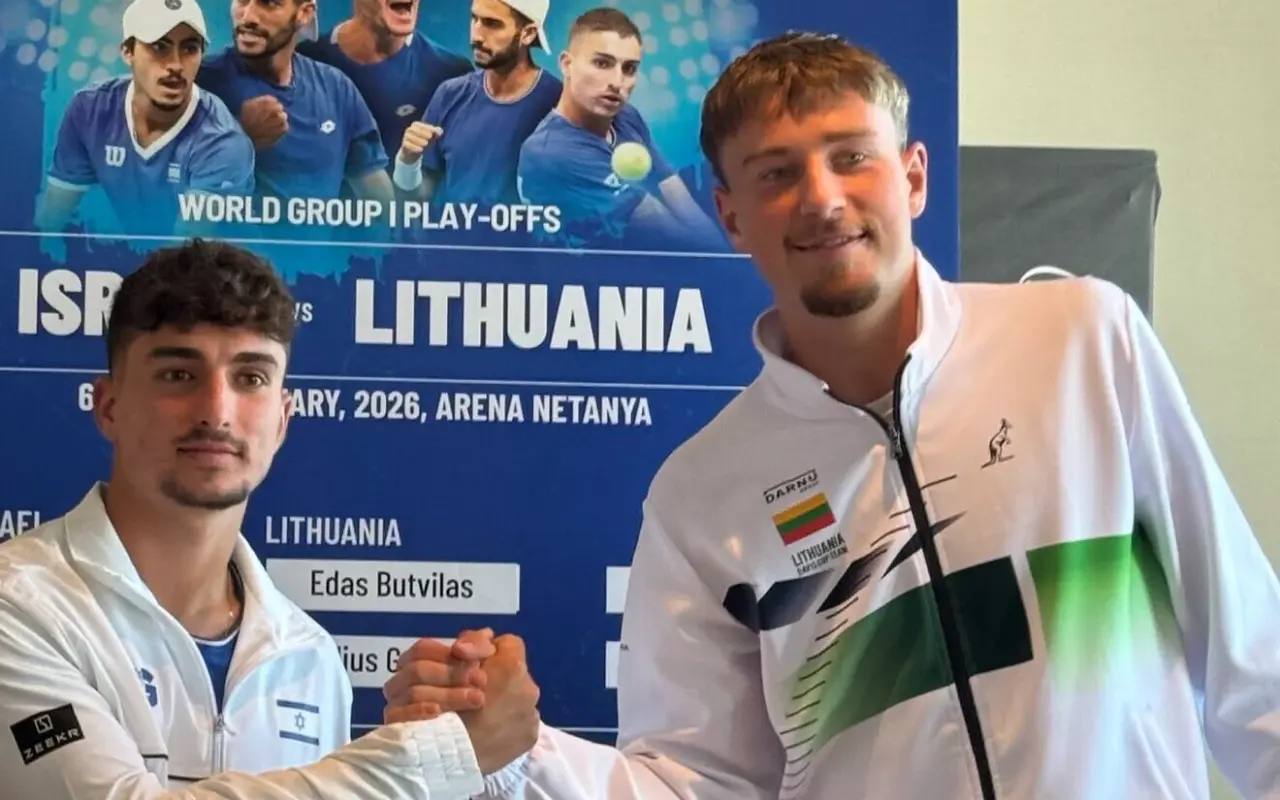
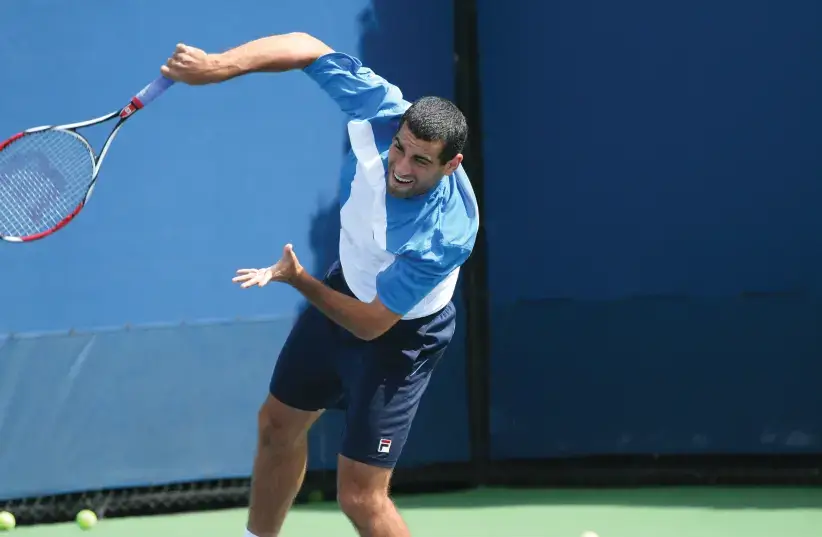
(Feb. 8, 2026 / JNS) Israel lost 3–1 to Lithuania in a two-day Davis Cup World Group I tie in Netanya over the weekend, despite a spirited effort and strong support from an enthusiastic home crowd at the Netanya Arena.
The Davis Cup returned to Israel for the first time in two-and-a-half years, drawing nearly 2,500 flag-waving fans who packed the arena, pounding drums and cheering on Israel’s five-man squad. While hopeful, supporters were also realistic. The disparity in world rankings proved too great for Israel to overcome.
Israel’s highest-ranked player, Amit Vales, entered the tie at No. 873 in the world, with the remaining four ranked around 1200. Lithuania’s two players who competed were ranked No. 129 (Vilius Gaubas) and No. 277 (Edas Butvilas).
Now in its 126th year, the Davis Cup is the world’s largest annual international team competition, with a record 160 nations participating in 2026. This weekend alone, 78 teams competed across 39 countries.
The event officially opened Thursday with a draw ceremony and media conference at the Vert Lagoon Netanya Hotel. Israel Tennis Association President Avi Perets welcomed the delegations, while International Tennis Federation representative Alex Hughes noted the tournament’s global reach. Netanya Mayor Avi Slama spoke of sport’s unifying power, saying it can help “bring peace in the world.”
Friday’s matches began with a formal ceremony, as ball kids and officials led both teams onto the court. National anthems were played, and chair umpires from countries including Spain and England officiated the matches in both English and Hebrew.
In Friday’s opening singles match, Amit Vales faced Edas Butvilas in their first-ever meeting. Vales rallied after trailing early, forcing a tiebreak, but lost the first set 7–6 (7–3) before Butvilas closed out the match with a dominant 6–0 second set.
In the second match, Ofek Shimanov played Vilius Gaubas, who took the first set 6–0 in just 23 minutes. Shimanov improved in the second set but Gaubas prevailed 6–4. “I started really slow—I felt a bit of pressure,” Shimanov said.
Lithuania led 2–0 after Friday. On Saturday, Lithuania reshuffled its doubles lineup, pairing Gaubas and Butvilas in an effort to clinch the tie early. Israel countered with doubles specialist Daniel Cukierman alongside Shimanov.
After falling behind early, the Israelis mounted a dramatic comeback, winning their first set of the weekend 7–6 in an 11–9 tiebreaker before closing out the match 6–3. The victory narrowed Lithuania’s lead to 2–1.
Cukierman praised the crowd and urged fans to stay for the decisive fourth match, which would determine whether the tie extended to a fifth rubber.
In that match, Vales faced Gaubas. After dropping the first set 6–1, Vales battled back to take the second set 6–3. In the deciding set, however, Gaubas regained control and sealed the match 6–2, despite Vales taking a medical timeout for a forearm issue.
Gaubas later acknowledged the challenge of playing in a loud arena filled with drums and chants.
With the win, Lithuania advances to World Group I play in September, with the chance to reach the Qualifiers. Israel will compete in Davis Cup Group II later this year.
Members of the Lithuanian team said they enjoyed their stay in Netanya, particularly its seaside location. While practice schedules limited sightseeing, the Israel Tennis Association (ITF) arranged tours of Jerusalem and Tel Aviv for members of the delegation.
Lithuanian captain Laurynas Grigelis, who previously competed in Israel, said he hopes to return. Assistant coach Tadas Babelis praised the organization, hospitality and food, adding that the team had no security concerns. An ITF official summed up the visit by saying, “Israel is not what you see on TV.”
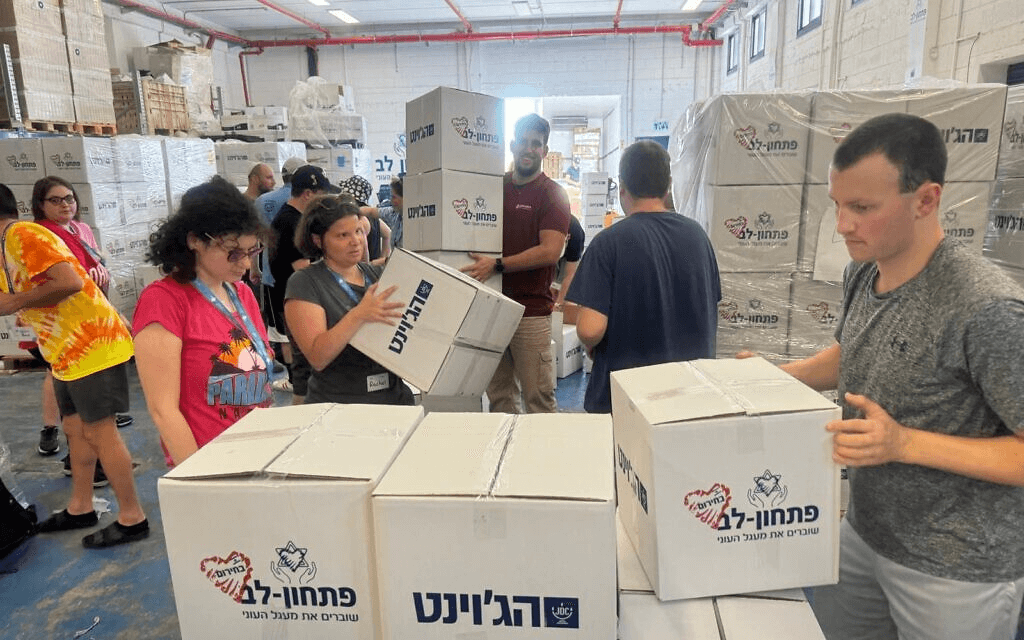
A group of Camp Ramah/Birthright participants help pack food supplies in Israel, September 2024. The trip was for adults with non-physical disabilities who volunteered in various locations around Israel. (courtesy Howard Blas)
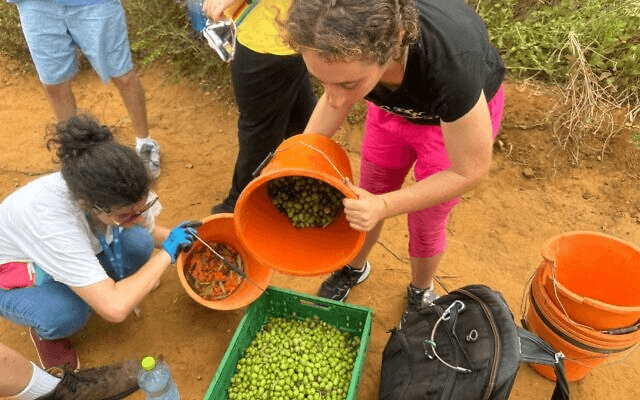
At a farm in central Israel on Monday, a group of American volunteers spread out through the olive groves holding an informal, friendly harvesting competition. Wearing heavy gloves in the late morning heat and carrying thick plastic buckets to collect the spoils, the group moved quickly and soon assembled a sizable haul of hard, green olives.
It was not the usual group of volunteers from abroad: the 12 participants all were on the autistic spectrum or had other non-physical disabilities, in what sponsor Birthright Israel said was the-first-of-its-kind volunteer group to visit Israel during the Israel-Hamas war.
This trip was “different because we’re doing a lot more of my kind of things. I love volunteering,” said participant Maddy Katz, a young woman with glasses who proudly showed the olives she had gathered.
They almost didn’t make it to pick olives at Harvest Helpers, a farm in Rishon Lezion run by food rescue organization Leket Israel, because that morning, due to the escalating situation in Israel’s north, they learned that they would have to relocate from Tel Aviv to Jerusalem for the last few days of their visit.
Having to quickly pack their things and change the itinerary at the last minute didn’t phase Katz, who said the trip had “a lot of moving parts.” She was looking forward to going home to Columbus, Ohio, where her first priorities would be “sleep, shower and laundry,” and then updating her binder, where she keeps records of her 80,000 hours of volunteering over the last 10 years.
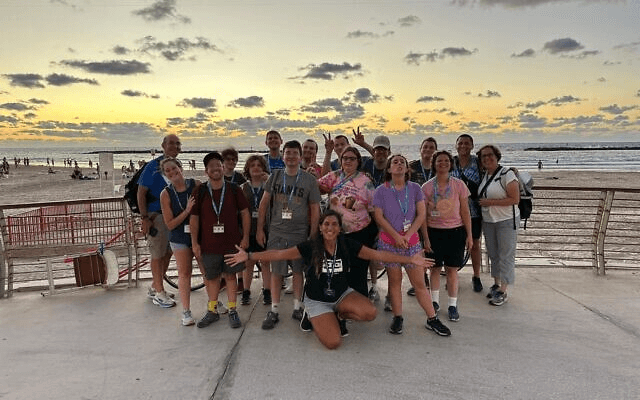
Group of Camp Ramah/Birthright participants and their guides in Tel Aviv, September 2024. The trip was for adults with non-physical disabilities who volunteered in various locations around Israel. (courtesy Howard Blas)
The volunteer group, due to return to the US early Wednesday, was sponsored by Conservative Judaism’s National Ramah Tikvah Network and Birthright Israel’s Onward program. All the volunteers had previously participated in Ramah camps in the US and most had already been in Israel.
According to Birthright Israel, this was the first volunteering trip for disabled adults during the conflict. Since November 2023, Birthright has brought over 7,500 volunteers on similar trips to Israel, they noted, and organized its first “accessible trip” in 2001.
In addition to agricultural work, the group’s 10-day visit included volunteer activities where they helped pack up food and supplies, but they also toured Israel’s Paralympic training facility, spent time in Tel Aviv, visited the Western Wall, and more.
Group of Camp Ramah/Birthright participants harvesting olives in Rishon Lezion, September 2024. The trip was for adults with non-physical disabilities who volunteered in various locations around Israel. (courtesy Howard Blas)
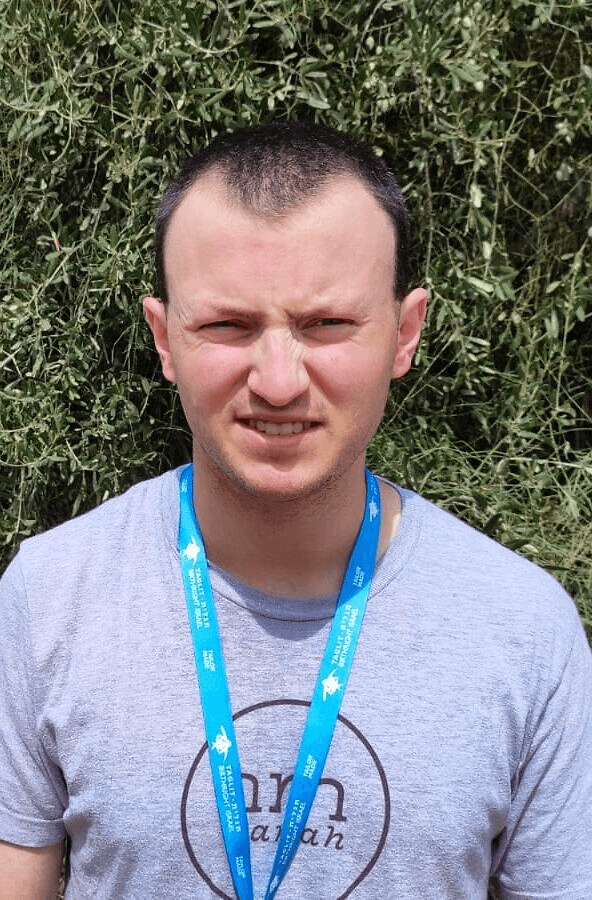
“I think that with the war going on and all that stuff, I wanted to go to give back to the community because everyone, especially up in the north, is really having a hard time dealing with the rockets and the fires,” he said.
Michael ‘GG’ Goodgold, an American volunteer harvesting olives in Rishon Lezion, on September 23, 2024. Goodgold was part of a trip for adults with non-physical disabilities who volunteered in various locations around Israel. (Gavriel Fiske/Times of Israel)
Goodgold, who stays “on top of the news from Israel no matter what time it is,” said that it actually “felt peaceful” being in Israel, despite the war, and he particularly enjoyed visiting the beach in Tel Aviv.
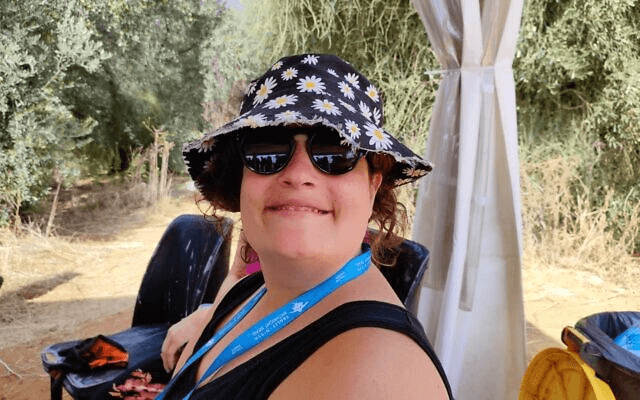
Annie Michaels, also from Chicago, has been to Israel “nine or 10 times,” she said. This trip had been “a very good experience” partly because it was “my really first time being alone, volunteering and doing all these activities on my own independently,” without her immediate family.
(The group was accompanied by several guides at all times and individual members were allowed to independently visit their family in Israel.)
“I’m happy to stay. I’m sad to leave,” Michaels said, but added that back home, she “feels great” to be able to share stories about her visits to Israel or about “what was happening when I’m volunteering and just giving back to the world.”
Annie Michaels, an American volunteer harvesting olives in Rishon Lezion, on September 23, 2024. Michaels was part of a trip for adults with non-physical disabilities who volunteered in various locations around Israel. (Gavriel Fiske/Times of Israel)
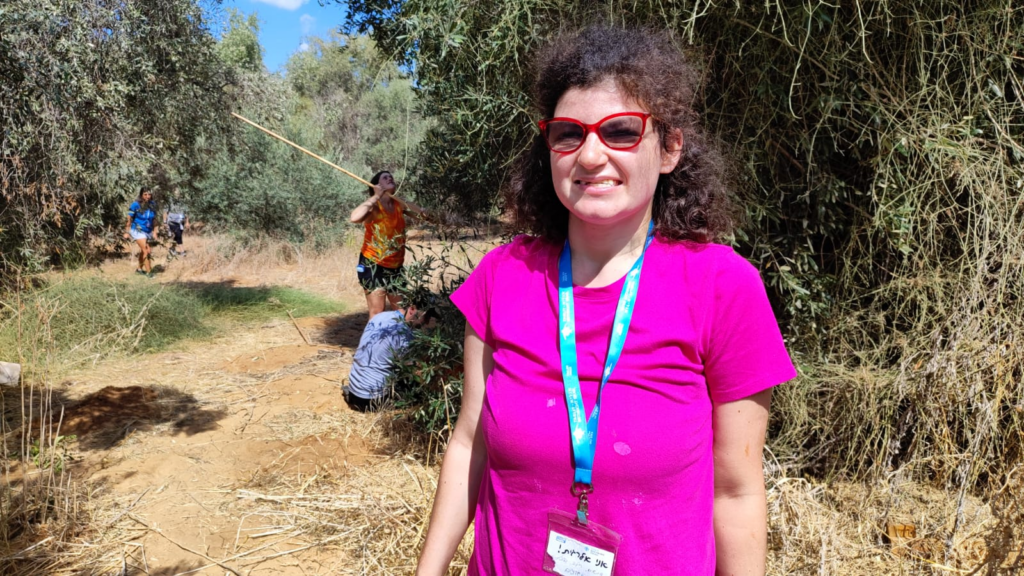
For Hannah Berman from New Jersey, the olive picking was a new experience. “I’ve never picked olives before. It’s a lot of work,” she said, showing her hand, which had red scrapes.
Nonetheless, “I don’t know how excited I am to go back,” she said wistfully, but she admitted that she would be “excited to see my family.”
Back home, Berman said, she was busy working on her autobiography, for which she conducts interviews with people in her life. This Israel trip won’t be included, she said, because she “has already picked the endpoint,” from before the trip.
Hannah Berman, an American volunteer harvesting olives in Rishon Lezion, on September 23, 2024. Berman was part of a trip for adults with non-physical disabilities who volunteered in various locations around Israel. (Gavriel Fiske/Times of Israel)
A major men’s tournament set to attract top players to Tel Aviv as well as six lower-level professional tournaments were canceled, a high-profile women’s tennis player offered negative comments about Israel, Israel Tennis Education Centers were unable to offer programs to hundreds of children, and Israel’s come-from-behind Davis Cup victory over favored Japan on September 17, just three weeks before the war, seemed a distant memory.
But thanks to the quick action and commitment of the Israeli tennis community, Israeli tennis is up and running, in the Holy Land and around the world, albeit with some caution and modifications.
The indoor hard-court Tel Aviv Watergen Open, scheduled for November 5-11 at the Expo Tel Aviv was abruptly called off due to the war. In a supportive statement, Association of Tennis Professionals (ATP) Chairman Andrea Gaudenzi said: “The violence and acts of terror witnessed in Israel are beyond comprehension. We strongly condemn any form of terrorism and mourn the loss of innocent lives across this conflict. We hope and pray for peace in the region.”
Two-time Wimbledon finalist and current world No. 6 women’s tennis player, Ons Jabeur, was less sympathetic.
Tunisian tennis star Ons Jabeur has condemned acts of violence on social media, but also included the hashtag #FreePalestine in her post. (credit: REUTERS)
The 29-year-old Tunisian Muslim wrote on Instagram: “What Palestinians have been going through during the last 75 years is indescribable. What innocent civilians are going through is indescribable; no matter what their religion is, or what their origin is. Violence will never bring peace; I cannot stand with violence but I also cannot stand with people having their lands taken.” She ended her post with the #FreePalestine hashtag.
Israel Tennis Association registers a complaint
The ITA (Israel Tennis Association), via the ITF (International Tennis Federation), approached the Women’s Tennis Association (WTA), the main organizing body of professional women’s tennis to complain about Jabeur’s post. Following a win at the WTA finals in Mexico in November, Jabeur continued to comment on the war.
“It’s very tough seeing children, babies dying every day,” she said. “It’s heartbreaking, so I have decided to donate part of my prize money to help the Palestinians.”
Avi Peretz, ITA chairperson, wrote in an ITA Facebook post: “This tennis player fights, incites and supports a murderous terrorist Nazi organization. We’re glad she’s in the minority…”
ITF President David Haggerty shared heartfelt condolences for the plight of Israel and Israelis.
“We are deeply shocked and saddened by the loss of life. Our hearts go out to all those affected by the violence in Israel in recent days.”
Haggerty also thanked the ITA for the help and quick actions it took regarding the evacuation of the dozens of players, coaches and judges who were present in Israel ahead of international tournaments that were to take place in Israel. He added that the ITF “strongly condemns the violence we have witnessed in Israel. It is our fervent hope that peace and security in the region can be found.”
When the Watergen Tel Aviv Open was relocated to Sofia, Bulgaria, on short notice, Peretz played an important role in the tournament.
“My father is from Bulgaria,” he noted. “This is his hometown, and for me this is a very emotional moment.
“I hope that the situation in Israel will normalize and next year we will be able to invite Stefan Tsvetkov [President of the Bulgarian Tennis Federation] to the tournament with us.”
Tsvetkov offered support for Israel.
“We sympathize with our friends from Israel who at the moment cannot have a normal life and sports calendar. I hope that there will be peace in the region again soon.”
At the Sofia Open, Adriana Mannarino of France defeated Jack Draper of England in the Finals, 7-6, 2-6, 6-3.
Back home, meanwhile, former Israel tennis great, Jonathan (Yoni) Erlich, current director of the high-performance program at ITEC, reports on their countrywide efforts to meet the needs of children in need throughout Israel during these difficult times.
“For the first 10 days, the whole country was in shock and all of the tennis centers were shut down,” Erlich said. “But right away, we were in communication with our kids – through chat, Zoom and WhatsApp. Since there was no school, we gave them videos for homework, and encouraged them to keep active and exercise.”
ITEC has helped over 500,000 children, many of whom live in underserved towns throughout Israel, since opening its first center in 1976. ITEC currently serves nearly 7,000 children weekly throughout 24 Israeli communities.
Erlich recounted ways in which ITEC families and staff have been pitching in during the war.
“When people were evacuated from the south and from the north, families in Tel Aviv, Ramat Hasharon, Jerusalem, Haifa, and other places opened their homes to players and their families. We really used our great and strong organization to take care of all of our kids.”
He noted that within two or three weeks, tennis centers with bomb shelters resumed tennis operations and children were welcomed to play in any open center.
ITEC has also hosted soldiers from Special Forces in their Ramat Hasharon center for what Erlich described as a day of “fun, tennis, lessons and lectures about motivation” by himself and his former longtime doubles partner, Andy Ram.
Erlich, who is also captain of Israel’s Davis Cup team, recently learned that his team will be playing its next round versus the Czech Republic in the Czech Republic in February.
Israel is one of 24 teams to play in the Davis Cup qualifiers on the road to the World Cup.
“It is huge! I feel very fortunate to lead the team and still be connected with the Davis Cup after 23 years.”
There have been some posts on social media calling on the ITF (International Tennis Federation) to not allow Israel to participate in the Davis Cup. They note the ban on Russian players in the wake of the Ukraine conflict, who have not been allowed to participate in team events in tennis since March 1, 2022.
Erlich is unfamiliar with such posts and looks forward to his work with the current team (he has not named the team members yet). He is also excited about the “next generation” he hopes will emerge in the next few years.
In the meantime, several potential Israeli Davis Cup team players continue to represent their country in tournaments around the world.
Yshai Oliel, No. 434 in the world, recently advanced to the quarterfinals and semifinals of several tournaments in Greece. Daniel Cukierman, No. 481, played several tournaments in Italy, advancing to the quarterfinals in Ortisei, Italy.
Erlich is looking forward to the very important upcoming Davis Cup tie.
“Now it is more urgent to do something great and show joy. We will go proudly to the tournament. If we usually give 100%, this year we will give 200%!”
What do you do post retirement when your job WAS playing in the US Open?
When tennis lovers retire from their jobs, they often choose to play more tennis to help overcome the inevitable boredom and isolation which often comes from no longer being surrounded by fellow workers.
They may even travel to some bucket-list tournaments such as the Australian Open, Wimbledon, the French Open or the US Open. But what do you do post retirement when your job WAS playing in the US Open?
For Israeli professional tennis players who spent many hot August days and late nights playing under the lights in Queens in front of large, raucous, Israeli flag waving crowds, the famed tournament still holds an important place – and they think about the tournament each August.
Shlomo Glickstein, now 65, was Israel’s most accomplished tennis player in the 1980s. He reached a career high ranking of 22 in singles (1982) and was No. 28 in doubles (1986). While he beat some of the world’s greats, including No. 1 Ivan Lendl and such top 10 players as Harold Solomon and Eliot Teltscher, he will never forget a US Open match in 1985 that he considers to be one of the most important matches of his life.
“One match could have changed my whole career,” Glickstein reported. “I played McEnroe in the first round in 1985. I wasn’t meant to come. My wife was due with our first baby. I was at a German league match and found out I was playing in the US Open!” He noted that he came to the US on a Saturday, and that it rained Sunday and Monday. “I played Tuesday with no practice. It was an unbelievable match. I lost in five to McEnroe – I was up 2 sets to 1. It was my most exciting and most important match ever. It could have gotten me back in the top 100.” Glickstein still recalls the match vividly 38 years later.
Andy Ram at US Open practice 2009 (credit: Wikimedia Commons)
In an August 28, 1985 New York Times article entitled, “McEnroe Barely Survives First-Round Match,” writer Peter Alfano writes of the four-hour match between the defending US Open champion and No. 175 ranked Glickstein: “With crowd behind him chanting ‘Shlomo, Shlomo, Shlomo,’ Glickstein nearly pulled off what would have been one of the most spectacular upsets in Open history. McEnroe would go on to lose in the finals to Ivan Lendl.”
Glickstein retired from tennis in 1988 and served as CEO of the Israel Tennis Association.
“For the first few years after retiring 35 years ago, I used to be into the US Open. It is still in my blood and nice to remember playing on the biggest stage. I went a few times and met a few friends.”
Glickstein reports that he worked at a New Jersey Y camp in the US for several years and he worked for the ITA (Israel Tennis Association) for 12 years. He served as CEO from 2007-2012 and was professional director during his last year there. He is now working privately in the tennis world and is coaching a few players.
Shahar Peer, 36, who played in the US Open for over a decade as both a junior and a professional, actually went to the US Open last year as a spectator, with her husband.
“I am pretty casual about it when the US Open comes,” said Peer, who currently lives with her husband, who is completing a medical fellowship, and two young children. “I don’t miss it. I had enough of tennis, I guess – the pressure, the commitment, everything around it! And I really enjoy my life now. All is good.”
Peer reached the US Open Juniors semifinals in 2004, and played her first US Open womens’ qualifiers that same year, where she advanced to the second round. She played in the US Open every year from 2005-2015, reaching the quarterfinals in 2007. Peer reached her best singles ranking of No. 11, the highest of any Israeli tennis player in history, in January 2011. She achieve a doubles ranking of No. 14 in 2008.
In contrast to Peer, fellow Israeli women’s player, Julia Glushko acknowledged: “I do miss it – a lot! I don’t feel sad at all – I’m very thankful for everything tennis gave me and for the opportunity to play the best game in the world.”
Glushko participated in every US Open from 2011 through 2019, with the exception of 2017. She played in the qualifiers for four years and played in the main draw four times. Glushko’s biggest success at the US Open was in 2014 when she reached the third round before losing to Daniela Hantuchova in a third set tiebreaker.
Glushko, who retired in 2019, that she does “miss competition though and funny enough, when I think of tennis, I think of the US Open most of the time. It is my favorite Slam and I’ve always done well there.”
Glusko playfully noted that when she “saw that Caroline [Wozniacki] was coming back to playing, it made me think that maybe I can do the same? I don’t think I will, but it definitely gets you thinking.”
Glushko will attend the 2023 to support her good friend Australian Pricilla Hon, No. 207, who is in the qualifying tournament.
While Amir Hadad, 45, may not be as well known as other Israeli tennis players, a single act one summer at the US Open lives on in tennis history.
“I still remember that famous summer of 2002 like it was yesterday. It was the one-year anniversary of 9/11,” Hadad recounts, referring to the time he teamed up at the US Open to play doubles with Pakistani Muslim player Aisam al Quershi.
The doubles team made it to the third round, where it lost to Wayne Black and Kevin Ullyett, both of Zimbabwe. Hadad also advanced to the quarterfinals of the mixed doubles, which he played with Petra Mandula of Hungary. That year, Hadad also advanced to the final round of the singles qualifiers.
“I love New York and the US Open. It is always great to be there to play. The last experience was a very big one. There was a lot of buzz around us. There was some good tennis and it was a special one for sure!”
While Hadad last played professionally in 2010, he continues to be in touch with friends from his playing days, including Indian doubles player Rohan Bopanna, 43, who is still competing professionally. He is also “still interested and very much involved in tennis.”
The father of two teaches and coaches in Tel Aviv and “watches all of the US Open – singles, doubles, all!”
Dudi Sela, a long time US Open favorite of Jewish and Israeli fans due to his good nature and stunning late-night battles on court, gives himself mixed reviews for his performance here, but praises the fans.
“I miss a lot playing the Grand Slams – the pressure and the excitement before the match, and of course the feeling of winning a match. Although I didn’t have much success in New York, I have a lot of friends in the city. I love the atmosphere on the courts and the Jewish people coming out to support the Israelis. I am lucky I found something that I like doing and I am still in tennis coaching.”
Sela will be on hand at the Open coaching Israeli junior Mika Buchnik, the 43rd-ranked junior in the world. The 16-year-old phenom trains at the Dudi Sela Tennis Academy and will be competing in the girls’ qualifying tournament. “I really want to help the younger generation in Israel to fulfill their potential and be much better players,” Sela adds.
Israeli tennis star ‘doesn’t miss’ travel and work of competitions
Andy Ram, half of the beloved Israeli doubles team of Ram and [Yoni] Erlich, hopes to spend some time at this year’s US Open.
“The US Open is a nice place to come. It is the biggest event in the tennis world. I am always excited to come as a spectator and to remember I was part of it. But I don’t miss the travel, the efforts. Watching it on TV and enjoying it and thinking I was part of it in the past is a nice feeling,” Ram noted. The 43-year-old retired from professional tennis in 2014.
Ram has kept busy since retiring. He spends time with his three children – ages 12, 8 and 4 – he owns three (soon to be six!) ice cream stores throughout Israel, he is a public speaker, and he works with an Israeli businessman as a consultant.
Ram continues to be involved in tennis as well.
“I am still close with Yoni. We talk every day and I am helping him with ITEC [Israel Tennis and Education Centers]. While he is not competing professionally, the US Open is on his mind. Ram jokes: “I still have a chance to win it – it is the only Slam I did not win!”
Ram’s Grand Slam accomplishments are far too numerous to mention. He won the Australian Open in doubles in 2008 with Erlich, and he won the mixed doubles at both Wimbledon (2006, with Vera Zvonareva) and the French Open (2007 with Nathalie Dechy). Ram and partner, Max Mirinyi, lost in the 2009 semifinals in Flushing Meadows.
Jonathan “Yoni” Ehrlich, 45, the other half of the Ram/Ehrlich team, recently retired from a decade’s long and distinguished tennis career. In addition to winning the 2008 Australian Open with life-long friend, Ram, he won 22 tournaments and attained a world doubles ranking of No. 5 in 2008. He also represented Israel at the Davis Cup and in the Olympics on many occasions.
While Erlich is not planning to attend this year’s US Open, he may be in a good position to assure Israelis will soon make it to the big stage. He recently joined Israel Tennis & Education Centers as Director of the High-Performance Program. He acknowledges: “We had had no great Israeli players in the last 20-25 years,” and says, “My focus these past six months has been on how to rebuild – coaches, players and the program.”
“My biggest challenge is to help create the next generation of Israeli professional tennis players.”
When Erlich is successful, we look forward to see him cheering on Israeli juniors and pros – from the coaches’ box at the US Open.