For Julia Glushko, Tuesday was a day of firsts on Court 6 at the US Open as the Israeli came back to beat Monica Niculescu 3-6, 7-5, 6-4 in first-round action.
It was the first truly hot day of the tournament; it was the first day using the Hawkeye electronic replay system where umpire’s calls may be challenged, the first match for Israel’s Glushko where on-court coaching is not permitted (it is allowed in the qualifying tournament but not in the main draw); the first day where some members of the crowd were loudly cheering for her tricky, forehand slicing Romanian opponent, Niculescu; and it was the first day when Glushko appeared in danger of defaulting mid-match due to an injury.
But the new-and-improved Glushko is adaptable and she is a fighter and was determined to play to the bitter end.
Glushko, ranked No. 162, took on Niculescu, currently No. 62 in the world, though Niculescu once reached a career high of No. 28 in singles in 2012, spent significant time in the top 50, has reached a high of No. 11 in doubles and played in the Wimbledon doubles finals in 2017.
Niculescu’s unconventional style of play, consisting of an extreme grip, a topspin backhand and an unpredictable forehand slice is different than nearly every player on tour and takes some time for opponents to learn and master. And her first serve percentage – 92 percent in the first set to Glushko’s 54% – is one of the highest in tennis.
Glushko quickly learned Niculescu’s style, often hitting deep to her backhand to avoid her deadly slice forehands. Glushko also attacked the net more often than usual. Neither player held serve until Niculescu held in game 5, broke Glushko and held again to go up 5-2. Glushko managed one more game before being closed out 6-3.
Glushko came out fighting in the second set and appeared on course for a major turnaround. Glushko served and won the first four games to go up 4-0. Then Glushko had what appeared to be a freak, nearly match-ending injury. She collided with the net post with her left knee and came crashing to the ground. She remained on her back, audibly crying, with her left knee up.
A compassionate, quick thinking Niculescu was the first responder, bringing ice and kind words to her opponent as Glushko awaited more proper medical attention.
To the crowd’s astonishment, Glushko returned to action following a medical time out, her left knee wrapped extensively.
While Glushko favored the leg slightly, she returned to action at her usual high level of play. She gave up two games before holding serve to go up 5-2. It was Niculescu’s turn to go on the offensive, as she battled back to 5-5 before Glushko mustered enough strength to close out the 69-minute set 7-5.
Both players got a fresh start with a required 10-minute break for changing outfits and a bathroom break. Glushko abandoned her tennis whites for a black shirt and white skirt, though the 28-year-old Israeli began the third and decisive set down 2-0.
Aggressive play, careful shot placement and long rallies brought the set to 4-4.
Glushko inched ahead to go up 5-4. The crowd, evenly split between pro-Israel Glushko supporters and pro-Romania Niculescu supporters nervously awaited the outcome of game 10. Glushko, on her back injured and wailing just one set earlier, closed out the 55 minute set and fell to the ground – this time with tears of joy.
Coach Keren Shlomo acknowledged that Niculescu was an especially tough opponent due to her tricky slices.
“Julia played very well first set, she hung in there, and was very aggressive – and she pulled it off,” said Shlomo, who admitted feeling nervous when Glushko fell to the ground. “She pulled through in her mind and heart and did it well. “ By winning the two hour, 38 minute first-round match, Glushko moves on to the second round and is guaranteed to receive $93,000. If she beats No. 20 seed Naomi Osaka of Japan to advance to the third round, she earn $156,000. The US Open remains the richest purse in tennis with total compensation of $53 million.
The male and female singles champions each earn $3,800,000.
In other action, former world No. 1 Caroline Wozniacki cruised past error-prone Samantha Stosur 6-3, 6-2 to reach the second round in Flushing Meadows.
The Dane, who is the highest seed left in the draw after top seed Simona Halep fell in the first round on Monday, needed less than 90 minutes to get past the Australian, who committed 34 unforced errors and eight double faults.
The quick and comfortable win was a relief for the 28-year-old Wozniacki, who was able to get out of the blistering New York heat in relatively short order and save energy for her second-round match against Ukrainian Lesia Tsurenko.
Also, Jelena Ostapenko sweated out a 6-4, 4-6, 7-5 win over German Andrea Petkovic to reach the second round as the thermometer pushed towards 100 degrees Fahrenheit (38 Celsius).
Jewish-American men’s No. 139 Noah Rubin was beaten by Russian Mikhail Kukushkin 6-3, 6-1, 4-6, 7-6(3) in their first-round duel.
Day 2 of the US Open qualifiers offered music and dance, the official dedication of the new 14,069 seat Louis Armstrong Stadium, and lots of great tennis.
Early arrivals got to see Roger Federer up close practicing in the Grandstand. Trumpeter Wynton Marsalis led an eight-piece marching band in a musical performance as part of the Armstrong Stadium dedication, and tennis legends James Blake and Michael Chang defeated John and Patrick McEnroe 4-6, 6- 12-10 in the first match ever played on the new Armstrong Court.
And guests enjoyed musical and dance performances from Paraguay, Ecuador, Mexico and Peru as part of US Open (New York City borough of) Queens Day.
Dozens of matches today on 14 courts included 14-year-old Cori Gauff battling Heather Watson in a qualifying match (Watson won 6-4, 6-1). And Israel’s only remaining entrant in the qualifying draw, Julia Glushko, survived a two-hour scare from Mexico’s Renata Zarazua.
Glushko, ranked No. 162 in the world, got off to a slow start and trailed 4-0 before battling back to 4-4. The momentum appeared to shift and Glushko, up 40-0, appeared ready to break No. 228 Zarazua and cruise to victory in the first set. Instead, Zarazua took the first set 6-4.
Glushko lost the first game of the second set then played aggressive, hard-hitting tennis, which included approaching the net for putaways three times in one game. Gluskho, with the support of the crowd, took the set 6-1.
In the deciding third set, Glushko started down 2-0 and held serve in the important third game. Glushko broke Zarazua in the fourth game and again held serve to bring the set to 3-2. At 4-4, Glushko again demonstrated her capacity for aggressive tennis, which included risky shots deep on the baseline, volleys and overheads. Glushko went up 5-4 to receive for the match. Up 40-30, Zarazua made an uncharacteristic double fault. Glushko #162 won 4-6, 6-1, 6-4 and advanced to round two of the qualifiers Thursday versus No. 106 Viktorija Golubic of Switzerland.
Glushko was pleased, if not a bit surprised by her victory following a slow start.
“Oh, My God! I was so nervous in the beginning, I couldn’t breathe!. But I got out of it. I am so happy I got through,” said the 28-year-old Israeli.
Glushko took three months off of tennis earlier this year and started working three months ago with new coach and former Israeli tennis player Amir Haddad as well as with a new fitness trainer. She also travels with former Israeli tennis player Keren Shlomo, who was offering coaching from the sidelines during Wednesday’s match.
Gluskho is pleased to be surrounded by positive people who believe in her and attributes much of her recent success to her team, as well as to her hard training and positive attitude.
“I feel like my mental game was really good today. I focused on the good stuff and the positive talk to myself really made a difference.”
Shlomo agrees: “Julia started very nervous but she pulled through. She did the things we talked about and she pulled it off. She has been working really hard and really wants it. She deserves it!”
With Deniz Khazaniuk’s round 1 qualifiers loss Tuesday to Tamaar Kopratsch of Germany (4-6, 6-4, 6-3), Glushko is Israel’s only hope for a player in the US Open Main draw. She will need to win Thursday and Friday to win one of the coveted 16 remaining spots in the womens draw. While Israel tennis fans have grown accustomed to seeing the likeable Dudi Sela at the US Open each year, he will not be playing this year.
Sela, ranked No. 166, has been plagued by an arm injury and has not played since reaching the quarterfinals on grass at the Dell Technologies Hall of Fame Open in Rhode Island in July. Another crowd favorite, Yoni Ehrlich, will enter the doubles draw for this year’s US Open.
There are no Israelis playing the junior US Open tournament.
WEST BLOOMFIELD, Mich.—Felicia Bowers’ smile was the size of Lake Michigan when she received the latest update on the number of Facebook viewers who have watched the “Art Through Felicia’s Eyes” video. “You just broke 1 million!” exclaimed Bassie Shemtov, co-founder and director (with her husband, Rabbi Levi) of Friendship Circle. Within a few hours, the number of viewers had already jumped to 1.2 million.
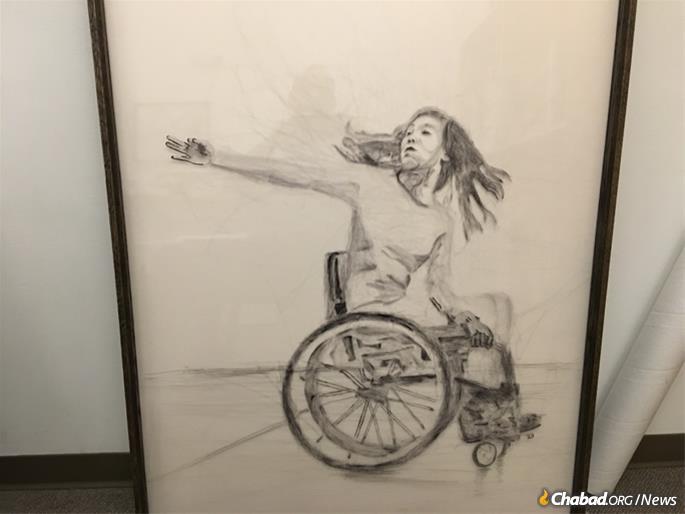
The 27-year-old Detroit resident and her art have been receiving a great deal of attention, partly due to her portrait, “The Dancer”—depicting a very active dancer in a wheelchair—which sold for $14,500 as part of a recent evening event that raised more than $100,000 for the Friendship Circle.
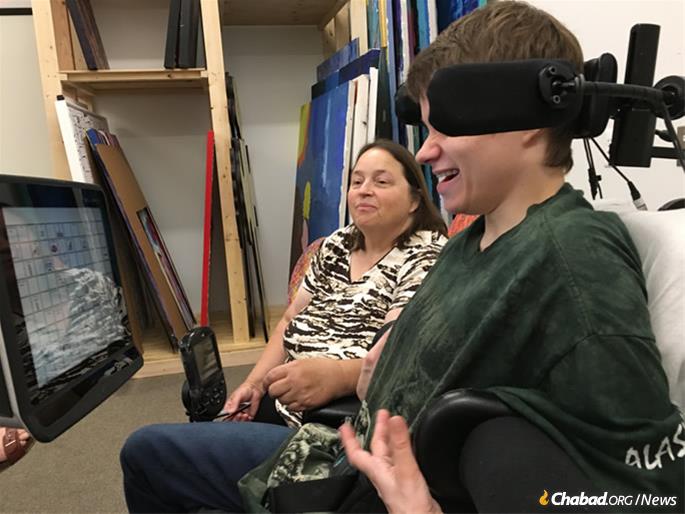
Bowers is intelligent, articulate, persistent and has a great sense of humor. She also has cerebral palsy, is non-verbal, uses a wheelchair at all times, and communicates—and draws—with assistive technology, a Tobii Dynavox tablet with Eyegaze eye-tracking software.
The artist has many followers and admirers in the Detroit area, across the United States and online. Using her eye-tracking equipment, she recently spoke with Chabad.org at Friendship Circle’s Farber Center in West Bloomfield Township, Mich.—and shared her interest in art, how she uses her eyes to communicate and create art, her involvement with Friendship Circle, and her advice for other artists with and without disabilities.
We met in an art room, surrounded by works created by Felicia Bowers and other artists with disabilities at the Dresner Foundation’s Soul Studio. Her mother, Tina Bowers, and Friendship Circle of Michigan’s special-projects coordinator, Jamie Reedholm, joined in the conversation.
The Interview:
Q:Tell me a little bit about yourself. How old are you? Where do you live? Who are some important people in your family and circle of friends?
Felicia: I am 27 years old. I live with my mom, dad and my dog, Max. He is a Shiatzu. He comes here sometimes and sits on my lap!
Q:How and when did you hear about Friendship Circle? What are some of the things you do here?
Felicia: I was watching the news and saw Lillia.
Jamie Reedholm: From the beginning of Friendship Circle, we had a young woman named Lillia who, like Felicia, was in a wheelchair. They had a lot in common, but we learned that afterwards. We were able to get Lillia her own apartment. And with the generosity of the people in our community, it was fully accessible and totally hers. The news came and did a story about it. That’s how Felicia and her family learned about Friendship Circle. Sadly, Lillia passed away.
Q: Can you explain how you are communicating with me right now?
Felicia: I use my eyes to say what I want. There is a camera in the bottom of my device. It tracks my eyes, and when I look at a particular square, selects it. It is a type of Dynavox, a Tobii Dynavox.
Tina Bowers: It can strain your eyes. She is very strong. She had help programming each page—each square has a sentence underneath—she knows what is under each square. She knows where everything is, where she needs to go. She does a lot of spelling. She goes to the dictionary. She looks for a word.
Felicia: My boyfriend, John Wirth, programmed my Tobii.
Felicia Bowers using her Tobii Dynavox tablet with Eyegaze eye tracking software, as her mother, Tina Bowers, looks on.
Q:What are some of the things you do when you come to Friendship Circle?
Felicia: I went shopping and bowling and swimming. I met new friends.
Jamie: The first program she was involved in when she came to Friendship Circle is called “Teen Trips.” Every Sunday, we take teens and young adults on trips.
Q: When did you start with the art part of the program?
Felicia: 2016
Q: How did you discover that you were interested in art?
Felicia: I have always enjoyed art. I remember the first time I created art in middle school. It was the first time I felt free from cerebral palsy and in control of my body.
Q: What did you do? What was the project when you had the moment when you felt so free?
Tina prompts Felicia: Do you remember what you were drawing? Were you painting? Painting with your foot? You were painting with your foot. You had different colors, with a paintbrush taped to your foot. She colored with her hands, but we had to tape crayons on to her hands and we had to mount the paper a certain way to the table for her to color. When she was about 2 or 3 years old, she was walking in the baby walker. I had taped crayons onto her hands, and she walked over to the wall and I had told her not to color on the wall, and she colored on the walls!
“The Dancer”
Q: So she was very typical … big surprise … a defiant 2-year-old …
Tina: Her dad saw it and said, “No!” so we got a piece of plywood and leaned it against the kitchen cabinet and stuck paper on it, and she used to draw while walking over there. It is funny—while in baby-walker upright, she would always go backwards because she didn’t have good support of her body. I was talking to my mom one day and saying, “I wish she could walk forward.” Next minute—she came out from the kitchen, into the living room, walking forward. She leaned against the tray and was walking forward. That is how she was coloring—she would support herself on the tray of the baby-walker, and she would go over and color on the board—that’s why her dad set it up there so she could get to the paper, leaning against it and just color.
Q: (For Tina): You saw she had this interest from an early age, that there was this interest in art, something inside … ?
Tina: Yes. She was drawing lines, always telling me what colors she wanted. She was doing color selections. That’s when she was a baby. I didn’t know it was going to go anywhere because we didn’t know how much her body could do. As she got older, it seems she went from elementary to junior high, and when she got the communication box, she was using a switch. We didn’t have the Eyegaze at that time. But she still had a unit where if she wanted something, she would go to each block, and when she wanted that square, she clicked the clicker—with your foot, right?
A self-portrait by Bowers with her boyfriend, John Wirth
Q: I get the feeling the artist was always inside and with each technology (brush on foot, crayons on finger, etc.) it became …
Tina: She is still growing, and doing more and more and more. And now look what she is doing with lines, with her eyes.
Q: What is your favorite form of art? Is it line drawings, painting, ceramics …
Tina to Felicia: Is it the line drawing? You should put that (the response) in there (in the Dynavox).
Tina: It refreshes her memory for what she wants to say … when she hasn’t talked all day, she is trying to figure out what to say …
It has always been inside of her. It’s just now she is trying to get it all out and it is really very frustrating for her to get her thoughts on the screen, to type all the sentences out. It has been very frustrating all these years. She has been trying to tell us so much all these years.
Now that she has started Soul Center, she has gotten stronger and is learning a lot more—not just drawing, but talking.
Jamie: The social aspect.
Tina: She needed all this. She had some at school, but it is stronger here. And since she has been with John, she has gotten stronger. It is amazing.
Works on display at the Dresner Soul Studio, a unique vocational training program, studio and gallery where artists with disablilites work daily from 10 a.m. to 3 p.m. Their work is then sold in the gallery.
Q: What are some of the themes in your art and why? Things or ideas which keep coming up? That you like to draw?
Felicia: My favorite art piece is to make art which reminds me of the people I love.
Q: Can you give me an example? Something you draw that reminds you of people you love?
Felicia: (Staring at the wall across from her, at her self-portrait of her and John) (Everyone laughs)
Q: Where did you get the idea of the dancer? Do you like to dance?
Felicia: I was little and used to go to Eagle’s Club.
Tina: They used to have a dance; you could take your family and dance. My sister would push her around in her wheelchair and dance with her, twirl her around. That’s what brought that out. That’s what she’s feeling when she sees a dancer. The painting is an actual dancer in a wheelchair dance company in L.A.
Rabbi Levi Shemtov, co-founder and co-director with his wife, Bassie, of Friendship Circle
Q: What are you working on now?
Felicia: I am drawing Ellen!
Tina: Television host Ellen DeGeneres.
Q: I know you guys aren’t Jewish. What is it like to be included in a Jewish program?
Felicia: We appreciate being in the program.
Tina: She really appreciates everything they are doing. She is growing so much more with her communication box, learning more, talking more and getting more words out there. This has opened doors even more.
Q: What is your advice/message for other artists—with and without disabilities?
Felicia: Never give up!
Q: What do you think our society has to keep doing to be more welcoming and inclusive and better for people with disabilities?
Felicia: Be caring and understanding.
Q:Last question. Can you describe the night when your “Dancer” portrait was sold? What was that like? How did you feel?
Felicia: Wow.
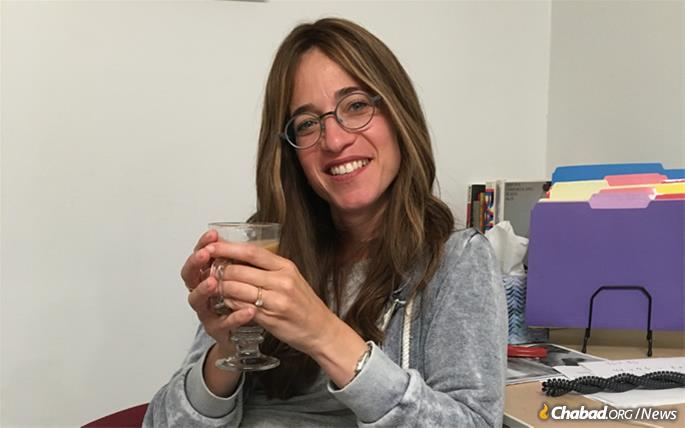
Bassie Shemtov, co-founder and co-director (with her husband, Rabbi Levi Shemtov) of Friendship Circle
Artists and Teachers Express Hope for the Future
While Felicia and her art continue to receive worldwide attention and praise, she is one of a number of talented artists and teachers at the Dresner Soul Studio, a unique vocational training program, studio and gallery where artists work daily from 10 a.m. to 3 p.m. Their work is then sold in the gallery.
On the day of my visit, Rollie King of Minneapolis was walking around the gallery. “I really love art, and I’m beyond amazed. This stuff is really great!” She pointed out some of her favorite pieces. “This clock is outstanding!” She is particularly proud of her nephew, Kevin Shink, an artist in his mid-50’s, and pointed out his large three-dimensional creation depicting the city of Detroit.
While Bassie Shemtov is proud of all of the artists, there is particular pride in Felicia Bowers. “Felicia will be able to make a real living, especially as her story is getting out there and as she creates more work, which is something that nobody thought was possible.”
Shemtov says that much of the studio’s success can be attributed to the dedication and creativity of Anthony Marcellini, programs and exhibitions manager at the Soul Studio. “Anthony is so talented. He had no experience working with people with special needs before joining us here,” says Shemtov. “Yet he has a knack of understanding people and truly respects and loves the artists.”
Paintings on display at the Dresner Soul Studio
Marcellini notes the unique opportunities at Soul Studio, “For me, what has been most revealing about working with someone like Felicia is discovering her potential. Because cerebral palsy limits normal methods of communication, many people would write her off as non-verbal and perhaps even low functioning. But actually, she is very smart and has enormous verbal and creative potential. She simply needs the right tools to work around her specific situation. She needs challenges and encouragement to create, newer, different and better work along the way. This is actually the same with every artist in our program, though each person’s specific needs and drives are different.”
Marcellini has been instrumental in helping Felicia continue to find ways to be her best as an artist. Felicia has evolved from painting with her feet and using crayons attached to her fingers, to carefully sketching with her Dynavox. Marcellini explains the technical aspects of Felicia’s drawings.
“Felicia draws using a Tobii Dynavox tablet with Eyegaze eye tracking software. Because of Felicia’s cerebral palsy she is unable to use her arms and legs to the precision she would like to make art. So she has learned how use eye tracking software, to move a cursor across the computer screen and make lines. Every time she turns her eye towards the screen it is like she is clicking the button on the mouse, or like putting pencil to paper, and when she moves her eye away it unclicks, like lifting the pencil off the paper. This, as you might imagine, takes tremendous precision and concentration to operate. Felicia has been using this software and similar software for quite some time, and is able to do this simply because she is very precise, hardworking and talented at it. We are now trying to get her to loosen up and be a little freer with it, to explore new and freer ways of expressing herself. We are also trying to bring in some of the methods she used in the past, like painting with her foot or head, to add some expression to the drawings.”
Marcellini loves his work at the Soul Studio. “What is so exciting about this place is that it is an art studio first, where participants come to the studio curious, enthusiastic and driven. They are met by an equally curious, enthusiastic and driven staff of practicing artists and designers, whose sole aim is to propel their creative ideas into new spheres by providing tools to sidestep or surmount their disabilities. It is a place of constant surprises that has totally shifted my perspective, on education, service and ability. Here art serves as a primary form of communication when common forms are less accessible.”
Artist Kevin Shink with his large three-dimensional creation depicting the city of Detroit
Nicole Kahan began volunteering at the Friendship Circle when she was in seventh grade and continued to work here through high school. She sees tremendous benefit in Friendship Circle for both participants and for the community. “It benefits the overall community because it normalizes people with disabilities and shows the community that we can all be friends. It benefits its volunteers because it allows people to interact with others they wouldn’t normally interact with. It also helps you gain a lot of leadership experience as well as normalizing these interactions. It creates opportunities for teens.”
Kahan is one of the many admiring members of the Detroit community who appear in the viral “Felicia’s Eyes” video. “When I first saw Felicia’s artwork, I truly was speechless. She had the ability to create something so incredible in such a different way.”
Team Israel’s Cody Decker continues his playful ways – even in American professional baseball.
Cody Decker was arguably the heart, soul and class clown of Israel’s baseball team, which took the world by surprise in the 2017 World Baseball Classic. Decker and his teammates won the qualifiers in Brooklyn and they beat three opposing teams (South Korea, Chinese Taipei and the Netherlands) in the first round in Korea. Team Israel then lost two of three games in Round 2, played in Japan.
“Cody Decker played for all three teams that Israel has fielded in the WBC and there is no doubt that he has been a vital cog in all of them. Aside from his playing skills and ability to play a multitude of positions, it’s his personality, his way to keep the guys loose, his perspective on life and the game, that have made him most valuable. He ‘gets it’ and he’s able to get others on board.”
Decker and nine teammates visited Israel last year before the tournament.
“I think that having Cody and Jenn [his wife] on the trip to Israel made ‘the cause’ that much more real for him. For the first time, he really understood what he was playing for and the speech he gave at the Beit Shemesh field dedication exemplified that commitment,” adds Kurz.
Decker currently plays infield for the Reno Aces (the AAA affiliate of the Arizona Diamondbacks) in the Pacific Coast League, where he is batting a solid.261 with eight home runs and 24 RBIs.
The love and admiration felt for Decker during the World Baseball Classic continues in Reno.
Aces catcher Anthony Recker observes, “Cody is a blast to be around. He’s always one of the first guys in the building and last one out. He’s the kind of guy who knows when to have fun and when to get down to business. I’m glad to have him as a teammate.” Aces manager Greg Gross adds, “Decker has provided us some offense off the bench this year and is always a threat to go deep. His personality is obviously there and is fun for the guys in the locker room. He’s a talented ballplayer and has been for a long time in this league.”
The Magazine caught up with Decker in the dugout after the Reno Aces defeated the Sacramento River Cats (the AAA affiliate of the San Francisco Giants) 8 to 2. Decker struck out in the bottom of the sixth, his only plate appearance, when he appeared as a pinch hitter.
Have you seen the 2018 documentary film Heading Home: The Tale of Team Israel yet?
Yes, about four times now. Jenn did a Q and A for a group; I’ve done some Q and As and will be doing another in Orange County (California) in the off season, so that will be fun.
My impression is that the film is good. I am very glad they made it; they need to work on marketing. It is far less a Jewish story than a baseball story. It is about putting together a ragtag bunch of players who had been overlooked their entire careers. We had a chance to go out in front of the world and show that we were better than they thought. That was the story, but it was more that – we happened to all be Jewish. I kind of love that this is how it was all put together. I think that is the right story to tell; there are plenty of Jewish elements. It is as much that as it is the other story.
You and Jenn both got to go to Israel? You recently got married?
We went to Israel – Tel Aviv, then Jerusalem and stopped in Beit Shemesh. At no point did I think that I would enjoy Jerusalem more than I enjoyed Tel Aviv – this big, beautiful thriving city. I was expecting Jerusalem to be old and very historic but not as grand as it was. WOW – was I way wrong! I loved every second in Jerusalem. It was beautiful, amazing watching all faiths throughout. That was really cool when the Muslims were praying. My wife (we got married six months ago) is Christian, so seeing a lot of the old churches and going with the tour guide and learning. This right here is where Jesus was. The whole trip was very fascinating. It was fantastic and we loved every second of it.
When you think about what it has done for your relationship with Judaism, and Israel – what is it like looking back?
I can’t wait to go back! I wouldn’t say it necessarily made me more religious or spiritual or anything but it makes you appreciate… I have always appreciated my heritage. Going over there and seeing the Western Wall – it was probably the most striking thing to me. We went on a Friday night. There were so many people praying and dancing. It was crazy – it was great – I loved every second!
Do you think Team Israel will be part of your future down the road?
Peter [Kurz], the team president, is hoping that I am coming back to Team Israel!
Do your teammates on the Aces know about this Team Israel and Jewish part of you?
Not really – it is not something that regularly comes up in conversation. The fact that I am Jewish almost never comes up. Unless I make a joke about it – every time we have Sunday chapel, I say like, “When is the rabbi getting here so I can pray too? Can I join?” They say, “It’s nondenominational.” “You mean that Sunday Christian chapel you guys are doing? Nondenominational, huh? Cool. Yeah, I’m busy…
Sounds like there are not that many Jewish ballplayers…
There just happens to not be a lot of Jewish baseball players. I don’t think there is any particular reason for it, other than that there just aren’t that many of us. I grew up in Santa Monica [California], a huge Jewish community, and I played with a lot of Jewish kids. I’m not going to lie to you. Most of them were terrible! It is not because they were Jewish. They just weren’t very good at baseball. Then when I got older and started traveling the country, and occasionally the world, you find out there just aren’t a whole lot of Jews playing baseball.
You go around the country, in Texas and certain spots in Florida, there just aren’t that many Jews around. It’s not like Santa Monica, where it is just normal. A large Mexican community, a large Jewish community, a large African American community, and for whatever reason, I was just unique, I was just brought up with that.
Has your role as team prankster continued with the Aces?
No, I’m leaving guys alone. People are watching me too closely. They know I’ll do it! I’d love to but… I’ll even say something and they’ll give me the side eye. They’ll think I’m lying or trying to set them up. I’m not. I’m actually enjoying that more than anything, that people are very suspicious of me at all times. It keeps them alert, I think.
Do they know about the Mensch on the Bench? Are they aware of that?
They are. The Mensch on the Bench was over in Jackson. He is back home in Santa Monica. We shipped him in a huge box. He is in my parents’ office and it’s just a gigantic box that happens to have a Mensch in it. I was thinking of selling it. I think it is time to sell it. Or auction it off for a charity. I don’t know how to do it.
But your teammates here don’t know about the Mensch on the Bench?
Yeah, they do. It was in my locker in spring training. It had its own locker in spring training. I had my locker, which said “Cober Commander” on it, and the next locker next to me was the Mensch. The Mensch was there.
How has the experience been with the Aces? I heard you had some injuries, pitched a little bit…
I pitched because we were out of pitchers. I don’t think I am too worried about my arm going to pieces, pitching 52 miles per hour! I am just going up there to throw strikes and let them get themselves out. Injuries? I’m good.
This is my seventh season in the PCL [Pacific Coast League], my fifth or sixth PCL team…Tucson, El Paso, Albuquerque, Omaha, Vegas… seventh! I’ve always had a lot of success playing here as an opposing player. Coming here I got off to a really hot start. Important guys in the Diamondbacks organization got activated so my playing time took a pretty hefty dip. I had to work on being off the bench, which is not the easiest of jobs. I had a DL [disabled list] stint during that time. I’m having a pretty good year all things considered. I know what I can do on the field. I’ve always felt I belonged in the big leagues; that’s why I’m doing this.
But I will say the Aces have been fantastic. The front office has been good. The stadium is always beautiful. Our locker room is great. Our jerseys have gotten better. We had a jersey issue… we had two jerseys that weighed roughly 35 pounds [15.8 kg.}. Luckily, we fixed one of them. The other one still weighs a solid ton and a half.
The Diamondbacks organization has been nothing but the most classy, honest and well-put-together organization. I really appreciate being a part of this organization. Hopefully I will get out there more consistently eventually and get a shot at the big leagues.
Any plans for All-Star break [which started the day after the interview]?
I’m actually flying to Las Vegas to meet up with my wife, which I am very excited about. Four nights with my wife will be very nice. Take her out to dinner, maybe go to a show or something. I look forward to seeing her.
Is that where you are living?
No, we are based in Los Angeles, but she is going there for work stuff. I’m flying there. She is driving there as we speak. I’m going to meet her there.
Has the Jewish community in Reno reached out to you?
Is there one here? I’m not gonna lie to you, I don’t know of one. So I have been reached out to by no one. Normally when I go play in a place, I’ll be stretching before a game, and I’ll have like five people yelling “Cody, Cody, I’m Jewish.” I don’t know, I don’t know of a Jewish community here. But in fairness, I haven’t been out trying to find it.
Do you think that Team Israel is something that can be in your future?
That’s a couple of years down the road. I guess we’ll address it when it comes up. The qualifier was a really great experience. Loved every second of the qualifiers. It was a special group of guys.
Are you still in touch with those guys?
I was already in touch with them to begin with. Nate Freiman and I had played together for years. Nate is one of my dearest friends. He was at my wedding. And I have known Zach Bornstein for a long time. Ryan Lavarnway is a good friend. There are not many of us. We kind of all have friendships. Blake Gailen, we would hit together every off season. He is still one of my good friends. He was almost in my wedding. He was on standby in case somebody went down. It is a good group of guys, every one of them. I miss them and look forward to seeing them all again. I’m sure I’ll some them again, somewhere down the road. All in all, it is a good deal.