Original Article at The New York Jewish Week

A partnership between Ramah and Birthright brings young adults with disabilities to experience Israel

Los Angeles Jewish communal professional Michelle Wolf’s daughter had been on a Birthright Israel trip, and she wanted her 22-year-old son Danny to have the same experience. But until recently, she thought that a free Israel tour together with young peers was not in the cards for Danny, who has cerebral palsy and many specialized needs.

To Wolf’s delight, her son is headed to Israel this December on the first-ever Ramah Tikvah/Amazing Israel Birthright Israel trip. Ramah, the camping arm of Conservative Judaism, has organized Israel trips for Tikvah Program participants and alumni in the past. This, however, is the first one being offered in collaboration with the exceptionally successful initiative that has brought more than 600,000 young Jews to Israel since 1999.

“When we got an email about the trip, we were so excited! Danny is thrilled to be going to Israel with some of his friends from Camp Ramah in California, where he has gone for the last nine summers,” said Wolf.

According to National Ramah Tikvah Network director Howard Blas, between 20 and 25 young adults with disabilities are expected to fly to Israel from New York on December 18 for the 10-day adventure. The trip’s itinerary includes Jerusalem, Tel Aviv, the Galilee, and Masada. There will also be unique opportunities, such as a meeting and conversation with IDF soldiers with disabilities.

Many—though not all—of the 18- to 29-year-old participants will have attended a Tikvah Program at one or more of Ramah’s ten overnight camps. Those who have applied and been accepted to the trip hail from every region of North America.

Elana Naftalin-Kelman, Tikvah director at Camp Ramah in California, noted that the largest contingent is from her program.

“The combination of Birthright and Ramah is one that our families have been waiting for. Raising a child with disabilities is very expensive and families don’t have disposable income. This trip is finally giving our Tikvah families access to Israel for their children,” she said.

Naftalin-Kelman expects this Israel experience to deepen the relationships between the Ezra (vocational training program) participants and the other staff at her camp next summer.

“The young men and women in our Ezra program already have good connections with members of our mishlachat (visiting Israeli counselors), but I think those bonds will become even deeper this coming summer due to this trip,” she said.

Those who will have been on the Birthright trip will also be able to share common experiences and memories with neurotypical peers at camp who will likely have visited Israel with the Ramah Seminar summer program, or Tichon Ramah Yerushalayim, Ramah’s semester in Israel for high school students.

Tikvah Program founders Herb and Barbara Greenberg look forward to welcoming the Birthright group during their visit. The couple, which made aliyah in 1998, knows how much detailed planning goes into organizing an Israel trip for young people with disabilities.

“We organized the first Tikvah Israel trip in 1984, and it was not only a learning experience for our kids, but also for Israeli society, which was not used to seeing and interacting with groups like ours,” Barbara Greenberg said.

“Israel had no concept of inclusion to that point,” she said.

The Greenbergs led seven trips through the early 1990s (Blas led subsequent trips), each time increasing their knowledge about how to help young people with disabilities experience Israel. For instance, they discovered that everything on the itinerary had to be a hands-on and on-site activity.

“You can’t talk about the history of a place while riding on the bus. You have to talk about it when you are actually at the site, so that there is a visual, tactile and experiential context,” Herb Greenberg said.

These concrete connections help form strong memories for the trip participants.

“The kids come back with the same feelings as any other kid. They have a visceral connection to Israel and feel more Jewish,” Barbara Greenberg said.

New Yorker Jacklin Simoni is sending her 20-year-old daughter Nora, who attends the Tikvah Program at Camp Ramah in New England, on this December’s trip for just this reason.

“I want her to see what I saw when I first visited Israel. I was so excited to visit Jerusalem and the wall, I felt I was part of a bigger community that just my own,” Simoni said.

Read more

Original Article Published On The Ruderman Family Foundation

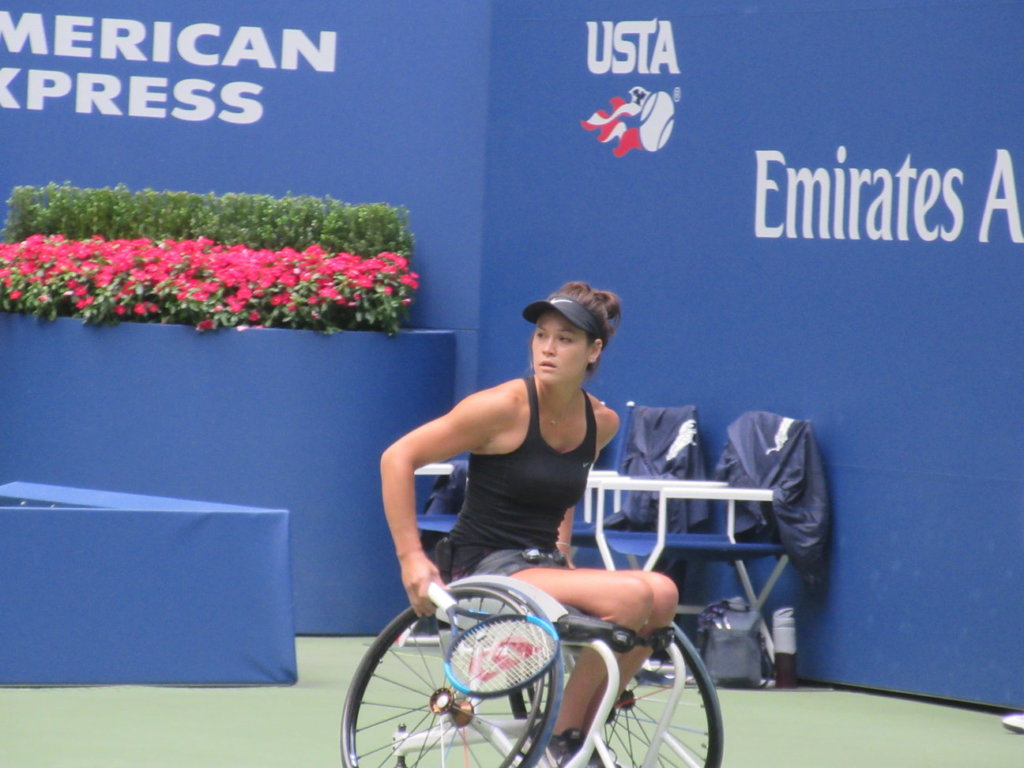
Dana Mathewson hits lightning serves and ground strokes and races to return seemingly out of reach tennis balls on Arthur Ashe Stadium at the prestigious U.S. Open tennis tournament.  Yet, her name is not nearly as well known in the tennis world as Roger Federer, Rafael Nadal and Serena Williams.  Every time this 26 year old number #1 ranked player from San Diego takes court for singles or double matches, people notice more than her amazing strokes.   Dana and her opponents play world class tennis while sitting in specially designed, light weight wheelchairs.  Her journey to Arthur Ashe stadium is a result of her great determination and talent.  It was also made possible by extraordinarily innovative and inclusive programming, both at the U.S. Open and at the University of Arizona where Dana was introduced to wheelchair tennis.

At the US Open, wheelchair athletes receive the same treatment and respect as all other participants—chair umpires, ball persons, digital scoreboards, press conferences, and even the chance to play in the famed Arthur Ashe Stadium.  Following Mathewson’s first round doubles victory with partner, Aniek Van Koot of the Netherlands, they were interviewed post-match by the on court emcee and signed autographed balls which were hit in to the stands for lucky fans to catch.

Mathewson’s journey to the U.S. Open began when she contracted a rare neurological disease known as Transverse Myelitis at age 10.  The disease causes the immune system to attack the spinal cord and she went from running sprints on the soccer field to being paralyzed in a matter of minutes.  Mathewson’s mother recognized the importance of sports and recreation for physical and mental health and encouraged Dana to play adaptive sports.

Dana Mathewson and doubles partner,   Aniek Van Koot of the Netherlands, communicating between points on court at Arthur Ashe Stadium during first round/semi finals 2017 US Open doubles match.  The two won the match and lost in the finals 6-4, 6-3 to Buis and de Groot.

When it was time to explore colleges, Mathewson wanted to find a place where she could continue her athletic career.  Unfortunately, most universities fail to go beyond minimal compliance with the ADA (the Americans with Disabilities Act).  Campuses provide services to help students with academics, such as extended time on tests and note-takers in class.  However, the University of Arizona takes a more holistic approach to inclusion for students with disabilities.   The institution acknowledges the importance of sports, recreation and healthy living for students with disabilities.  The University of Arizona’s adaptive athletics program is open to students and community members and currently includes five competitive sports: basketball, rugby, track, road racing, and tennis.  The athletic department is housed within the disability resource center.

“When I heard Arizona had a program, I said I was definitely going there, and they offered me a scholarship. It is not an NCAA sport as of yet, it is a club sport, but we compete against other schools. They have collegiate nationals and they help with tournament assistance like coaching,” says Mathewson.

The adaptive athletics program at the University of Arizona does not play “watered down” versions of sports, nor does it demand any less commitment from its athletes than do other athletic programs on campus.  Dana attributes her success to this rigor.  She explains, “We practiced daily like all D1 (division 1) athletes. This was a big stepping stone to me becoming a pro player and getting to tour and getting to play on Ashe.”  At Arizona, Mathewson competed with athletes from such schools as Alabama, Whitewater, Texas Arlington, and Grand Rapids.

Dr. Amanda Kraus, the Director of Disability Resources at the University of Arizona, herself a wheelchair tennis player, says, “The University of Arizona (UA) has a long history of disability resources on campus.  We work to cultivate an inclusive and welcoming experience that goes beyond minimal compliance obligations with a proactive and progressive approach to campus access.  We support all aspects of the disability community and are particularly proud of our Adaptive Athletics program.  The largest in the nation, we host six competitive teams and have seen over 30 athletes compete in the Paralympic Games.”

The program and the accomplishments of its athletes are indeed impressive – sending 30 competitors in the Paralympic games speaks volumes about the preparation that the school provides for its athletes.  But perhaps the most remarkable element of the adaptive athletics program and its leadership is its holistic view of inclusion.  Kraus says, “We appreciate the power of sport to provide opportunities for personal development, health, competition and inroads to higher education.”  For a college campus to “succeed” at inclusion, it needs to provide more than note-takers.  It needs to foster an atmosphere that makes all students feel welcome in classrooms, cafeterias, sport facilities, dorms, and more.

Dana’s experience at the University of Arizona has been tremendously beneficial.  The hours of practicing and competing paid off:  Mathewson has also played tennis at Wimbledon, and when she  heard that the U.S. Open would be at Arthur Ashe stadium, she said it was “a pinch me kind of moment”.

One of the most compelling aspects of inclusive programming is that it pays off long-term. Bryan Barten, a current US Open quad division participant who coached Mathewson at the University of Arizona from 2009-2013,is proud of her accomplishments and those of other wheelchair athletes—on and off the court.  He explains, “I have engineers, attorneys, people in education, scientists.  So many different players who played for me are doing great things outside of sports. That’s what makes me proud.”  Indeed, when student athletes are meaningfully included in sports, this demonstrates that they should accept nothing less from the other places they spend their time.

Mathewson is well on her way to making an impact outside of the sports arena. The day the US Open ended, she was off to England to start a master’s degree program in audiology with the hopes of becoming a pediatric audiologist.

Dana Mathewson and doubles partner, Aniek Van Koot of the Netherlands, communicating between points on court at Arthur Ashe Stadium during first round/semi finals 2017 US Open doubles match. The two won the match and lost in the finals 6-4, 6-3 to Buis and de Groot.

Read more

Original Article Published On The Chabad.ORG

Two young Israeli boys were riding their bikes along Manhattan’s East River Esplanade near Carl Schurz Park at 84th Street. They looked up, smiled, and called to their father in Hebrew: “Abba, look! A sukkah!

Inside, a young couple with daughters 2 and 4 years old were enjoying a late-afternoon Yom Tov snack as runners, bikers, families pushing strollers and pedestrians walking dogs enjoyed the esplanade outside. The sukkah offers an amazing view of the Triborough Bridge and Roosevelt Island.

In a neighborhood where an apartment with a balcony or private rooftop large enough to host a family sukkah costs about $4 million, public sukkahs are a must for just about anyone who wants to spend time and eat in a sukkah.

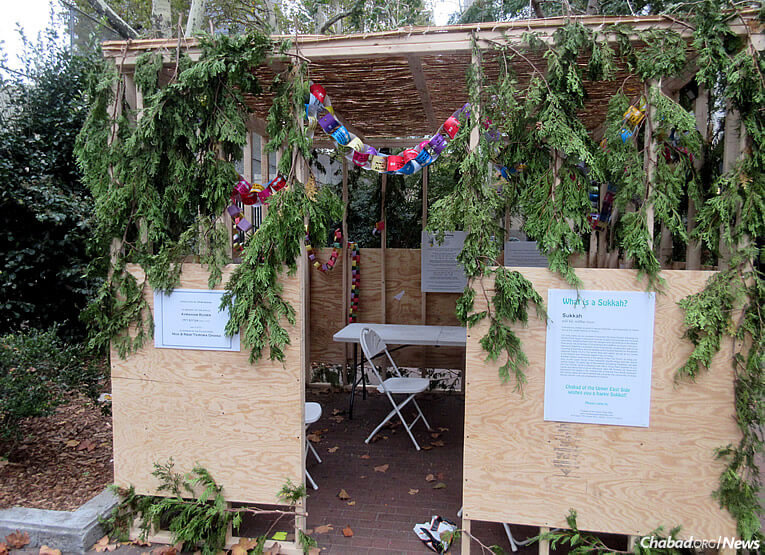
About a 10-minute walk from the esplanade—at the sukkah just outside the John Jay Playground and tennis practice wall at East 77th Street and Cherokee Place (East of York Avenue)—a curious mother, father and two kids peeked in, asking “What shul put this up?” They admired the paper chains and art crafted by a group of schoolchildren, and the hanging evergreens of the sechach—the roof, made of materials grown from the ground—and read the sign saying that it was a Chabad sukkah. They also recited the “Leshev” and “Shehecheyanu” blessings as a family, noting that it was their first time observing the mitzvah of sukkah this holiday season.

Chabad sukkahs in public spaces on Manhattan’s Upper East Side, including the ones along the Esplanade (East 84th Street), John Jay Playground (East 77th Street and Cherokee Place), Rupert Park Playground (91st Street and Second Avenue), Samuel Seabury Playground (96th Street and Lexington Avenue), as well as the five sukkahs on roofs and balconies at the Chabad House (419 East 77th St.), answer an issue all too familiar to Jewish urban-dwellers.

The Chabad school's gimmel class made paper chains and other decorations. (Photo: Howard Blas)

“We have a unique challenge here, where even the wealthiest can’t easily put up a sukkah since they don’t have spaces that look up to the sky,” Rabbi Ben Tzion Krasnianski, director of Chabad Lubavitch Upper East Side in New York City, tells Chabad.org. And so, he says, “it is more critical than ever to build sukkahs in public spaces.”

In Manhattan, few people live in homes with backyards, courtyards or porches with an unobstructed view of the sky. Residents wishing to fulfill the mitzvah of sitting and eating meals in a sukkah usually need to visit a local synagogue. While some shul sukkahs are open to the public, they are only accessible at certain hours.

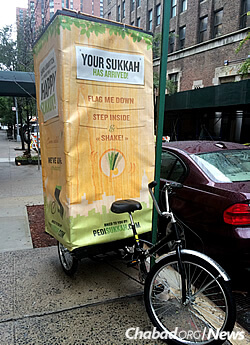
The Chabad sukkahs and a special pedi-sukkah (attached to the back of a tricycle)—parked at 92nd Street and Lexington Avenue when not being used around the neighborhood—make it easier for Upper East Side residents to observe the mitzvah. Insists Krasnianski: “We need to make sure that no Jew is left behind!”

A pedi-sukkah meets neighborhood needs. (Photo: Howard Blas)

Chabad’s public sukkahs are not limited to Manhattan’s Upper East Side, of course. Dozens of public sukkahs dot New York City and thousands more are erected globally—in every city, town and country in the world with a Chabad center, as well as in small, remote Jewish communities where Chabad rabbinical students, known as “Roving Rabbis,” travel for the holidays.

Shaking Lulav: ‘A Positive Jolt’

Local rabbis say they appreciate Chabad’s efforts to bring the holiday of Sukkot to residents and visitors in the city.

Rabbi Ben Skydell of Congregation Orach Chaim, at 1459 Lexington Ave., near two Chabad sukkahs in the parks, notes: “In a city where people often feel that they have no spiritual home, these sukkahs provide a place not only for the holiday’s mitzvot, but also a place to call home.”

Rabbi Elie Weinstock of Congregation Kehilath Jeshurun, at 125 E. 85th St., says “having sukkahs available is a nice, friendly touch in a busy and often anonymous city. The phrase, ‘Let all who are hungry come and eat’ isn’t just for Pesach!”

Add to that 30 yeshivah students who walk the streets of the Upper East Side during Sukkot, giving people the opportunity to fulfill the mitzvah of lulav and etrog. Krasnianski says the Chabad sukkahs in the park are also staffed to help with the mitzvahs of Sukkot and to teach about the holiday.

“For some people, this is the first time in their life holding the lulav and etrog, and sitting in the sukkah,” he says. “Waving the lulav gives a positive jolt—to stand tall and erect with Jewish pride.”

While now in the midst of the intermediate days of Sukkot, Upper East Side rabbis are also looking forward to the annual Simchat Torah celebration on Oct. 12, held jointly with Kehillat Jeshurun.

“Thousands come to the fair, filling the streets,” says Krasnianski. “We bring the joy of the holiday right out to the people!”

Chabad Public Sukkahs in Manhattan, 5779 (2018)

Here is a list of public Sukkahs in Manhattan sponsored by Chabad-Lubavitchduring Sukkot 5779 (2018):

Chabad of Upper East Side

East River Esplanade (enter at E. 84th St.)

John Jay Park (E. 77th St. all the way east)

Chabad Israel Center of the Upper East Side

Ruppert Park (corner of E. 91st St. and 2nd Ave.)

Samuel Seabury Playground (corner of E. 96th St. and Lexington Ave.)

Chabad of Lower East Side:

104 Delancey St. (between Essex St. and Ludlow St.)

Chabad of Washington Heights:

Chabad of Washington Heights, 50 Overlook Terrace (side entrance)

Chabad of Harlem

JCC Harlem, 318 W. 118th St.

Chabad of Battery Park City

Museum of Jewish Heritage, 36 Battery Pl. (behind)

Chabad of Midtown Manhattan

New York Public Library Porch (corner of 5th Ave. and W. 42nd St.

Chabad of F.I.T.

340 8th Ave. (between W. 27th St. and W. 28th St.)

Chabad of Tribeca / SOHO

Chabad of Tribeca / SOHO, 54 Reade St. (between Church St. and Broadway)

Chabad of Beekman Sutton

Chabad of Beekman Sutton, 336 E. 53rd St. (between 1st Ave. and 2nd Ave.)

The Chabad Loft

Union Square Park (sukkah is located in SW area of Park, next to fountain – open daily from 10 a.m. to 6 p.m.)

Chabad at Columbia University

Chabad at Columbia University, 625 W. 113th St. (between Riverside Dr. and Broadway)

Chabad House Bowery (Serving NYU)

Chabad House Bowery, 353 Bowery (between E. 3rd St. and E. 4th St.)

Chabad of Hamilton Heights

Chabad of Hamilton Heights, 635 Riverside Dr. (corner of Riverside Dr. and W. 141st St.)

City College Quad (corner of W. 139th St. and Amsterdam Ave.)

3647 Broadway (between W. 150th St. and W. 151st St.)

The Chelsea Shul & Rohr Center for Jgrads

The Chelsea Shul & Rohr Center for Jgrads, 236 West 23rd Street (between 7th Ave. and 8th Ave.)

Chabad of Roosevelt Island

North of Firefighters Field, 405-425 Main St.

Chabad of the West Sixties

Chabad of the West Sixties, 310 West 75th Street (between Riverside Dr. and West End Ave.)

Chabad Center For Jewish Discovery

E. 20th St. between 1st. Ave. and 2nd. Ave.

Jewish Latin Center

South of E. 20th St. along East River

Chabad Young Professionals

Madison Square Park (at corner of E. 26th St. and 5th Ave.)

The sukkah in front of Chabad of the Upper East Side (Photo: Howard Blas)
The sukkah at the East River Esplanade at East 84th Street (Photo: Howard Blas)
Read more

Original Article Published On The Jerusalem Post

Lia Kes is involved in every aspect of the design process, visiting factories, meeting with customers, and selecting dyes and recycling materials for garments.

NEW YORK – Lia Kes’s fashion show threw guests for a loop during a recent New York Fashion Week event at the Beekman Hotel in Lower Manhattan. Instead of the glitz that industry insiders have come to expect of NYFW exhibitions, Kes’s show, KES SS18 – which stands for [Spring/Summer 2018] – presented guests with a low-key subterranean vibe.

There were no famous models, no elegant runways, no DJs spinning electronic music – instead, Israeli-born Kes featured 28 original designs, modeled by seven mixed-age, multi-ethnic models: Yuliya in a black Augustine double- wrap slip dress, Tierra in a macro mosaic top, Hartje in an asymmetric cow-neck top and harem pants, and Qi Wen in a high-low halter dress with reverse monk top.

“There is a subtlety and spirituality to Lia,” observes Meredith Berkman, a writer and customer based in Manhattan who wore a Kes-designed outfit to the show. “That is what makes her so intriguing.”

Berkman discovered Kes’s Upper West Side store several years ago because of the big Hebrew letters and pictures of Israel in the window. She was immediately attracted to the label that promoted its Jewish and Israeli background.

Kes grew up on the 1,300-person Kibbutz Afikim, just south of the Kinneret. She reflects fondly on her first sewing teacher and mentor, Ahuva Gottesman.

“I still think about her frequently – her professional qualities were some of the highest I came across in my whole professional life.”

After two years in the Israel Air Force and a bachelor’s degree in fashion design from Shenkar College in Tel Aviv, Kes relocated to the US, settling in, doing a brief stint in California and then returning to New York where she launched her namesake collection.

“I feel like it took me a while to combine who I am now,” Kes said.

“I am an immigrant, an Israeli American, a sort of a hybrid – not completely Americanized and not completely Israeli.”

With boutiques located at 463 Amsterdam Avenue at 82nd Street in Manhattan and in Southampton in Long Island, New York, Kes has found success catering to the locals.

“It is the mix of the right people with the right community to create something so amazing,” she said.

She is involved in every aspect of the design process, visiting factories, meeting with customers, and selecting dyes and recycling materials for garments that can require up to 40 pieces of fabric.
At home, Kes is an involved mom to her two daughters – ages 10 and 13 – and is active in their Jewish day school, Heschel, and Jewish Community Center.

Last fall, during a spate of stabbings in Israel, two Heschel mothers who are also customers and philanthropists approached Kes with an idea – to produce a desirable object that could raise funds for Israel. Together, they created Project AHAVA, a conceptual messenger tote from which all proceeds would go to charities that support Israel.

Customers purchased $180 denim messenger bags – funky, unfinished objects with words describing Israel (eternal, radiant, innovative, lush) printed on the inside. All proceeds went to support the Israel Trauma Coalition.

“Working with her on the Ahava Project was amazing,” said Stacy Helfstein. “Lia is a shining star. She gives 100% and is not happy until the product is perfect.”

Kes continues to leave her imprint on the New York and fashion worlds, building community one outfit at a time. At her Upper West Side store on a recent weekday, shoppers included young hipsters, 80-year-old women – and, of course, a group of Israeli ex-pats.

Read more