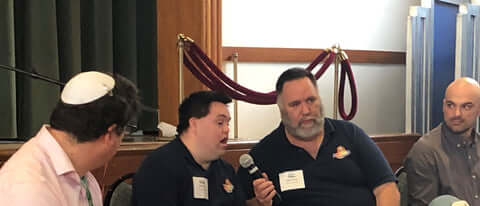
CEUs available from CRCC, APD, APSETrack 3: Community Supports Presentation will address WHY People with disabilities work (financial, social, physical, etc) and will explore the range of options, including book stores, pizza stores, coffee shops, assembling Ikea furniture, bicycle repair, and reading mammograms.
Washington Wizards forward Deni Avdija is proudly representing Israel and Judaism on and off the court.
The 20-year-old Israeli is having a good second season in the NBA and finally having opportunities to interact with the local Jewish community. Avdija lit the menorah on the fifth night of Chanukah at the Rockville Town Center in Montgomery County, Md., 20 miles north of the team’s Capital One Arena.
He wore a white kipah, chanted the blessings, signed autographs, answered questions from fans and expressed appreciation to the members of the Jewish community who helped him celebrate his first Hanukkah away from family.
“I want to say thank you to the people who came here and supported me and light the menorah with me. Those little things with the community, especially with the Jewish community, it’s not easy to celebrate the first Hanukkah out of home,” he said.
Avdija elaborated on Thursday night’s “in-person-with-fans” event during Friday’s post-practice media session. “It was pure enjoyment to meet and share this special moment,” he said. “The love and support the Jewish community game me is unreal!”
Avdija, who is currently the only Israeli playing in the NBA, has always looked to the example set by Omri Casspi and Nadav Henefield—Israelis who also had distinguished basketball careers in the United States. “I saw what they did and knew I wanted to do that, too. I aimed for that from a young age.”
In fact, he takes his role quite seriously. “It is great representing Israel; I am trying to do my best on and off the court to give pride to my country.”
And he noted that he has always loved the “Festival of Lights.”
“My mother had a special connection to this holiday,” he related. “This is the holiday we focused most on. It is just good vibes—this holiday in Israel when I was growing up. You had sufganiyot everywhere, the songs, the menorahs … everywhere. It is just one of my favorite holidays for sure. And I wait every year to celebrate it again and again.”
On a health digression, Avdija reported that he was “not feeling well” and was “a little tired.” He is listed as “questionable-non-COVID illness” for the Friday home game against the Cleveland Cavaliers. The Wizards, 14-8, are coming off an eight-point win against the Minnesota Timberwolves, marking their eighth home win of the season.
On Sunday, the Wizards begin a three-game road trip versus Toronto, Indiana and Detroit, and will play the next nine of 10 games on the road.
Avdija is averaging 6.1 points, 5.1 rebounds and 20 minutes of playing time per game. He is second on the team in blocked shots.
“I feel stronger, more experienced,” he said, “am getting fewer foul calls and am learning something new and getting better every day.”
When Pascale Bercovitch made aliyah from France at age 17, she had no money, no friends, and no legs. But the always upbeat Bercovitch arrived with a positive attitude, determination to serve in the IDF, and a firm commitment from the esteemed Brig.-Gen. Aharon Davidi to make that happen – even if she was a recent amputee.
Now, the 54-year-old Tel Aviv resident is a seasoned Paralympian, motivational speaker, writer, mother of two and very happy longtime Tel Aviv resident. The Paralympic medalist, who has participated in three sports – handcycling, rowing and kayaking – over four Paralympics, recently returned from the Paralympics in Tokyo. Back home, she is also a local hero at the boathouse along the Yarkon River, and an advocate for accessibility and for people with disabilities in general.
Bercovitch took off 10 days to rest after returning from the recent Tokyo Paralympics, then immediately got back in her kayak. “I have to paddle! It is like with hunger – a person has to eat!”
She is still seriously considering competing in the 2024 Paralympics, which are to be held in Paris, not far from where she grew up. For now, Bercovitch has been good to herself. “I am training daily but doing one instead of two workouts a day.”
Bercovitch has many projects on her to-do list. “I have a lot to do, including a book about my life.”
HANDBIKING IN London, 2012. (credit: IPC)
She is also a sought-after motivational speaker. And she wants to spend more time with her daughters – 12-year-old Mica will soon celebrate her bat mitzvah, and 20-year-old Eden, who is a soldier with elite sports status. Eden just so happens to excel in the same sport as her mother – rowing, and is a member of the Israeli National Kayaking Team.
Bercovitch’s interest in Israel is remarkable, given how little she knew about Judaism or Israel growing up in France.
She was born in France to two parents who were also born in France. She was a good student, and enjoyed literature and French culture. Despite her strong French upbringing, she recounts, “I had a feeling from a young age that I didn’t fully belong to France, but I couldn’t say why.”
The precocious and contemplative Bercovitch was always thinking of ways to positively impact the world. “From age 13, I dreamed of living in a new country and building it.”
She had a sense that France was already “set,” and that there was little she could do to effect change. Everything in France and Europe is stuck, she thought, and turned her sights to other places in the world, including Africa.
She secretly began sending her weekly allowance money (“meant for things like buying croissants!”) to Doctors Without Borders. “My parents eventually discovered it when I started getting mail from the organization!”
As Bercovitch dreamed of living in another country and helping the local people, she was hearing stories from her father of the hardships people living in Communist countries were experiencing. He spoke of relatives who had lived in Poland and Romania, and he explained about life in Soviet countries.“
I wanted to go there. I wanted to change the world,” offers Bercovitch.
HER LONG journey to Israel started at age 15 when she chanced upon a Jewish radio program by Gérard Benhamou. “I began to listen to the Jewish radio. We had one frequency for Jewish radio in French; we do until today. I secretly listened to the program three times a week, under my blanket at night!” reports Bercovitch. “I knew I am half Jewish, but didn’t know what it means. Suddenly, I heard about this small country that has a very big vision and I thought, okay, I am also small and I also have a big vision.”
Bercovitch notes that her identification with Israel was in its early stages and she was very excited when Benhamou had a special guest – Brig.-Gen. Aharon Davidi, speaking about his new Sar-El program.
“We are inviting guests, Jewish or not, to have a three- or four-week experience in the army – and we pay for the ticket,” said Davidi.
Bercovitch was trying to recall whether the program paid for all or part of the ticket. But she vividly remembers her reaction to hearing Davidi speak. “I felt like I got a big boom on my head from a hammer – I jumped from bed, got a pen and paper to write down the contact information, and called the next day.”
She was disappointed to learn that she needed to be 19 but was not discouraged. “I won’t wait a year and a half!”
Bercovitch told her parents some of the story of the opportunity that potentially awaited. “I told my parents I found a way to have a free holiday abroad. I told them I was too young, but I didn’t tell them it was for Israel.”
Her parents, knowing how mature and beyond her years Pascale was, said that they would explain to the program organizers that she was “not a usual kid!”
BERCOVITCH MADE her first trip to Israel at age 17. “I didn’t want to come as a tourist – I wanted to come and help!”
She loved the experience and was overjoyed when Davidi came to visit France. Davidi, who died in 2012, was the head of the IDF Paratrooper and Infantry Corps, became the director of Community and Cultural Activities of the Golan and Jordan Valley, and was the founder of Sar-El. He came to France and told Bercovitch, “I heard you were the youngest on the program!”
She shared her passion for Israel and her desire to one day serve in the army. “He loved me! He gave me his business card and said, ‘If you come, I want to help you.’”
Then she experienced the unimaginable: On her way to school one wintry day when she was 17, she slipped on ice at a train station and was pulled under a train. The driver did not see her as it was early morning. As Bercovitch waited for help to arrive, she realized both of her legs had been severed at the thigh.
In spite of this life-altering event, Bercovitch set her sights on Israel. “I told my mother, ‘Please call Sara-El and tell them I’m going to be a little late [in coming to Israel and to the army].” She adds, “The accident was in December 1984, and I had a secret plan to start the army in 1985. My mother did not know what she was doing.”
To this day, Bercovitch is amazed and appreciative that Davidi came to visit her in the hospital in Paris in March 1985. “I remember it was snowing. He was a very special, generous and very tough man. I called him Paddington since he had a kova tembel [round, brimless hat] and a big beard.
“He said, ‘I heard about the accident, and despite having no legs, you are always welcome.’ He said he was ready to keep his word and wanted to help me. It was one of the best days of my life!”
She continues, “Six months after the accident, I called him and said I am coming. He asked if I was done with my treatment. I said yes. I lied! He knew. I took a ticket and flew from Paris to Tel Aviv.”
Bercovitch’s army service was a little mundane, though useful for a new olah acclimating to life in Israel. “I was preparing coffee and food. It was boring, but I learned Hebrew!”
She also reports that she spent her time in the army learning about the language, the culture of Israel, and the realities of her new physical condition.
After her army service, Bercovitch had a successful journalism career and split her time between Israel and France. “I traveled a lot and had two apartments – one in Tel Aviv and one in Paris.”
Thanks to Davidi, Bercovitch was also introduced to sports. “He arranged for me to do sports at the pool two times a week, and I was on the national swim team.”
Bercovitch then became a motivational speaker. She can’t stop speaking about Davidi. “He opened the army gates to paraplegics. All that I am today is because he believed in me.”
As Bercovitch looks back on her many years in Israel, she is pleased with all that she has accomplished, yet she remains honest about the many challenges she has faced.“
I had to always be inventive and manage. It was very tough. When I got here I had $100, a suitcase and wheelchair. I had no family support. I was 17. I was totally alone. And nothing was accessible 37 years ago. There were stairs everywhere!”
Even when Bercovitch became a Paralympic athlete at age 40, she faced challenges. “They said I was too old to do anything. And there was no money! No financial support and no psychological support.”
She has thus far managed to complete in four Paralympic games, and she just might go for her fifth. “I am not saying I won’t be in Paris [for the next Paralympic Games]. I may!”
For now, Bercovitch enjoys being a mother to her two daughters, and takes being a role model for disabled and nondisabled athletes very seriously. “People know me, and it is an amazing feeling. For example, recently a class of 10-year-olds with their teacher stopped at the boathouse and said, ‘This is Pascale!’ It is worth it to be a model to these kids. I bring the values of what I am able to do. I am aware of what I can bring. I want people to identify, to understand, to react properly.”
Bercovitch concludes, “I love Israel. I love the people, the weather and the sea. My kids are fully Israeli and thank me for raising them here. I love everything – except for the bureaucracy!”
Silver Spring, MD (Kemp Mill neighborhood) Website: ShredSupport.com Email: Shred4U2@gmail.com (contacts: Dina and Amy) Facebook: https://www.facebook.com/shredsupport
“Shred Support is a shredding service located in the Kemp Mill neighborhood of Silver Spring, MD that is committed to the employment of people with disabilities. When you use Shred Support, your documents will be confidentially destroyed and recycled. Our shred team is friendly and professional. Just ask us for a reference at any time or see our testimonials.”
My Personal Connection:
I know the two founders, Uriel and Jacob, from our summers together in the Tikvah Program at Camp Ramah in New England. This Jewish summer camp includes campers with intellectual and developmental disabilities and offers a vocational training program. Uriel and Jacob, two talented 20-somethings with Down Syndrome, have participated in the vocational training program for over 5 years, where they worked in the camp’s mail, package and fax center. Outside of camp, Jacob has worked at a UPS store and Uriel at the University of Maryland Hillel in their food service program. I have continued to be in touch with both young men and their families as they have explored longer term employment. Both also participate in the camping movements year round virtual vocational training and socialization program which was created during the COVID pandemic.
From the Website:
It’s estimated that one third of the workforce has been working from home since March 2020. Couple that with all who have used the time at home to sort & organize…and that’s a lot of documents piling up! Shred Support is here to help! Your documents will be confidentially destroyed and recycled (yes, Shred Support is more than just friendly – it’s Eco-Friendly too).
Just 37 percent of working-age people with disabilities have a job, compared to 77 percent of people without disabilities. This staggering statistic represents over 12.5 million working-age people with disabilities who want to work and who are a valuable asset to the workforce. Shred Support aims to smash that statistic by employing adults with disabilities who are ready to get to work and be a productive member of the community.
Founders and owners Jacob and Uriel have a track record of reliability & exceptional work ethic. They have each been involved in self-directed programming since 2018 and bring these qualities & professionalism to each task.
How Does Shred Support Work?
-Fill out a work request form and someone will reply within 2-3 business days. A Shred Support Specialist will be assigned to you and we will set up a drop-off date and address.
-Bring your paper in a shred-support bag, your own bag, or a box to the drop-off point on the assigned date. (We cannot shred folders, CDs, plastic envelopes, binder clips, adhesive-backed labels, polaroid pictures).
-We will weigh the shred order so we can determine the cost. (Pricing: $1.50 per pound for new customers and $1.25 for returning customers)
-Your shredding will be destroyed confidentially and then recycled.
-We will send you your invoice which will also be your confirmation that the shred job has been completed.
Lessons Learned/Challenges:
-It has been challenging finding similar disability run shredding businesses with whom to consult; that said we found one in Houston and the mom who runs it was incredibly helpful.
-Need for business and legal advice regarding business structure and joint proprietorship
-Measuring success and becoming profitable (plans include feasibility study and 5-year business plan).
-Consider seeking investors
-Importance of maintaining working equipment
-We would like to have a space for Uriel and Jacob to work together – in an ideal world outside of both homes. However, Covid is still too prevalent, so we are hopeful for a space in one of the homes so they can at least work together.
– We would like to explore options for better marketing – maybe a college student intern. This would include social media as well as targeted emails.
– Once we have a bigger space, we would like to invest in larger and more reliable equipment.
– Sometime in the next year, we would like to seek out business contracts. We would purchase locked shred containers that offices would drop their “to-be’shredded” papers into and then they would call for a pick-up when the container becomes full. We would have a different pay structure for clients with contracts with us.