Original Article Published On The Jerusalem Post

The Danish Jewish Museum in Copenhagen presents 400 years of Jewish life in Denmark.

This High Holy Days period – when most synagogues around the world have made the difficult decision to tell members not to come for in-person services – I am transported back to a special Yom Kippur four years ago at Copenhagen’s Great Synagogue.

I spent the holiday in the synagogue where the current rabbi, Jair Melchior’s great-grandfather, Chief Rabbi Marcus Melchior, also told the congregation on Rosh Hashanah Eve 1943 (September 29) not to come for Rosh Hashanah services. His congregants were not facing a pandemic; rather the Jews of Denmark were facing a roundup and likely extermination by the Nazis.

The miraculous outcome for nearly all of the Jews of Denmark offers inspiration and hope to all of us living through difficult times.

A compassionate German diplomat tipped off Rabbi Melchior, who stood at the bimah and urged the Jews to hide or flee, and to share the urgent message with their friends and family members. Non-Jews in Denmark mobilized and hid Jews in homes, churches, convents, schools and hospitals.

Nearly 7,200 Jews and 680 of their non-Jewish family members were helped to safety by Danish fishermen who shuttled the Jews by fishing boats across the water separating Denmark from Sweden. Nearly 500 Danish Jews who did not make it out in the fall of 1943 were eventually deported to the Czech town of Terezin, or Theresienstadt in German. Yad Vashem planted a tree in the Avenue of the Righteous Among the Nations in honor of the Danish underground and its rescue of the Jews.

I think of this incredible story every Rosh Hashanah and Yom Kippur. I had the wonderful opportunity to pray with the Jewish community of Copenhagen for slihot (penitential poems and prayers) and Shacharit (morning services) during the week leading up to Yom Kippur, and for all Yom Kippur services. My wife and several other observant Jews were in Copenhagen for a conference and knew it would be impossible to return home to America or Israel in time for the start of the holiday. Some left the conference early; a handful were lucky enough to experience Yom Kippur in Copenhagen.

On my early morning walks through the dark streets of Copenhagen to the synagogue built in 1833, on Krystalgade 12, and during my long daily walks through the beautiful city, I learned that there are many reminders of the Holocaust, both obvious and subtle. A fellow worshiper, a 6th-generation Dane who informed me of the sizable Danish-Jewish community in Ra’anana I never knew about, pointed out a nondescript law office building that once served as Nazi headquarters and was rebuilt after a bombing by the Allies.

When I first arrived in Denmark, I set out for the Chabad House to introduce myself to Rabbi Yitzi and Rochel Loewenthal, the Chabad shluchim (emissaries), to arrange Shabbat and holiday meals. The Chabad House, located at 10 Ole Suhrs Gade, is on a street with old-world charm, between the Botanical Gardens and Sortedams Lake. A careful observer may spot a green door with a mezuzah – and a gold sign overhead that reads: Chabad Huset, or Chabad House. The building was once used as Nazi headquarters.

IT IS now the Chabad House and the home of the Loewenthals, who arrived in Copenhagen in 1996 to serve the Danish-Jewish community. This community traces its history in Denmark back to the 1600s. In the early 1600s, King Christian IV founded the town of Glückstadt and allowed Albert Dionis, a Jewish merchant, to settle in the city. He later extended this right to a few other Jews in 1628. Jews were offered protection, and the right to hold private religious services and maintain their own cemetery, which they founded in 1693. Since 1900, another Jewish cemetery has been used as the burial ground in Copenhagen for more than 6,000 Jewish people.

By 1780, approximately 1,600 Jews lived in Denmark. At this time, the king instituted a number of reforms that helped Jews integrate more fully into Danish society; they were permitted to attend university, join guilds, build schools and own real estate. In 1814, Danish Jews were granted civic equality; they received full citizenship rights in 1849 – one of the first countries in Europe to do so. Nearly 3,000 Jews came to Denmark in the early 1900s to escape such events in Russia as the Kishinev pogrom of 1903 and the Russo-Japanese War of 1904-1905.

The Danish Jewish Museum in Copenhagen, designed by architect Daniel Libeskind, presents 400 years of Jewish life in Denmark. The design of the museum offers another reminder of the Holocaust experience in Denmark. The word “mitzvah” constitutes the emblem and concept of the museum, and the museum was reportedly designed around the courage demonstrated by the Danes.

The Chabad House itself contains some important pieces of Danish Jewish history. The England-born rabbi and his American wife, who have learned Danish and continue to speak to their children in English, Yiddish and Hebrew, proudly display two pieces of local history on the wall of the main room of the Chabad House: a 400-year-old coin from King Christian the Fourth, bearing the tetragrammaton in Hebrew; and a yellow Jewish star from the Holocaust.

The Loewenthals have the important responsibility of helping to look after the Danish-Jewish community, which now numbers about 7,000 people. There are few kosher shops or restaurants in Copenhagen, few kosher-certified products in local grocery stores and kosher meat is hard to find and expensive, mainly because of Denmark’s laws prohibiting shechita (kosher ritual slaughter). Thus, all kosher meat must be imported. Rabbi Loewenthal regularly visits companies where he oversees kosher supervision, teaches local Danish school students about Judaism and teaches at the Jewish day school.

Rabbi Loewenthal prays each morning, either next door to the Chabad House at Machsike Hadas (if there is a minyan) or at the Great Synagogue, a 15-minute walk from his home, through the Botanical Gardens or up Gothersgade Street, or even past Rosenborg Castle, the National Gallery of Denmark or Copenhagen University. I met the rabbi at services each pre-Yom Kippur morning. Security was tight, even on a weekday morning, partly as a result of the February 2015 shooting death of Jewish security guard Dan Uzan, 38, by Omar Abdel Hamid El-Hussein, during a bat mitzvah celebration outside the Great Synagogue.

SECURITY WAS especially tight on Yom Kippur evening, when the entire community assembled for Kol Nidre. A Danish police officer, after questioning those seeking to enter, used a special key to open the shul gate. Flowers outside the synagogue served as a reminder of the killing a year and a half earlier.

I was struck by the range of people – and by their outfits. Some wore fancy dresses, jewels and furs; others wore shorts and Guns & Roses T-shirts. Some stayed for the entire service – led by a cantor and an all-male choir. Some stayed only for the brief Kol Nidre part; yet others left after the very moving reading of “the names” in Danish. The rabbi movingly read the names of the members of the community killed by the Nazis.

Community members were welcoming, though most were not well-versed in the High Holy Day liturgy. The voices of the Israeli cantor and choir were heard while those of congregants were barely audible.

The current chief cantor, Edan Tamler, is a very hip 20-something, American-born Israeli who made aliyah in 2012 and lives in the mixed religious/secular yishuv of Esh’har in the Lower Galilee. Tamler was a contestant on The X Factor Israel TV show in its first season, reaching the finals as part of a boy band named Fusion that the judges built around him. He was subsequently signed by Israeli pop star Ivri Lider, X-Factor judge and mentor to Tamler.

Tamler has been in Denmark for several weeks this August, serving as full-time cantor and teaching music at the Jewish school. “It’s been great to be back in Denmark and getting to pray with a congregation once again,” reports Tamler. “It hasn’t really been possible in Israel since the novel coronavirus started. I’m so excited to be reunited with the community and looking forward to leading the Yamim Noraim (Ten Days of Repentance) services that are less than a month away! It’s a true honor to be able to lead prayers in such a magnificent synagogue and beautiful community with so much history.” The Loewenthals, who provided tasty pre- and post-Yom Kippur sustenance when I was there for the holiday, continue to care for the needs of the community – even during these unusual times. “Obviously COVID-19 has had an effect. Denmark closed down very early, but started reopening in April with the shuls – big and small – opening since Shavuot. We have reopened the shuls – big and small–  albeit with precautions and a limited capacity.

“The same is true of the Chabad House, where we have classes, though most are also online, and for meals we have families sitting together with space between the family groups. We have seen that some people are concerned and stay home, and I suspect that will last for a while. Most families with children are more or less back to normal business. For Rosh Hashanah and Yom Kippur we are taking precautions and will probably put a tent outside to help accommodate more people in the correct fashion,” says Rochel Loewenthal.

The Lowenthals are busy preparing for the High Holy Days. Yet, she has time to say kind words about the talented young cantor in town. “Edan is a great guy. A wonderful hazan and he brings a youthful perspective and fresh tunes to the shul.”

Rosh Hashanah and Yom Kippur in Denmark promise to be meaningful – even during these unusual COVID-19 times.

Read more

Jim Palmer, Dave McNally, Mike Cuellar, Pat Dobson and Dean Kremer?!

The first four are the Baltimore Orioles pitchers from my childhood who accomplished the unimaginable—these four were 20-game winners in a single season—1971.  Dean Kremer?  Well..there is no way he can win 20 games in a season, given the 2020 season only has 60 games!  We are proud of Dean, nonetheless.

I have been following Dean Kremer, the Israel Baseball player for many years. Now, he is Oriole, bringing pride to Baltimore baseball fans, Jewish and non-Jewish alike.  WJZ-TV in Baltimore captured the excitement with its headline before his first MLB start against the New York Yankees: 

Mazel Tov! Orioles’ Dean Kremer Becomes 1st Israeli to Reach Majors, Debuts Sunday Against Yankees”

Kremer came to the Orioles as part of the Manny Machado trade in 2017. He almost reached the big leagues last season with his 3.72 ERA and 122 strikeouts over 113 2/3 innings across three levels of minor league baseball.  He went 9-4 in 15 starts with Double-A Bowie, and went as far as AAA.

According to WJZ, he assumes the roster position of pitcher David Hess, who was optioned Saturday night, and took the rotation spot of Asher Wojciechowski.  Kremer debuted on Sept. 6 against the New York Yankees.  He allowed only one run and one hit, struck out seven batters in 6 innings and was credited with the win as the O’s beat the Yanks 5-1.

Kremer pitched 5 more innings vs. the Yanks on September 12 with 7 more strikeouts.  His third start was against the Devil Rays on September 17, where he pitched 5 innings and had 6 more strike outs. Kremer didn't factor into the decision in the first game of Thursday's doubleheader against the Rays, giving up one run on three hits and three walks. Kremer reported, “I didn’t have my best stuff today, but I really needed to compete,” Kremer said. “They put eight lefties in the lineup so it took me a while to get my breaking ball going. It’s a good thing I had my cutter to get me through, but it was definitely a day where I had to grind through each at-bat.”

 His ERA is currently an impressively low 1.69. 

The Orioles are officially out of the pennant race.  Kremer faces the Boston Red Sox’s Nathan Eovaldi (3-2) in Boston tonight, his final start of the season.

Kremer was born in Stockton, California to Israeli parents and is the first Israeli to sign with an MLB team.   He was drafted by the San Diego Padres in the 38th round of the 2015 Major League Baseball Draft.  He chose not to sign. He was drafted again–by the Los Angeles Dodgers–in the 14th round of the 2016 Major League Baseball draft.

Kremer previously pitched for the Team USA baseball team in the 2013 Maccabiah Games in Israel, where the team won the gold medal.  In 2014 and 2015, Kremer pitched for Israel in the qualifying for the European Baseball Championship, where he received the Most Valuable Pitcher award. He also pitched in September 2016 in the qualifier for Israel at the 2017 World Baseball Classic.

We are excited to watch Dean Kremer continue to accomplish great things—both in the MLB and for Israel.  Fellow Californian and Team Israel teammate, Ryan Lavarnway, proudly wears double chai (#36) for the Florida Marlins, where the 33-year-old has served as backup catcher and had 4 hits in 11 at bats.  Lavarnway was drafted by the Boston Red Sox in 2008, and has played for several major league teams, with a career .215 average in 419 at bats. (see my 2019  Jerusalem Post article about Ryan!

Go Dean and Ryan!

Read more


Rosh Hashanah featured major changes, some sadness, and even a possible miracle.

Rosh Hashanah was just different this year, regardless of your level of observance, preferred place of worship, or at home customs.  Services took place on Zoom, they took place outdoors, they were shorter, socially distanced, they featured shofar blowers in various neighborhoods, and there were no big festive meals.

And Jews woke to the sad news that Justice Ruth Bader Ginsburg had died Erev Rosh Hashanah (Friday) from complications of metastatic cancer at the age of 87

But there was also a happy story—perhaps even of a miracle—which may have slipped by without notice this Rosh Hashanah.  Diego Schwartzman, a very nice, proudly Jewish 28-year-old professional tennis player from Argentina, stunned Rafael Nadal in straight sets on Saturday at the Internazionali BNL D’Italia Italian Open tennis tournament in Rome.  True, he wasn’t in synagogue this Rosh Hashanah, but there is a parallel between Schwartzman’s actions, and the story Jews who were in synagogue were reading. 

On the first day or Rosh Hashanah, we read about Abraham and Sarah, and the birth of Isaac, after many years of waiting.   Maimonides, the famous rabbi and commentator from the Middle Ages, notes that Abraham had to undergo 10 trials or tests from God.  Two of the tests are alluded to in this reading:  God tells Abraham to send Hagar (Sarah’s maidservant) away after having a child with her, and he becomes estranged from his first son, Ishmael. 

Abraham’s 10th and final test is the story we read on the 2nd day of Rosh Hashanah—the Binding of Isaac, when God tells Abraham to sacrifice his son Isaac on the altar, then calls him off after he passes the test.

I don’t think Schwartzman (#15) was thinking about this story while on the clay with Nadal (#2).  But, he, too survived his 10th test—he beat Rafa after losing their nine previous matches.  Schwartzman’s Rosh Hashanah miracle was beating Rafa 6-2, 7-5 in just over two hours in the quarterfinals of the Italian Open.  Nadal is ranked No. 2 in the world; Schwartzman is 15th.  Schwartzman excitedly said, “For sure, it’s my best match ever.  I played a few times against the three big champions in tennis. I never beat them until today. I’m very happy.”

On the second day of Rosh Hashanah, Schwarzman defeated Denis Shapovalov, the 21-year-old Canadian, who was born in Tel Aviv.  Schwartzman won Sunday’s semifinals match, 6-4, 5-7, 7-6 (4).

Today, Schwartzman squared off against world #1, Novak Djokovic, in the finals.  What a difference a few days and weeks makes.  I wrote in the Jerusalem Post about Schwartzman’s shocking first round loss in the US Open. And every news outlet in the world covered the story of Djokovic being  disqualified from the US Open just a week ago for unintentionally hitting a line judge in the throat with a ball.

Djokovic has beaten Schwartzman in all four previous matches before today’s finals—though Schwarzman took Djoker to five sets in the 2017 French Open.  And he took him to 3 sets in last year’s Rome semifinals.  In today’s finals, Djokovic defeated Schwartzman 7-5, 6-3. 

Schwartzman may not have been in shul this year, then again, who was?!  Thank you, Diego, for bringing us so much pleasure this Rosh Hashanah.  They say that what happens on Rosh Hashanah is a siman, a sign of what is to come this year.  Best wishes for a sweet, successful year on and off the court, Diego!

Read more

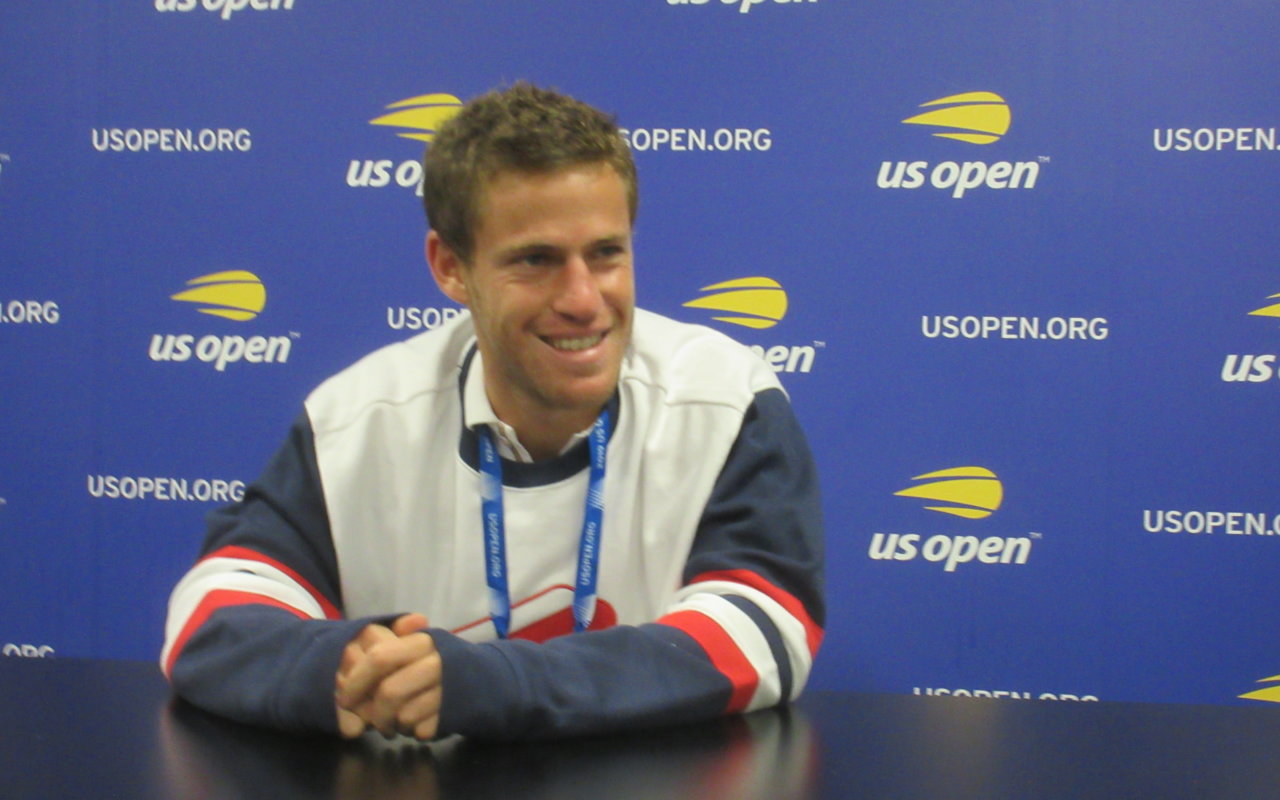
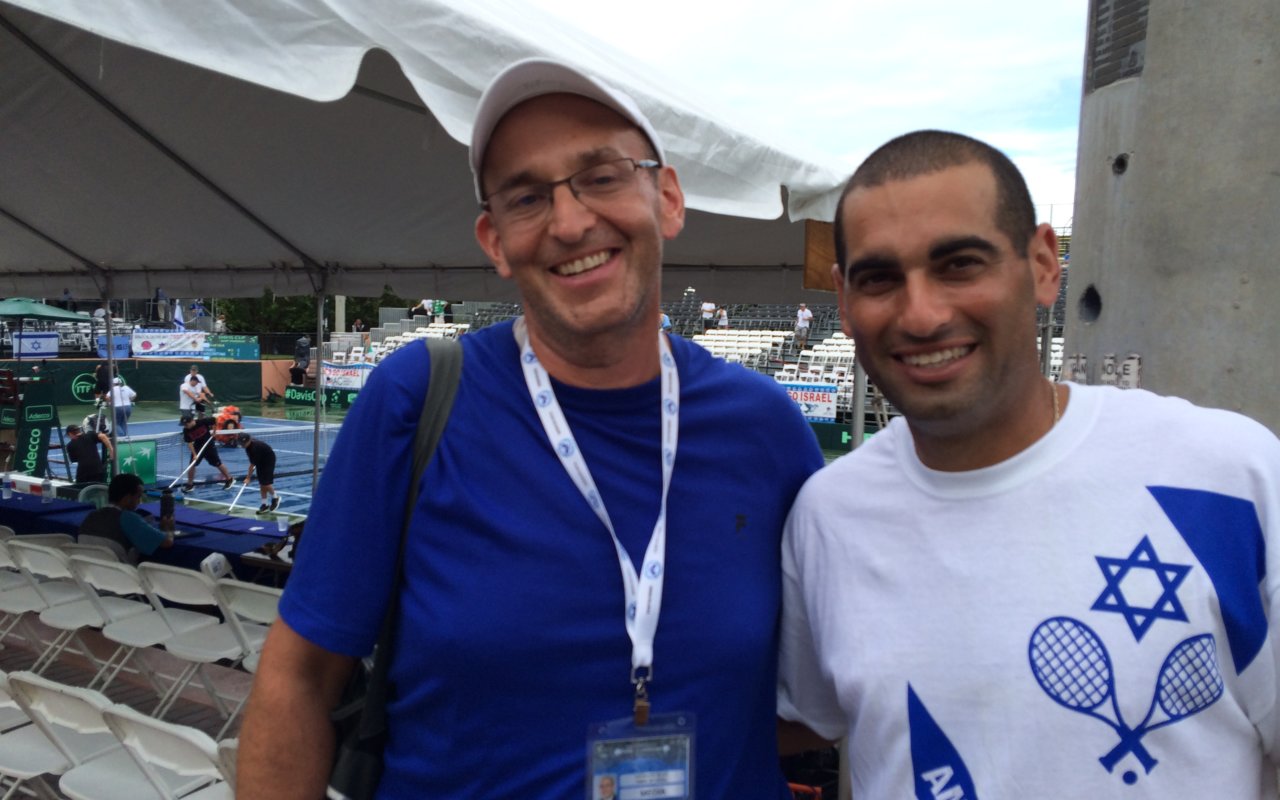
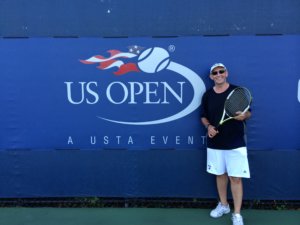
I have tennis on my mind 24/7 these days!   Yesterday, I was delighted to have two tennis articles published in the Jerusalem Post—one featuring Israeli tennis legend, Andy Ram, and the other featuring American Jewish tennis player, Noah Rubin, who is making a name for himself on the court and off, with his Behind the Racquet series, where he has helped more than 50 professional tennis players share their stories of challenges, mental health issues, etc. (I couldn't resist sharing my photo with Andy Ram from the Davis Cup in Florida a few years back–and the photo from a US Open media tournament!)

I have been thinking about tennis since the very exciting, albeit with no fans or media US Open, which just came to a close. I was lucky enough to have a good number of articles published in the Jerusalem Post; while Noah Rubin made it “in,” my final US Open wrap up piece didn’t make it—this happens sometimes given the time frame between writing and publishing—especially with Israel 7 hours ahead of the US!  The never published piece—which references the extremely exciting Zverev/Thiem match, Osaka/Azarekna, Wheelchair Tennis, and the upcoming French Open—scheduled to take place with fans—is in italics below.

Tennis is also on my mind since I have been lucky enough to play 3 or 4 times a week these past few weeks.  It seems that tennis’ popularity really IS on the rise.  In a pre-US Open blog, I noted that racket and balls sales are up in recent months—tennis IS the social socially distant sport—unlike basketball or football or so many other sports, it is possible to socialize while maintaining a safe distance while playing tennis.  

It has been especially fun to play on public courts with so many different partners, from so many different backgrounds.  It is fun going to the local pubic courts and watching parents introducing children to the game on one court, while pros give lessons on other courts, and old friends play on yet other courts.  Let’s hope the weather holds out for outdoor tennis—just a few more weeks!  Perhaps by then, indoor courts will open somewhere, and the grass growing through the public park cracks will die—just in time for next season!


US OPEN WRAP UP—by Howard Blas

Another US Open, albeit an unusual one, is in the books.  No. 5 Alexander Zverev and No. 2 Dominic Thiem walked out on the court at Arthur Ashe Stadium at 4:17 pm New York time to battle it for the winner’s trophy and top prize of $3 million ($1,500,000 for the runner up).   Zverev raced off to a two set lead and appeared to be on track to quickly defeat Thiem, despite Thiem leading the head-to-heads, 7-2, including a 3-0 edge in the majors.  At the 2020 Australian Open, Thiem met Zverev in the semis and said, “I know what Sascha is capable of.  The last match we had in Australia, we were both, I mean, really, really good. It was such a close match.”

Three hours later, Thiem learned what Thiem is capable of!  Thiem battled back to win the greatest comeback in US finals history, winning 26, 46, 64, 63, 76 (8-6) in four hours, two minutes and becoming the first US Open finalists to come back to win from two sets down.  Thiem experienced right leg cramps in the tie breaker, but managed his fastest served of the match at 132 MPH, while encountering two Zverev double faults and a weak 68 MPH second serve.

In the post-match interview, Zverev said, “It was a tough battled.  I wished you would have missed a little more and I would be holding the trophy.”   He then began crying in describing his parents’ absence from the tournament due to a positive Covid test.

Thiem responded, “I wish we could have had two winners today.  We both deserved it.”

Prior to today’s match, the most significant feature of this year’s US Open finals was that it didn’t feature anyone named Nadal, Federer or Djokovic.  At the start of the tournament, 17-time Grand Slam champion, Novak Djokovic, appeared on track to be the easy tournament winner.  The tennis world was stunned when he was defaulted in the fourth round last Sunday after hitting a ball in frustration that struck a line judge in the throat on the court at Arthur Ashe Stadium. This was truly a US Open for the record books.

On Saturday, No. 4 seed, Naomi Osaka trailing by a set and a break, battled back for an incredible 1-6, 6-3, 6-3 victory over former world No. 1 Victoria Azarenka to win the women's singles title.  Osaka, 22, captured the 2018 US Open under very different circumstances. Serena Williams, who lost in this year’s semifinals, was penalized a game for calling the chair umpire a “thief” during a protracted argument, with play delayed and fans booing.  Osaka ultimately won, 6-2, 6-4 for her first Grand Slam title.

At the conclusion of yesterdays’ match, Osaka recounts, “I feel like two years ago, I maybe would have folded being down a set and a break, but I think, all the matches that I played in between that time shaped me and made me or forced me to mature more. Especially all the matches that I've played here were very tough. I think definitely I'm more of a complete player now. I feel like I'm more aware of what I'm doing.”

Azarenka, the 31-year-old Belarussian, who reached her last Grand Slam final seven years ago, and spent several years in a complex custody battle over 4-year-old son, Leo, was proud of her performance while also paying proper tribute to Osaka.  “I did everything I could today. Could I have played better? I think I could. But I left everything I could on the court today. She won the match. All the credit to Naomi. She's a champion.”

Osaka is the first woman to rally from a set down to win the singles championship match since Arantxa Sanchez Vicario in 1994. She is also the first Asian player to win three Grand Slam singles titles, breaking the tie she held with China’s Li Na.  Osaka’s father, Leonard Francois, is Haitian-born, and mother, Tamaki Osaka, is Japanese. 

Osaka has made headlines these past few weeks for taking a stand on social justice issues. 

Naomi Osaka wore masks featuring names of Black victims of police brutality and racial injustice throughout the entirety of her U.S. Open run. Her masks honored the memories of Breonna Taylor, Elijah McClain, Ahmaud Arbery, Trayvon Martin, George Floyd, Philando Castile and Tamir Rice. 

In the Western & Southern Open tournament leading up to the US Open, also played on the grounds of the US Open, Osaka followed the lead of the NBA’s Milwaukee Bucks basketball team, who walked off the court before a playoff game against the Orlando Magic, setting off a two-day sports blackout.  Osaka’s boycott and wiliness to forfeit lead to the tournament taking a brief break before resuming.

At a press conference following her US Open final victory, a reporter noted that Osaka has been receiving thank you messages from some of the families of those killed and asked if she would be willing to meet with families and talk with them once the tennis season is over.  Osaka replied, “Yeah, I mean, definitely. I feel like for me I learn more through experiences. Everyone sort of thinks they know, or I actually don't want to know how they're feeling or how they felt during the process. For me, I feel like sharing stories and hearing people's experiences is very valuable.”

With Osaka’s US Open victory, she returns to the Top 3 in the world rankings.

This year’s US Open featured men’s and women’s doubles and wheelchair tournaments, but not mixed doubles or juniors.  The USTA originally planned to not feature wheelchair tennis this year in an effort to keep the number of people onsite to a minimum; ultimately, they relented and hosted men’s and women’s wheelchair singles and doubles and quads singles and doubles.

Shingo Kunieda, the No. 1 seed form Japan, won the U.S. Open men's wheelchair singles title, defeating Alfie Hewett 6-3, 3-6, 7-6 (3) in a 2 hour 54-minute marathon.

In a press conference with USTA CEO Mike Dowse and US Open tournament director Stacey Allaster, held just three hours before the historic men’s finals, the two reflected on the tournament, lessons learned and the upcoming French Open. They were proud of their decision to carefully and thoughtfully proceed with the tournament.  Dowse reports, “We really established some guiding principles at the beginning. The first one was could we do it in a healthy and safe way for everyone. That included the players, the staff, even the local community here in New York.  The second guiding principle was is this good for the sport of tennis, will it reignite our industry in the broader tennis ecosystem. The third question is frankly did it make financial sense, that included for the players and for the USTA, again the broader tennis ecosystem.”

With the tournament winding down, they addressed finer points of the tournament, including automated line calls on the outside courts.    Allaster reports, “We've had four weeks of the experiment of Hawk-Eye Live. It's been a terrific success. There's no debate.”  She shared interesting data points. “Over the four weeks, Hawk-Eye Live has made a total of 304,000 calls. Close calls, 11,901. Those are the red or green that the chair umpire is seeing. The close calls during the US Open, just over 9,000.  This was a 2020 focus. We made no decisions around 2021. But this was a great effort on behalf of all of our competition team and the Hawk-Eye team members, both tours, to support the experiment. We couldn't be more pleased with how it has been executed.”

When asked about key takeaways from the US Open, Dowse spoke of the importance of ongoing collaboration with so many people and agencies in the decision making process. Allaster adds, “I think these four weeks have been able to demonstrate to the world how our sport can return to play safely.”  Dowse notes, “We had weekly calls with our peers at the Grand Slam board, so we've shared best practices with them, specifically Roland Garros who is starting in a few weeks.” 

This has been a most unusual year for professional tennis.  Wimbledon, which usually takes place in July, was cancelled.  The rescheduled French Open, usually held in late May, will take place in two weeks, from September 20-October 4th.  Unlike the US Open, held with no spectators and few members of the press in attendance, the French Open will permit spectators.  “I trust that the French Federation, with their leadership, and the French government, that they're managing the virus with their medical facts. They've deemed in their country, in their city, that it's safe,” notes Allaster.


Read more