Interviewing

Despite a first-round loss at the US Open, up-and-comer Julia Glushko says she’s proud to represent her adopted country – and looks forward to better results in the future.

For many of the women in the main draw of the US Open, the path to the two-week tournament was straightforward. For Julia Glushko, an Israeli ranked 160th in the world, the road to her first-ever Grand Slam started many months ago — and ended triumphantly last week, with victories in three tough qualifying matches.

Once at the Open, the 22-year-old’s experience proved a bit of an anticlimax — the Ukrainian-born player put up a tough fight Monday, but lost 7-5, 6-2 in her first-round match against the No. 25 seed, Yanina Wickmayer of Belgium.

Despite the disappointing result, Glushko views her participation as a reason for celebration, capping off an extraordinary year of growth for the Modiin resident. In December, Julia (pronounced “Yulia”) won the Israeli national title by defeating Shahar Pe’er, ending the latter’s five-year reign as champion. The victory kicked off a 2012 of tournaments around the world, including the biggest singles title of Glushko’s career: a July win at an International Tennis Federation tournament in Louisville, Ky.

I pay for my travel, mostly from my prize money.  This time, I raised enough money for my coach, Liran Kling, to come.”

Glushko’s US Open appearance was scheduled as the third match of the day, but due to a 2½ -hour rain delay, she didn’t set foot on the court until 7 p.m., when spectators were arriving for a night session featuring Kim Clijsters, Roger Federer and a music performance by “American Idol” winner Jordin Sparks.

Wearing tennis whites and a bandage on her left knee, Glushko hit strongly off both her forehand and backhand. Even with her relatively low ranking, members of the crowd clearly knew who she was, chanting words of encouragement — “yallah” (let’s go) and “kadima” (come on) — familiar to any Israeli.

“I am so thankful that people came out—there were a lot of Jewish and Israeli people cheering for me,” said Glushko, who’s fluent in Hebrew, Russian and English.

Despite her loss, Glushko wasn’t disappointed. “It was a tough draw, but I think I did pretty well,” she reflected. “I was ready to play, [and] can learn a lot for the next time.”

Beyond her first Grand Slam experience — following a failed January attempt to qualify for the Australian Open — Glushko’s trip to New York also meant a chance to reunite with her former doubles partner, the Israeli-Arab player Nadine Fahoum. Now a development associate in New York for the Israel Tennis Center, Fahoum, who recently wrapped up her college career at Duke University, sees a promising future for her old  partner.

“Qualifying for the US Open main draw is the first big step to becoming one of the top players in the world,” Fahoum said. “I wish her much success.”

But while Glushko, who ranked as high as No. 10 in the world as a junior, appears to be on her way, challenges lie ahead — particularly financial ones.

Following her match, the 5-foot-7 player spoke with the Times of Israel. An condensed excerpt appears below.

What is it like representing Israel and Jewish people around the world?

It is probably one of the most special things. There are not many athletes from Israel. I am thankful to be able to represent Israel at the US Open.  For the women, it is only me and Shahar in the main draw.

Do you think Israel can produce more top players? What are some of the challenges facing Israel?

There are a lot of Israel Tennis Centers, and a lot of people who play, but it is hard because everyone goes to the army at age 18.  Also, tennis is an expensive sport. The tennis centers work hard to raise money, but it is expensive — traveling overseas, a coach, etc. I pay for my travel, mostly from my prize money.  This time, I raised enough money for my coach, Liran Kling, to come.

There are ups and downs to playing tennis. You are away all the time. It is hard on your body —  I have pain in my knees all the time. It is a hard life, but I love it. I feel lucky. I try not to think about [match results] or money — I just think about working hard and keeping healthy.

“The country gives so much to me, so whatever I can give back, I want to give back.”

What was your experience growing up?  How did you get into tennis?

I was born in the Ukraine and moved to Israel when I was 8. I feel so Israeli! I am happy [my parents] moved, because life in Israel is so much better. We lived in Jerusalem for three years, in [the Katamon neighborhood], near the tennis center, where both of my parents are teachers. I remember so clearly the first time I went to the Israel Tennis Center: It was at night, the lights were on and they let me play — and they coached me –for free. We moved again, to Ramat Hasharon, so I could play tennis there.  I was home-schooled for the last few years of high school, then went to the army.

Can you describe your army service?

I served for more than two years.  I was a sports mitstayen [an elite athlete allowed to continue her career as she completed her army service].  I did three weeks of basic training where I stayed on the base, learned how to shoot a gun and slept in a room with nine other girls. After that, I was able to come to my base whenever I was [not playing tennis]. Serving in the army is important to me: It is one of the basic things of the country — it is special. The country gives so much to me, so whatever I can give back, I want to give back.

(Source: http://www.timesofisrael.com)

Read more

As his new album debuts, the renegade religious rapper tells The Times of Israel why he drastically changed his lifestyle.

Sitting backstage at Matisyahu’s concert in Stamford, Connecticut five days before the July 17 release of his new album, “Spark Seeker,” his father Bob Miller is smiling. Warm up band Moon Taxi has left the stage (as part of the Summer 2012 “Alive@Five” Festival), the sun is going down, the Stamford Town Center is packed and the crowd is cheering.

Matisyahu dances during his set at a summer concert in Irvine, Calif., in this May 2006, file photo. (photo credit: AP Photo/Chris Pizzello/FILE)

Matisyahu, best known for performing in traditional hasidic garb — black kippa with tzitzit (ritual fringes) swinging under his white shirt — is now dressed in a white T-shirt, black faded jeans, fashionable white sunglasses and green Nike sneakers. For most in the audience this is their first in-person look at his handsome, clean-shaven face. Matisyahu, born Matthew Paul Miller, no longer looks like a Lubavitcher. And he no longer embraces a hasidic lifestyle.

On December 13, 2011, Matisyahu shocked the Jewish world by posting a beardless picture of himself on Twitter, with additional commentary on his website.

This morning I posted a photo of myself on Twitter.
No more Chassidic reggae superstar.
Sorry folks, all you get is me… no alias. When I started becoming religious 10 years ago it was a very natural and organic process. It was my choice. My journey to discover my roots and explore Jewish spirituality — not through books but through real life. At a certain point I felt the need to submit to a higher level of religiosity… to move away from my intuition and to accept an ultimate truth. I felt that in order to become a good person I needed rules — lots of them — or else I would somehow fall apart. I am reclaiming myself. Trusting my goodness and my divine mission.
Get ready for an amazing year filled with music of rebirth. And for those concerned with my naked face, don’t worry… you haven’t seen the last of my facial hair.
— Matisyahu

Many articles and blog posts have pondered the question of who is this new Matisyahu? Many wonder if he is “still religious.” Father Bob confidently reports, “He is the same person he always was. He has always been searching, and he always will.”

Mother Rochelle was also backstage at the Stamford concert, along with their daughter and family friends which included Matisyahu’s fifth grade health teacher who danced with her former student on stage. Ms. Miller was happy that Matisyahu was performing a short 27 kilometer drive from their home in White Plains, New York.

Rochelle enjoys the concert but shares more motherly concerns: The 33-year-old Matisyahu, wife Talia, and sons Laivy (7), Shalom (5), and Menachem Mendel (1), recently moved from Crown Heights, the world headquarters of Chabad Lubavitch, to the Pico Robertson neighborhood of Los Angeles, California.

“I am extremely sad. I have been to Los Angeles five times since their move in September. Maybe they will move back after two years there!”

The soft-spoken, very forthcoming Matisyahu respectfully notes, “My wife took me there. She wanted to go. She wanted the weather. She’s from New York.”

At first, Matisyahu reports, “I wasn’t necessarily interested in leaving,” but he soon realized, “I wasn’t tied to one place.” Matisyahu consented and the family relocated.

Perhaps an additional benefit of living in Los Angeles is the proximity to Hollywood. Matisyahu will appear in the horror movie, “The Possession,” set to open August 21. Ironically, the now clean-shaven Matisyahu plays Tzadok, a rabbinic exorcist. The movie, which stars Kyra Sedgwick and Jeffrey Dean Morgan, is the story of a girl who buys an antique box at a yard sale and is unaware that an evil spirit lives inside. For Matisyahu, acting is a return to his second love — he reportedly always had a passion for acting and was in plays in college.

Matisyahu is still best known for his first love, music. His musical styles include reggae, beat boxing and rap. His current tour, which ends on September 29, will take him and his band across the United States, Canada and Portugal. He continues to play such well known songs as “Jerusalem” and “King Without a Crown,” as well as cuts from his upcoming “Spark Seeker” album.

Matisyahu spoke candidly with The Times of Israel pre-concert from the back of his van, en route from the Stamford Marriott to his tour bus outside the Stamford Town Center. The musician spoke openly about a favorite song on his new CD, his family, and his recent transformation.

How is this different from past tours? Who is your audience?

How is anything ever the same? I go for deep. I have a hard time answering simple questions. The audience is different. We are on tour with the Dirty Heights. It is a younger crowd.

Your new CD “Spark Seeker” comes out on July 17. Are you excited about the release? Do you have a favorite song?

Of course I am excited. I don’t have a favorite song but one I have been performing lately, we’ve been staring off our shows with and the one my record starts with is “Crossroads.” I don’t even remember recording it to be honest with you. And I don’t remember writing the lyrics, but I did feel that when I listened to it, especially after all the changes, and everything that has been going on — I just felt like that it really sums up a lot of what I was feeling.

On “Light,” there was that line — “one tiny moment to shine.” [he is referring to the song “I Will Be Light.”] Looking back on the record, I feel like that was the main lyric of that record and I feel like “Crossroads” every night when I’m starting to sing it. I just feel like it’s perfect, I just feel like it’s right . Sometimes you write a song and it has a certain mood in it, and a feeling in it, and you are not always in that mood. Or that lyric doesn’t always resonate. The song that’s definitely resonating for me now is called “Crossroads.” And it feels powerful every night to go out and to perform it.

How do you deal with life in the spotlight?

I don’t know. How do you deal with it? It’s pretty cool.

You change your appearance — that’s one thing! Do people not recognize you these days?

Not even at my own shows!

When I saw you at the hotel, I didn’t even recognize you. You were wearing blue gym shorts, a blue T-shirt and tennis shoes — you just looked like a regular basketball player. People always grow and change and that’s awesome. Why did you decide to make your religious transformation so public?

The question is how do I not make it anything but public? I didn’t think I wanted to mention it. I wasn’t planning on mentioning it afterwards, with the Twitter thing. But I was going through Twitter and I read that quote [“When the tide comes in I lose my disguise”] — a fan quoted that lyric from “Thunder,” and I was like, “Oh, that’s perfect!”

‘Who is to say what the disguise is?’

Sometimes you write lyrics and it can mean one thing for you and then a year later it can mean a totally different thing for you and at that moment I felt, wow, there is something inside of me even at that point that felt that I was in disguise. There was some part of me even four years ago when I wrote that song that felt one day I’m going to take off my disguise and then, on the other hand, you can say, “Who is to say what the disguise is?” Maybe the other one is the disguise. But in that moment, I felt it was time to reveal panim, the face. So then I was thinking, “People will see me at shows and they won’t get that it’s me — I’m gonna have to mention it. People are going to want to know what’s going on.”

How are you navigating your current level of Jewish observance on the road?

It’s kind of a different thing for me now. There are certain things I am still holding on to strongly, like obviously not performing on Shabbos, not traveling on Shabbos. Kosher. Kosher has been easy for me in this run because we have a chef and he is a vegetarian and he cooks just for me. So that one’s like knocked off. So that’s that. Shabbos is Shabbos.

‘There are so many rules in Judaism, and if you get into them and you get obsessed and you have the kind of life that I have, it can make you a very unhappy person’

Everything else, for the most part, I’m not holding myself to it in terms of the rule aspect of it. It is more about an ideal. Ideally I would like to put my tefillin on every morning and daven mincha and daven ma’ariv [two of the three daily prayer services]. And I would like to say brachos [blessings] and all these things. But I sort of stopped holding myself to it. It is a weight off now I do it when I have the time and it feels right. When I make the time, I am a little bit more accepting, a little more patient with myself maybe than I was in past years trying to fit in putting tefillin on with, like, in the morning when I had to be at a radio station at 8:30… There are so many rules in Judaism, and if you get into them and you get obsessed and you have the kind of life that I have, it can make you a very unhappy person. It can make everything complicated and more stressful than it needs to be, so I kind of loosened the knots a little bit.

How was the transformation for your family?

My one-year-old dealt with it. He had to get used to seeing my face. I think the first time I held him, he didn’t recognize me. But it was very quickly that he got it. I think they look in the eyes. And the feeling and the voice. Maybe more than anyone else my one-year-old son got it right away. No judgments, certainly from him. And then, my other two boys go to Chabad school (in Los Angeles), and I had to warn them and tell them that people might say stuff. We had to have a lot of conversations.

‘More than anyone else my one year old son got it right away. No judgments’

I think it’s given them a whole new take on… everything, because they will want to know. That things are not as simple; life is a little more complex. It is not so clear.

We had a conversation with my son on the way up here that was so interesting, where he was saying that… the whole thing with Jews and non-Jews and the differences and all that. I try to open them up and just give them alternatives. Basically, I just tell them, “When you are raised in a religious family, you learn that there is no alternative. That there is one ultimate truth. And you can see it might come in various shades and colors. At the end of the day there is one truth and that one truth is this.”

I’ve had to talk to my kids and explain that maybe that’s not so. Basically what I tell them is that no one can ever be sure of anything — and in this life, your teachers, parents, yourself — you can have your own ideas, your own opinions, intuitions feelings, etc., whatever it is. But never to be too sure of yourself, and never to be too sure of anyone because, at the end of the day, we don’t know. That was a new idea for them. But amazing conversations — me and my sons.

 (Source: http://www.timesofisrael.com

Read more

Nadine Fahoum, a Muslim from Haifa, has become Israel’s unofficial ambassador off the court, and a phenom for Duke on it.

For Nadine Fahoum, serving as an ambassador for Israeli tennis and the State of Israel is a pleasure — though anything but straightforward. The 22-year-old Muslim Israeli-Arab from Haifa recently graduated from Duke University in Durham, North Carolina, where she majored in business administration and received a certificate in marketing and management. While there she also found the time to rank number one in tennis singles and helped the Lady Blue Devils tennis team to a national ranking of number three.

Fahoum also served as a de facto Jewish studies teacher and spiritual adviser to three American Jewish teammates. “They asked me about the Jewish holidays and when the Yom Kippur fast begins and ends,” says Fahoum, who regularly visited the Freeman Center for Jewish Life and participated in campus groups such as “Peace or Pieces?” — a forum for Jewish and Muslim students’ “controversial issues.”

‘I was the only Arab kid in school until my brother enrolled in the same school a few years later’ 

Fahoum got an early start feeling comfortable in the Jewish world. Her parents — mother Wafa Zoabi, a lawyer, and father, Anan, a bakery owner — sent Nadine and her younger brother to Haifa’s prestigious Reali Hebrew School. “I was the only Arab kid in school until my brother enrolled in the same school a few years later.”

Her brother, Fahoum Fahoum, 20, has continued to follow in his sister’s footsteps. Fahoum currently studies economics and plays tennis at Old Dominion University in Norfolk, Virginia — the university Nadine transferred from to play tennis at Duke.

“When Fahoum was a junior, I took him and three Jewish kids to play in a tennis exhibition in Boca Raton, Florida,” recounts Shaul Zohar, manager of the Israel Tennis Center in Kiryat Shmona. “We were at a Shabbat dinner and the host asked, ‘Who wants to do the blessing over the wine?’ The three all said no — and so Fahoum did the kiddush!”

Nadine and Fahoum have represented Israel in over thirty countries — starting with her first tournament in France at age 14 and including Switzerland, Portugal, Greece, and India. And they are not told what to say on behalf of the State of Israel.

“I say what I think,” says the polite, soft-spoken Nadine. “I have heard both sides my whole life. We all want the same thing — to live in peace.”

“We need to find a solution as soon as possible. It is a tough situation. We have to start where we are and look forward, not backward, and move forward from here.”

When asked what she would recommend as a solution, she pauses, carefully considering her reply. “We must learn from an early age to live together, when we are not prejudiced. That is why programs like the coexistence programs at the Israel Tennis Center are so important.”

She explains how its initiatives, such as the Twinned Peace Kindergarten, bring children and their families together in meaningful ways. “They go to each other’s houses, do homework together and travel to tournaments together.”

It has not always been easy. Many years ago, at New York’s JFK airport, security officials noted Fahoum’s name and asked to inspect her luggage. Coach Zohar intervened and said, “We are all the same — if you check her bag, you must check all bags. Check all or leave her alone!’”  She was allowed to pass without inspection. Israeli security has subsequently invited Nadine’s mother to offer workshops to security personnel on how to treat minorities.

Nadine recently began working as a development associate in New York City for the ITC. “If there were 10,000 Nadines, the [Israeli-Arab] situation would be different,” says Zohar.

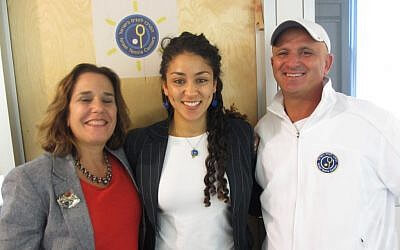
The Israel Tennis Center team: Jacqueline Glodstein, Nadine Fahoum and Shaul Zohar.

“I’m sure there are — we just have to identify them and have them speak up,” adds Nadine.

“We have to encourage them to speak up,” adds Jacqueline Glodstein, vice president of global development for Israel Tennis Center.

Nadine has been living with Glodstein and her family in their Long Island home for the past six months. The family, whose members have all spent significant time in Israel, has found it very enlightening. Glodstein says, “We never had an opportunity to get to know on an intimate basis an Arab Israeli Muslim. It was an amazing opportunity for all of us. Living together, you just begin to know each other in a very special way — you create relationships and bonds.” The Fahoum parents also stayed in the Glodstein home for a e week during a recent trip to the United States.

For now, it is back to work for Nadine. While she will be focusing on her ITC responsibilities, she will still manage to find time for tennis. “I love tennis — I will always play!”

(Source: http://www.timesofisrael.com)

Read more

Walking out of the Bruce Springsteen concert in Philadelphia last week, I heard a yalmuke-wearing teenager exclaim, “If Bruce Springsteen was a rabbi, I’d go to his shul [synagogue]!” The 62-year-old Rock and Roll Hall of Fame inductee had just delivered a three-hour concert—without even an intermission—during which he crowd-surfed across the pit of the Wells Fargo Arena, danced on stage with his almost 90 year old mother during crowd-favorite “Dancing in the Dark,” and pointed heavenward for several minutes during the encore, “Tenth Avenue Freeze Out,” paying proper respect to “The Big Man,” Clarence Clemons, who died last June. Springsteen kicked off his Wrecking Ball tour on March 18th, to promote the release of his 17th album.

The young fan was suggesting that Springsteen knows how to connect with people and inspire them with his message. Charismatic and caring, he even knows his fair share of Bible.

I overheard another, less-observant, friend confided that he was planning on spending the eve of Friday April 6thseder night—with Bruce, the E Street Band, and 20,000 close friends at Manhattan’s famous Madison Square Garden!

Many Jews are connected to Bruce. Fans have long speculated on the extent of the Boss’s connection to all things Jewish. Here is a partial list of obvious (though admittedly “long shot”) connections to Judaism, the Jewish People and Israel.

1. His Name

Many have (incorrectly) speculated that the Boss’ last name gives him away as Jewish. Adam Sandler set the record straight in his “Chanukah Song Part II”:

So many Jews are in the show biz/ Bruce Springsteen isn’t Jewish/But my mother thinks he is.

2. Jews in the Band

The Mighty Max Weinberg (drummer), spoke at the American Museum of Jewish History in Philadelphia the night before two gigs at Wells-Fargo. Weinberg played his first bar mitzvah at age 7, attended synagogue at Temple Sharey Tefilo in East Orange, and in a recent email interview with the JTA, reported that drumming “was my way of living a life of tikkun olam.” Weinberg also said, “I was greatly influenced by the poetic approach to leadership by the late Rabbi Avraham Soltes, who made the stories and scripture come alive through music and his charismatic teachings.”

Max’s son, Jacob, briefly toured with the E Street Band when Max was tied up with his commitment to the Conan O’Brien TV show, and Springsteen’s longtime manager and producer, Jon Landau, is Jewish. Pianist Roy Bittan is Jewish. And Suki Lahav, an Israeli post-army violinist from Kibbutz Ayelet HaShahar, toured and recorded briefly with Springsteen in the 70’s before returning to Israel. Her then-husband, Louis Lahav, was a recording engineer for Bruce.

3. Biblical References

A former student of the St. Rose of Lima Catholic school in Freehold Borough in New Jersey, Springsteen knows his bible. Aside from the occasional Jesus reference, lyrics contain gems such as these three:

“Rocky Ground”

Forty days and nights of rain have washed this land…
Flood waters rising and we’re Canaan bound

“Red Headed Woman”

Well, push comes to shove
Man, and shove comes to push
And I was Moses standing ‘fore the burning bush

“Adam Raised a Cain”

In the Bible Cain slew Abel
And East of Eden he was cast,
You’re born into this life paying,
for the sins of somebody else’s past,

4. Jewish References

Springsteen’s hometown of Long Branch, long associated with the seaside town of Asbury Park, is a stone’s throw from Deal, New Jersey—home to nearly 5,000 Syrian Jews who vacation in there each summer. Call me a conspiracy theorist, but as one blogger noted, a line in “Fourth of July, Asbury Park (Sandy)” might have been inspired by the Syrian Jewish Beach Club Casino in Deal:

And the boys from the casino dance with their shirts open like Latin lovery on the shore/Chasin’ all them silly New York virgins by the score

5. “Shtick” in Concerts

Generally reserved for klezmer bands, “Hava Nagila” is not the first song you’d expect “The Boss” to play. Columnist Jeffrey Goldberg reports that Rahm Emanuel, President’s Obama’s former White House Chief of Staff, prompted Springsteen to play 45 seconds of the Jewish melody at a Washington, DC area show in May, 2009. Emmanuel spotted a sign made by a hardcore fan, requesting the famous—albeit unlikely—song:

“My daughter (a Jewish day school student) didn’t want to go because of homework, so I figured she needed a Jewish excuse to go to the concert. I made the ‘Hava Nagila’ sign—I’m in the mortgage credit market, so there’s not a hell of a lot for me to do these days—and we brought it to the concert,” he said. “I made it like the Torah, two sticks on each side.”

And, in his Bruce Springsteen & The E Street Band: Live in New York City record, while getting the crowd pumped up, Bruce references…a bar mitzvah! He says, “ I’m gonna throw a rock and roll exorcism…a rock and roll baptism and a rock and roll bar mitzvah!”

6. Israel

First the bad news—he ain’t coming to Tel Aviv.  But, back in November, there were articles in several Israeli publications speculating that he might finally perform in the Promised Land. Unlike Elvis Costello and Pete Seeger, Bruce has not criticized Israel or called for its boycott or divestment. When Bruce completes the US leg of his tour in May, he will then traverse Europe before wrapping up in Helsinki, Finland on July 31st—he just doesn’t have enough time to hit the Holy Land. The closest the Boss gets to the Middle East is Lisbon (June 3rd), Milan (June 7th), Florence (June 10th), Trieste (June 11th) and Madrid (June 17th).

But I can’t hold it against him—The Boss is clearly a fan of the Jews! His lyrics, show antics, and band that nearly comprises a minyan point to his connection to Judaism. He  might not be Jewish, but I’m convinced: I want Bruce to be my Rabbi.

Read more