Published Articles

Nadine Fahoum, a Muslim from Haifa, has become Israel’s unofficial ambassador off the court, and a phenom for Duke on it.

For Nadine Fahoum, serving as an ambassador for Israeli tennis and the State of Israel is a pleasure — though anything but straightforward. The 22-year-old Muslim Israeli-Arab from Haifa recently graduated from Duke University in Durham, North Carolina, where she majored in business administration and received a certificate in marketing and management. While there she also found the time to rank number one in tennis singles and helped the Lady Blue Devils tennis team to a national ranking of number three.

Fahoum also served as a de facto Jewish studies teacher and spiritual adviser to three American Jewish teammates. “They asked me about the Jewish holidays and when the Yom Kippur fast begins and ends,” says Fahoum, who regularly visited the Freeman Center for Jewish Life and participated in campus groups such as “Peace or Pieces?” — a forum for Jewish and Muslim students’ “controversial issues.”

‘I was the only Arab kid in school until my brother enrolled in the same school a few years later’ 

Fahoum got an early start feeling comfortable in the Jewish world. Her parents — mother Wafa Zoabi, a lawyer, and father, Anan, a bakery owner — sent Nadine and her younger brother to Haifa’s prestigious Reali Hebrew School. “I was the only Arab kid in school until my brother enrolled in the same school a few years later.”

Her brother, Fahoum Fahoum, 20, has continued to follow in his sister’s footsteps. Fahoum currently studies economics and plays tennis at Old Dominion University in Norfolk, Virginia — the university Nadine transferred from to play tennis at Duke.

“When Fahoum was a junior, I took him and three Jewish kids to play in a tennis exhibition in Boca Raton, Florida,” recounts Shaul Zohar, manager of the Israel Tennis Center in Kiryat Shmona. “We were at a Shabbat dinner and the host asked, ‘Who wants to do the blessing over the wine?’ The three all said no — and so Fahoum did the kiddush!”

Nadine and Fahoum have represented Israel in over thirty countries — starting with her first tournament in France at age 14 and including Switzerland, Portugal, Greece, and India. And they are not told what to say on behalf of the State of Israel.

“I say what I think,” says the polite, soft-spoken Nadine. “I have heard both sides my whole life. We all want the same thing — to live in peace.”

“We need to find a solution as soon as possible. It is a tough situation. We have to start where we are and look forward, not backward, and move forward from here.”

When asked what she would recommend as a solution, she pauses, carefully considering her reply. “We must learn from an early age to live together, when we are not prejudiced. That is why programs like the coexistence programs at the Israel Tennis Center are so important.”

She explains how its initiatives, such as the Twinned Peace Kindergarten, bring children and their families together in meaningful ways. “They go to each other’s houses, do homework together and travel to tournaments together.”

It has not always been easy. Many years ago, at New York’s JFK airport, security officials noted Fahoum’s name and asked to inspect her luggage. Coach Zohar intervened and said, “We are all the same — if you check her bag, you must check all bags. Check all or leave her alone!’”  She was allowed to pass without inspection. Israeli security has subsequently invited Nadine’s mother to offer workshops to security personnel on how to treat minorities.

Nadine recently began working as a development associate in New York City for the ITC. “If there were 10,000 Nadines, the [Israeli-Arab] situation would be different,” says Zohar.

The Israel Tennis Center team: Jacqueline Glodstein, Nadine Fahoum and Shaul Zohar.

“I’m sure there are — we just have to identify them and have them speak up,” adds Nadine.

“We have to encourage them to speak up,” adds Jacqueline Glodstein, vice president of global development for Israel Tennis Center.

Nadine has been living with Glodstein and her family in their Long Island home for the past six months. The family, whose members have all spent significant time in Israel, has found it very enlightening. Glodstein says, “We never had an opportunity to get to know on an intimate basis an Arab Israeli Muslim. It was an amazing opportunity for all of us. Living together, you just begin to know each other in a very special way — you create relationships and bonds.” The Fahoum parents also stayed in the Glodstein home for a e week during a recent trip to the United States.

For now, it is back to work for Nadine. While she will be focusing on her ITC responsibilities, she will still manage to find time for tennis. “I love tennis — I will always play!”

(Source: http://www.timesofisrael.com)

Read more

Original Article Published On The Washington Jewish Week

When photographer, Anna Shteynshleyger, was a little girl growing up in Moscow in the late 1970s and early 80s, she never imagined the life that would await her in a quiet suburb of Washington, D.C. Looking back, Shteynshleyger playfully and painfully recalls her arrival to Gaithersburg in February, 1992. “It was horrible. It was a nightmare, awful, lifeless, like hell!”

At age 15, Shteynshleyger found herself in Seneca Valley High School in Germantown, unable to speak English and unable to drive. Her father had arrived in the States seven years earlier and was commuting between New York City and Arlington. He helped organize the relocation of Anna and her mother. These trying years marked an important turning point in Shteynshleyger’s personal, professional and Jewish life.

As Shteynshleyger recalls, her father was “very wise – he went to a second-hand shop and bought me a used camera, a Pentax K1000, for $100. I immediately signed up for a photography class with a teacher named Jay Corder. It was my only way to connect with the world.” Shteynshleyger continues, “I remember selling my first print to my ESOL (English for Speakers of Other Languages) teacher Mrs. Hildebrandt for $5! And I had a small exhibition at the JCC on Montrose Road.” Shteynshleyger’s camera and the local branch of the Gaithersburg Library helped Anna overcome what she describes as “isolation, loneliness and disconnection.”

“In the library, I chanced on books about Judaism. My first observance of Jewish tradition was through these books. I learned the Sh’ma and candle blessings from books!” Her journey into the arts and Judaism continued when Shteynshleyger attended the Maryland Institute College of Arts in Baltimore. She wondered, “How do I get a hold of Jews in this town?” Her prayers were answered when she met the Katz family – Rabbi Joseph Katz and his wife, Masha. She spent each Shabbat in their home in Baltimore.

Shteynshleyger then enrolled in the master of fine arts program in the photography department at the Yale University School of Art. After completing her MFA in 2001, she and her then husband moved to Des Plaines, Ill., to what she described as a small, suburban Chabad community. Anna spent four years living in this tight-knit religious community. During that time, she photographed family, friends and herself.

Her photographs from the Des Plaines years are currently featured as part of Perspectives, 2012, at the International Center for Photography (ICP) in Manhattan. Her exhibition, entitled City of Destiny, is named after the motto of Des Plaines.

The other two artists chosen for the ICP exhibit are Chien-Chi Chang and Greg Girard. Chang’s photos depict Chinese immigrants in America and feature photos of those living in the States and those still living in China; Girard looks at the lives of American service personnel and their families on bases in the Far East. According to curator Christopher Phillips, “in different ways, each poses the questions of what is home, where is home, and what happens when members of a tight-knit cultural community are transported to unfamiliar locales?”

Phillips is clearly taken by Shteynshleyger’s work and her personal story. When he first met the artist, she simply presented her photos and remained silent. “After a long silence, she said, ‘What do you think?’ “ Phillips explains Shteynshleyger’s belief that “the artwork should be strong and compelling enough that the artist doesn’t need to tell what it is.” By the third meeting, notes Phillips, “Anna began telling me about her life!” Phillips describes a “deep tension – artistic and spiritual longing – that attracted me to her. It is a central tension that drives her work.”

One photo in the ICP exhibit, Covered, 2008, is from the collection of New York City residents Mitchell and Lauren Presser. The viewer sees a person’s back. The person in the photo has short brown hair and what looks like a beard. Upon closer examination, it is a woman – wearing two wigs. “Anna’s work offers an almost voyeuristic inside view of her small tight-knit community of family and friends. It also provides great insight into her personal struggles and development. … Without a single word, Anna captures an inner struggle with both religion and art,” notes Mitchell Presser.

Another photo featured in City of Destiny, “Portrait With Mordecai,” depicts an unhappy-looking couple. We later find out that the pregnant woman in the photo is the artist herself. Presser offers, “The portrait of her with Mordecai, her ex-husband, is a narrative of her life through a single moment in time, without a single word of explanation. City of Destiny is a portal into Anna’s challenges and development. It tells a very personal story.” Shteynshleyger’s work has been getting a great deal of attention these past few years. A solo exhibition of her work was held at the Museum of Contemporary Art in Chicago in 2004, and in 2010, her work was displayed at the Renaissance Society at the University of Chicago.

Shteynshleyger is currently a divorced mother of two. She lives in Chicago and is an assistant professor in the photography department of the School of the Art Institute of Chicago. She is currently working on photographs that explore the ideas of violence.

And how does Washington, D.C., look to the artist now? Shteynshleyger has brought her children back to the D.C. area. “My parents still live in Vienna, and we visit every summer. They have come to see the usual tourist sites. They don’t seem to suffer from my burdens of memory.”

For Anna, however, “Going back through D.C. reminds me of how desolate and isolated one can feel in the world.” City of Destiny will be on display at the ICP in Manhattan through May 6.


Read more

‘Etrog’ by Anna Shteynshleyger

A religious woman with two wigs, a shriveled etrog in an etrog holder and an unhappy expecting couple sitting on a futon are but three of the riveting photos which greet the viewer of “City of Destiny,” an exhibit of the works of photographer Anna Shteynshleyger, a graduate of Yale University School of Art. Shteynshleyger’s photos will be on exhibit at the International Center of Photography (ICP) in Manhattan through May 6.

“City of Destiny” is the motto of suburban Des Plaines, Ill., the tight knit Orthodox religious community where Shteynshleyger lived for four years.

Shteynshleyger was born in Moscow in 1977 and moved to suburban Gaithersberg, Md. at the age of fifteen. “I didn’t speak English, I couldn’t drive — it was awful,” recalled Shteynshleyger in a phone interview from her office in Chicago, where she spoke of her first exposure to both photography and Judaism. “My father gave me a camera — it was my only way to connect with the world.”

In order to deal with what Shteynshleyger describes as “isolation and loneliness,” she discovered the nearby public library and their books on Judaism. While the Shteynshleyger family was not particularly observant, Anna enjoyed books about every aspect of Jewish life.  She recounts that she learned both the Shema prayer and the Shabbat candles blessings from books found in her local library.

Shteynshleyger’s Jewish journey continued as a student at the Maryland Institute College of Arts in Baltimore. She spent most Sabbaths with an Orthodox rabbi and his family in the Park Heights section of Baltimore. She then moved to New Haven, where she completed an MFA in 2001 at the Yale University School of Art in the department of photography. She had some involvement at the Joseph Slifka Center for Jewish Life at Yale, though she playfully notes it was mostly around “food and holidays.”

After graduating from Yale, Shteynshleyger settled in a small Chabad community in Des Plaines. The photographs on display in “City of Destiny,” mainly of family and close friends, capture her experience in Des Plaines. One photograph, “Backyard” is taken at a distance and depicts a girl with family members, appearing small as they are surrounded by very tall trees.  “Picnic” captures pink Crocs, dirty paper plates, a beer bottle and package of cigarettes—all sitting on a child’s play table. Another, “Portrait with Mordecai,” features the artist (pregnant) and her husband.

“Anna’s work offers an almost voyeuristic inside view of her small tight-knit community of family and friends,” notes art collector Mitchell Presser of New York. “It also provides great insight into her personal struggles and development.” For example, he says, “In ‘Etrog’ we see the fruit, once used in religious ceremonies, now dried and shriveled, but still encased in a protective womb appearing as a trophy of things past. The portrait of her with Mordecai, her ex-husband, is a narrative of her life through a single moment in time, without a single word of explanation. ‘City of Destiny’ is a portal into Anna’s challenges and development.
It tells a very personal story.”

(Source: http://www.jewishledger.com)

Read more

Original Article Published on The Jerusalem Post

Jordan Farmar is carefully moving around the court, shooting three pointers and free throws. This is despite a groin injury, which has kept him out of the New Jersey Nets lineup for four straight games. It was only a week ago that Farmar’s three-point last-minute score led the Nets to victory. Towards the end of a practice session at the New Jersey Nets training facility in East Rutherford, New Jersey, the bearded 1.88 m, 82 kg guard sat down with the Jerusalem Post to discuss basketball and life in America and Israel.

The 25-year-old Farmar grew up in Los Angeles, California. His father is African-American and Christian. His step-father, who raised him and is a huge influence on Farmar, is Israeli and Jewish. Farmar studied at UCLA and was the 26th pick in the first round of the 2006 NBA draft. He played with the Los Angeles Lakers from 2006-2010, has played with the New Jersey Nets since 2010 to the present and played for Maccabi Tel Aviv for four months, during the recent NBA strike. His teams have won the NBA championship twice and he was selected as Euroleague Player of the Week in November, 2011. Farmar wears number 2 and averages 10.6 points per game.

You are very close to Omri Casspi. Did you get to hang out with him when the Cleveland Cavaliers were in town recently? How is he doing?

I saw him last Monday night. He is in a tough spot.The NBA is a big business. He’s gotta keep working. It goes up and down if you are not a super star player. I know he had an injury recently and is trying to get back in form.

How did you guys first meet?

For a while, I was the only Jewish player in the NBA. Then he got drafted and joined me! He is the first Israeli-born player. He came to town to play us – we connected around Israel and being Jewish.

What is your best move? How would you describe your style?

Up tempo. Get people involved. Score when need to. Be able to run a team. I like to get out and run, set a screen, make a pass. I appreciate a good game of basketball and people who understand the game.

What is the main difference between basketball in the NBA/US and Israel?

There are superstar players in the US like Lebron, Kobe, Dwight, Howard. You don’t see guys like that overseas. They are incredible. In Israel, the little things are appreciated — the pass and the assist are appreciated as much as the actual stats. And it seems to be about winning – guys want to win. Here, the business of basketball can sometimes get in the way.

What was it like playing for Maccabi Tel Aviv during the strike? You were a Euroleague player of the Week in November, 2011! Was your role different on your Israel team?

I played for four months “I played a lot ” maybe 30 games. In Israel, my team would go as far as I could take them. Here I back up Deron Williams, probably the best point guard in the world!

How were you received in Israel?

Everybody embraced me. I was very welcomed, and wanted and appreciated for having made the decision to play. I felt like I was at home it was a whole family atmosphere wherever I went.

How is your Hebrew?

It is not my strong point! I can definitely understand conversations, I can understand what is going on and I can get my get point across, but I don’t speak well.

What is your relationship with Israel?

My stepfather is from Tel Aviv and we have a lot of family in Israel in the Shabazi neighborhood of Tel Aviv. My daughter, my fiance and I spent a lot of time with family during our four months in Israel.

Tell us about the basketball camp for Israeli Jewish and Palestinian children you were involved with:

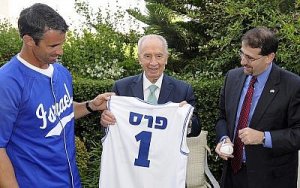
I got involved through my agent, who is Jewish. It started with the Seeds of Peace. They bring kids from different conflict areas Egypt, Jordan, all over. They all come to a summer camp in Maine. They live together, sleep together, eat together. I spent a day there during my first year. Then I worked with them in Israel in 2008. It is through the Peres Peace Center. They have eight camps all over the country. At the beginning of the program, kids argue. Then, with sport as the medium, they forget about everything they were taught (about the others). They are “just kids” they work together to accomplish a goal. And they high five each other.

Any plans to do it again?

(Smiling). I got pretty busy winning an NBA championship, free agency, having a baby….

It sounds like your Israeli step dad was a pretty important influence on you.

My dad was always around, but my step dad was with me every day. My step dad raised me. We are close. He worked six days a week. He instilled good values in me. He is the only person I know who can wake up without an alarm at the time he planned to wake up. He is disciplined and responsible. Aman! A great father figure. He was in the army in Israel.

Does your step dad get to watch you play?

He is a huge Lakers fan. He loves to watch me play. It was great to be part of that team. When he came to the States, he loved Magic (Johnson), (Nick) Van Exel, Eddie Jones, Kobe, and Shaq.

Were you connected to the LA Jewish and Israeli community?

Growing up in LA was great! I love LA! We were a Jewish household. We had visitors from Israel and family coming in and out. I went to Hebrew school, had a bar mitzvah….

What is your favorite Israeli food?

Malawah.


Read more