Published Articles

Original Article Published On The Jerusalem Post

This year’s US Open is unquestionably different – without Israelis, fans or in-person coverage

Back in March, September’s US Open tennis event seemed like a pipe dream. Despite no-shows like Rafael Nadal, a recuperating Roger Federer, and such top women’s players as women’s No. 1 Ashleigh Barty, former French Open and reigning Wimbledon champion Simona Halep, No. 5 Elina Svitotolina and current US Open champ Bianca Andreescu, the tournament is taking place as planned – and is entering round 4 with such top players as Novak Djokavic and Serena Williams still alive.

The United States Tennis Association has taken every precaution imaginable to work toward a safe tournament – including no fans, no media, and frequent COVID-19 tests for all players, who are essentially required to live in a bubble. At a press conference before the tournament, Michael Dowse, CEO and executive director of the USTA; Stacey Allaster, USTA chief executive of professional tennis, US Open tournament director; and Dr. Bernard Camins, medical director for infection prevention for the Mt. Sinai Health Systems, member of the USTA Medical Advisory Group, detailed the multi-tiered system in place for players and guests, tournament officials, broadcasters and event staff. The system was set up to limit interactions.

“We have worked through dozens of scenarios so we can anticipate situations that could arise during the tournaments, planned for them accordingly, and are ready and able to adapt,” said Dr. Camins. “We have been in close consultation with the USTA, the WTA, ATP and other tennis officials so that we could create the current version of our testing and mitigation strategy.”

Even with such precautions in place, it was clear from the outset that the system would be imperfect. As the tournament got underway last Monday, seven players were placed in a “bubble within the bubble” because they were in contact with Benoit Paire, a French player who tested positive and was forced to drop out of the tournament. This past Saturday, US Open Public Relations issued a statement on the women’s doubles team of Kristina Mladenovic and Timea Babos, forced to withdraw before their second-round match.

No Israelis qualified for this year’s US Open. In past years, such Israeli players as Andy Ram and Jonathan Erlich, Dudi Sela, Shahar Peer, Julia Glushko and juniors like Yshai Oliel generated a great deal of excitement among loyal Jewish and Israeli fans.

Andy Ram, whose illustrious career included three Grand Slam wins and multiple appearances on behalf of Israel at both the Davis Cup and Olympics, is keeping an eye on the US Open – even six years after retiring from professional tennis. In a recent interview with The Jerusalem Post, Ram noted that he is especially interested in seeing how the US Open pulls off this event in the age of coronavirus.

“It is such an operation. It is one of the biggest sports events in the world, next to the Olympics,” noted Ram. “It is two weeks and big money. It will be interesting to see how they get back and manage to pull it off and bring all of the players. If they can find a solution, maybe the rest of the sports world will follow. I am really looking forward!”

Julia Glushko, Israel’s recently retired tennis star, played in eight US Opens between 2011 and 2019. At last year’s US Open, she lost 5-7, 6-3, 6-2 in the first round of the qualifiers to Katarina Zavatska. Glushko, 29, admits to having some FOMO – fear of missing out – by not being at this year’s US Open.

“It’s actually a bit weird not being in NYC at this time of the year,” she told the Post. “Even though everything has stopped and I haven’t been feeling like I’m missing out on much, I do feel a bit left out seeing everyone posting about the bubble.”

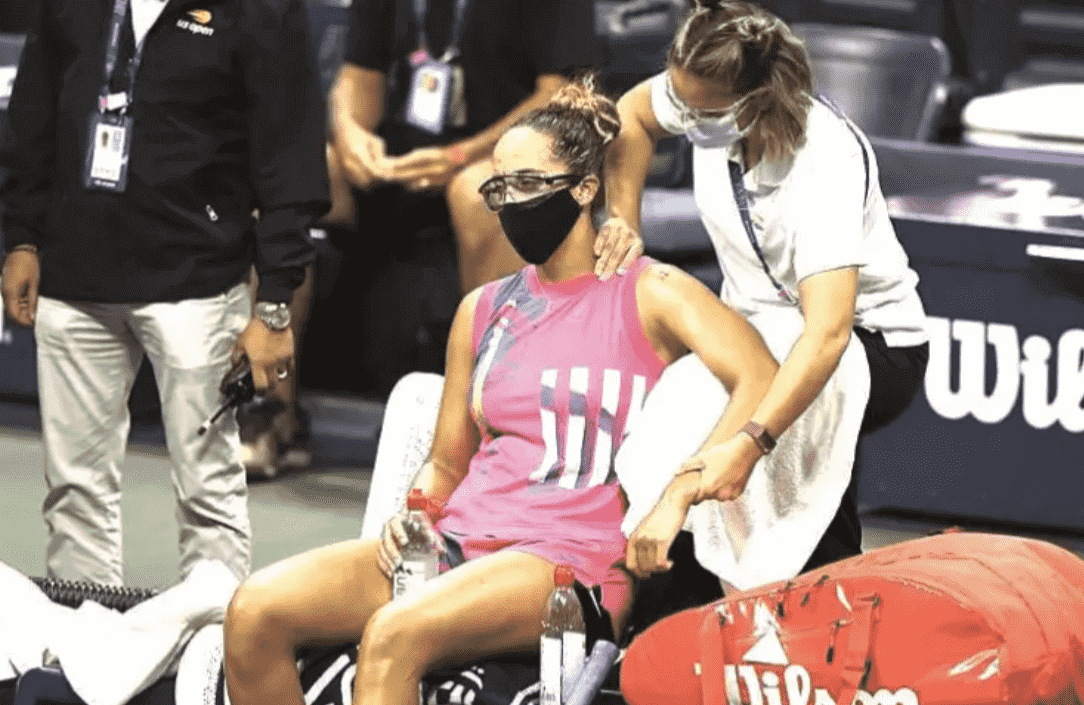
Players are required to live at one of two Long Island hotels, and they are not permitted to venture out of the bubble into Manhattan. Masks are required while on the grounds of the US Open – even during massage and courtside physio sessions. And dining is essentially alone or socially distanced.

The US Open has been working hard to provide a meaningful player experience. And the players are appreciative.

A very large entertainment space usually used by Mercedes-Benz to host important clients, now houses treadmills and exercise bicycles in an open-air gym-type space. The South Plaza of Arthur Ashe Stadium is a make-shift entertainment center used to entice the athletes to stay outdoors as much as possible. It features cornhole sets, a temporary mini-golf course, a human-size chess board, billiards, white Adirondack chairs, umbrellas and beach balls. Hanging out in the locker room for long periods of time is not an option this year.

Organizers have converted 67 of the 80 suites inside of Arthur Ashe stadium. They feature furniture which can easily be cleaned, stocked refrigerators, Lavazza espresso machines and a physio table to each suite. The top 32 male and female are given luxury suites.

Kim Clijsters, a three-time champion in the main draw of the US Open, was lucky enough to receive one of the three unclaimed suites. The 37-year-old mother of three reported, “The suite has been great. Just the convenience for me, I wasn’t seeded, but to receive a suite was obviously a big bonus. We felt very thankful to be up there and to watch the tennis the last couple of days.”

Players are generally pleased to be here, though quite aware of the obvious contrast to past years.

Andy Murray, who came back from two sets down to win a thrilling first-round match, in his first time at the US Open since 2018, reported: “I’m pumped. It’s obviously slightly strange circumstances this year with no fans and stuff here. That’s one of the things I enjoy about competing.”

Murray does, however, appreciate how easy it is to walk the grounds without being stopped by fans.

“When you’re walking to and from practice, you have to get somewhere for a certain time, it’s nice. You know that there’s no one around, that you’re not going to get stopped. Yeah, it’s very quiet and very relaxed.”

But he conceded that “on the whole, I’d way rather this place was filled with people that are excited to come and watch tennis. Yeah, I miss that.”

Players continue to express their appreciation to the US Open at both media sessions and on social media. On Twitter, Sloane Stephens wrote: “Thank you to the @usopen for keeping us safe in our bubble for the next few weeks. Testing, social distancing, hand sanitizing, masks, and all of that goodness plus some tennis!!”

Kirsten Flipkens tweeted: “Impressed by the organization of the @usta Thumbs up! Have really done a good job to provide a safe environment for players and their teams.”

At the hotels, players can enjoy an outdoor lounge and dining area which have been set up on the hotel parking lot, and they can watch both tennis matches and musicians on a live screen – while not using the golf simulator, fitness center and arcade.

While the players are watching matches from the hotel, from the grounds of the US Open, or from luxury suites, the 1,300 people who usually cover the US Open for newspapers, magazines and networks around the world, are doing so from the comforts of their homes – from Auckland, London, Shanghai, Buenos Aires and New York. They are watching the event on their own television sets, and closely watching their hundred plus WhatsApp messages about players coming to the media center for interviews. We can ask questions in the chat, or on screen. Photos are made available from the few in-house tournament photographers.

While many members of the media spend most of their time each year inside the media center, watching monitors and writing, there is nothing like the excitement of wandering the grounds of the US Open, watching matches courtside, and interviewing players in person. This reporter, who has been covering the US Open courtside and from the media center for the past 15 years, shares Julia Glushko’s FOMO.

This year, there is no opportunity for chance or arranged meetings with Stan Smith, Jimmy Connors, or Chris Evert. There will be no one-on-ones after matches – win or lose – with Shahar, Julia or Dudi. There will be no spotting up-and-coming Israeli juniors. And of course, there is no seeing the true greats – Roger, Rafa or Serena – live, in action.

Despite this minor disappointment, we tip our tennis hats to the US Open for pulling of this absolutely unprecedented event. Praying to be back in Queens a year from now for next year’s US Open!

Read more

Original Article Published On The Jerusalem Post

All services will be broadcast for free, live from New York’s Brooklyn Bowl, without an audience, via Fans.com.

NEW YORK – The coronavirus pandemic isn’t stopping The Brooklyn Bowl, the funky and famous bowling alley and music venue in Williamsburg, New York, from marking the High Holy Days, as it has done for the last nine years.This year’s “Bowl Hashana” will be online, however, as the venue’s owner, Peter Shapiro and the team at “Just Jewish” have gotten creative and found what they call “a suite of musically and spiritually driven High Holiday services” which also include Yom Kippur this year.

Four events – (all listed US East Coast, Brooklyn time) on the first night and first day of Rosh Hashanah (September 18 at 7:30 p.m. and September 19 at 10 a.m.), Kol Nidre (September 27 at 7 p.m.) and Yom Kippur day (September 28 at 10 a.m.) will be led by Rabbi Daniel Brenner and musical director and Antibalas co-founder, Jordan McClean. Jeremiah Lockwood, who was a member of Balkan Beat Box, will serve as musical and spiritual supervisor remotely.

“As a rabbi, I hope to draw on the spiritual power of the liturgy and ritual of the high holidays to speak directly to the anguish, soul-searching and desire for redemption that the last five months has brought upon us,” said Brenner. “Broadcasting the music and ritual of the Yamim Noraim [Days of Awe] from the Brooklyn Bowl, a place that hundreds of thousands of New Yorkers associate with joy and the celebration of America’s musical diversity, will not only connect new audiences to ancient prayers, but will help comfort and inspire us at a time when we all could use some uplift.”Lockwood added, “I am grateful to have the chance to reunite this community at this deeply meaningful time of year. This format for presenting music will be unique in my experience as an artist and spiritual seeker, and I am very excited to see how the observers receive it!”
All services will be broadcast for free, live from New York’s Brooklyn Bowl, without an audience, via Fans.com.

Shapiro, publisher of Relix Magazine and a concert promoter, best known as the promoter for Fare Thee Well: Celebrating 50 Years of the Grateful Dead,” is pleased Bowl Hashanah, and now Yom Kippur services, will continue to be offered at the Brooklyn Bowl, even during these unusual times.

“The Jewish Holidays are always a powerful time of the year, where renewal and hope and forgiveness help center us as we enter a new season and a new year. Rosh Hashanah and Yom Kippur will be even more meaningful this year, given the significant challenges that we are facing on a daily basis. Personally, I can’t wait to hear the sound of the shofar. I am really hoping for a very strong blow at the Bowl, one that really clears out the pipes, of both the Internet and our souls!”

Read more

Original Post Published On The Jerusalem Post

After two straight US Open quarterfinals, Jewish-Argentine knocked out early • Djokovic cruises • Gauff ousted

Cameron Norrie of Great Britain battled back from two sets down and two match points to stun the US Open’s Argentine No. 9 seed, Diego Schwartzman 3-6, 4-6, 6-2, 6-1, 7-5 in a four-hour first-round match at the USTA Billie Jean King National Tennis Center in New York on Monday night.
Schwartzman, the No. 13 in the world, experienced cramps on several occasions and took a fall up 3-2 in the fifth set that required treatment on his left hand by the trainer. The gregarious, proudly Jewish 28-year-old is a three-time Grand Slam quarterfinalist. He reached the US Open quarterfinals in both 2017 and 2019, but couldn’t pull out the match against Norrie.

“I had a very bad day,” said Schwartzman after the match. “I was far from playing at the level that I showed many times here at the US Open. I took advantage of the early chances, but I was giving a lot physically and I started to get tired and cramped up a couple of times. In a normal year, when I am playing a lot, I do well, but it is much harder going a long time without competing. It was a very bad tournament for me and all I can do is try to improve for what is coming.”No. 76 Norrie spoke to the British media after the match.“I just had a phenomenal attitude and stayed patient with myself,” said Norrie. “I think my attitude won it for me today and my legs got me through it.”  Norrie had eleven aces to one for Schwarzman. The match broke a US Open record with 58 break points.Norrie advances to play Argentinian Federico Coria in the second round.  Players in the main draw earn $61,000 for appearing in the first round.  Male and female tournament winners earn $3 million.  Norrie has yet to win any titles.  He is 4-10 in Grand Slam matches and has reached the second round four times.

Schwartzman made news during last week’s ATP 2020 Western & Southern Open Masters 1000, which was also played on the grounds of the US Open.  He was upset when Argentine tennis players Guido Pella and Hugo Dellien were quarantined after their fitness trainer tested positive for COVID-19.

“They lied to our faces,” Schwarzman said angrily, “They said that there would be no retaliation for anyone who tested positive.”Relatedly, a number of competitors at the US Open expressed their frustration on Monday after they were moved into a so-called “bubble within a bubble” as they had been in contact with Frenchman Benoit Paire, who tested positive for coronavirus.

Tournament organizers quietly removed Paire from the draw on Sunday, with the Frenchman later confirming on social media that he had tested positive.French players Adrian Mannarino, Kristina Mladenovic and Edouard Roger-Vasselin were subsequently placed under an “enhanced protocol plan” for “players who might have been potentially exposed” to the virus, allowing them to continue competing in the tournament instead of withdrawing.

In other first-round action, Novak Djokovic needed less than two hours to continue his unbeaten season.The top-seeded Serbian routed Bosnia’s Damir Dzumhur 6-1, 6-4, 6-1 in 1 hour, 58 minutes.The win was Djokovic’s 24th in as many matches this year. He won the Australian Open and three tournaments this year, including the Western & Southern Open in New York last week.

Djokovic saved six of the seven break points he faced against Dzumhur while converting six of his 18 break opportunities.A heavy favorite for the title with Spain’s Rafael Nadal and Switzerland’s Roger Federer absent, Djokovic will next face Kyle Edmund. The British player got past Kazakhstan’s Alexander Bublik 2-6, 7-5, 7-5, 6-0.In other matches, fourth-seeded Stefanos Tsitsipas of Greece demolished Spain’s Albert Ramos-Vinolas 6-2, 6-1, 6-1 in 98 minutes.

Maxime Cressy will get the next shot at Tsitsipas, as the American wild-card entrant produced his first victory in a Grand Slam event.Cressy, a 23-year-old UCLA product, beat Slovakia’s Jozef Kovalik 6-1, 2-6, 6-4, 6-4.Fifth-seeded Alexander Zverev needed four sets to get past South Africa’s Kevin Anderson 7-6 (2), 5-7, 6-3, 7-5.Seventh-seeded David Goffin of Belgium eliminated the United States’ Reilly Opelka 7-6 (2), 3-6, 6-1, 6-4.Other seeded winners Monday included Israel-born No. 12 Denis Shapovalov of Canada, No. 19 Taylor Fritz of the United States, No. 20 Pablo Carreno Busta of Spain, No. 24 Hubert Hurkacz of Poland, No. 26 Filip Krajinovic of Serbia, No. 27 Borna Coric of Croatia and No. 32 Adrian Mannarino of France.

In an all-United States matchup, Steve Johnson outlasted 16th-seeded John Isner 6-7 (5), 6-3, 6-7 (5), 6-3, 7-6 (3). Isner fell despite an ace edge of 52-22.On the women’s side, Coco Gauff failed to make it past the first round as 31st-seeded Anastasija Sevastova defeated the 16-year-old sensation 6-3, 5-7, 6-4.

Gauff had a memorable run 12 months ago at age 15 when she recorded two wins at the US Open before losing to top-seeded Naomi Osaka in the third round.But the magic wasn’t there against the 30-year-old Sevastova, who was a US Open semifinalist in 2018 and reached the quarterfinals in both 2016 and 2017.Gauff committed 13 double faults and 41 unforced errors against 27 winners in the match at Louis Armstrong Stadium.

“I could’ve played better today, but I’m just going to get back to work and get ready for the French Open,” Gauff said of the event that begins Sepember. 21.Also, top-seeded Karolina Pliskova of the Czech Republic routed Anhelina Kalinina of Ukraine 6-4, 6-0.Fourth-seeded Naomi Osaka, two days after withdrawing from the Western & Southern Open final due to a hamstring injury, emerged with a 6-2, 5-7, 6-2 win over another Japanese player, Misaki Doi.

Sixth-seeded Czech Petra Kvitova also was sharp with a 6-3, 6-2 win over Romania’s Irina-Camelia Begu.American Alison Riske, seeded 13th, got past Germany’s Tatjana Maria 6-3, 6-2, No. 17 Angelique Kerber of Germany notched a 6-4, 6-4 win over Australia’s Ajla Tomljanovic and No. 30 Kristina Mladenovic of France recorded a 7-5, 6-2 win over Hailey Baptiste.

Reuters contributed to this report.

Read more

Original Article Published On The Jerusalem Post

Also read it in Spanish On Enlance Judio

Until her death Monday at age 85, Buxton was still waiting for her August 1958 application for membership in the All-England Lawn Tennis Club to be approved.

Sandra Harwitt – my seatmate on the free bus which takes US Open credentialed media, umpires, coaches and players from Manhattan to the US Tennis Center in Queens – playfully asked if I recognized the 80-year-old woman in front of us.

Harwitt, a tennis writer and author of The Greatest Jewish Tennis Players of All Time, clearly did. It was Angela Buxton, the feisty 1956 Wimbledon women’s doubles championship from England, best known for befriending and teaming up with African-American Althea Gibson.

Why would a Liverpool-born Jewish woman, who spent World War II in South Africa, and spent significant time in the US, India, and Israel, break the color barrier in tennis? Quite simply, Buxton saw herself and Gibson as outsiders.
Until her death Monday at age 85, Buxton was still waiting for her August 1958 application for membership in the All-England Lawn Tennis Club to be approved.
“I think the reason is quite clear,” the feisty, straight-talking Buxton told me in her English accent in a 90-minute interview in the media dining room at the 2014 US Open.

“I can only assume it is because I am a Jew.”

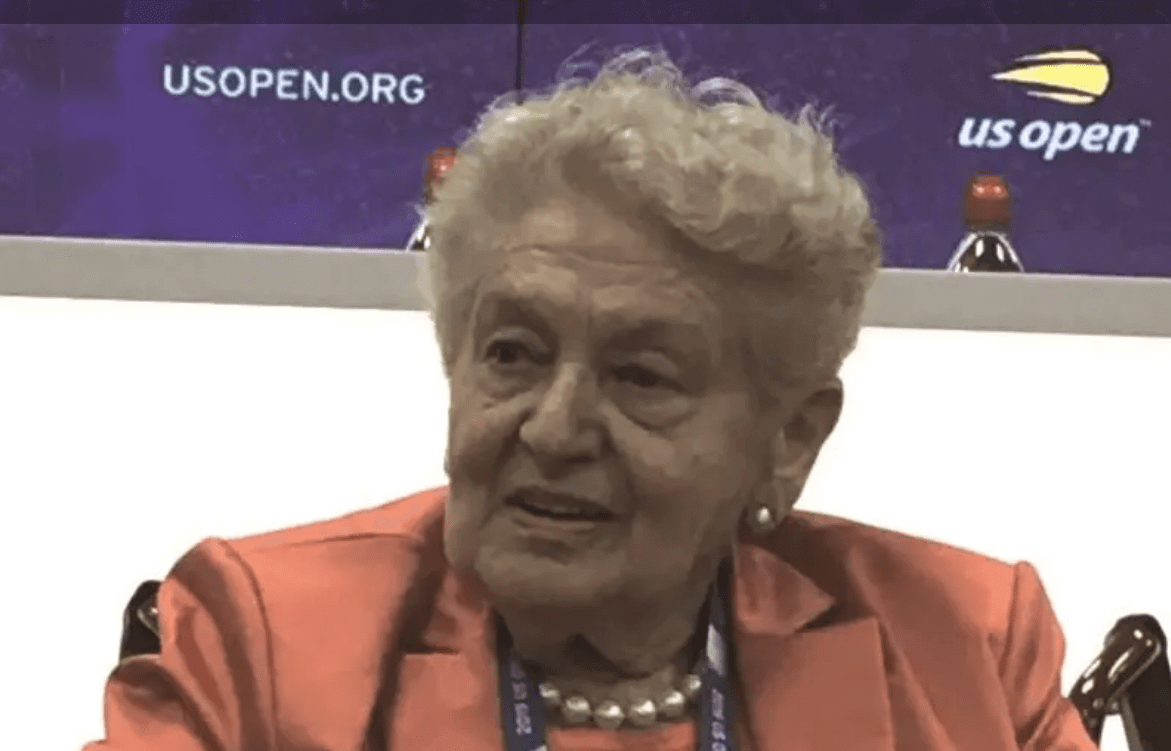
Buxton always spoke candidly. She was delighted that I write about tennis for Israeli and other topics for Israeli publications. We became friends and stayed in contact over the years. Buxton would call, send her tennis articles—or a DVD of the movie, Althea and Angela: A Perfect Match, and she insisted I read the book, The Match: Althea Gibson & Angela Buxton: How Two Outsiders – One Black, the Other Jewish – Forged a Friendship and Made Sports History. I last saw Buxton at the 2019 US Open – this time in a wheelchair – at the dedication of the Althea Gibson statu

Buxton experienced racism for the first time as an 8-year-old in South Africa, when friends and neighbors disapproved of a friendship with a black girl her age. Buxton’s first encounter with antisemitism also occurred in South Africa when a man remarked, “You Jews are all the same. You think you own the world!”

As a teenager she applied to join the Cumberland Club, the top tennis facility in North London. Coach Bill Blake reportedly rejected Buxton, saying “You’re perfectly good, but you’re Jewish. We don’t take Jews here.”
Instead, she practiced on the private tennis court of Simon Marks, the Jewish owner of the department store Marks & Spencer.
As a pro, Buxton’s first encounter with antisemitism in the tennis world occurred at the Los Angeles Tennis Club in 1952. She was denied membership because she was Jewish.

Buxton’s first encounter with antisemitism in the tennis world occurred at the Los Angeles Tennis Club in 1952. She was denied membership because she was Jewish.

In 1953, Buxton had a very positive Jewish experience. She traveled to the Maccabiah Games from England to Israel – by boat, on a ship called “Artza,” – with 100 Jewish fellow athletes.

In 1956, Buxton asked Gibson to be her doubles partner at the French Championships and Wimbledon. After the pair won Wimbledon, a British newspaper headlined a report, “Minorities Win.” Buxton injured her wrist at an August 1956 tennis tournament in New Jersey and her tennis career soon came to an end.

Buxton’s colorful post tennis-playing life included teaching and coaching tennis, starting the Buxton Tennis Center in North London, sports writing and volunteering with her three children – then-ages 6, 4, and 18 months – on Kibbutz Amiad during the Six Day War.

Buxton returned to Israel many times over the years and helped found Israel Tennis Centers.

Buxton was inducted into the Black Tennis Hall of Fame in 2015 for her relationship with Gibson and the International Jewish Sports Hall in Israel in 1981.

I will miss seeing Angela schlepping her big “wheely” suitcase through the grounds of the US Open, and her calling me at random times to share a story or article. The world has lost a legend – one with a real Jewish soul!

Read more