Published Articles

Original Article Published On The Jerusalem Post

Jewish New Yorker aims to qualify for US Open, starts program to shine light on deep issues facing pro tennis players

Jewish tennis player Noah Rubin has been doing great things with rackets – on and off the court – since he was a little boy. The 23-year-old, 195th-ranked ATP professional from Long Island, New York, had a tennis-themed bar mitzvah, enjoyed a successful run as a junior, and has already had some memorable on-court moments since turning pro in 2015.

Rubin has beaten top tour players such as John Isner (2018 Citi Open in Washington DC), and he has given Roger Federer a run for his money, losing 7-5, 6-3, 7-6(3) in the second round of the 2017 Australian Open.  Rubin continues to hover around No. 200 in the rankings and travels the world participating in both the ATP Pro Tour and Challenger Tour events.

He is also active and vocal off the court, advocating for more equitable earnings for all tournament players, and helping humanize the sport through his “Behind The Racquet” project on Instagram, Twitter and Facebook.  The initiative features many of the world’s best tennis players posing behind their rackets and telling personal stories of depression, anxiety, alcohol abuse and more.

This week, Rubin is working to secure a spot in the main draw of the US Open in New York at the USTA Billie Jean King National Tennis Center. He is no stranger to the Grand Slam event; Rubin has played in either the US Open Qualifying Tournament or the main draw every year since 2013.  To earn one of 16 coveted spots in this year’s main draw, he must first win two more matches in this week’s qualifiers.

A local favorite who was surrounded by family and friends during his first-round match, Rubin easily defeated Italian Gianluca Mager 6-2, 6-3 on Tuesday to set up a second-round duel with 166th-ranked Spaniard Guillermo Garcia-Lopez late Thursday night.

Rubin comes from a tennis family.  According to his mother, Melanie, Noah began playing tennis while “still in diapers.” Melanie and her ex-husband, Eric, would get up at 5 a.m. and drive daughter Jessie and Noah to a 6-8 a.m. indoor tennis clinic on Saturday and Sunday mornings. Jessie Rubin McNally, who met her husband on a Birthright Israel trip, went on to play as the captain of the Binghamton (NY) University tennis team, but her younger brother took tennis to another level.

“Eric and I were a good team,” said Melanie. “He would feed Jessie and Noah balls, and I would pick up the balls and offer encouragement.”

As a young child, Rubin played tennis several days a week.  He played for the John McEnroe Tennis Academy and competed in tournaments, but also played on a soccer team and attend Hebrew school three days a week from second grade through the age of 13.

Rubin celebrated his bar mitzvah at the Merrick Jewish Center, a Conservative synagogue on Long Island and organized a “mitzvah project” collecting used tennis rackets to donate to the Israel Tennis Centers (recently renamed the Israel Tennis and Education Centers).  As Rubin playfully noted, “I can recite my haftarah to this day!”

After his bar mitzvah, Rubin stopped attending Hebrew school and began to focus on tennis. He attended high school in Bellmore, Long Island, for one year before, as his training and tournament demands intensified, he switched to learning online.

As a junior player, Rubin reached No. 6 in the world in the International Tennis Federation.  In 2014, he was the No. 1 junior in the United States.  He reached the second round of the French Open juniors’ tournament in 2014 and soon after won the Wimbledon junior tournament.

One month later, Rubin won the 2014 US Tennis Association’s Boys 18s National Championships in both singles and doubles.  As a result of this victory, he received a wild card in to the main draw of the 2014 US Open. Since turning pro in 2015, Rubin has won four ATP Challenger titles and reached a high ranking of No. 131, in 2018.

The likable Rubin – who stands 5-feet-9-inches tall (1.75 meters) and weighs 155 pounds (70 kilos) – is articulate, earnest and very forthcoming to The Jerusalem Post this week in describing his first-round match, some personal struggles and the often challenging life of young professional tennis players.

“There is this anxiety which fills me at the US Open,” said Rubin. “As you can see, right behind me are my family and my friends – everybody who is close to me.  I love the support, but once I step on court it hits. There is a lot of pressure.  These are all the people who have worked so hard to get me to where I am.  I don’t want to let them down.”

Rubin said that he “loves to show off, not in front of people I know.”

Acknowledging that some of his best tournaments have been in Australia, Rubin offered: “That is because it is on the other side of the world.”

Rubin appeared to be healthy during his match against Mager.  When asked about his health in recent months, given a number of injuries in past years, he unexpectedly reported, “Another injury has stricken me and it is mental.  A lot of people don’t talk about that and that is what I am fixing.  It is a huge issue in tennis.  I have this ongoing quote that I say – tennis is not conducive to happiness.  That is a tough thing since tennis is the thing I love and I still love.  But the system of tennis doesn’t make it a viable choice to really smile each and every day.”  

Rubin tries hard to keep perspective.

“My new mentality these past five months, actually really the past two months, has been to try and just enjoy tennis, enjoy the atmosphere. People are here to support me.”

Rubin has worked hard to help fans understand the real life experience of professional tennis players and to offer insight in to how they are feeling.

“There are a lot of problems in this sport and it leads to depression, alcohol abuse, etc. I am desperately trying to get people to understand what is going on.   I want to help the world of tennis. I think nowadays people are starting to outwardly speak, but it will still take more effort.”

He is making progress through Behind the Racquet.

Rubin described the goals of the online series – to break the stigma of mental health, to allow players to share their stories and to let fans relate to players on a deeper basis.  Rubin hopes to “bring new excitement to tennis.”

Behind the Racquet currently has 13,600 followers on Instagram. Even tennis great Venus Williams has posted about it online.

Melanie proudly added that tennis legend Billy Jean King has also commented on Noah’s important contribution.  Melanie said that many players have reached out to Noah privately to “thank him from the bottom of their hearts” for what he is doing in capturing the often lonely, physically taxing life of an on-tour tennis player.

“He is really trying to do something good and help people. He has already made people’s lives better.”

His sister Jessie put Noah’s off-court work in a Jewish context.

“He is doing Tikkun Olam – he is trying to repair what needs to be repaired.”

Noah would appreciate her reference to the important Jewish concept of “healing the world.” Proud of his Judaism, Rubin plays around the world sporting a necklace he describes as “the hand of God with a chain in the middle,” which his father bought him as a 17th birthday present. He is pleased when fans engage him about being Jewish.  While he acknowledges that he represents America and New York wherever he goes, he adds, “I am a Jewish New Yorker and that means a lot to me.”

Rubin would very much like to visit Israel for the first time, but noted that his tournament schedule has made this difficult. He almost had the opportunity to play in the Jerusalem Challenger Tournament this year – “I tried to go but it was during the French Open Qualifying Tournament.”

“I will get to Israel,” asserted Rubin.  “It is not even a question. I will get there with my girlfriend or my family or by myself. I’ll run over there if I have to.”

Read more

Original Article Published On The Jerusalem Post

Plucky Glushko can’t overcome cough, Zavatska in first-round of qualifiers • Sela also ousted

NEW YORK – The Yiddish-originating adage of “man plans, and God laughs” applies even to professional tennis players. All the best coaching, practice sessions, healthy eating and natural talents cannot guard against life’s unpredictable occurrences. On Tuesday, Israel’s Julia Glushko was in action in the first round of the US Open Qualifying Tournament, having returned to New York after a year of numerous, unexpected health and medical issues. 

The 29-year-old Glushko, currently ranked No. 248, faced 19-year-old Ukrainian power hitter Katarina Zavatska (No. 127) in the mid-day heat in Flushing Meadows. Long rallies, careful shot selection, and very few double faults and unforced errors kept the 2-hour, 25-minute slugfest close for two sets. Glushko took the first set 7-5, but Zavatska fought back to close out the second set 6-3 as her set-point shot rolled off the top of the net, landing far out of Glushko’s reach.

Following a short break, Glushko took the first game of the decisive set before quickly falling behind 4-1. Glushko held serve at 4-2 and lost the next two games, double faulting to end the match in a 5-7, 6-3, 6-2 defeat. 

“It was a good match,” said Glushko’s coach Keren Shlomo. “Zavatska played really well. She doesn’t give you anything. You have to work for everything.” 

In a post-match interview, Glushko added, “I had so many heath issues, it was scary. I had just one thing after another!” 

Glushko’s rough year actually started in the first round of last year’s US Open, when she hurt her left knee and fell to the ground in severe pain during her match against Monica Niculescu. Her knee was taped and she made what appeared to be a semi-miraculous recovery. Glushko battled back to win the match before losing in the second round to the eventual tournament champion Naomi Osaka. 
When Glushko returned to Israel, she learned that she had a fracture in her left knee. Once the fracture healed, she had surgery to clean the meniscus. Following a nearly seven-month recovery and rehabilitation, Glushko entered the qualifying tournament at Indian Wells, California. She played several tournaments in China and in Europe before again being sidelined – this time with sinus inflammation.

Glushko then entered the French Open qualifying tournament, where she lost in the third round and suffered a shoulder injury. She played in the qualifying tournament of Wimbledon in July, despite lingering shoulder pain. She was then diagnosed with a blood infection, which caused her to miss most of this summer’s US tournaments. Just a week ago, Glushko developed a cough and was treated with antibiotics. 

“It has been very on and off this year,” said the Israeli. “I feel like half the tournaments I was either playing injured or sick.” 
She described missing one her favorite tournaments, the Australian Open, and she missed playing with her Israeli teammates to the Fed Cup. 

“I learned that I can’t control life. You always have some deadline to make, or a tournament or a ranking. I learned that life is just bigger than that. I tried to control life too much. It doesn’t work… I just try to be happy each day.” 

Meanwhile, Dudi Sela hoped his visit to New York would last at least a week or two. The 34-year-old Israeli, ranked No. 167 in the world and on his way back from injuries which kept him out of last year’s US Open, needed to win three matches in this week’s US Open Qualifying Tournament to secure one of 16 coveted spots in the men’s main draw.

 Instead, Sela was dismissed in just over two hours in the first round of the qualifying tournament by 27-year-old Canadian Steven Diez, ranked No. 175. Sela called for the trainer in the third set to treat his wrist, before falling 4-6, 6-4, 6-2.

Sela is no stranger to the US Open. Since 2003, he has been entertaining fans in Flushing Meadows, often in come-from-behind battles late in the night. He played the US Open qualifying tournaments in 2003, 2005 and 2006 without advancing to the main draw. 
From 2007-2011, and again from 2013-2017, Sela made it to the main singles draw, though never advancing past the second round. His career won/loss record at the US Open is 6-10.

Sela returned to this year’s US Open after skipping last year’s tournament due to a wrist injury. He has also dealt with back injuries in recent years. Sela mostly played Challenger tournaments in 2019; success in these lower level tournaments helped him acquire ranking points.

In June, Sela won the inaugural Little Rock Open, an ATP Challenger Tour, marking his 23rd career win and his first in two years. Sela has earned slightly under $47,000 in prize money this year, and just under $4 million in his career. In 2009, Sela reached a career high ranking of 29. First-round losers in this year’s US Open Qualifying Tournament earn $11,000.

On Tuesday, Sela generally dictated the pace early in the match and enjoyed support of vocal Israelis in the crowd, cruising to an easy 6-4 win.

Diez held serve in the first game of the second set before Sela went up 3-1, displayed masterful shot selection and placement, and he appeared on course to win close out the match. However, Diez hit a series of successful passing shots and held serve to take the second set 6-4.

Sela came out fighting in the third set, but Diez quickly took held control and broke Sela to go up 3-0. Sela appeared on course for a comeback when down 4-2, however following a series of balls hit long and wide, the Israeli appeared to lose his desire and Diez closed out the final set 6-2. 

Other Jewish players in action on Tuesday include Noah Rubin, the 23-year-old from Long Island, New York who was the Wimbledon boys’ title in 2014, and Jamie Loeb, 24, of Ossining, New York. Loeb was the 2015 NCAA champion at the University of North Carolina.

Currently ranked No. 195, Rubin notched a 6-2, 6-3 first-round victory over Gianluca Mager of Italy.
“The first win definitely helps moving forward,” said Rubin. “More than anything, I just want to have fun and enjoy myself, and that is why I am here.”

Loeb was ousted in her match by No. 29 Harriet Dart of England.

“It’s always great having a home crowd,” said Loeb following her 6-2, 7-6 loss to Dart on Tuesday. “I wish I could’ve pulled it out today, but it’s tough.”

Read more

Original Article Published On The Jerusalem Post

The 32-year-old catcher played for Team Israel during its run through World Baseball Classic qualifiers and tournament in 2017

Ryan Lavarnway is one of the lucky ones – if you consider switching jobs every few months on average “lucky” – though he doesn’t take his success for granted.

The 32-year-old catcher, who played for Team Israel during its stellar run through the World Baseball Classic qualifiers and tournament in 2017, has bounced around Major League Baseball, but mostly in the minors – with 10 teams in 10 years. Still, Lavarnway represents the roughly 10 percent of minor league baseball players who ever see action in the majors.

The California-born Colorado resident has been blessed with memorable moments with several major league teams, and has faced often unexpected, last-minute call-ups and cross-country moves – including three in the past month alone.

“It has been crazy!” exclaimed Lavarnway to The Jerusalem Post during a phone interview from his hotel room in Louisville, Kentucky following a Sunday game in which he went 1-for-3 for the AAA Louisville Bats in a 12-0 loss to the Toledo Mud Hens.

“One day you are in Triple-A in Scranton, Pennsylvania [for the New York Yankees]. The next day, you are in the big leagues.”

In July, Lavarnway was released by the Yankees and immediately signed with the Cincinnati Reds, where he hit two home runs and had six RBIs in his Reds’ debut on July 19, becoming the first Reds catcher to tally three hits, two homers, and six RBI in a game since the legendary Johnny Bench did it in 1973. He went 5-for-18 in five games with the team before being sent down to Cincinnati’s AAA affiliate in Louisville.

Given Lavarnway’s chaotic past month and the 140-game minor league baseball schedule, it is impressive that he was able to commit to a day and time to speak with a reporter. He was upbeat, friendly and forthcoming in recounting his exciting and fulfilling baseball journey so far.

He vividly recalled career highlights, including his first two-homer game with the Boston Red Sox, and a similarly exhilarating walk-off homer with the Pittsburgh Pirates. Lavarnway also spoke fondly about his great run with Team Israel, and his amazing trip Israel.

Lavarnway was born in Burbank, California, grew up in Woodland Hills, California, and has mainly been a catcher – with stints in the outfield and first base – since his little league days. He attended Yale University in Connecticut for three years, where he juggled his academic studies with a very successful baseball experience.

Lavarnway earned Ivy Player and Rookie of the Week honors in March 2006 as a right fielder before switching to catcher full-time. In 2007, he led the NCAA in batting average (.467) and slugging percentage (.873), set the Yale single-season record in batting average, slugging percentage, home runs (14), hits (70), doubles (17), RBIs (55), and total bases (131). He also had an Ivy-League-record 25-game hitting streak and won the G.H. Walker, Jr. Award as Most Valuable Player.

In his junior year in 2008, Lavarnway led the Ivy League in home runs (13), RBIs (42), walks (29), slugging percentage (.824), and on-base percentage (.541), while batting .398. He missed the last 11 games of the year after breaking a bone in his left wrist while diving into home plate in April. He finished his three-year college career with a .384 batting average, 33 home runs, and 122 RBIs in 120 games, and he became the Ivy League’s all-time leader in career home runs.

Lavarnway left Yale 11 credits short of graduation as he was drafted in the sixth round of the 2008 MLB Draft by the Boston Red Sox. He played at every level of the minors within the Red Sox organization –from the Class A South Atlantic League Greenville Drive, to the Class A+ Carolina League Salem Red Sox, to the Class AA Eastern League Portland Sea Dogs. He racked up many honors, including 2010 Red Sox co-Minor League Offensive Player of the Year. Lavarnway spent the 2011 season between the AA Portland Sea Dogs and the AAA Pawtucket Red Sox.

Lavarnway got his first big break on August 18, 2011 when he was called up to the Red Sox; fellow Jewish player, Kevin Youkilis, went on what was then called the disabled list (now known as the “injured list”). He got his first major league hit the next day, and started for the Red Sox on September 27. Lavarnway still proudly remembers this game as he hit his first two major league home runs and had four RBIs in an 8–7 victory over the Baltimore Orioles.

Lavarnway returned to the minors and again saw action with the Red Sox on August 1, 2012, when he was called up from the Triple-A Pawtucket Red Sox. Lavarnway and fellow Yalie, fellow Jew (and in 2017, Team Israel battery mate), Craig Breslow, were Boston Red Sox teammates during part of the 2012 season. Lavarnway returned to Pawtucket where he was named best power prospect in the International League as well as the 2012 International League All Star starting catcher.

Lavarnway continued to be part of the Red Sox organization through 2014. In June, he had surgery to remove the hamate bone from his left wrist. He was designated for assignment in November, and his dizzying “see-the-country” baseball career continued as he was claimed off waivers in the winter, first by the Los Angeles Dodgers, then by the Chicago Cubs, and was signed by the Baltimore Orioles – his fourth team in 18 days. He played 10 games with the Orioles early in the 2015 season, then chose to become a free agent over accepting a minor league position in the Orioles’ organization.

He signed a minor-league contract with the Atlanta Braves in May 2015 and had 49 plate appearances for AAA Gwinnett before being called up to the majors. He was released by the Braves in May 2016. Lavarnway signed a minor-league contract with the Oakland Athletics, started the season with the Triple-A Nashville Sounds, and was called up to Oakland in July. He played in one game – covering for a catcher on paternity leave – and then returned to the minors before being called up again by the A’s on July 27. He was designated for assignment in August and chose to become a free agent at the end of the season.

Lavarnway continued to find major league clubs interested in him. In January 2018, Lavarnway signed a minor league contract with the Pittsburgh Pirates, where he had a decent 77 games for Triple-A Indianapolis before being called up to Pittsburgh on September 4. He had four hits in six at bats.

In November, Lavarnway again became a free agent – and was again picked up by another club. The New York Yankees signed him to a minor-league contract for the 2019 season, where he played with AAA Scranton, before being released July 18, and rushing off to Cincinnati. The next day, he hit two home runs for his new team.

Lavarnway continues to enjoy the excitement of playing baseball – and the potential to be called up for that dream moment.

“I am with my 10th organization since 2014,” he said. “I go where the job is, I don’t think about it. Every time I am called up – that’s what makes it worth it. Hopefully, I will help get a team to the World Series – it is an opportunity I don’t take for granted.”

Lavarnway feels his experience over so many years in different organizations and at different levels has made him a “quick-learn” on the job.

“It helps that I’ve been around a while and have so much experience catching different types of pitchers. I can catch guys I’ve never seen before, and I can build trust with new pitchers.”
As Lavarnway looks back on the 11 years since leaving Yale, he is proud of his professional and personal accomplishments.

He reported that he and his wife of six years, Colorado native Jamie Neistat Lavarnway, have gotten used to the “ups and downs.” She has had jobs in each town, has written a food blog in the past [“The Fork and Knife of a Baseball Wife”on cookinginredsocks.com] and has most recently done volunteer work in animal rescue in Nashville.

“It is hard to find something portable,” notes Lavarnway, indicating that Jamie has done an amazing job coordinating their personal travel and professional moves and “could be an excellent travel secretary” for a baseball team.

Ryan and Jamie love to travel and try new restaurants.

“We are trying to cross off the top 50 restaurants in the world,” reports Lavarnway. They recently visited the well-known Israeli restaurant in Paris, L’As du Fallafel (“it was so good!”). Next up on the Lavarnway’s off-season travel agenda is Thailand.

“In each city, [Jamie] finds the best restaurants for us to explore.” Lavarnway truly appreciates how fortunate he is to have a job with a long off-season. “We have a great life-where else can you have four months to travel?!”

The Lavarnways’ travels have also taken them to Israel, though that trip, with other members of Team Israel, was different from the others—Ryan recalls it as being “life changing.”

The blue-and-white’s impressive run in the World Baseball Classic and the team’s trip to Israel, was chronicled in the recent film, “Heading Home.” Lavarnway – who served as Team Israel’s starting catcher, went 8-for-18 (.565) with two doubles, a home run, and six RBIs, while walking five times – loved the movie.

“They did an amazing job, and it’s cool that a moment that was so important in my life is on video so I can relive it.”

Lavarnway can barely contain his excitement when speaking about the trip to Israel. While he always thought of himself as Jewish (his mother is Jewish and his father is not) and connected to the religion in his youth, he proudly stated that “the Team Israel experience and going to Israel helped me find my Jewish identify and reaffirm my own Jewishness.”

Lavarnway never got to participate on a Birthright Israel trip as he was busy playing baseball each summer. He refers to the Team Israel trip as “our baseball Birthright.” He especially enjoyed “seeing Israel, feeling the love, and seeing the people,” and liked learning about Jewish and Israeli history.

The Lavarnways continue to be connected Jewishly and are members of Temple Emanuel in Denver.

Lavarnway still feels very connected to Team Israel and to Israel Baseball.

“Our goal is for Israel Baseball to continue to grow. We didn’t want to just be a one-time WBC highlight. We wanted to grow the game internationally and domestically. Our whole goal was to get homegrown Israeli baseball players to keep playing at the highest level.”

While Lavarnway is willing to consider future involvement with the team as it works to qualify for the 2020 Olympics, he notes that he “hope[s] to be on a big league team in September – that is when the qualifiers are. But if I’m not, I’m totally willing to participate.”

Lavarnway loves baseball and hasn’t given much thought to life beyond. As he playfully commented, “Plan B distracts from Plan A.” While completing college is not itself a Plan B, he is taking steps in that direction. Lavarnway said that Yale has recently begun offering credit for online courses. Despite his busy 2019 baseball season, he recently completed two courses – Movie Physics and The Genius Course. “I just submitted my final paper for two Yale credits – I am now two credits closer to graduation,” though he still has seven more classes to complete to earn his degree.

For now, Lavarnway will focus on the rest of the baseball season – and dream of the call-up which may bring him back to the majors for a pennant race and another twist in his whirlwind tale.

Read more

Original Article Published on The Chabad.ORG

Tell a friend you are going to federal prison and responses vary from surprise, to sarcastic comments, to questions about why a person would spend precious volunteer time visiting someone who had committed a crime. When I was asked to take part in a new visitation program as a reporter, my own first reaction to the assignment was one of nervousness and even embarrassment. What could I possibly have in common with these guys, even if we were both Jewish? What would we talk about? How would I explain my participation in this program to my friends and family members? Why would I go through an application and screening process just to visit people who had done something bad?

I spoke to a few friends who, much to my surprise, shared with me that each of their communities had several members who had spent time in prison. I began to think about those inmates’ families and what it must be like to have a family member in prison. I wondered what it’s like being Jewish in prison, and what the process of re-entering the Jewish community after release is like.

I’d have to venture inside a facility to find out.

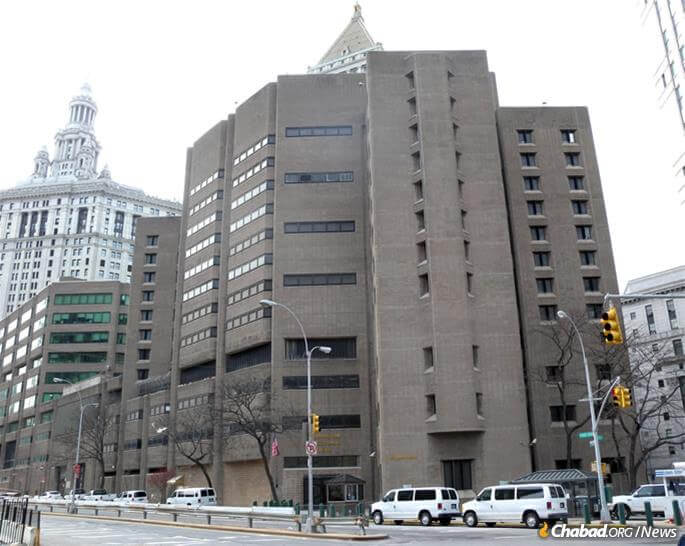
A few months later, with the help and guidance of the Chabad-Lubavitch affiliated Aleph Institute—the leading Jewish organization caring for the incarcerated and their families—I found myself passing through a metal detector and having my hand stamped at the Metropolitan Correctional Center (MCC) in New York, not far from City Hall. A federal facility known for its strict security, MCC is a 12-story concrete fortress in the heart of Manhattan, a place The New York Times quotes an inmate describing as “less hospitable than Guantanamo Bay”—he would know, he’d been in both. MCC is adjacent to the courthouse where I’ve gone for jury duty, but I’d never even known of its existence. Stripped of my phone, keys and wallet, and with only my reporter’s notebook and pen in hand, an officer led me through a series of claustrophobic passageways, eventually to the visitation floor.

In the small, triangular-shaped room where I was told to wait for the Jewish inmates I’d be meeting one at a time, I noticed a would-be inspirational poster on the wall. “Make it happen,” it cheerily read. “There is no challenge too great for those who have the will and heart to make it happen.”

It dawned on me that though geographically close to my own home, I was in an alternate universe.

Visitation Opens Up

The Aleph Institute was founded in 1981 by Rabbi Sholom Ber Lipskar at the express direction of the Rebbe, Rabbi Menachem M. Schneerson, of righteous memory, who was an early and passionate proponent of criminal justice reform. With the goal of reaching out to Jews in limited environments, Aleph has a division dedicated to the incarcerated and a separate one working with the military. It has been a pioneer in both fields.

The guiding principle behind Aleph’s prisoner initiatives, following the Rebbe’s leadership, is that someone who has committed a criminal act is still dear to G‑d and created in His image, with religious responsibilities, the ability to improve, and human emotional needs. Above all, each person has a unique role to play in the world, and the goal must be to assist them in reintegrating into society, where they can resume their individual missions.

“When a person finds himself in a situation of ‘after the sunset,’” the Rebbe wrote in a November 1977 Chanukah letter addressed to prisoners, “when the light of day has given way to gloom and darkness—as was the case in those ancient days under the oppressive Greek rule—one must not despair, G‑d forbid, but on the contrary, it is necessary to fortify oneself with complete trust in G‑d, the Essence of Goodness, and take heart in the firm belief that the darkness is only temporary, and it will soon be superseded by a bright light, which will be seen and felt all the more strongly through the supremacy of light over darkness, and by the intensity of the contrast.”

Despair and despondency is part and parcel of prison life, a feeling of being alone in a harsh, dark world. That’s why Aleph’s motto is: “No one alone, no one forgotten.”

And by feeling “not forgotten,” the chances of making a smooth post-prison transition improves drastically. Of the nearly 2.2 million people incarcerated in the United States today, nearly 75 percent will return to prison within five years of release. As reform advocates continue to work on various programs across the system to lower the recidivism rate—including pre-sentencing diversion, drug rehabilitation and, crucially, educational efforts—one aspect that has continuously borne results are visitation programs. Prisoners who maintain connections with the world outside, members of their families and communities, have a far better chance of landing on their feet once they re-enter society.

Aleph has facilitated prison visits by Chabad rabbis and rabbinical students for decades, but as I learned from Aleph Visitation Circle coordinator Binah Banayan, the process is now opening up. In fact, the Aleph Visitation Circle recently became the first organized volunteer effort in the Jewish community to involve “regular people” outside the rabbinate in one on one prisoner visitation.

“The visitation program was started with the idea in mind that there are a lot of inmates that do not get any visits from their friends or family,” explains Rabbi Dovid Raigorodsky, also an Aleph Visitation Circle coordinator. “This can leave them feeling very lonely, almost like they don’t matter.”

Aleph contacted the Bureau of Prisons (BOP) to begin the work of setting up a one-on-one volunteer visitation program, and BOP eventually granted permission. Since September of 2018 the program has enlisted 65 active volunteers who have visited 20 different federal institutions nationwide, making over 250 visits to date. Another 30 volunteers are currently pending approval by the BOP.

The process of becoming a volunteer is fairly straight-forward. When I decided to make the plunge, I completed the online application form, provided references, and a few weeks later was accepted and offered several possible visitation dates at MCC.

I carefully read the rules about the prison dress code required for visitors and policies on what they may take inside into the prison (essentially nothing). Several days before my first visit, I was given the names and inmate numbers of two Jewish prisoners and told to report at MCC.

I found the entrance and approached the check- in window—not entirely confident the clerk would find the folder with the letter authorizing my visit. To my surprise, they had the information, and I headed in.

In the Tank

Like the rest of the building, and despite the inspirational posters, the visitation floor is not very welcoming. Several of the rooms were occupied by attorneys meeting with their clients, clad in their drab, brown prison garb. The vending machine, I noticed, was broken.

My meetings would last an hour each, and as I waited for the guards to return with the first inmate I’d spend time with, I wondered what we’d discuss.

The first prisoner, “S,” was a man approximately 55 years old. He immediately put me at ease. We spoke about our lives and learned that we had children studying in the same university, lived in a similar neighborhood and were deeply connected to Jewish practice.

Though I didn’t ask, he proceeded to tell me about his financial crimes. “Everybody has problems and makes mistakes,” he told me. He’d already served 15 years in prison.

S spoke fondly and with great appreciation of the rabbis who visit regularly. “You meet these people, and you are magnetized to them. Getting visits means you are alive. Visitations are called ‘not forgetting;’ in here, you are forgotten to the world.”

He seemed to know all of the Jewish inmates, including two women who work in the commissary. He described the experience of being a Jew in prison. “It is difficult. We are a minority in the U.S., and especially here!”

S expressed great appreciation for the visitation program. “Aleph is important because when you are in here, you live in a different world than outside; you are not in touch with society. Aleph helps you know what is going on outside; we live vicariously through others.” S feels that the visits by Aleph will greatly help him make the adjustment to the outside world easier after all his years behind bars. “Aleph gives services for people to re-enter society, funds for relocating and to get on our way.”

Minutes after S left our meeting to return to his job, “V,” a muscular man in his mid-30s, entered the small room. He, too, is committed to Jewish practice and belief, and is upset at what he describes as the lack of services Jewish prisoners receive. “There are no religious services for Jews; we get juice on Friday nights for Shabbat—no challah. This year, we did start getting matzah for Passover.”

V proudly says that he puts on his tallit and tefillin each day, and prayers three times a day.

V has struggled with addiction for many years, and acknowledges his past errors. ”Everybody makes mistakes in life,” he says, noting that “addiction is a sickness.” At the same time, he points out, ”everybody deserves a second chance … we are not bad people.”

V, too, feels a kinship with other Jewish prisoners. Although it will be years before he is released, V remains positive. “I know G‑d is with me. I have faith. I keep going.”

A Fulfilling Experience

Though my first prison visit went smoothly, on the second attempt I learned it’s not always that easy. For some reason the clerk at MCC couldn’t find my authorization and I was sent away without seeing the inmates I was scheduled to visit. Even more frustrating, I had no way of communicating with the inmates to explain to them what happened.

I had never met or spoken with others who have decided to spend time visiting prisoners, and I wondered if their experience was similar to mine. What did they do or speak about on their visits?

Avrumi Frankel of Lakewood, N.J., has been visiting prisoners at nearby FCI (Federal Correctional Institution) Fort Dix for about a year. After seeing an ad looking for people to read the Megillah on Purim, Frankel eventually connected with the Aleph Visitation Circle and completed all the paperwork. He has made 15 prison visits since. As opposed to the MCC, where I had been, Frankel says the visiting room at FCI Fort Dix is one big room where he can meet with many inmates at once, a reflection of the various rules and regulations that govern each facility differently.

“It is a very fulfilling experience,” Frankel says. “You feel that they are desperate for visitors, and that they really appreciate it. They feel good that people are thinking about them.” Frankel points out that even people not on his list come over to him during the visiting time.

Frankel has developed an ongoing, evolving relationship with the Jewish prisoners, and he makes a point to say that he never judges them—that job has already been done by someone else.

“I don’t think they are bad people,” says Frankel. “I think they are good people who have made bad choices.”

Another volunteer I got the chance to speak with was Rabbi Zalman Gansburg. Gansburg is co-director, together with his wife, Chani, of Chabad of Palmetto Bay and Deering Bay in Florida, but as opposed to going in as a rabbi, Gansburg chose to visit prison through the Aleph Visitation Circle the same way that all non-rabbinic visitors do.

“There is a special spiritual fulfillment visiting someone in prison; the impact you have on his life is amazing,” Gansburg explains. As a Chabad emissary Gansburg is no stranger to assisting people from all walks of life, and yet he feels there is something special about the simple act of visiting the incarcerated.

“You see the impact right away,” he says. “How can you not when the inmate tells you you’re the first visitor they have had in over a year?”

The experience has shaped the way Gansburg views and relates to all people. “It’s humbling. It brings you down to reality.”

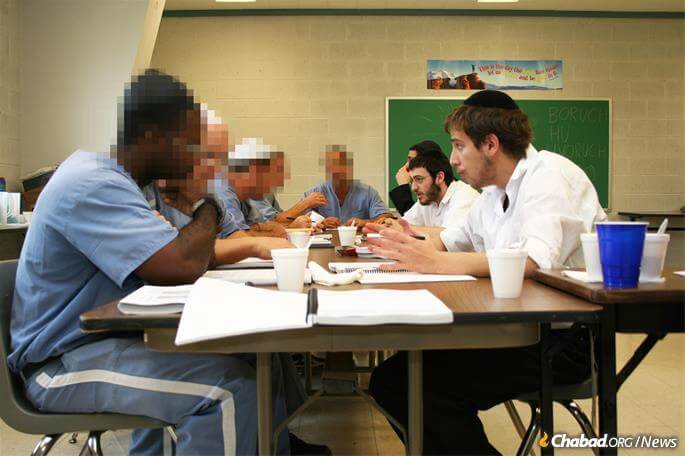
Gansburg’s visits have also developed over time, and what started as friendly talk about life experiences and the like now involve a formal learning component. One of the men he visits got himself a Tanya, the foundational text of Chabad Chassidic philosophy, and each of them study the same section of the Tanya. Since Gansburg isn’t allowed to bring in books, now when he visits they’re able to discuss their studies and trade perspectives on the Torah they’ve both learned.

Gansburg hopes his own experience will encourage others to volunteer with the Aleph Visitation Circle. “When you go into a prison and interact with someone behind bars, and talk to him and try to understand him, you expand your views on life and you are able to understand people more and life more. It makes you a better father, husband, son, brother, and above all, a better person.”

Judging by my own experience 1,200 miles north, I couldn’t agree more.

As the program expands, volunteers are needed in every city and state—especially Brooklyn, Miami, Los Angeles, and Chicago. To date, over one hundred and four prisoners have received visitors thanks to the program. The goal, Aleph says, “is to reach every Jewish prisoner and remind them that even in prison they are never alone or forgotten.”

To volunteer for the Aleph Visiting Circle, visit their website or contact Sara Schmukler at sara@aleph-institute.org, 310-598-2142 ext. 231.

Read more