Writing

Annual convention shows the kosher and calorie-minded food industries are each taking a page from the other’s cookbook.

SECAUCUS, N.J. — When Scott Gantwerker and Wayne Silverman were roommates 40 years ago at Michigan State University, they regularly made granola.

“Then came Passover, and we couldn’t make it — until Wayne started using matza,” Gantwerker recalls. “He sent Passover granola each year to family and friends.”

After graduation, Gantwerker went on to a career in the food industry, working for such companies as Quaker Oats, Pepsi and Pepperidge Farm. Silverman, for his part, embarked on a career at communal organizations, including leadership roles at the Jewish Federation in Austin, Texas, and Hillels of Georgia. But the two men never lost their love for granola, and eventually found their way back to it — and each other.

“We put our careers on pause so we could do it full-time,” says Gantwerker, speaking at Kosherfest 2012, where the pair’s holiday-friendly cereal — branded Matzolah — was named the best new kosher-for-Passover food.

‘Most Passover breakfast products are so bland that the box often tastes better than what’s inside’

“Most Passover breakfast products are so bland that the box often tastes better than what’s inside,” Silverman says. “So I experimented with making a delicious granola that had matza and quality ingredients that were permitted on the holiday” — such as coconuts, California raisins and three types of nuts.

Foodman LLC, which makes and markets Matzolah, was one of 325 companies promoting their wares earlier this month at Kosherfest, the annual trade show of the kosher food industry. Now in its 24th year, the convention attracts thousands of kashrut professionals to Secaucus, NJ, where visitors range from chefs and cookbook writers to representatives of supermarket chains, specialty food stores and Jewish summer camps. Much is at stake for those with products to push: Already valued at $12.5 billion, the kosher food market is growing at an annual rate of 15 percent, according to a 2010 study by Lubicom Marketing and Consulting, which specializes in kosher products.

While Kosherfest showcased a wide spectrum of foods — featured products came from countries including Vietnam, Argentina and the Philippines — a growing number are attempting to capitalize on consumer enthusiasm for health food, highlighting their bona fides as sugar-free, gluten-free, organic or vegan.
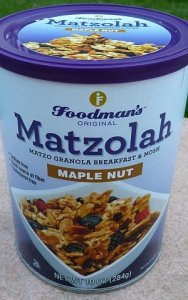
As its name suggests, Matzolah combines matza and granola as a kosher-for-Passover cereal. (Courtesy of Kosherfest)

On one side, kosher food companies are responding to demand from health-minded customers, with Adama Naturals rolling out a line of meats that contain no nitrates or artificial ingredients. Skinny Kosher Creations offers soy-based meals for those trying to lose weight.

At the same time, some traditionally non-kosher companies have realized that going kosher expands their customer base — and that a kosher label can also have a positive association among the non-observant.

“Even some non-Jews look for the kosher symbol,” says Viki Sater, who runs the Port Washington, NY-based Viki’s Granola. “People associate it with cleanliness. It’s one more certification on a product.”

Like Viki’s Granola, a number of additional nutrition- and fitness-minded companies have obtained kosher status despite having no direct connection to anything Jewish. Kickbutt Amped Energy Ballz, for example, a dietary supplement made in Canada, offered its wares not far from Transition Nutrition’s Bliss Mix, a combination of nuts and dried berries.

While not every Kosherfest product reflected the trend toward healthier eating — high-calorie deli meats, pastries and candy remained in abundance — many traditional Jewish food producers are evolving, creating healthier versions of familiar dishes or venturing into entirely new terrain.

Many traditional Jewish food producers are evolving by creating healthier versions of familiar dishes, or venturing into entirely new terrain

Gold’s, long known for its borscht, horseradish and schav — an Ashkenazi soup — now makes salsa and Wasabi. Manischewitz, synonymous with kiddush wine and gefilte fish, is now described by CEO and co-president Alain Bankier as “a food company which happens to be kosher.” Having “rebranded and expanded,” in Bankier’s words, “to be better, healthier, tastier,” the company now offers products such as Moroccan roasted vegetables; a chicken couscous sauce; a flaxseed bar made with almonds and cranberries; and “exotic root” vegetable chips.

If the number of visitors lining up for a sample was any indication, however, Kosherfest’s most popular new item was relatively healthy — at least on the scale of kosher desserts.

Gelato Petrini’s chocolate/peanut butter gelato, made with soy milk, received the convention’s awards for best new dessert and best overall new product. Dawn Petrini, the company’s director of sales and marketing, emphasized its benefits for the calorie-conscious: “Gelato is a healthy, natural alternative to ice cream. It tastes great and satisfies that little urge for something sweet.”

As one of the gathering’s biggest hits, the company has high hopes for how its product will do among kosher consumers.

“Now that we’ve moved from a 500- to a 7,500-square-foot plant,” Petrini said, “we just hope we can satisfy the demand.”

 (Source: http://www.timesofisrael.com)


Read more

Though baseball is a ‘Jewish sport’, its roots in Israel are still taking hold. Team Israel is taking to the baseball diamond this week in South Florida in a bid to participate in the March 2013 World Baseball Classic. How did the blue and white players get there, and what are their chances?

Former Major Leaguer Brad Ausmus in Israel as part of his new post as coach of the Israeli team for the World Baseball Classic tournament. (photo credit: Michal Shmulovich)

In the baseball world, South Florida is associated with Major League Baseball’s spring training. And September is traditionally the season of pennant races and league championships. But starting this September 19, Roger Dean Stadium in Jupiter, Florida [90 minutes north of Miami and half an hour south of where the New York Yankees train each March] will host teams from France, Spain, South Africa and Israel — all part of the World Baseball Classic (WBC) qualifying round. There, a handful of well-known Jewish former Major League players will on hand as they help Israel qualify for a spot in the March 2013 World Baseball Classic.

Shlomo Lipetz, pitcher. (photo credit: courtesy)

While not as well known as Major League Baseball’s World Series or even the Little League Baseball World Series, the World Baseball Classic is considered to be the premier international baseball tournament. It is run by WBCI (World Baseball Classic, Inc.) and is sanctioned by the International Baseball Federation. Major League Baseball and the Major League Baseball Player’s Association together created the event, which has thus far been held twice. Team Japan, the reigning World Baseball Classic Champion, won the tournament in both 2006 and 2009. More than 1.5 million fans from all over the world have attended the tournament to date.

Between September and November, four qualifying tournaments will be held in various locations around the world. Host cities include Jupiter, FL (USA), Regensberg, Germany, Panama City, Panama, and New Taipei City, Taiwan. Six games will be played at each location, following a modified double elimination format. Teams competing include Canada, Great Britain, Czech Republic, Panama, Brazil, Colombia, Nicaragua, Philippines, Thailand, New Zealand and China Taipei.

In March 2013, the first round of the main tournament will get underway in Phoenix, Arizona. The second round will take place in Miami, Florida, and the championship round will be held at AT &T Park in San Francisco, California.

Israel is participating in its first WBC. The pool of potential players expands beyond actual citizens of the State of Israel since, according to WBC tournament rules, countries are allowed to field players who are eligible for citizenship in a given country. In Israel’s case, anyone eligible for citizenship under the Law of Return is permitted to try out for Israel’s team. This may be good news for the Jewish State — given the overall weak popularity of baseball in Israel, and Israel’s relatively poor record of producing homegrown baseball standouts.

While an article on the Israel Baseball League website, “Baseball in the Times of Our Forefathers,” satirically suggests that baseball has been played in Israel since biblical times, baseball was likely introduced to Israel on July 4, 1927, at the Sephardic Orphanage in Jerusalem when the governess of the orphanage handed out baseball equipment to her charges. Later, in the 1970s, immigrants from North America began playing baseball upon their arrival in Israel.

Baseball has been slow to catch on in Israel. Between 1,000 and 3,000 people currently play in baseball and softball leagues in Israel, though few regulation sized fields exist

Baseball has, nonetheless, been slow to catch on in Israel. Between 1,000 and 3,000 people currently play in baseball and softball leagues in Israel, though few regulation sized fields exist.

In December 1986, the Israel Association of Baseball was formed to create an infrastructure and promote baseball in Israel. In July 2005, the Israel Baseball League was formed, and in June 2007, six teams kicked off the inaugural season of the IBL.

The IBL existed as a league for only one season. The Israel Association of Baseball (IAB) currently exists to promote baseball in Israel. There are currently five leagues with teams playing in sixteen centers from Tel Aviv to Beit Shemesh, Ra’anana, Jerusalem and Even Yehuda. The IAB trains coaches and umpires, hosts coaches and teams from overseas, and sends youth teams to tournaments around the world.

Haim Katz, the IAB President, is passionate about baseball, a game he calls “the most Jewish sport in North America.” Katz, 59, moved from Pittsburgh, Pennsylvania to Israel in 1978. His love of baseball was “handed down from my father,” reports Katz; he traces his interest in baseball to 1960, the year he attended the World Series. He attended Game 2 when his Pittsburgh Pirates lost to the New York Yankees, 16-3. He playfully notes that he is still a Pirates fan.

Katz says he and the IAB seek to increase awareness of Israel baseball in the US and Israel, try to engage North American Jews in Israel baseball, and build bridges with the US and Israel.

“We like to put Israel in a more positive light — not just to talk about nuclear bombs, but to show positive things about Israel — we have pretty much achieved our objective so far.”

Katz was extremely proud and excited when he was approached by the World Baseball Classic to “present motivation and a potential roster” for a team to potentially participate in the 2012 qualifiers. “Somewhat to our surprise, they accepted us!” notes Katz half jokingly. “We would have preferred to play the tournament in Israel, but we have no field; we are working on it!” (Katz is referring to an initiative to build a $5 million field/ballpark in Ra’anana. The city has reportedly agreed to provide land and the Israel Sports Authority will pay $1.5 million; the IAB would be responsible for the rest of the funds.)

In assembling the team for the WBC tournament in Florida, Katz has tried to offer opportunities to up and coming Israeli players, while also including well-known, Jewish former Major Leaguers.

Brad Ausmus, 43, who spent 18 years as a major league catcher and who currently works in the San Diego Padres organization, will serve as manager. While the official roster has not yet been announced, former major leaguers Shawn Green and Gabe Kapler have, according to Ausmus, “agreed to serve in some type of player/coach capacity.”

The 39-year-old Green, who played for four major league teams and hit 328 home runs in his 15 year career, will likely serve as the team’s hitting coach. Kapler, 36, played for 12 years and won a World Series with the 2004 Boston Red Sox; he retired in 2010.

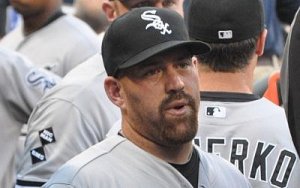
Kevin Youkilis of the Chicago White Sox (photo credit: CC BY Joe Bielawa/WIkipedia)

Other players rumored to be considering roles with the team (either for the qualifiers, or in March 2013, should Israel advance to the tournament) include: Milwaukee Brewers outfielder Ryan Braun, Chicago White Sox third baseman Kevin Youkilis, Texas Rangers second baseman Ian Kinsler, New York Mets first baseman Ike Davis, San Diego Padres right-handed pitcher Jason Marquis, Boston Red Sox Catcher Ryan Lavarnway, and New York Mets infielder Josh Satin. There has recently been some online talk about granting a spot to Adam Greenberg, 31, who, in 2005 as a member of the Chicago Cubs was hit in the head by the first pitch of his only major league appearance. Former Major Leaguer Art Shamsky, who played for the 1969 “Miracle Mets,” will serve as Israel’s ambassador to the World Baseball Classic Qualifiers.

Manager Ausmus, who grew up in a not very Jewishly connected family in Connecticut (USA), was contacted by Haim Katz over a year ago, via an email to the San Diego Padres organization. He, Peter Kurz, the Secretary General of the IAB, Green and Kapler met. Ausmus soon after agreed to be part of Team Israel.

“When I was appointed manager, it became very clear that I needed to visit Israel, since I never had. At the end of May, my wife and I spent about a week in Israel, traveling to tourist sites, seeing baseball facilities, meeting some of Israel’s baseball players. I loved floating in the Dead Sea, surfing in the Mediterranean Sea at Tel Aviv (and bragging about it to my surfer friends in Tel Aviv), and going to Jerusalem.

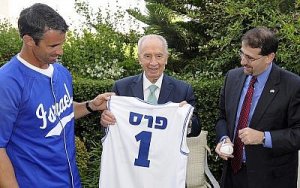
Brad Ausmus, President Shimon Peres and US Ambassador Daniel Shapiro. (photo credit: courtesy of US Embassy)

“Jerusalem just amazed me — the history, the ruins, the vitality of the people in Jerusalem is phenomenal — you don’t feel this type of energy anywhere else in the world. I was awestruck by my visit there. And my meeting with President Peres, arranged by the US Ambassador, Daniel Shapiro, was amazing — he is an impressive man — I get the feeling he could slide in to any situation with people of any background and make them feel comfortable.”

“We are extremely fortunate to have someone of Brad’s caliber to manage the team. His skills and knowledge of baseball are top rank — and the team has top talent. Brad sees the bigger picture here, he is a pleasure to work with, and he is a mensch!” observes Katz.

Some 18 members of the team coming from Israel are playing several exhibition games in the Miami area on September 11 and 12. The rest of the team will join on September 13 and play several more exhibition games in South Florida. Team Israel’s first tournament game will be on September 19 against South Africa and it will play a second game on Friday, September 21, against either France or Spain, with possible games on Saturday or Sunday if it advances.

(Source: http://www.timesofisrael.com

Read more

Nadine Fahoum, a Muslim from Haifa, has become Israel’s unofficial ambassador off the court, and a phenom for Duke on it.

For Nadine Fahoum, serving as an ambassador for Israeli tennis and the State of Israel is a pleasure — though anything but straightforward. The 22-year-old Muslim Israeli-Arab from Haifa recently graduated from Duke University in Durham, North Carolina, where she majored in business administration and received a certificate in marketing and management. While there she also found the time to rank number one in tennis singles and helped the Lady Blue Devils tennis team to a national ranking of number three.

Fahoum also served as a de facto Jewish studies teacher and spiritual adviser to three American Jewish teammates. “They asked me about the Jewish holidays and when the Yom Kippur fast begins and ends,” says Fahoum, who regularly visited the Freeman Center for Jewish Life and participated in campus groups such as “Peace or Pieces?” — a forum for Jewish and Muslim students’ “controversial issues.”

‘I was the only Arab kid in school until my brother enrolled in the same school a few years later’ 

Fahoum got an early start feeling comfortable in the Jewish world. Her parents — mother Wafa Zoabi, a lawyer, and father, Anan, a bakery owner — sent Nadine and her younger brother to Haifa’s prestigious Reali Hebrew School. “I was the only Arab kid in school until my brother enrolled in the same school a few years later.”

Her brother, Fahoum Fahoum, 20, has continued to follow in his sister’s footsteps. Fahoum currently studies economics and plays tennis at Old Dominion University in Norfolk, Virginia — the university Nadine transferred from to play tennis at Duke.

“When Fahoum was a junior, I took him and three Jewish kids to play in a tennis exhibition in Boca Raton, Florida,” recounts Shaul Zohar, manager of the Israel Tennis Center in Kiryat Shmona. “We were at a Shabbat dinner and the host asked, ‘Who wants to do the blessing over the wine?’ The three all said no — and so Fahoum did the kiddush!”

Nadine and Fahoum have represented Israel in over thirty countries — starting with her first tournament in France at age 14 and including Switzerland, Portugal, Greece, and India. And they are not told what to say on behalf of the State of Israel.

“I say what I think,” says the polite, soft-spoken Nadine. “I have heard both sides my whole life. We all want the same thing — to live in peace.”

“We need to find a solution as soon as possible. It is a tough situation. We have to start where we are and look forward, not backward, and move forward from here.”

When asked what she would recommend as a solution, she pauses, carefully considering her reply. “We must learn from an early age to live together, when we are not prejudiced. That is why programs like the coexistence programs at the Israel Tennis Center are so important.”

She explains how its initiatives, such as the Twinned Peace Kindergarten, bring children and their families together in meaningful ways. “They go to each other’s houses, do homework together and travel to tournaments together.”

It has not always been easy. Many years ago, at New York’s JFK airport, security officials noted Fahoum’s name and asked to inspect her luggage. Coach Zohar intervened and said, “We are all the same — if you check her bag, you must check all bags. Check all or leave her alone!’”  She was allowed to pass without inspection. Israeli security has subsequently invited Nadine’s mother to offer workshops to security personnel on how to treat minorities.

Nadine recently began working as a development associate in New York City for the ITC. “If there were 10,000 Nadines, the [Israeli-Arab] situation would be different,” says Zohar.

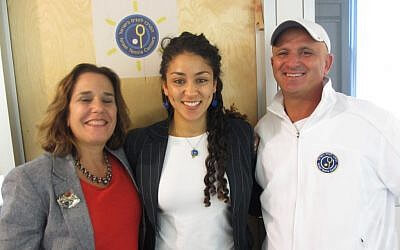
The Israel Tennis Center team: Jacqueline Glodstein, Nadine Fahoum and Shaul Zohar.

“I’m sure there are — we just have to identify them and have them speak up,” adds Nadine.

“We have to encourage them to speak up,” adds Jacqueline Glodstein, vice president of global development for Israel Tennis Center.

Nadine has been living with Glodstein and her family in their Long Island home for the past six months. The family, whose members have all spent significant time in Israel, has found it very enlightening. Glodstein says, “We never had an opportunity to get to know on an intimate basis an Arab Israeli Muslim. It was an amazing opportunity for all of us. Living together, you just begin to know each other in a very special way — you create relationships and bonds.” The Fahoum parents also stayed in the Glodstein home for a e week during a recent trip to the United States.

For now, it is back to work for Nadine. While she will be focusing on her ITC responsibilities, she will still manage to find time for tennis. “I love tennis — I will always play!”

(Source: http://www.timesofisrael.com)

Read more

Walking out of the Bruce Springsteen concert in Philadelphia last week, I heard a yalmuke-wearing teenager exclaim, “If Bruce Springsteen was a rabbi, I’d go to his shul [synagogue]!” The 62-year-old Rock and Roll Hall of Fame inductee had just delivered a three-hour concert—without even an intermission—during which he crowd-surfed across the pit of the Wells Fargo Arena, danced on stage with his almost 90 year old mother during crowd-favorite “Dancing in the Dark,” and pointed heavenward for several minutes during the encore, “Tenth Avenue Freeze Out,” paying proper respect to “The Big Man,” Clarence Clemons, who died last June. Springsteen kicked off his Wrecking Ball tour on March 18th, to promote the release of his 17th album.

The young fan was suggesting that Springsteen knows how to connect with people and inspire them with his message. Charismatic and caring, he even knows his fair share of Bible.

I overheard another, less-observant, friend confided that he was planning on spending the eve of Friday April 6thseder night—with Bruce, the E Street Band, and 20,000 close friends at Manhattan’s famous Madison Square Garden!

Many Jews are connected to Bruce. Fans have long speculated on the extent of the Boss’s connection to all things Jewish. Here is a partial list of obvious (though admittedly “long shot”) connections to Judaism, the Jewish People and Israel.

1. His Name

Many have (incorrectly) speculated that the Boss’ last name gives him away as Jewish. Adam Sandler set the record straight in his “Chanukah Song Part II”:

So many Jews are in the show biz/ Bruce Springsteen isn’t Jewish/But my mother thinks he is.

2. Jews in the Band

The Mighty Max Weinberg (drummer), spoke at the American Museum of Jewish History in Philadelphia the night before two gigs at Wells-Fargo. Weinberg played his first bar mitzvah at age 7, attended synagogue at Temple Sharey Tefilo in East Orange, and in a recent email interview with the JTA, reported that drumming “was my way of living a life of tikkun olam.” Weinberg also said, “I was greatly influenced by the poetic approach to leadership by the late Rabbi Avraham Soltes, who made the stories and scripture come alive through music and his charismatic teachings.”

Max’s son, Jacob, briefly toured with the E Street Band when Max was tied up with his commitment to the Conan O’Brien TV show, and Springsteen’s longtime manager and producer, Jon Landau, is Jewish. Pianist Roy Bittan is Jewish. And Suki Lahav, an Israeli post-army violinist from Kibbutz Ayelet HaShahar, toured and recorded briefly with Springsteen in the 70’s before returning to Israel. Her then-husband, Louis Lahav, was a recording engineer for Bruce.

3. Biblical References

A former student of the St. Rose of Lima Catholic school in Freehold Borough in New Jersey, Springsteen knows his bible. Aside from the occasional Jesus reference, lyrics contain gems such as these three:

“Rocky Ground”

Forty days and nights of rain have washed this land…
Flood waters rising and we’re Canaan bound

“Red Headed Woman”

Well, push comes to shove
Man, and shove comes to push
And I was Moses standing ‘fore the burning bush

“Adam Raised a Cain”

In the Bible Cain slew Abel
And East of Eden he was cast,
You’re born into this life paying,
for the sins of somebody else’s past,

4. Jewish References

Springsteen’s hometown of Long Branch, long associated with the seaside town of Asbury Park, is a stone’s throw from Deal, New Jersey—home to nearly 5,000 Syrian Jews who vacation in there each summer. Call me a conspiracy theorist, but as one blogger noted, a line in “Fourth of July, Asbury Park (Sandy)” might have been inspired by the Syrian Jewish Beach Club Casino in Deal:

And the boys from the casino dance with their shirts open like Latin lovery on the shore/Chasin’ all them silly New York virgins by the score

5. “Shtick” in Concerts

Generally reserved for klezmer bands, “Hava Nagila” is not the first song you’d expect “The Boss” to play. Columnist Jeffrey Goldberg reports that Rahm Emanuel, President’s Obama’s former White House Chief of Staff, prompted Springsteen to play 45 seconds of the Jewish melody at a Washington, DC area show in May, 2009. Emmanuel spotted a sign made by a hardcore fan, requesting the famous—albeit unlikely—song:

“My daughter (a Jewish day school student) didn’t want to go because of homework, so I figured she needed a Jewish excuse to go to the concert. I made the ‘Hava Nagila’ sign—I’m in the mortgage credit market, so there’s not a hell of a lot for me to do these days—and we brought it to the concert,” he said. “I made it like the Torah, two sticks on each side.”

And, in his Bruce Springsteen & The E Street Band: Live in New York City record, while getting the crowd pumped up, Bruce references…a bar mitzvah! He says, “ I’m gonna throw a rock and roll exorcism…a rock and roll baptism and a rock and roll bar mitzvah!”

6. Israel

First the bad news—he ain’t coming to Tel Aviv.  But, back in November, there were articles in several Israeli publications speculating that he might finally perform in the Promised Land. Unlike Elvis Costello and Pete Seeger, Bruce has not criticized Israel or called for its boycott or divestment. When Bruce completes the US leg of his tour in May, he will then traverse Europe before wrapping up in Helsinki, Finland on July 31st—he just doesn’t have enough time to hit the Holy Land. The closest the Boss gets to the Middle East is Lisbon (June 3rd), Milan (June 7th), Florence (June 10th), Trieste (June 11th) and Madrid (June 17th).

But I can’t hold it against him—The Boss is clearly a fan of the Jews! His lyrics, show antics, and band that nearly comprises a minyan point to his connection to Judaism. He  might not be Jewish, but I’m convinced: I want Bruce to be my Rabbi.

Read more