Access Israel

Originally appeared in jns.org, March 19, 2026

Home Front Command and “purple” initiatives help vulnerable populations access shelters, information and essential services.

As Iranian and Hezbollah missile attacks continue across Israel, people with disabilities and the elderly face unique and often overlooked challenges—from reaching shelters in time to coping with overstimulating environments once inside.

In response, the Home Front Command and a range of civil society initiatives are working to ensure that vulnerable populations remain safe, informed and supported.

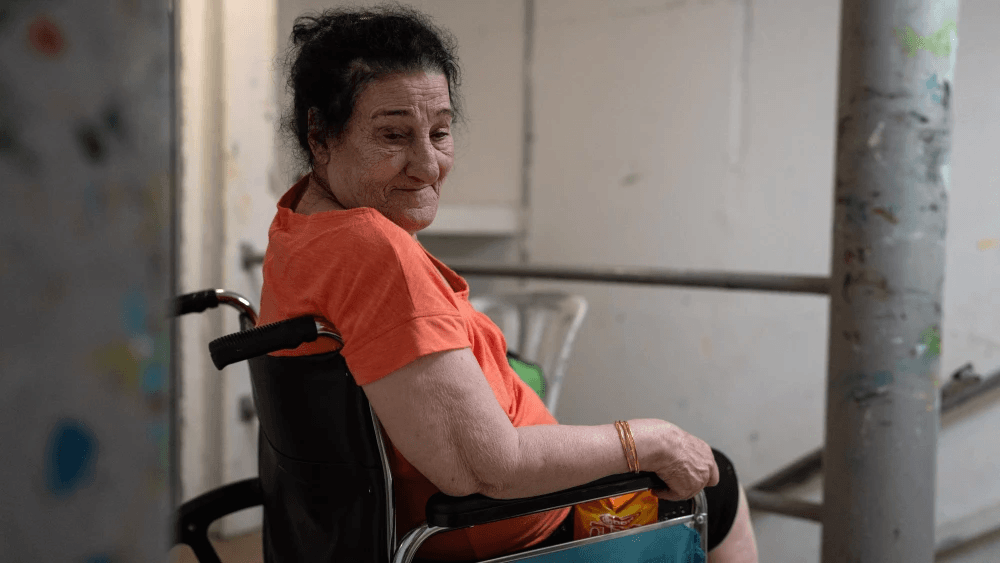
For many, the obstacles are immediate and practical. Individuals who are deaf or hard of hearing may not hear warning sirens. Those with mobility impairments may struggle to access shelters. People with autism can find crowded, noisy spaces overwhelming.

“The most important thing is planning ahead and knowing the safest place,” said Tami Durst, the Home Front Command’s professional academic officer and desk commander for people with disabilities. “It is proven that following the guidelines and getting to a shelter on time saves lives.”

The Home Front Command has adapted its emergency guidance to reach diverse populations, offering materials in multiple languages, including English, Russian and Amharic, and tailoring content for different disabilities.

Services include sign-language training videos with subtitles, phone alerts using repeated vibrations or flashing lights for those who are deaf, and simplified, illustrated materials for people with intellectual disabilities.

“Booklets have illustrations and simply explain things such as what a missile is,” Durst said.

The agency conducts daily Zoom sessions for people with disabilities, partnering with organizations such as ALUT (autism), Elwyn (multiple disabilities) and Migdal Or (visual impairments).

In Israel, families can call 104 for assistance or request group briefings.

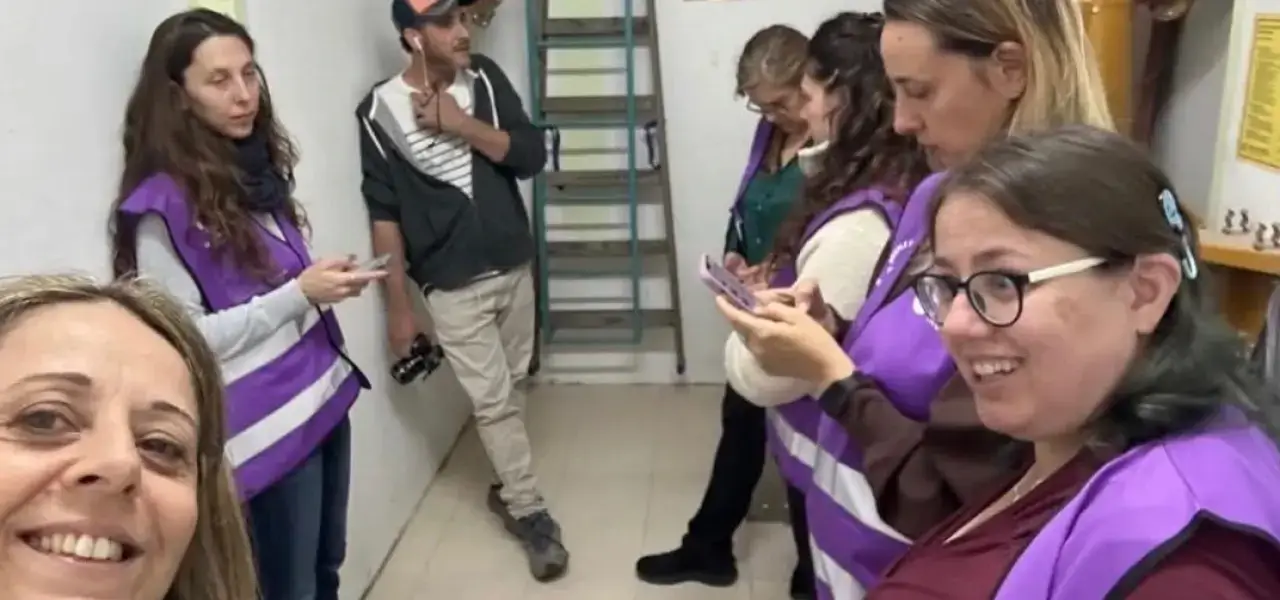
Shavvim volunteers operating the Purple Hotline, March 2026. Credit: Shavvim.

Nonprofits play key role

Beyond government efforts, nonprofit organizations are playing a critical role.

Access Israel estimates that roughly 25% of Israel’s population—about 2.6 million people—are individuals with disabilities or older adults who may need assistance during emergencies.

Shavvim, an advocacy and media platform focused on disability issues, estimates that more than 1.6 million Israelis live with disabilities, a number that has risen sharply since Oct. 7, 2023, due to injuries and trauma.

Both groups operate initiatives known as “purple” campaigns, a reference to the color associated with International Day of Persons with Disabilities.

Access Israel’s Purple Vest Mission mobilizes trained volunteers to assist individuals in reaching accessible shelters, relocating to protected housing when necessary and obtaining essential supplies during prolonged emergencies.

“Emergencies do not affect everyone equally,” said Michal Rimon, founder of the Purple Vest Mission and CEO of Access Israel. “For people with disabilities and older adults, it takes more time to reach safety; even a few seconds can mean the difference between safety and tragedy.”

Jamie Lassner, executive director of Accessibility Accelerator and a volunteer with the initiative, said the program’s impact lies in preparation.

“They understand accessibility, they understand disability, and they act with urgency, compassion and dignity,” she said. “That preparation is no longer theoretical. It is saving lives.”

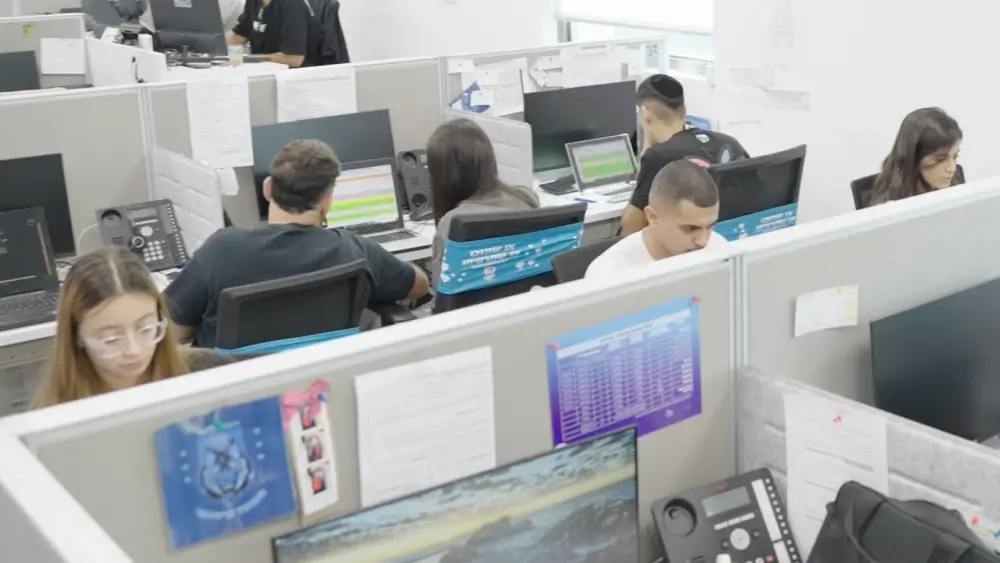
Shavvim operates a “Purple Hotline,” offering emergency assistance and rights-based support for people with disabilities and their families.

The hotline grew out of an operations center established after the Oct. 7, 2023, attacks, fielding calls from individuals unable to reach shelters, access medication or evacuate safely. It also assisted newly injured reservists in navigating rehabilitation systems and the families of children with complex needs.

“We received calls from wheelchair users who couldn’t get to a safe room, from people needing food or medicine, and from parents struggling to care for children with special needs during constant alerts,” said Idan Motola, founder and CEO of Shavvim.

The hotline, relaunched on March 1 after a previous pause, has assisted more than 4,500 people to date. Among its efforts, volunteers distributed hundreds of tablets to children with autism spending extended periods in shelters.

Motola said hotline operators were called, inter alia, by families without protected spaces and from those unable to obtain medication or food, calls from parents of children with complex needs who could not evacuate safely, and from newly injured reservists encountering Israel’s rehabilitation and welfare systems for the first time.

“We received calls from wheelchair users who couldn’t get to a safe room or shelter, and from people with food requests, those with husbands on reserve duty, those needing to buy medicine and people needing help babysitting kids while they ran an errand. We also got requests for tablets for families of children with autism spending a lot of time in the shelter. We gave out 250!”

Shirly Pinto Kadosh, Israel’s first deaf member of Knesset and a longtime advocate for accessibility, said the initiative addresses critical gaps.

“People with disabilities in Israel still face dangerous barriers during war and daily life alike,” she said. “The Purple Hotline is meant to ensure that no one is left alone when systems become impossible to navigate.”

As the war continues, organizers said the goal is not only to respond to immediate needs but to build lasting systems of support that extend beyond times of crisis.

Read more

Original Article Published on the Jerusalem Post

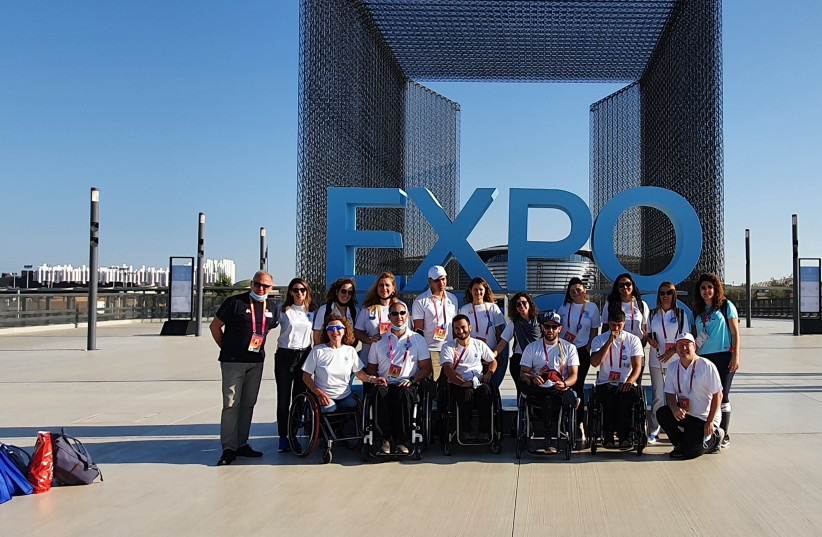
The Israeli pavilion at the Expo 2020 offers the experience of being a disabled person in an urban environment.

Access Israel is well known in Israel for its disability awareness work and advocacy efforts on behalf of people with disabilities.

Last week, a delegation of leaders from Access Israel took their message and their “urban obstacle course” on the road to Dubai. Visitors to the Israel pavilion at Expo 2020 Dubai had an opportunity to experience what it is like to navigate an urban environment in a wheelchair or as a blind or visually impaired person.

Access Israel, an NGO established in Israel in 1999, also marked December 3 the International Day of “People of Determination” at its pavilion, along with colleagues from Keren Kayemeth LeIsrael-Jewish National Fund (KKL-JNF), Start-Up Nation Central, and the Regional Cooperation Ministry.

The organizations also showcased advanced accessibility technologies, including an automatic speech recognition device developed by Voiceitt; medical technology and innovative communication technologies produced by EyeControl, an AI-based motion-control system that analyses wheelchair seating positions developed by ReSymmetry; and a panoramic, 3D photography system that identifies accessibility obstacles in a range of terrains, including urban environments.

According to most estimates, people with disabilities comprise 15% of the world’s population.

 Access Israel brings ‘urban obstacle course’ to Dubai. (credit: ACCESS ISRAEL)
Access Israel brings ‘urban obstacle course’ to Dubai. (credit: ACCESS ISRAEL)

“The Israeli innovation ecosystem offers multiple technological solutions to a global challenge, with the hope of enhancing the lives of people with disabilities and achieving a more precise lateral integration,” said Michal Seror, director of ecosystem development at Start-Up Nation Central. “Start-Up Nation Central regards the display of the Israeli technology in Dubai as a direct continuation of our long-term partnership with the UAE.”

KKL-JNF, Access Israel, Start-Up Nation Central, the Regional Cooperation Ministry, Google and FAISR also created a collaborative social event to increase awareness. One hundred people with and without disabilities jointly created the logo of the International Disability Alliance on the Expo lawn by holding up blue umbrellas.

Michal Rimon, CEO of Access Israel, found the making of the umbrella campaign video, which required 100 people to stand in the Dubai heat with an umbrella raised, to be one of the most touching and memorable moments of their stay in Dubai.

“I was afraid it would be difficult to get so many people to agree to be part of it. Eventually, we had hundreds of participants – those who did not have an umbrella cheered and clapped and the entire hour became a real attraction – bringing together people from all over the world on this special date and raising awareness for us all.”

Rimon welcomed the opportunity for Israel to actively participate in this important world event.

“The Expo is one of the largest global exhibitions and a great opportunity to send our message and share our projects with people literally from all over the world. We had a chance to get together with people from all our neighboring countries as well as from other parts of the world. Israel’s leadership in inclusion and disability was evident, and people want to learn more.”

Access Israel founder and wheelchair user Yuval Wagner added, “Arriving at UAE on an official delegation of Israel with an amazing unique combination of people with and without disabilities, wearing the Israeli flag with pride and receiving great reactions from the people themselves, was an amazing experience and true pride for us all.”

Wagner looks forward to returning soon.

“The fact that we left with a specific request from several local contacts – that they want more and want us back already in January – is probably the best proof to the potential and the ripple effect of our visit.”

The Access Israel delegation had planned to organize an accessible candle-lighting event on December 5 in Dubai, utilizing a menorah developed by Impact Labs and printed on a 3D printer. The menorah makes it possible for people with arm and hand disabilities to light candles using a special lighter.

While the menorah was indeed accessible, it was deemed ineligible on board the plane to Dubai due to its fire-starting mechanism.

Instead, Wagner, who has limited use of his hands, lit candles on the eighth night of Hanukkah in Tel Aviv with TOM (Tikkun Olam Makers) and the Impact Labs team.

Read more

Original Article Published On The JNS

The Israeli Paralympics team is headed to Tokyo to compete in nine sports in the delayed 2020 Summer Paralympics from Aug. 24 to Sept. 5.

Simone Biles, Naomi Osaka and the sports world, meet Pascale Bercovitch, Shraga Weinberg, Moran Samuel and Doron Shaziri. Olympians Biles and Osaka have helped raise awareness about mental health in sports. And the four elite Israel athletes, along with 27 other Israeli Paralympians, are doing their part to show the world the extraordinary capabilities of people with physical disabilities.

The Israeli Paralympics team is headed to Tokyo to compete in nine sports in the delayed 2020 Summer Paralympics from Aug. 24 to Sept. 5.

Bercovitch will compete in paracanoeing, Weinberg in wheelchair tennis (quad singles and doubles), Samuel in rowing (women’s single sculls) and Shaziri in 50-meter men’s rifle (shooting). The Israeli delegation is scheduled to compete in athletics, bocce, goalball, kayaking, powerlifting, rowing, shooting, swimming, table tennis and wheelchair tennis. They will join 4,400 athletes from around the world set to compete in 539 events in 22 sports.

Paralympic athletes are assessed and then placed into competition categories, called sport classes, according to what extent their impairment affects their performance. According to the Olympics official website, “The Paralympic Movement offers sport opportunities for athletes with physical, vision and/or intellectual impairments that have at least one of the following 10 eligible impairments: impaired muscle power, impaired passive range of movement, limb deficiency, leg length difference, short stature, muscle tension, uncoordinated movement, involuntary movements, vision impairment or intellectual impairment.”

Yehoshua Dekel, president of Israel Paralympic Committee, is excited about the Israel team, which will set off for Tokyo in shifts, with each group arriving close to their days of competition. While he hopes the athletes will “bring home many medals,” he’s pleased that each athlete serves as a dugma—a role model—for Israeli children with and without disabilities.

“Our athletes are heroes,” reports Dekel, noting that they regularly make appearances at Israeli schools to share stories of their disabilities and their journeys to their sports accomplishments. “They are an example of what is possible.”

Dekel is also pleased that the Israeli government has become increasingly supportive of Israeli Paralympic athletes in the past five years. He notes that additional support also comes from the private sector.

The Israeli Olympics and Paralympics delegation competing at the upcoming Olympic Games in Tokyo attends a ceremony at the President’s Residence in Jerusalem on June 23, 2021. Photo by Olivier Fitoussi/Flash90.

She had me at ‘bonjour’ …

Yuval Wagner, the founder and chairperson of Access Israel, who is also a person with a disability, will be cheering the Israeli athletes from his home in Israel. “Access Israel is excited about the Israeli Paralympic delegation for being role models for all of us aiming for excellence and on the journey for the medal, promoting awareness for inclusion and accessibility.”

Jamie Lassner, executive director of Friends of Access Israel (FAISR), is particularly excited to watch two Israeli rowers compete. Pascale Bercovitch, who leaves for Tokyo on Aug. 25, reports, “I am so happy the Paralympics are happening. I am genuinely so happy to be part of it!”

She notes the difficult years of training, waiting, anticipating and hardships. “Preparation was really complicated because of the coronavirus pandemic,” says Bercovitch, who at times trained on a kayak machine in the garden behind her apartment, and at times was able to train in the Yarkon River once athletes were given special permission despite multiple lockdowns.

Bercovitch, 54, is one of the oldest Paralympians in this year’s competition. She has competed in previous Paralympics, including in 2012, where she placed sixth in a handcycling. In 2016, she competed in paracanoe.

She is also a writer, filmmaker and motivational speaker, speaking candidly about her experience losing two legs in a train accident as a teenager, making aliyah alone from France and serving in the IDF, and training and competing as an elite athlete.

FAISR’s Lassner adds fondly, “Pascale had me at the first bonjour when we met on the Tel Aviv promenade in the summer of 2019. She is a mentor, a motivator and my only friend headed to a fifth Olympics in a row. Her warmth, smile and joie de vivre are infectious.”

Lassner is similarly impressed with Paralympian Moran Samuel, who has also competed in more than one sport. “What amazes me is that she went from being a leader on an Israeli basketball squad—a team sport—to the solitude of rowing. She is a true athlete with an incredibly focused heart.”

The Paralympics traditionally take place two weeks after the Olympics end and are held in the same city and venues. Many around the world have become familiar with the competition through the 2020 Netflix film, “Rising Phoenix,” which tells the story of the Paralympics. In the show’s words: “Elite athletes and insiders reflect on the Paralympic Games and examine how they impact a global understanding of disability, diversity and excellence.”

Following on the anticipated success of the upcoming Tokyo Summer Olympics, Israel hopes to also send a delegation of participants to the 2022 Winter Olympic Games in Beijing.

Read more

Original Article Published On the Jerusalem Post

The two organizations are in the midst of 12 days of hiking in New York with teams consisting of people with and without disabilities.

NEW YORK – Not every hiking trail in the world is accessible for people with disabilities, but don’t tell that to Friends of Access Israel (FAISR) and Paratrek. They simply don’t agree. 

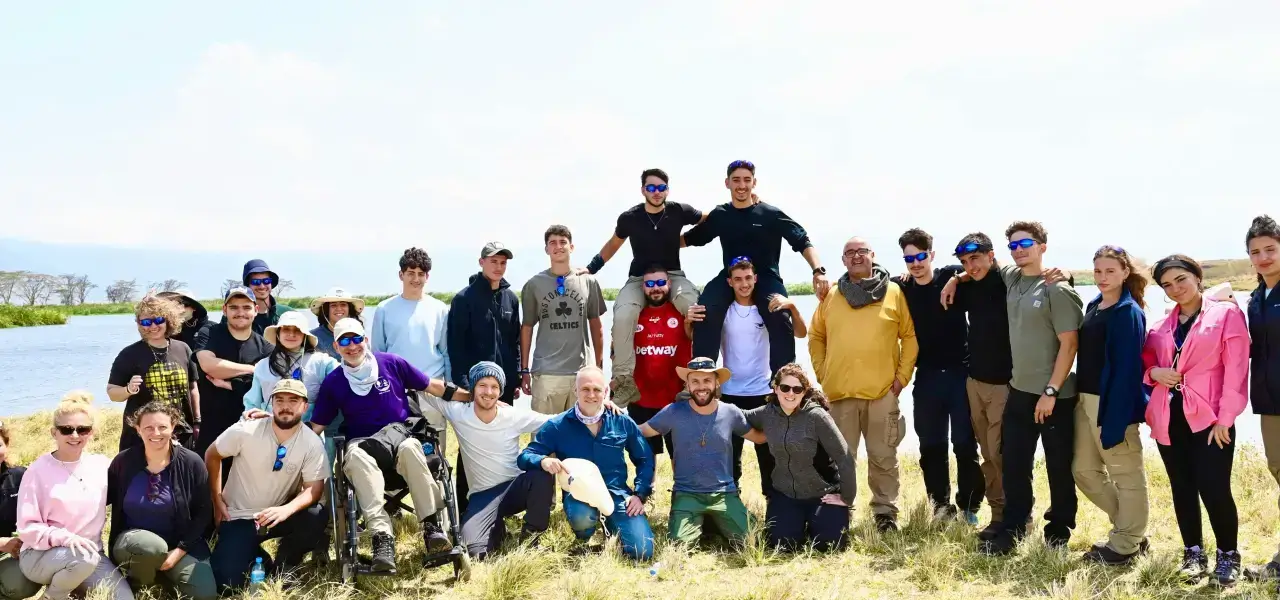
The two organizations, which have already accompanied four people with paraplegia to reach the not-so-accessible top of Mount Kilimanjaro, Africa’s highest mountain, are in the midst of 12 days of hiking in New York with teams consisting of people with and without disabilities. 

The USA treks (August 1 to 3 and 8 to 11) are taking place in Rockefeller State Park in Pleasantville, New York (USA). Teams from Israel and Delaware, Pennsylvania, Connecticut, Florida and New York in the United States are participating in hikes that vary in level of difficulty. Each day’s hiking adventure is led by a person with a disability.

 August 1 is Team Colton, August 2 is Team Alan, August 3 is Team Fred and August 4, the only day taking place in New York City’s Central Park, is Team Paratrek, named after the trekker vehicle that assists people with physical disabilities to access rugged terrains. August 9 to 11 is Team Chapel Haven, in honor of hike participants from Chapel Haven in New Haven, Connecticut (USA), a nationally accredited transitional living program founded in 1972 and devoted to teaching adults with cognitive disabilities and social disabilities to live independent and productive lives.

James A. Lassner, Executive Director of FAISR, refers to the hike as the “FAISR Universal Expedition – USA Trek #1,” with the hashtag, #AccessibleTogether. Lassner notes, “The hike/trek capitalizes on team members’ respective physical strengths, mental toughness and diverse abilities.” 

The word “Universal” is meaningful and intentional. “Universal’ is the concept of planning in advance to build events, schools, workplaces and technology so they are usable by a wide range of people, regardless of age or disability status. While universal design promotes access for individuals with disabilities, it also benefits everyone. Universal has added meaning because the word “universal” contains the letters ‘USA’ and the word ‘Israel.’” 

Colton Robinson, an 11-year-old model who was born with spina bifida, is the namesake for Team Colton. When Colton was five years old he was a finalist for a “Cutest Kid” contest for Parents Magazine and was signed by a modeling agency in NYC. He was the first model signed to this agency’s diversity division. Colton has modeled for Tommy Hilfiger, Runway of Dreams, Toys R Us, Target, Lands End and many other companies. He was also the first child that uses a wheelchair to model in New York Fashion Week. 

“Colton is currently a model for Target stores both online and at their various USA locations. More importantly he is a fine model of being a perfect gentleman. We have a lot to learn from him!” says Lassner.

The hike’s first day marked the US debut of the Paratrek Trekker, the brainchild of Israeli inventor Omer Zur. On his post-army trip many years ago, Zur wanted to hike in Turkey with his father, a person with quadriplegia as a result of fighting in the Sinai during the Six Day War. Zur soon realized that he had to come up with a suitable device that can handle off-road hiking without taking away his father’s independence. The simple-looking yet highly sophisticated Paratrek trekker can successfully traverse through rough and rocky terrain, steep inclines, narrow paths, over sand, boulders, rock and gravel. 

The Trekker successfully navigated Kilimanjaro with people with paraplegia less than two years ago.

“We are thrilled to debut our trekker at the FAISR Universal Expedition in New York. Our trekker has made it to 19,341 feet of Mount Kilimanjaro with FAISR, the Dead Sea in Israel which is the lowest place on earth and many other sites and trails around the world,” said Zur. “Our vision is to make it possible for individuals, families and groups to choose for themselves if, when, and where they wish to enjoy the great outdoors. As we introduce our trekker, we are confident that National and State parks will be interested in them as they will enhance accessibility at each of their venues.”

Fred Maahs Jr, a wheelchair user who is also chief operations officer for Travel for All and editor of Melange, Accessibility for All magazine, is heading up Team Fred on Day 3. 

“Travel for All is proud to be a partner of Friends of Access Israel and to assist with the travel arrangements for the Faisr Universal Expedition. Our missions align – we both believe that the world should be accessible and inclusive so that all people can explore and experience its beauty and wonders.”

Future hikes and treks will take place mostly in Israel with some events taking place in the United States. The ultimate goal is to make specific trails in both countries accessible for everyone.

Friends of Access Israel, together with its collaborative partner, Access Israel, strive to improve accessibility and inclusion globally for people with disabilities and the elderly via advocacy, education and inclusion. 

“With each improvement we empower them to live self-determined lives enabling them to work, travel, study and consume with dignity, equality and maximum independence,” reports FAISR’s Lassner. 

Read more