Originally appeared in JNS.org on April 19, 2026
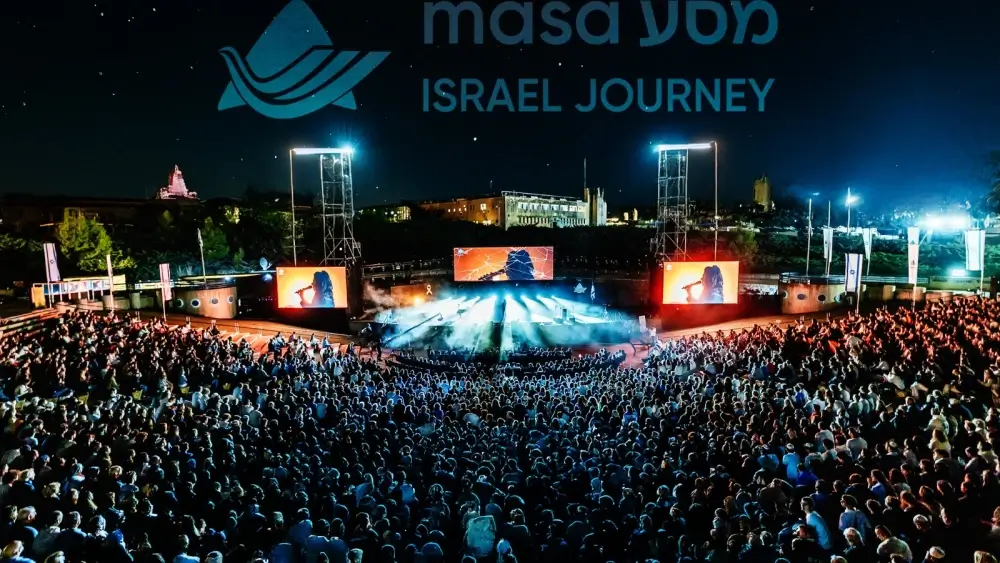
Hosted by Masa Israel Journey, the largest English-language Memorial Day ceremony will be broadcast worldwide, focusing on the stories of lone soldiers, new immigrants and victims of terror from across the Diaspora.
As Israel ushers in Yom Hazikaron on Monday evening in memory of the country’s fallen soldiers and victims of terror, hundreds of thousands of Jews worldwide are expected to tune in to the International Yom Hazikaron Ceremony, now in its 18th year. The event was founded by the Jewish Agency for Israel and the Government of Israel and is organized by Masa Israel Journey.
This year’s ceremony, which commemorates lone soldiers and victims of terror from across the Jewish Diaspora, will be held in English and translated into multiple languages, including Hebrew, Spanish, Russian and French, making it accessible to Jewish communities in approximately 60 countries and across multiple time zones, including Australia and New Zealand, Europe, the United States and Canada, as well as Turkey, Morocco, Ukraine, the Philippines, South Africa, Brazil and Argentina.
Due to the war and the fact that many delegations are unable to travel to Israel to attend in person, the ceremony will be pre-recorded and broadcast across multiple platforms, allowing Jews around the world to connect to the day from afar.
At the heart of the ceremony are the stories of lone soldiers, new immigrants, civilians and visitors who came to Israel from around the world and either fell in the line of duty in the IDF or were murdered in acts of terror, both in Israel and abroad.
Among those laying wreaths will be Barbara Lubliner, a Masa alumna who made aliyah from Spain and lost her husband, Lt. Col. (res.) Ariel Lubliner, also a Masa alumnus, during reserve duty in Gaza in the Swords of Iron War. Lubliner, 34, originally from São Paulo, Brazil, is survived by his wife, Barbara, and their two-year-old son, Lior. As a 22-year-old university student in Brazil, Lubliner participated in a Masa program, studied Hebrew on a kibbutz ulpan, made aliyah in 2014 and joined the IDF’s Paratroopers Brigade. Following his university studies, he worked as a consultant for commercial companies.
On Oct. 7, Ariel left for reserve duty and served four extended deployments, during which his son, Lior, was born. In June 2025, Ariel was killed in Khan Yunis, becoming the 900th fallen soldier since the start of the war.
The ceremony will also honor the memory of Yaron Lischinsky, 28, and Sarah Milgrim, 26, Israeli embassy staff members who were killed on May 21, 2025, outside the Young Diplomats Reception hosted by the American Jewish Committee at the Capital Jewish Museum in Washington, D.C. The gunman reportedly shouted “Free, free Palestine” during his arrest.
Lischinsky’s family relocated from Israel to Germany when he was one year old, returning to Israel when he was 14. Although asthma prevented him from serving in a combat unit, he served in the Military Police and later worked on the parole board committee, assisting military prosecutors and defense attorneys. After completing studies in international relations, Asian studies, Middle Eastern studies and crisis resolution, he pursued a career with Israel’s Ministry of Foreign Affairs. Following the Oct. 7 attacks, he volunteered in public diplomacy efforts at the Israeli Embassy in Washington and assisted delegations of released hostages visiting the U.S. capital.
During this time, he met Sarah Milgrim, who also worked at the embassy. The two became a couple, and Lischinsky had planned to propose at the Western Wall in Jerusalem before both were murdered.
Milgrim grew up in a Reform Jewish home in the Kansas City area, attended Jewish preschool and observed Shabbat weekly. She was active in Hillel and Chabad at the University of Kansas before pursuing a master’s degree at American University in international relations, natural resources and sustainable development. She later participated in a Masa program in Israel, interning with Tech2Peace, an organization promoting dialogue initiatives within Israel’s high-tech sector. In 2023, she began working as Civil Society Affairs Manager at the Israeli Embassy in Washington, focusing on outreach to diverse communities in the United States, including young adults, the LGBTQ+ community and minority groups, with emphasis on gender equality, prevention of sexual violence and climate change issues.
Other individuals to be commemorated include First Sgt. Jordan Ben Simon, who made aliyah from France and was killed during Operation Protective Edge in Gaza; Master Sgt. Yulia Vekser Daunov, who immigrated from Ukraine and was killed on Oct. 7; and Yaakov Leviton, a Masa alumnus murdered in a terror attack at Bondi Beach in Sydney, Australia, who is survived by his wife and five children.
Kaddish will be recited by Shmuel Daunov, the widower of Master Sgt. Yulia Vekser Daunov, who was killed in battle at the Nova festival near Re’im on Oct. 7. The Prayer for the State of Israel will be delivered by Emily Damari of Kibbutz Kfar Aza, who was kidnapped from her home and survived 471 days in Hamas captivity.
The ceremony will conclude with a performance by Yuval Raphael, who will sing “New Day Will Rise,” expressing hope for brighter days ahead.
Maj. Gen. (res.) Doron Almog, chairman of the Jewish Agency, said the stories of those who fell after coming from the Diaspora highlight the deep bond between world Jewry and Israel.
“The stories of those who fell from the Diaspora remind us that the bond between the Jewish people and the State of Israel is not merely an idea, but a courageous choice and a deep commitment,” Almog said. “On this Memorial Day, we remember them together, in Israel and around the world, and draw strength from our shared responsibility for the future of the Jewish people.”
Meir Holtz, CEO of Masa Israel Journey, said the ceremony reflects a shared sense of responsibility across global Jewry.
“‘Together, We Remember’ is not just a slogan—it is an essential truth for our people,” Holtz said. “Hundreds of thousands from around the world will remember together those who made the ultimate sacrifice for the continued existence of the State of Israel, especially those who chose Israel as their home or were murdered solely for being Jewish.”
Masa Israel Journey provides immersive educational programs for young adults ages 16–40, offering experiences in Israeli society, culture and history. Since its founding in 2004 by the Jewish Agency and the Government of Israel, Masa has served more than 220,000 participants from over 60 countries.
The ceremony will begin on Monday, April 20, 2026 (Yom Hazikaron eve) at 7:55 p.m. Israel time.