Today was a wonderfully uneventful day.   Drove to Bradley Street Bicycle Co-op [https://bsbc.co/] in downtown New Haven, CT with one of my children, bought a used bike, replaced a seat post on one of my own used bikes, got three replacement tubes—just in case of unexpected flats on the road.

While US cities are confronting and dealing with such big and difficult issues of racism, inequities, police brutality, looting and more, all is calm on Bradley Street.   It is a rather uneventful, wonderful day.  Outside the old brick building with a huge open garage, people of all ages from all walks of life wait for John Martin and his team to repair bikes, sell used bikes, or (during non-Corona times) lend tools and teach bike repair. 

As the website notes, “The Bradley Street Bicycle Co-op is a community bike shop working towards an equitable New Haven by getting people on bikes…We are a community learning with our hands, laughing with strangers, and building a better world together…We make decisions based on principles and beliefs, not based on what makes us more money. We take care of each other and love meeting new friends. We always show up; to the shop, to events, to things that mean something to one another.”

Not yet a believer as to why every city in the world needs half a dozen Bradley Street Bicycle Co-ops?  Read on:

Why We Exist

A healthy city is diverse, equal, and sustainable. Healthy cities do not happen naturally; we all must take part in building and maintaining its physical, social, and cultural fabric.

New Haven is incredibly diverse, vibrant, and passionate. But it also has deep obstacles to overcome. Our neighborhoods are divided, the gap between the rich and the poor is one of the highest in the United States, and we don’t spend enough time with people who are different than us. This is not a problem for just some of us, this is a pain that affects us all. But as we see ripples of segregation affect our communities, we also see ways to make it better.

Our answer is not ‘bikes will save the world’; building healthy cities is about much more than physical objects. But bikes can serve as a tool and a platform for change. The mission of the Bradley Street Bicycle Co-op is broad: we focus on the problem and the person while forging a better path forward. We need to give more to those who have less and we need to spend more time with each other. We built the Bradley Street Bicycle Co-op to do this.

Why bikes? In New Haven, lack of quality transportation is rated as the highest problem people face when accessing the job market. Owning a car is expensive, our public transportation system is unreliable, and walking is often too slow or not an option. Bikes provide a low-cost, highly efficient way of moving through the city. Bikes vastly improve job access to those without cars. They are cheap to acquire and maintain. They increase physical exercise, they keep our environment clean, and through their maintenance and upkeep they provide a platform for coming together. And they are fun! The more people we can get on bikes, especially those with need, the more we can gain job access and reduce income inequality.

Why spend more time together? Every time we run Shop Hours and work together to get more bikes back in the streets in a diverse and inclusive space, the less divided and more healthy our city becomes. By hanging out, making new friends, and working together to fix bikes, the Bradley Street Bicycle Co-op helps us listen to each other, give out more trust, and love New Haven.

I love bikes, bike stores, and bike gadgets.  I have visited bike stores in other cities, states and countries.  There is NOTHING like schmoozing with bike lovers with good values and kind hearts—all while searching in used parts bins for an old bike bell, a used seat and reflectors.  See you at Bradley Street Co-op!


Read more

Original Article Published on The Jewish News Syndicate

Say hello to Camp Yalla, which will bring entertainment and connections to kids in the most modern of ways.

This past March, when the reality of no school and parents working from home began to set in, a few young Jewish summer-camp lovers began to raise the next inevitable question: What if camps are unable to open this summer?

Mariel Falk and Avi Goldstein, veteran campers and staff members at Camp Modin in Maine, and a few friends with years of experience at other Jewish summer camps, created Camp Yalla—a virtual Jewish summer-camp experience for 8- to 12-year-olds.

“My heart was breaking over the loss of physical summer camps,” reports Miriam Lichtenberg, a veteran of both Camp Nesher in New Jersey and Camp Ramah, a network of camps affiliated with the Conservative movement. “I wanted to help rectify that and perhaps fill in the gaps that so many children would be missing—namely, community, friendship and a place to be your full self.”

Lichtenberg, will serve as Camp Yalla’s director of Jewish programming, says summer camp is “where I found myself.”

“It is where I made some of my closest friends, developed some of my fondest memories and have always been able to be my truest and best self,” she explains. “Camp Yalla gives me hope. At our camp, we will bring some of the best things about physical camp to our experience—the friendships, the laughs, the deepening of the self and the mind, the ability to be silly and free. Camp Yalla will have all of that, and I am immensely grateful and excited to be a part of that experience!!”

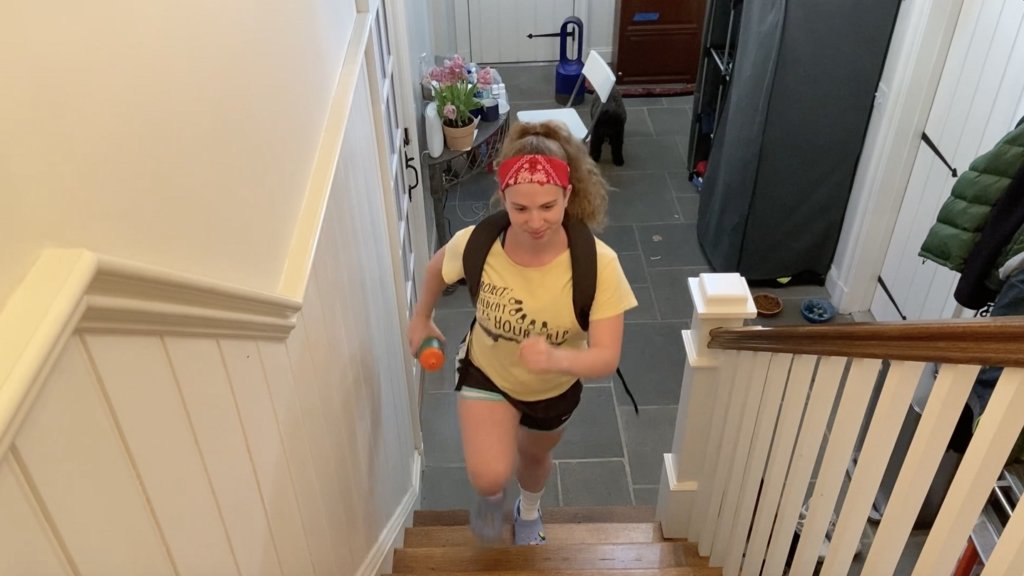
Avi Goldstein on a “scenic hike” up and down her staircase. Source: Screenshot.

Camp Yalla will offer three two-week sessions from July 6 to Aug. 14. A free trial period will take place this month on three consecutive Fridays (June 12, June 19 and June 26), so parents can see whether their kids enjoy the format and decide whether or not to register for the summer. The camp’s founders are aware that potential participants have spent months in front of computer screens, and have been learning from educators about Zoom best practices and protocols. They report that they will be offering “activities geared towards fun and play.”

Campers will choose electives “that suit their interests and give them a sense of ownership over their day.”

To date, 50 campers have expressed interest in attending Camp Yalla. Each session will likely be capped at 120 participants.

‘Social connections are vital, even as we social distance’

Co-founder Avi Goldstein, a recent college graduate with 10 years of experience at New England’s Camp Modin—seven as a camper and three as a counselor—explains that Yalla will meet Mondays, Wednesdays and Fridays for an hour each morning and afternoon. Mornings will consist of bunk activities to “build community, foster friendships and teamwork.”

Afternoon electives will include such activities as arts-and-crafts, theater, dance and virtual field trips. On Fridays, campers, as well as siblings and parents, are invited to Shabbat services, which take place well before the start of the weekly holiday, followed on Saturday night with Havdalah.

Goldstein, who wrote her undergraduate thesis on the role of Jewish summer camps in the United States in the post-Holocaust period, stresses their desire to offer a taste of Jewish summer camp and to get kids “to want to go to any Jewish summer camp in the future.”

“We are so passionate about Jewish camping!” she practically gushes.

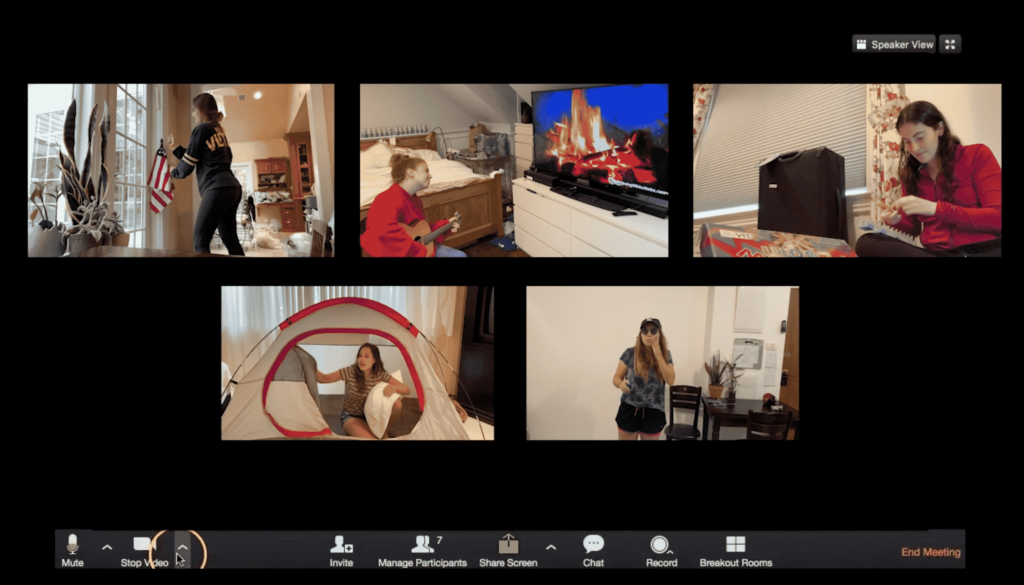
Top, from left: Camp Yalla communications director Lulu Weisfeld raising the flag; executive director Avi Goldstein at a virtual campfire; marketing director Sam Schmaier making some impressive bracelets with her Rainbow Loom. Bottom, from left: Executive director Mariel Falk waking up from a living-room camping trip; director of Jewish programming Miriam Lichtenberg carefully applying her sunscreen. Source: Screenshot.

Goldstein and her team have been in conversation with Rabbi Avi Orlow, vice president of innovation and education at the Foundation for Jewish Camp, about ways to potentially “feed” campers to other Jewish summer camps when they reopen in the future. Yalla may succeed in offering a camping experience to first-timers, who will then become lifelong participants. “Our goal is to foster communication, imagination, fun and positivity—and to get kids to want to go to any Jewish camp!”

Many Jewish summer camps and camping movements are exploring ways to offer camping virtually this summer, as well as ways to send “camp in a box” packets to families and to offer small family camps on their camp sites. “I am calling this the ‘summer of learning’ because camps will need to pilot new ways to engage, inspire and connect with their communities,” notes Jeremy J. Fingerman, CEO of Foundation for Jewish Camp.

Goldstein and her team are getting a well-rounded education in all aspects of running a Jewish summer camp. In addition to learning about offering programming online, they are learning about marketing, budgeting, staff hiring, payroll and the effective use of social media.

While offering Jewish summer camping online is new and uncharted, there may be benefits for both campers and families.

David Bryfman, CEO of the Manhattan-based Jewish Education Project, observes that “while summertime is often associated with separating ourselves from our screens, this year offers an opportunity for kids all around the world to engage with one another in meaningful, fun and social experiences. If we are to learn anything from this pandemic, it is that social connections are vital, even as we social distance.”

With children meaningfully engaged this summer, their parents may get a few minutes of downtime. “During this time—and maybe even more so in the summer months—parents need to be kind to themselves,” suggests Bryfman. “Giving yourselves a couple of hours ‘off-duty’ while your children attend virtual summer camp might be exactly what you need to be the best parents you can for the entire summer.”

Read more

Music has helped so many of us get through these tough few months.  For example, tomorrow is day 70 for Red Sox organist, Josh Kantor, who goes on Facebook Live for “7th Inning Stretch at 3 pm seven days a week for a half hour (or more!) each day ( https://www.facebook.com/7thinningstretch2020/) to play famous tunes on his organ and to raise money for local food banks (http://feedingamerica.org/find-your-local-foodbank).  He and his wife, Reverenced Producer Mary, are determined to keep this going every day until the baseball season resumes.

Singer Ben Folds, stuck in Sydney, Australia during the pandemic, sits at an organ and plays songs and tells stories on “Saturday Apartment Requests with Ben Folds.” Here is a link to #6: https://www.youtube.com/watch?v=ULe4yus47c0

Saturday nights are also reserved for Dead and Co’s “One More Saturday Night,” each Saturday night at 8 pm (here is a link to an awesome show from Citified in NY, 6/23/19): https://www.youtube.com/watch?v=ktDsE09W2Rk)

There is no shortage of great music.  I look forward to my daily email from Relix Magazine reminding me of the day’s shows:   Weir and Wolf Brothers Wednesdays (with conflicts with Dave Matthews Band each Wednesday), Phish’s Dinner and a Movie each Tuesday, and more.  Today’s email from Relix simply said, “June 2, 2020:  #TheShowMustBePaused.”

According to a letter posted on https://www.theshowmustbepaused.com/, two Atlantic Records music executives, Jamila Thomas and Brianna Agyemang, are spearheading an initiative known as “Blackout Tuesday” in reaction to what they describe as “the long-standing racism and inequality that exists from the boardroom to the boulevard.”

The Show Must Be Paused is a play on the well-known phrase which encourages perseverance, “The Show Must Go On.”  Let’s pray it is not “The Day The Music Died,” a reference to the infamous day, February 3, 1959, when musicians Buddy Holly, Ritchie Valens, and “The Big Bopper” J. P. Richardson, and well as pilot Roger Peterson were killed in a plane crash near Clear Lake, Iowa. 

Music has the ability to unite and heal—looking forward to the return of music tomorrow.

Read more

I used to check the ESPN App several times a day—just to get an overview of what is happening in the baseball, football, hockey, and basketball worlds.   For tennis, I regularly checked both the APT/WTA Live App, and Resultina, to find out pro scores in real time.  Resultina even allows tracking of a particular player, from top ten to known to all but diehards.  All of that checking has changed in the past few months—due to Covid-19 and the suspension of nearly all sporting events.  There is simply very little of importance happening in the sports world these days.

Yesterday, Sunday, a day which would have been packed in pre-Covid-19 days with major sports plus golf, featured the following ESPN stories:

“MLB is staring down a disaster that could last beyond 2020”

“Bundesliga players support Floyd following goals”

“Spurs’ Walker helps city clean up after protests”

The other stories listed in the ESPN were more of the same. The only actual sports “score” was of the NASCAR Supermarket Heroes 500 from Bristol (TN) Motor Speedway (in progress, with Elliot ahead of Blaney). The ATP/WTA app didn’t list a single match happening any time soon.  Resultina mentioned a match from last Monday May 25, the CTS President’s Trophy Prague, Czech Republic, where Kvitova d. Muchova, 6-3, 6-3.  My own tennis partner swears he still watches tennis regularly on the Tennis Channel, with umpires wearing masks and players literally getting their own balls! 

In short, very little positive to report in the sports world.

For that reason, I was delighted to receive the recent (May 28th) ITF (International Tennis Federation) Newsletter, featuring interviews with “stars from across the world of wheelchair tennis.”  This month’s UNIQLO interview looks at the positive impact that the BNP Paribas World Team Cup has had on the sport of wheelchair tennis.

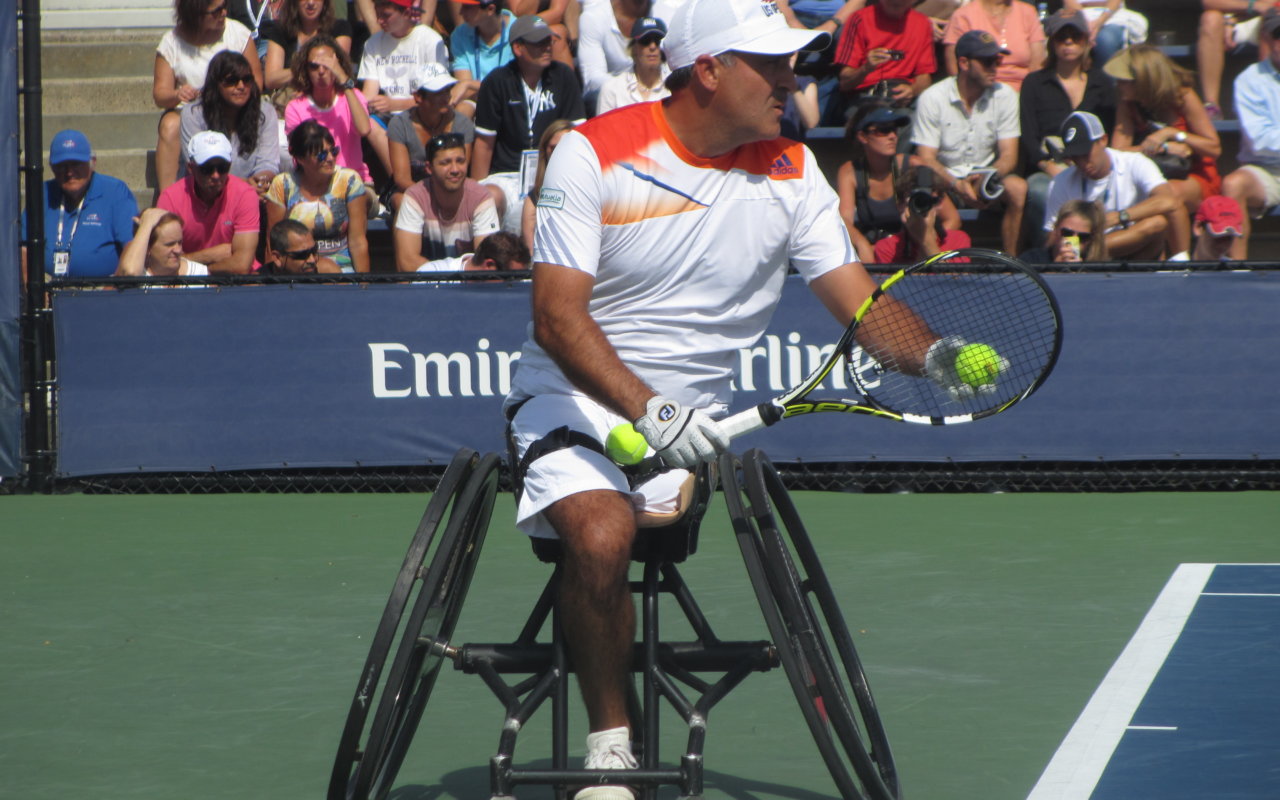
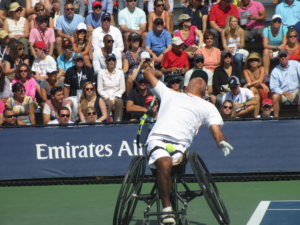
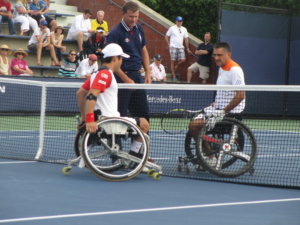
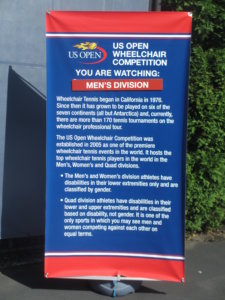
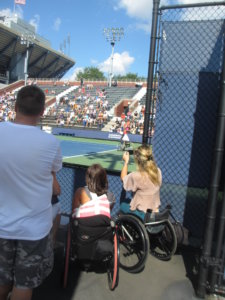
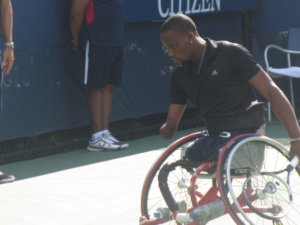
I was lucky enough to discover wheelchair tennis at the 2011 US Open—where I discovered that one of the top players at the time was Israel’s Noam Gershony (here is my Jerusalem Post article:  https://howardblas.com/2011/09/05/gershony-rolls-closer-to-paralympics-with-us-open-win/).  I have been following the sport ever since.  Here is another article I wrote in 2013: https://howardblas.com/2013/09/17/take-a-seat-courtside-at-the-u-s-open-wheelchair-tennis-competition/

Wheelchair tennis players are extraordinary athletes and competitors.  Rules for the sport are essentially the same as for more traditional singles or doubles. Perhaps the main difference other than the use of specialized chairs is the permissibility of two bounces—though many players chase down the ball on once bounce. Another big difference between wheelchair tennis and any other sport is that the sport boasts the longest winning streak in by far—held by Esther Vergeer—she ended her illustrious career in 2013 with a winning streak of 470 matches! 

Check out the sport when it is back in action.  One day soon, we will get to see singles and doubles, and also team tennis.   Since it started back in 1985, the World Team Cup has given wheelchair tennis players an opportunity to show off national pride by representing their countries. 


Read more