The Original Article Published On The Jerusalem Post

New York exhibit recalls the unlikely Jewish rock & roll journey of Bill Graham.

NEW YORK – It is hard to imagine what the music scene in Israel might have looked like had Bill Graham decided to choose the Jewish homeland instead of the Golden Medina.

The legendary impresario and music promoter, born Wolfgang Grajonca in 1931 in Berlin, was a young boy fleeing Germany in 1940. He and other Jewish orphans were given the choice to go to America or Israel.

“We’d never heard of either place, so we went to America!” recounts childhood friend Ralph Moratz in a three-minute video that greets visitors to the Bill Graham and the Rock and Roll Revolution exhibit on display from February 14-August 23 at the New-York Historical Society Museum and Library.

Soon after Graham arrived in America, the world of rock & roll would never be the same. Graham, at both his legendary venues the Fillmore East in New York and Fillmore West in San Francisco, and later as an international promoter for tours of Bob Dylan, The Rolling Stones and shows like Live Aid, became one of the key figures in the emergence of rock culture in the US and around the world.

The fascinating exhibit takes music lovers through over 300 objects including rare backstage photos and concert posters, ticket stubs and costumes. Fans can gravitate to displays of favorite bands, concert venues and music festivals – the Who, the Stones, Dylan, the Fillmore East and West, and Live Aid – all while listening to favorite tunes of Santana, the Grateful Dead and Big Brother and the Holding Company on immersive audio devices.

Howard Warner, 75, of Bayside, Queens, was fixated on photos of Janis Joplin. “She was great. She was taken too soon.” He then adds, “I remember all of these people. I can relate.” He was particularly taken by Graham’s World War II story, which he proceeded to recount.

But the excitement begins long before entering the actual exhibit hall. The main hallway of the museum features changing displays of such music legends as Crosby, Stills, Nash & Young in Oakland, and Jimi Hendrix in Winterland. A giant screen shows the Joshua Light Show, “the most technically and artistically sophisticated light show to emerge during the 1960’s,” as the Grateful Dead’s classic “Terrapin Station” from December 30, 1978, played in the background.

To the right of the ticket booth, a jukebox-like contraption displaying the words “Explore Bill’s Life” sucked me in with audio and visual tributes to Bill Graham. Jerry Garcia tells the story of Graham coming over to him “in a sweater, with a clipboard,” attempting to fix his broken guitar. “I loved him right at that moment. He was a real sweetheart.”

Jorma Kakounen of the Jefferson Airplane and Hot Tuna recalls meeting Graham at a benefit for the San Francisco Mime Troupe. Graham organized a successful benefit concert for the troupe, which helped launch his career as a concert promoter.

OTHER LONG-TIME friends mention Graham’s “grand pyrotechnics” at concerts, and recall how he “was not good at delegating,” was “literally everywhere” and personally handed out apples to show attendees at the Fillmore. A basket with fake apples is on view at the entrance to the exhibit.

When I finally entered the exhibit, I learned about Graham’s connection to the legendary apples he gave out to hungry fans at to the Fillmore Auditorium in San Francisco between 1965 and 1971. The sign encouraged concert-goers to “Have one… or two” fresh red apples. The apples suggest a connection to Graham’s impoverished childhood.

In 1939, the Nazis shut down the Auerbach kinderheim (children’s home) in Berlin. His father, Jacob, a civil engineer, died when Bill was two. His mother, Freida, who sold artificial flowers, costume jewelry and women’s clothing in Berlin in the 1920s, sent him to France. The children were told they were going on a two-week vacation when they were sent on July 4, 1940. He never saw his mother again.

Bill reports, “I don’t mind hearing what happened to me as a kid. I’ve asked very little about my mother and very little about my father. I have no recollection of either of them.” He also reports having no memories of anything prior to the age of nine.

In the moving black and white video, childhood friend Moratz describes their lack of food in France. “We were really hungry, and we helped ourselves to local apples. Bill would climb out of the window. It was one of the most enjoyable things…. [Later] Bill always had a bowl of apples.” He was referring to the famous concert apples.

Graham and his fellow orphans made their way from France, through the Pyrenees, to Barcelona, Madrid, Lisbon, Casablanca, Dakar, Cuba and eventually to New York.

Graham’s describes himself as “angry and belligerent” when he first arrived to his New York foster home. A couple from the Bronx, with a child, Roy, two years older than Graham and learning French and German – the two languages he knew – took him in.

The exhibit traces Bill’s fascinating childhood and teen years which included attending DeWitt Clinton High School and City College, a stint in the US Army serving in the Korean War (earning the Bronze Star and Purple Heart), summers busing tables, serving as a maître d’ (and listening to live music) at various Catskills resorts, evenings at the Palladium Ballroom in New York City dancing the Mambo to Tito Puente and Celia Cruz.

In the early 1960s, Graham moved to San Francisco and began to manage the San Francisco Mime Troupe. His successful benefit concert and promotion of several free concerts in the Bay Area led to his career as a full-time concert promoter. His successful career put him in constant contact with such legends as the Who, Hendrix, Dylan, the Allman Brothers, and the Dead.

WHILE GRAHAM quickly shed his European name and accent, he did not lose the connection to his Jewish past, and to the meaning of the Holocaust experience. The exhibit displays a Fillmore Auditorium dance hall permit from 1966. Many local merchants were opposed to the application for the permit.

“The rabbi from the temple next door said, ‘Mr. Graham’s people, they’re urinating on my holy walls.’” Graham then approached each merchant individually.

“I put on my suit and tie and went to see every merchant who had signed the petition and got 24 of them to say it was okay. Then I went to see the rabbi, who started lecturing me about persecution. I realized he thought he was talking to a goy.

“I put on my suit and tie and went to see every merchant who had signed the petition and got 24 of them to say it was okay. Then I went to see the rabbi, who started lecturing me about persecution. I realized he thought he was talking to a goy.

“How dare you talk to me about persecution! After I told him what happened to my mother and my sisters, he said, “We have to talk about the holidays. So out of concern for him, I volunteered not to have shows on the High Holidays.”

Many years later, when Graham learned in 1985 that president Ronald Reagan intended to lay a wreath at Bitburg’s World War II cemetery where Waffen-SS soldiers were buried, Graham took out a full page ad in The San Francisco Chronicle and urged people who shared his fury to join him at a rally in Union Square in San Francisco. Two days after Reagan’s visit to Bitburg, a firebomb (planted by neo-Nazis) destroyed Graham’s office.

Graham was in France at the time of the bombing, meeting with Bob Geldof to organize the first Live Aid concert. Graham lost nearly all memorabilia from his 20-year career including gold and platinum albums and hundreds of original Fillmore posters. His dance hall permit survived. Despite the devastating emotional toll the firebombing took, he continued working. Graham eventually led an effort to build a large menorah that is lit during every Hanukkah in downtown San Francisco.

Graham died tragically in a helicopter crash on October 25, 1991, while returning home from a Huey Lewis and the News concert. Graham, known for promoting concerts for various important societal causes, had attended the event to discuss promoting a benefit concert for the victims of the 1991 Oakland Hills firestorm. A sign at the exhibit notes, “Two days after Bill’s death, more than 2,000 mourners gathered at San Francisco’s Temple Emanu-El to remember him… Carlos Santana performed a moving eulogy, playing ‘I Love You Much Too Much,’ a Yiddish song Bill had taught him.

Graham came to America from the horrors of Europe, speaking no English. He shed his European accent, spoke unaccented English and left for his eternal resting place to the sound of Santana singing a Yiddish song in his memory.

Bill Graham and the Rock & Roll Revolution is organized and circulated by the Skirball Cultural Center, Los Angeles, in association with the Bill Graham Memorial Foundation, and made possible by the support of Alex Graham, David Graham and Danny Scher. The New-York Historical Society is grateful for the cooperation of the National Museum of American Jewish History.

Coordinated at New-York Historical by Cristian Petru Panaite, associate curator of exhibitions.

Read more

The Original Article Published in The Jewish News Syndicate

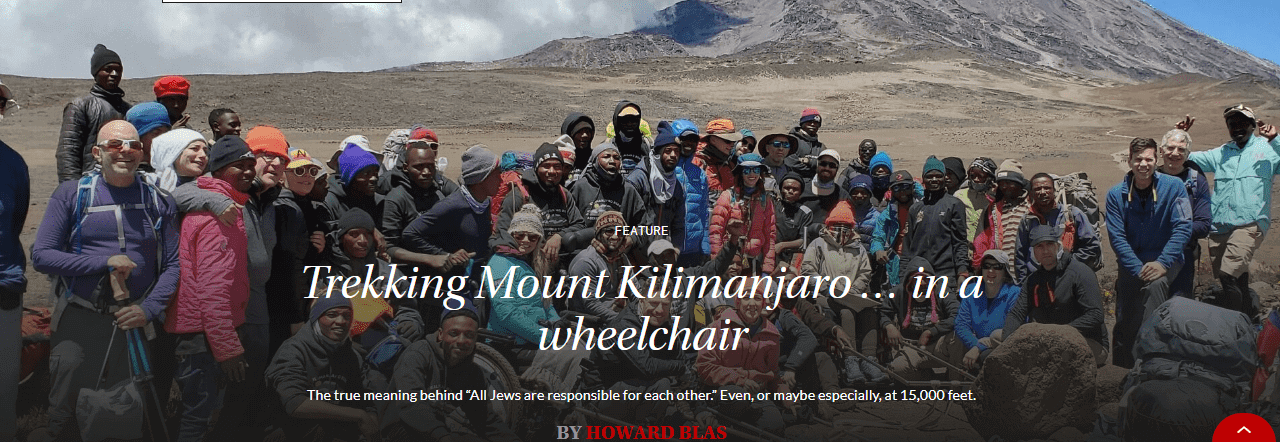
The true meaning behind “All Jews are responsible for each other.” Even, or maybe especially, at 15,000 feet.

When New York cardiologist, Dr. Aaron Gindea read the entire Torah portion of Beshalach at the Kibo Hut on Mount Kilimanjaro, he may have broken the record for reading from a Torah scroll at the highest recorded altitude—4,700 meters (15420 feet). But Gindea did not come to Tanzania to break any records. He and 25 participants on the Friends of Access Israel (FAISR) Kilimanjaro climb, including four climbers with paraplegia, came to reach Uhuru Peak 5895 meter (19,341 feet) in the name of accessibility and inclusion.

Gindea, his wife Geri, and hikers from Texas, Montana, Pennsylvania, New York, New Jersey and Israel set out to climb the dormant volcano in support of FAISR, an organization that promotes accessibility, inclusion and respect for people of all abilities around the world. FAISR’s collaborative partner, Access Israel, was founded a little more than 20 years ago in Israel and hosts an international conference each year in Israel, in addition to “Dinners of the Senses,” and consults on accessibility and inclusion worldwide.

Daily mileage would range from 3.1 miles on the acclimation days to 13.7 miles during the final midnight-to-sunrise ascent to the summit. The group would spend nights in very basic accommodations, including the Mandara Hut (2,700 meters), Horombo Hut (3,700 meters) and Kibo Hut (4,700 meters). The delegation would be accompanied by three cooks, 21 guides and 70 porters, who carry all participant clothing and sleeping bags, as well as food, water and cooking supplies. Cooks provided kosher meals both at the huts and along the route.

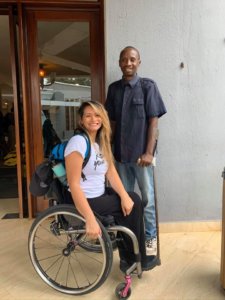
Marcela Maranon, a Peruvian-born woman from Dallas who is both an amputee and has paraplegia, along with Arnold John, a Tanzanian father of three who lives at the base of Kilimanjaro and had always dreamed of making it to the top. Credit: Friends of Access Israel.

Hikers with physical disabilities who participated in the strenuous, multiday climb included Starla Hilliard-Barnes of Montana, a twice-paralyzed participant; Marcela Maranon, a Peruvian-born woman from Dallas who is both an amputee and has paraplegia, and travels the world alone in her signature “The Journey of a Brave Woman” denim jacket; Arnon Amit, an Israeli man paralyzed in a car accident during his service in the Israel Defense Forces; and Arnold John, a Tanzanian father of three who lives at the base of Kilimanjaro and had always dreamed of making it to the top.

‘A humbling experience’
The hikers with disabilities navigated the mountain with the help of a specially designed off-road, rugged wheelchair known as “The Trekker,” made by Israel’s own Paratrek company. Omer Zur, founder and CEO of Paratrek, designed the chair to enable his father, paralyzed in Israel’s 1973 Yom Kippur War, to enjoy outdoor adventures with peers with and without disabilities. Zur, his colleague Rowee Benbenishty and Israeli Trekker-user Arnon Amit transported five trekkers, tools and replacement parts from Israel to Tanzania. Zur and his team maintained the Trekkers throughout the journey and trained the Tanzanian porters—six per Trekker—in proper pulling, guiding and pushing procedures.

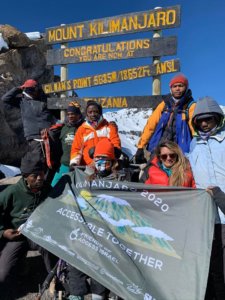
Hikers and their porters pose at the top of Mount Kilimajaro. Credit: Friends of Access Israel.

Participants without disabilities divided into teams—Team Marcela, Team Starla, Team Arnon and Team Arnold—and hiked together through five climatic zones and often rough terrain. David Icikson, president of Congregation Orach Chaim on New York City’s Upper East Side, had the additional responsibility of transporting a carefully wrapped Torah scroll in his day pack. Eleven members of the synagogue, including FAISR’s executive director and trip organizer, James Lassner, participated in the expedition. The group made good use of the scroll, reading it at morning minyans on Monday and Thursday mornings, as well as on Shabbat.

Despite the very real need for sleep following each strenuous day of hiking, group members were committed to getting up early for daily minyan as one participant was saying mourners Kaddish. Even the secular Israeli Paratrek mechanics—busy each day maintaining the special chairs—and Arnon, the Israeli climb participant, joined in the prayer session. Gindea remarked: “Sharing this unique experience with this special group made the davening itself remarkable. Having Omer, Rowee and Arnon (the three Israelis in the group) participate in the minyan (and help make the minyan) reinforced to me that Kol Yisrael areivim (“All Jews are responsible for each other”), even at 15,000 feet!”

On Friday evening, with four tough days of hiking complete, group members gathered in the mess hall for Kabbalat Shabbat services and dinner—complete with grape juice and challah from New York—carried in a backpack all week long. On the cold Shabbat morning, group members assembled in a dorm room with a wooden table and two sets of bunk beds. The Torah was carried down 10 steep stairs so that Arnon could have an aliyah from his wheelchair. Manhattan pediatrician Dr. Barry Stein recited the Haftarah portion on the 50th anniversary of his bar mitzvah, which he had celebrated in his native South Africa.

At lunch, Joseph Grunfeld (known affectionately to the group as “Joey G”), who experienced a traumatic knee injury to both knees three years ago, delivered a d’var Torah about crossing seas and climbing mountains. Gindea was moved. “As Joey G pointed out, B’nai Yisrael had to cross the barrier of the Red Sea before reaching Mount Sinai.” Gindea, still reflecting on the experience of celebrating Shabbat and reading Torah on the mountain, continues, “To be privileged to read about the crossing of the Red Sea and realizing that after Shabbat, beginning the week of Yitro, we would be climbing our own mountain was a humbling experience.”

‘How blessed we are with all we have’

At 11:30 pm. on Saturday night, with head lamps and layers of warm clothing, the group set out for the final all-night ascent. Thankfully, each participant—with and without disabilities—reached one of the three summits—Stella’s Point (5,756 meters), Gilman’s Point (5,685 meters) or Uhuru Peak (5,995 meters).

Josiah Baer and wife Emily, friends of Starla Hilliard Barnes and Shannon Barnes—all from Kalispell, Montana—were glad they had the opportunity to participate. “We all developed in to a family on this trip!” Josiah reports. “I learned about thankfulness and how blessed we are with all we have.” And he praised the porters. “They work so hard—and they never complain!”

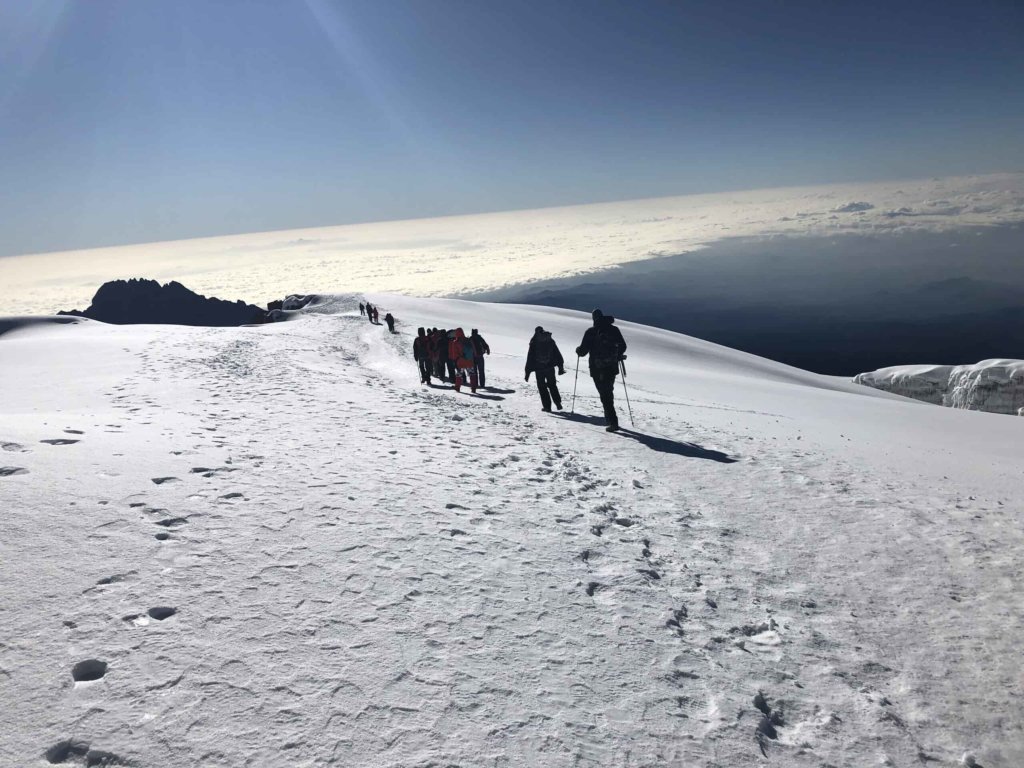
A view of the team hiking across the snow fields on the top of Kilimanjaro. Credit: Friends of Access Israel.

Josiah found the four participants with disabilities on the trip to be “super brave” as they put their trust in others who assisted them up the mountain. Ari Storch of Manhattan was impressed with how the group consistently “came together as a community” and “didn’t care about egos,” even when the group faced challenges. Arnold John, the local Tanzanian climber who always s dreamed of climbing Kilimanjaro, was very emotional, declaring, “I am very happy to climb this mountain. I prayed to God to bless me, and he answered my prayers!”

The group returned to their hotel in nearby Moshi for much-needed showers and the first opportunity in more than a week to check email and to call family members. Following a celebratory dinner, most delegation members opted to participate in a two-day safari, seeing baboons, rhinos, giraffes, elephants, zebras, flamingos, ostriches, gazelles and lions in the Tarangire National Park and the Ngorongoro Conservation Area.

The final day in Tanzania began with a rare opportunity to meet and pray with the small Arusha Jewish community, descendants of Yemenite and Moroccan Jews who came to eastern Africa in the 1880s. Yehuda Amir Kahalani, a local lawyer and college professor, is head of the community, which recently received its first Torah scroll, a donation from a synagogue in Ottawa, Canada. The group next enjoyed the opportunity to visit Shanga Village, a vocational training program for people with disabilities, and to purchase hand-crafted souvenirs at Shanga, the Arusha Cultural Heritage Center, and at the Maasai Market before flying to their respective homes.

Group members praying with the small Arusha Jewish community of Tanzania. Credit: Friends of Access Israel.

David Icikson returned the well-traveled Torah to its home at Orach Chaim Congregation in Manhattan. The synagogue’s spiritual leader, Rabbi Ben Skydell, greeted him. “We are extremely proud that so many members of our community participated in this amazing climb. Both through their raising awareness of the technologies for inclusion that are being produced in the State of Israel, and in convening the highest-altitude minyan/Torah reading in history, these climbers embodied the deepest teaching of our tradition—that the Torah is for everybody, everywhere.”

Lassner was similarly proud of his fellow congregants and all of the climbers. “This definitely wasn’t a week of ‘I.’ The biggest thrust in this exceptionally difficult feat is that all came with the attitude that ‘we’ are our sisters and brothers’ keepers!”

As a journalist who focuses on Jewish disability inclusion, I was privileged to attend the Access Israel conference last May, where I learned more about accessibility, inclusion and technology from, and along with, 800 participants from 22 countries. I also discovered that James Lassner, from my New York City community, had co-founded FAISR, Friends of Access Israel, and that a group was planning its first-ever climb on Mount Kilimanjaro. It took place from Feb. 4-10 (with me in along for the ride).

Read more