Published Articles

Original Post Published On The Jerusalem Post

After two straight US Open quarterfinals, Jewish-Argentine knocked out early • Djokovic cruises • Gauff ousted

Cameron Norrie of Great Britain battled back from two sets down and two match points to stun the US Open’s Argentine No. 9 seed, Diego Schwartzman 3-6, 4-6, 6-2, 6-1, 7-5 in a four-hour first-round match at the USTA Billie Jean King National Tennis Center in New York on Monday night.
Schwartzman, the No. 13 in the world, experienced cramps on several occasions and took a fall up 3-2 in the fifth set that required treatment on his left hand by the trainer. The gregarious, proudly Jewish 28-year-old is a three-time Grand Slam quarterfinalist. He reached the US Open quarterfinals in both 2017 and 2019, but couldn’t pull out the match against Norrie.

“I had a very bad day,” said Schwartzman after the match. “I was far from playing at the level that I showed many times here at the US Open. I took advantage of the early chances, but I was giving a lot physically and I started to get tired and cramped up a couple of times. In a normal year, when I am playing a lot, I do well, but it is much harder going a long time without competing. It was a very bad tournament for me and all I can do is try to improve for what is coming.”No. 76 Norrie spoke to the British media after the match.“I just had a phenomenal attitude and stayed patient with myself,” said Norrie. “I think my attitude won it for me today and my legs got me through it.”  Norrie had eleven aces to one for Schwarzman. The match broke a US Open record with 58 break points.Norrie advances to play Argentinian Federico Coria in the second round.  Players in the main draw earn $61,000 for appearing in the first round.  Male and female tournament winners earn $3 million.  Norrie has yet to win any titles.  He is 4-10 in Grand Slam matches and has reached the second round four times.

Schwartzman made news during last week’s ATP 2020 Western & Southern Open Masters 1000, which was also played on the grounds of the US Open.  He was upset when Argentine tennis players Guido Pella and Hugo Dellien were quarantined after their fitness trainer tested positive for COVID-19.

“They lied to our faces,” Schwarzman said angrily, “They said that there would be no retaliation for anyone who tested positive.”Relatedly, a number of competitors at the US Open expressed their frustration on Monday after they were moved into a so-called “bubble within a bubble” as they had been in contact with Frenchman Benoit Paire, who tested positive for coronavirus.

Tournament organizers quietly removed Paire from the draw on Sunday, with the Frenchman later confirming on social media that he had tested positive.French players Adrian Mannarino, Kristina Mladenovic and Edouard Roger-Vasselin were subsequently placed under an “enhanced protocol plan” for “players who might have been potentially exposed” to the virus, allowing them to continue competing in the tournament instead of withdrawing.

In other first-round action, Novak Djokovic needed less than two hours to continue his unbeaten season.The top-seeded Serbian routed Bosnia’s Damir Dzumhur 6-1, 6-4, 6-1 in 1 hour, 58 minutes.The win was Djokovic’s 24th in as many matches this year. He won the Australian Open and three tournaments this year, including the Western & Southern Open in New York last week.

Djokovic saved six of the seven break points he faced against Dzumhur while converting six of his 18 break opportunities.A heavy favorite for the title with Spain’s Rafael Nadal and Switzerland’s Roger Federer absent, Djokovic will next face Kyle Edmund. The British player got past Kazakhstan’s Alexander Bublik 2-6, 7-5, 7-5, 6-0.In other matches, fourth-seeded Stefanos Tsitsipas of Greece demolished Spain’s Albert Ramos-Vinolas 6-2, 6-1, 6-1 in 98 minutes.

Maxime Cressy will get the next shot at Tsitsipas, as the American wild-card entrant produced his first victory in a Grand Slam event.Cressy, a 23-year-old UCLA product, beat Slovakia’s Jozef Kovalik 6-1, 2-6, 6-4, 6-4.Fifth-seeded Alexander Zverev needed four sets to get past South Africa’s Kevin Anderson 7-6 (2), 5-7, 6-3, 7-5.Seventh-seeded David Goffin of Belgium eliminated the United States’ Reilly Opelka 7-6 (2), 3-6, 6-1, 6-4.Other seeded winners Monday included Israel-born No. 12 Denis Shapovalov of Canada, No. 19 Taylor Fritz of the United States, No. 20 Pablo Carreno Busta of Spain, No. 24 Hubert Hurkacz of Poland, No. 26 Filip Krajinovic of Serbia, No. 27 Borna Coric of Croatia and No. 32 Adrian Mannarino of France.

In an all-United States matchup, Steve Johnson outlasted 16th-seeded John Isner 6-7 (5), 6-3, 6-7 (5), 6-3, 7-6 (3). Isner fell despite an ace edge of 52-22.On the women’s side, Coco Gauff failed to make it past the first round as 31st-seeded Anastasija Sevastova defeated the 16-year-old sensation 6-3, 5-7, 6-4.

Gauff had a memorable run 12 months ago at age 15 when she recorded two wins at the US Open before losing to top-seeded Naomi Osaka in the third round.But the magic wasn’t there against the 30-year-old Sevastova, who was a US Open semifinalist in 2018 and reached the quarterfinals in both 2016 and 2017.Gauff committed 13 double faults and 41 unforced errors against 27 winners in the match at Louis Armstrong Stadium.

“I could’ve played better today, but I’m just going to get back to work and get ready for the French Open,” Gauff said of the event that begins Sepember. 21.Also, top-seeded Karolina Pliskova of the Czech Republic routed Anhelina Kalinina of Ukraine 6-4, 6-0.Fourth-seeded Naomi Osaka, two days after withdrawing from the Western & Southern Open final due to a hamstring injury, emerged with a 6-2, 5-7, 6-2 win over another Japanese player, Misaki Doi.

Sixth-seeded Czech Petra Kvitova also was sharp with a 6-3, 6-2 win over Romania’s Irina-Camelia Begu.American Alison Riske, seeded 13th, got past Germany’s Tatjana Maria 6-3, 6-2, No. 17 Angelique Kerber of Germany notched a 6-4, 6-4 win over Australia’s Ajla Tomljanovic and No. 30 Kristina Mladenovic of France recorded a 7-5, 6-2 win over Hailey Baptiste.

Reuters contributed to this report.
Read more

Original Article Published On The Jerusalem Post

Also read it in Spanish On Enlance Judio

Until her death Monday at age 85, Buxton was still waiting for her August 1958 application for membership in the All-England Lawn Tennis Club to be approved.

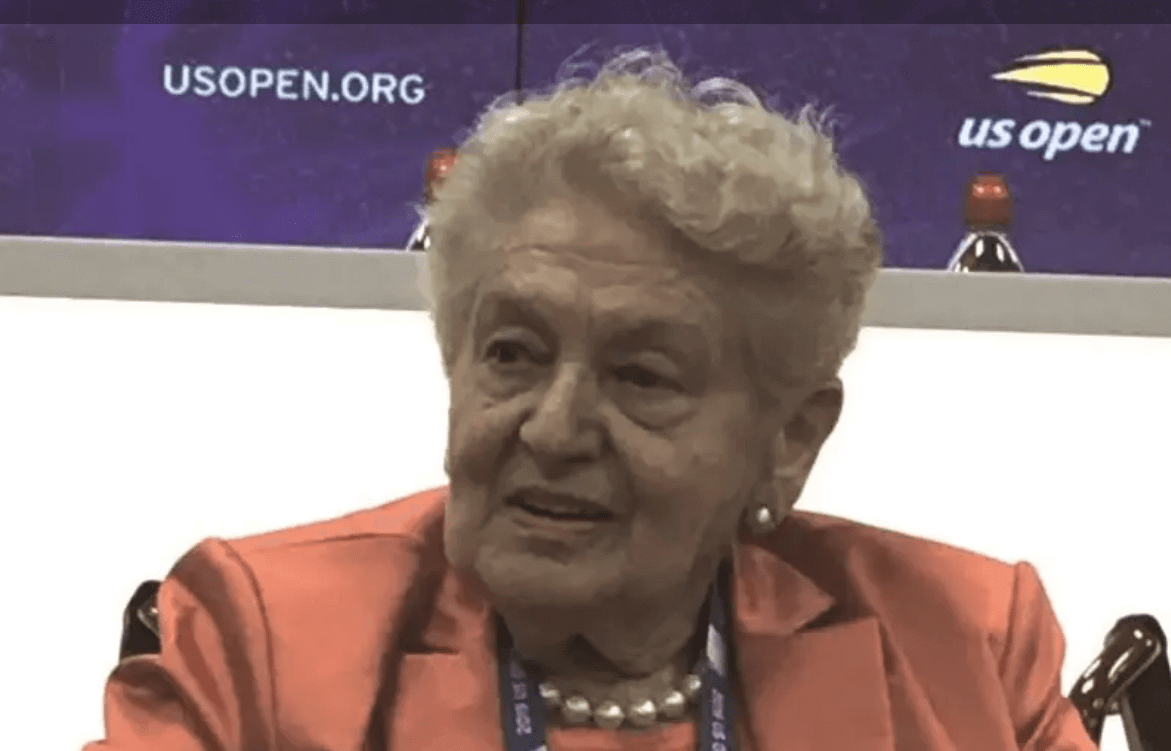
Sandra Harwitt – my seatmate on the free bus which takes US Open credentialed media, umpires, coaches and players from Manhattan to the US Tennis Center in Queens – playfully asked if I recognized the 80-year-old woman in front of us.

Harwitt, a tennis writer and author of The Greatest Jewish Tennis Players of All Time, clearly did. It was Angela Buxton, the feisty 1956 Wimbledon women’s doubles championship from England, best known for befriending and teaming up with African-American Althea Gibson.

Why would a Liverpool-born Jewish woman, who spent World War II in South Africa, and spent significant time in the US, India, and Israel, break the color barrier in tennis? Quite simply, Buxton saw herself and Gibson as outsiders.
Until her death Monday at age 85, Buxton was still waiting for her August 1958 application for membership in the All-England Lawn Tennis Club to be approved.
“I think the reason is quite clear,” the feisty, straight-talking Buxton told me in her English accent in a 90-minute interview in the media dining room at the 2014 US Open.

“I can only assume it is because I am a Jew.”

Buxton always spoke candidly. She was delighted that I write about tennis for Israeli and other topics for Israeli publications. We became friends and stayed in contact over the years. Buxton would call, send her tennis articles—or a DVD of the movie, Althea and Angela: A Perfect Match, and she insisted I read the book, The Match: Althea Gibson & Angela Buxton: How Two Outsiders – One Black, the Other Jewish – Forged a Friendship and Made Sports History. I last saw Buxton at the 2019 US Open – this time in a wheelchair – at the dedication of the Althea Gibson statu

Buxton experienced racism for the first time as an 8-year-old in South Africa, when friends and neighbors disapproved of a friendship with a black girl her age. Buxton’s first encounter with antisemitism also occurred in South Africa when a man remarked, “You Jews are all the same. You think you own the world!”

As a teenager she applied to join the Cumberland Club, the top tennis facility in North London. Coach Bill Blake reportedly rejected Buxton, saying “You’re perfectly good, but you’re Jewish. We don’t take Jews here.”
Instead, she practiced on the private tennis court of Simon Marks, the Jewish owner of the department store Marks & Spencer.
As a pro, Buxton’s first encounter with antisemitism in the tennis world occurred at the Los Angeles Tennis Club in 1952. She was denied membership because she was Jewish.

Buxton’s first encounter with antisemitism in the tennis world occurred at the Los Angeles Tennis Club in 1952. She was denied membership because she was Jewish.

In 1953, Buxton had a very positive Jewish experience. She traveled to the Maccabiah Games from England to Israel – by boat, on a ship called “Artza,” – with 100 Jewish fellow athletes.

In 1956, Buxton asked Gibson to be her doubles partner at the French Championships and Wimbledon. After the pair won Wimbledon, a British newspaper headlined a report, “Minorities Win.” Buxton injured her wrist at an August 1956 tennis tournament in New Jersey and her tennis career soon came to an end.

Buxton’s colorful post tennis-playing life included teaching and coaching tennis, starting the Buxton Tennis Center in North London, sports writing and volunteering with her three children – then-ages 6, 4, and 18 months – on Kibbutz Amiad during the Six Day War.

Buxton returned to Israel many times over the years and helped found Israel Tennis Centers.

Buxton was inducted into the Black Tennis Hall of Fame in 2015 for her relationship with Gibson and the International Jewish Sports Hall in Israel in 1981.

I will miss seeing Angela schlepping her big “wheely” suitcase through the grounds of the US Open, and her calling me at random times to share a story or article. The world has lost a legend – one with a real Jewish soul!

Read more

Original Article Published On The Jewish Philanthropy

The light bulb went off in the final minutes of the Zoom discussion of the movie “Crip Camp: A Disability Revolution” with disability rights pioneer and icon, Judith Heumann. In the Q&A for members of the Ramah camping community, one participant asked, “How do we give the typical campers a Tikvah experience if there is no camp this summer?” He was acknowledging the important reality that campers and staff would be denied the important opportunity to meaningfully interact in person with campers with disabilities from the Tikvah inclusion program.

Without missing a beat, Judy suggested that our synagogues and Jewish communal institutions mark the 30th anniversary of the signing of the Americans with Disabilities Act (ADA), which coincides with the same year we are celebrating the 50th anniversary of Tikvah.

The ADA, a civil rights law prohibiting discrimination based on disability, was signed in 1990 by President Bush. The law requires employers to provide reasonable accommodations to employees with disabilities and imposes accessibility requirements on public transportation. Ironically, religious entities like synagogues are completely exempt from portions of the ADA. All of their facilities, programs, and activities, whether they are religious or secular in nature, are exempt.

The ADA became a law twenty years after the Ramah camping movement started including campers with disabilities. In the early years, inclusion in Jewish summer camps was not a “given”. It required the persistence of passionate visionaries.

In the late 1960s, two special education teachers, Herb and Barbara Greenberg, proposed that Jewish children and young adults with disabilities be included in Jewish summer camps. Despite opposition by people claiming it would bankrupt the camps, disrupt the structure of the camps, lower the level of Hebrew and cause the “normal” campers to leave, the Greenbergs persisted. One Ramah director, Donny Adelman, said, “Why should Ramah exist if not for this reason?” He agreed to have Tikvah at his camp in Glen Spey, New York. In 1970, the camp welcomed eight young adults with disabilities. The camp soon moved to Camp Ramah in New England in Palmer, MA.

At around the time of Tikvah’s founding, Judy Heumann, a young camper with polio, was attending Camp Jened in upstate New York. “Crip Camp” profiles a group of teens with disabilities, including Judy, who attended Camp Jened during the late 1960s and early 1970s. Judy went on to become one of the most important and influential voices in the disability rights movement. Crip Camp won the Sundance Audience Award for US Documentary earlier this year.

Heumann personifies the history of disability rights in American. She fought to be included in the NYC public school system, took on the Board of Education in New York for the right to obtain a teaching license, founded Disabled in Action, and organized over 100 activists with disabilities to stage sit-ins in San Francisco and Washington, D.C. The sit-ins laid the groundwork for the ADA.

Heumann’s years of activism include serving in the Clinton and Obama Administrations. Judy has a new memoir, Being Heumann: An Unrepentant Memoir of a Disability Rights Activist, and she is a proud and involved Jew and member of Adas Israel in Washington, DC.

Camp Ramah and the National Ramah Tikvah Network’s growth and development parallel Heumann’s lifetime of activism. We have continued to expand the inclusion of campers with disabilities in our camps in North America, and in our Israel programs.

I worked as a Tikvah counselor in 1984 at Camp Ramah in New England, served for many years as a division head and Tikvah director, and currently serve as the director of our National Ramah Tikvah Network and of the Tikvah Program at Ramah Galim in Northern California. In 2015, when Ramah Galim was about to open its doors, director Rabbi Sarah Shulman and her board of directors insisted they open for all campers only once a Tikvah program was in place.

Tikvah programs have served several thousand campers with disabilities, and dozens of our staff members have gone on to work in fields related to disabilities inclusion. Most importantly, perhaps, is the shaping of attitudes for thousands of campers, staff members, families, and Israeli staff members.

The Ramah Camping Movement is not offering in-person camp programs this summer, and we will reschedule some of our “Tikvah at 50” festivities. However, we continue to offer robust programming to all of our Ramah campers online. Each day, our campers, with and without disabilities, participate in various Ramah-style programs virtually. Tikvah vocational program participants are engaged in a 12-session virtual vocational training program.

Thanks to Judy’s suggestion, Ramah will jointly celebrate “Tikvah at 50” and “ADA at 30.” Activities will include a panel discussion entitled “Jewish Journeys: Tikvah’s Role in the Jewish Disability Narrative” and staff/parent movie nights featuring clips on the theme of disabilities inclusion, singing and dancing, prayer services and more.

We greatly appreciate Judy continuing to encourage us at Ramah to do more to be inclusive and aware of the needs of people with disabilities. Here are other ways Judy suggests the Jewish community mark ADA at 30:

  • Share sermons or divrei torah (from the bima or in writing) about ADA
  • Screen and discuss “Crip Camp” and other ReelAbilities movies which show the many abilities of people with disabilities
  • Make concrete strides to go beyond ADA to be more inclusive in our shuls
  • Review what has been done thus far for disabilities inclusion and establish objectives for between now and February (Jewish Disabilities Awareness, Acceptance, and Inclusion Month).
  • Engage disabled and non-disabled people from your community – if not already doing so. (Many have already established task forces and working groups.)

Thousands of Jews have grown up at Jewish camps that include people with disabilities. They have seen first-hand how important it is for everyone to feel included. Let’s celebrate ADA at 30 with a renewed commitment to including everyone!

Read more