As the bus rolls up to the army base, A., one of the participants on the first ever Amazing Israel: Ramah Tikvah trip, begins to cry.
“No, there are soldiers here and they’ll have guns,” she moans. “No, no, no, no.”
Staff member Liz Offen speaks quietly and calmly.
“I know this is difficult for you,” she tells A. “We’re here for you. I know you can do this.”
A., holding hands with a friend, cautiously gets off the bus. At first she won’t even enter the large warehouse where special needs Israeli soldiers are folding army uniforms. She sits down outside, her friend with her, but she has stopped crying.
The participants on this Birthright trip, most of whom have attended the Tikvah program at different Ramah camps in the US, have a wide range of disabilities, both physical and emotional. They have come to the Bilu army base in Rehovot, outside Tel Aviv, to meet Israeli soldiers who also have disabilities and who are part of the Special in Uniform project.
The project takes more than 300 young Israelis with significant disabilities and trains them to do simple jobs in the army. It starts when the participants are still in school, which they attend until age 21. They can then volunteer for the army, and, if found suitable, can be inducted.
The Bilu army base is a logistical base for the Paratroopers Brigade. Today, the students are folding army uniforms and tying them together in stacks of five. They come one day a week as part of their school program.
“The goal is to integrate them into Israeli society,” said Tiran Attia, a retired lieutenant-colonel, who runs the program. “It is good for them, but it is also good for the regular soldiers. It teaches them to become more compassionate.
The army runs a separate program called Ro’im Rahok (Seeing Far), which integrates young high-functioning adults with autism in Israeli intelligence units.
The young uniform folders carry tables outside so that the Birthright participants can help with the folding. A few participate, but most just watch.
The Birthright participants enjoy putting on Israeli army uniform shirts and hats. One young man proudly says that his father served in the army and he is happy to be visiting an army base.
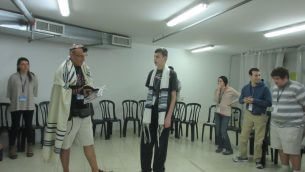
This is the first time that Birthright Israel has partnered with Tikvah of Camp Ramah. Tikvah is a program for campers with special needs at each of the Ramah camps. The Camp Ramah spirit infuses this trip, which includes daily tefillot, or morning prayers, as well as a spirited version of “Rise and Shine” complete with hand gestures.
Howard Blas, the director of the National Ramah Tikvah Network, and one of the organizers of the special needs trip, says they made some changes to the traditional Birthright itinerary, while still hitting up the major sites in Tel Aviv, Jerusalem, the Golan Heights, Masada and the Dead Sea.
For example, the group did visit the Yad Vashem Holocaust Museum in Jerusalem, but kept to a few of the smaller exhibits, rather than the main museum, which can take several hours to go through and is difficult to exit once you begin.
“We did a lot of things that are very multi-sensory like chocolate making, a jeep ride in the Golan and tree planting,” he said. “We also tried to do as many things as possible with animals because they love animals.”
Birthright has so far brought 600,000 Jews on free 10-day trips to Israel, including 2,000 adults with special needs.
Birthright CEO Gidi Marks says it is committed to bringing every young Jew who wants to visit Israel on a trip.
“OFFERING SPECIAL needs trips fits in with our broad mission of enabling each and every young Jew around the world, regardless of their circumstances, to take part in a once in a lifetime trip to Israel and connect with their Jewish heritage and identity,” he said. “These trips include all the hallmarks of the usual Birthright Israel experience: heritage sites, Israeli peers and countless special moments allowing them to connect with Israel and the Jewish heritage. Additional staffing and educational content customizations are made when and where necessary.”
For the parents of these young adults, it was a chance for their kids to be just like their neuro-typical siblings.
“I don’t think he would get an opportunity like this any other way,” Aron Wolf, whose son Danny has cerebral palsy and limited verbal ability, said. “I was skeptical that it would come through but it did. As far as I know, this is the first time that somebody with Danny’s disabilities has been included in any Birthright trip.”
Birthright Israel funded a caretaker for Danny, as well. His parents, like the parents of all the young adults on the trip, were thrilled to see the photos posted on Facebook each day. They also checked in with the caretaker frequently by phone.
“It sounds corny but he has the same birthright as any other young adult who is Jewish to experience Israel independently without his parents,” Danny’s mother, Michelle Wolf, said.
This is the first time that Danny has been so far from home. While he attends Camp Ramah in California, Michelle says that she is just a short flight away. She says she was concerned about sending Danny so far away alone.
“The idea of him being so far away from me was difficult,” she said. “I would have never even considered it if he hadn’t spent all of those summers at Camp Ramah.”
Tour guide Doron Kornbluth specially requested to guide this Birthright group. While most Israeli tour guides compete to stuff in as many sites and as much content as possible, Kornbluth said he had to take the participants’ disabilities into account.
“YOUR EXPECTATIONS have to be completely different,” he said. “A tour guide who is really invested wants to start early, end late, pack in a lot of information, teach a lot of history and that’s just not doable for this group. You cannot do as much at all.”
Another challenge is the range of disabilities of the participants. While all of them, except Danny, are able to walk, and most are able to speak clearly, a few are higher functioning.
Rachel Tracosas, 22, from Madison, Wisconsin, has high-functioning autism.
“It’s been an amazing experience to connect with my roots here in Israel,” she said. “I loved going donkey riding and going to the Kotel, which is what my brother did when he did Birthright last summer.”
The participants seemed to connect deeply with each other. Tracosas fed Danny at a lunch stop when the participants were given a budget and could choose what they wanted from a kosher food court in a local mall. Even that small independent step was exciting for them. They looked at all possible choices and discussed them before making their final decision.
Michelle Wolf said Danny’s caretaker told her that he is popular and that the participants all wanted to push his stroller. During lunch, several of the girls gathered around him, feeding him and smoothing his hair.
And every morning, when Danny managed to pull himself onto the bus by himself, his new friends gave him a spontaneous round of applause
The longtime timekeeper for Bruce Springsteen’s E Street Band, Max Weinberg, talks about his Jewish heritage and his upcoming first visit to Israel.
While his more famous “boss,” Bruce Springsteen, has been out front on international sold-out stages for over 40 years, drummer Max Weinberg has been a powerful anchor, perched on a platform in back, stoically keeping a powerful beat that propels Springsteen’s music.
Max Weinberg on His Future With Conan and Bruce (YouTube/The Rolling Stones)
But don’t be fooled. The New Jersey-born 66-year-old Weinberg, who joined the E Street Band in 1975, is just as comfortable in the foreground as in the background. When Springsteen put the band on hiatus in 1989, Weinberg moved to the front of the stage, serving as bandleader of The Max Weinberg 7 for Late Night with Conan O’Brien, and later for The Tonight Show with Conan O’Brien, as leader of Max Weinberg and The Tonight Show Band.
Weinberg’s allegiance to Springsteen proved paramount and when the Boss reconvened the band in the late 1990s, Mighty Max, as he is introduced onstage by Springsteen, was back in the drummer’s seat, where he’s remained ever since. Wrapping up their most recent tour in Auckland, New Zealand last February, The E Street Band is once again on a break and Springsteen has been busy performing his Bruce on Broadway solo show to sellout crowds since October.
But Weinberg continues to keep busy. He has traveled across the country performing as part of the Max Weinberg Juke Box Tour, a fun-filled show in which he and his crack soul-rock band pick songs to play from a long list of classics. He also regularly gives lectures about his life and drumming.
And as a Jew proud of his heritage, he seems to enjoy getting to know synagogues in Pennsylvania and New Jersey. According to Ariella Rosen, rabbi of Philadelphia-area synagogue Adath Israel, Weinberg had so much fun at the synagogue’s annual fund-raiser in 2016 that he came back a second time in 2017.
“There is mutual affection between Max and the congregation,” notes Rosen. “He played drums during havdala as Rabbi Eric Yanoff played keyboards – two years in a row. He enjoyed getting to know members of the congregation and he loved it when we presented him with an honorary member’s certificate.”
Weinberg spoke with The Jerusalem Post after Juke Box Tour twice – after an appearance in Jersey City, New Jersey, late last year, and for a longer interview in January, in which he proudly revealed he will be making his first trip to Israel next month.
I grew up in the suburbs of Newark, New Jersey, in a Jewish family. My grandfather was one of the founders in the early 20th century of our synagogue. My mother and her four sisters were very involved in temple life and the sisterhood and of course I had a bar mitzvah.
Some of my earliest musical experiences took place at the synagogue. In my own personal case, our rabbi was a very inspirational guy who approached the rabbinate artfully through music and poetry. That made a big impression on me. Music in the service itself was what they would call high church – very old school. I really enjoyed that. We had a 15-voice choir that was on the second floor, above the bima, behind a curtain, so you never saw them – with the organist. It was very majestic. And it was my first experience with organized music. These are the Reform Movement’s original hymns.
Our rabbi (Avraham Soltes) was a well-known rabbi in the United States. He had a TV show in the early 1950s – Lamp Unto My Feet. His son (Ori Soltes) is actually a very esteemed professor of Judaica and Hebrew studies at Georgetown University, and he was my best friend as a kid.
So that was very present in my family growing up.
Can you share more about your family? It sounds like the temple was an important place for you and your family.
I have two older sisters and a younger sister. Between Hebrew school, Sunday school and services, I probably spent more time in the temple than I did any place else! My initial musical experiences performing took place there.
What is your memory of your bar mitzvah?
I played at my bar mitzvah! Like most young 13-year-olds, the studying and the struggle to speak Hebrew mellifluously had you practicing a lot.
My bar mitzvah was very modest – a lot of family, a lot of friends – but not a big full-blown affair. My parents didn’t have the resources for that.
I remember fondly getting my first real suit, which kind of started a fascination with dressing up. I still have the tie I wore at my bar mitzvah!
I was confirmed. It was important in my family to appreciate the cultural heritage of our Judaism. My mother’s grandfather, who would be my great-grandfather, came from Russia around the turn of the 20th century and chose to go live around 1910 or 11 in Palestine. He died there in 1916 and is buried on the Mount of Olives. His name was Joshua Mindlin. So when you see pictures of my sister – my younger sister and I – we are the youngest of many first cousins. So it was quite a big extended family that immigrated here [to the US] in the late 1870s.
Where did your family come from originally?
They came from Europe through Ellis Island, then to Brooklyn and then to New Jersey. The heritage of being Russian, specifically Ukrainian Jews and Polish Jews, was something I was very aware of my entire young life, especially with a name like Max Weinberg. What is interesting is that it was not my father’s family name when they came here – it was a German name that was given to them when they came through Ellis Island and they never changed it. You know, in show business in the 1950s and ’60s, it was a bit in vogue to Anglicize your name, but I never did that.
I’ve fortunately through the years been very pleased to have support from the worldwide Jewish community, including Israel, and in places I’ve played – as someone who is not only aware of my heritage and my people and where I came from, but in many ways, as assimilated as my family became – I still maintained those ties.
Have you been to Israel?
I am actually going in February! Most of my family has been to Israel. My mother, many times. My first cousin went there in 1962, was on a kibbutz and ended up staying. She met her husband there and she moved back here [to the US] in the middle 1990s.
We had hoped that we would be able to play there. To tell you the truth, I haven’t been anywhere that I haven’t played. I have played everywhere and have traveled so much that I have virtually never taken a trip where I didn’t perform!
I feel remiss in not visiting before. I have many Israeli friends. [Well-known Israeli musician] David Broza is a good, close friend that I have performed with. He’s performed with my band. I have performed with his musicians. So I am very much looking forward to my trip.
My daughter and son-in-law just got back from Israel. I expect to see my great-grandfather’s grave.
I don’t know anyone who has been to Israel and has not fallen in love with it, so I look forward to having a marvelous experience.
Would you want to play on this trip to Israel?
My playing internationally is more related to my playing with the E Street Band. That’s why I haven’t really been many other places. I do expect some day to play there, but not this trip.
This is a pleasure trip and to see friends. Both my wife and I are very much interested in history generally. Whenever I have been on tour with the E Street Band, we have really tried to take in as many historical sites around the world – the United States a little bit, but particularly in Europe and some of the more exotic places we’ve been.
There has been a lot of talk in the musical community about the BDS movement, Roger Waters, for example. I wonder if you have ever spoken with Bruce about Israel, if BDS has ever come up, or is that something you guys stay away from? Have you guys ever talked about playing in Israel?
We talk about so many different subjects. It is good question about why we haven’t played there. I used to get a lot of letters from Israelis when I was on the Late Night with Conan O’Brien Show who seemed to be very proud of me – that here I was with the Max Weinberg name on my bass drum. So I got a lot of support from my Israeli brothers and sisters. I appreciated that very much.
You have been playing with Bruce for so long that you probably overlapped with Suki Lahav, the Israeli violinist who played with Bruce Springsteen for part of 1974 and 1975.
I certainly played with her. She was a brilliant musician. She played violin and her former husband, Louis, who I believe lives in South America now, was our engineer/ road manager/driver. They were both Israeli, of course. He was the first person I met associated with Bruce and the band when I auditioned. Suki was not in the band very long. It was 1974 and 1975 for six or eight months, but certainly made her mark. Frankly, when you hear the intro to “Jungleland,” if you are in the E Street Band, you think of Suki Lahav.
Can you share any stories or memories of being Jewish “on the road”?
We have a very dear friend who is the promoter in Germany. We once had Passover Seder years ago with this friend of ours. That would be something that I would point to as a special experience. He is originally from Berlin.
Have you seen Bruce on Broadway?
My wife and I attended his opening night back in October and thoroughly enjoyed it. It was a magnificent evening. It was very gripping, dramatic, funny, touching and moving – which we of course knew it would be – because that is what he does.
What is it like for you and the band when you have time off?
We have a terribly strong bond, all of us, but again, we all very much enjoy our break from playing, and everybody stays pretty much involved with music in a variety of different things.
I am very busy these days. I work 10 days a month between a variety of venues and bands and public speaking. Also, I did a guest spot on the CBS show Blue Bloods (aired January 19). So I try to keep busy.
Can we look forward to seeing Bruce and the E Street Band back on the road?
We always read the tea leaves. So we don’t really discuss much at all and it seems to always work out that way.
What are the hardest and best parts of being on the road so much?
I love it! I love being out on the road, in whatever capacity I may be doing it. Whether it is with my own group, or certainly with the E Street Band, I really enjoy traveling. I enjoy seeing sites. I like being on the go – that’s my personality. I like meeting people. I enjoy different cultures. We’ve had marvelous experiences around the world, playing in Africa, India, Asia and South America. It is a privilege to be able to work in that capacity when you are traveling – a little like a traveling salesman. What you are selling is your music. The ability to provide for people an opportunity as Bruce says often, “To dance all over their problems.” That is a mitzvah to me. In my own way, and with my background, I have kind of interpreted that as my own way of providing tikkun olam.
That is beautiful. If our clergy was half as inspiring as Bruce and the E Street Band, religion might be doing much better. It is really a religious experience going to a concert.
The idea of being useful is something that has always been stressed by Bruce, and within the band, of being of use in doing what you do. To bring joy to people through music has always been in the forefront of the thing we do individually and collectively. It really is a blessing to be able to do that.
It probably, in my case anyway, harks back to the feeling I got of sitting in the synagogue, which was a very imposing architectural edifice, listening to the music. We had the most amazing cantor in my temple, who was a baritone, in credible voice – Cantor Herman Dansker, in the 1950s; he retired in the early 1960s.
Is it true that you were a drummer in a bar mitzvah band at age seven – when you sat in on a bar mitzvah band playing “When the Saints Go Marching In?
I definitely played bar mitzvahs. You name it, I played it. Cruise ships. The Catskills. I played many of the Catskills resorts when I was a teenager. From Grossingers to Kutschers, to the Concord to the Nevele. There was a place that was owned by Neil Sedaka’s family called the Esther Manor – I think Esther was his aunt. It was in Libertyville, New York, which of course was the Borscht Belt, the center of classic Jewish show business from the middle 1930s to the beginning of the 1970s. But I caught it at the end of the 1950s and in to the ‘60s.
How did you get started in the first place in this whole drumming business? You have spoken before about the role of the drummer and you have used the word seder (order).
If you’ve read that concept, then you know it was seeing Elvis Presley on The Milton Berle Show, before Ed Sullivan. I already was pretty musical, singing, which I don’t do anymore. I was musical and seeing Elvis and his band, particularly his drummer, D.J. Fontana, just kind of grabbed me. Then, of course, four or five months later, he was on The Ed Sullivan Show and everything just… well, that was the Big Bang. So my experience wasn’t that different from many other young people my age and older, obviously. I guess I was five when that happened and it really made an impression on me. The beat really just grabbed me. I know it is a cliché, but it was really true. I was just very directed to being in that world. As a teenager, I was actually able to go out and make money and play jobs. It just sort of naturally fit me. I am just glad to continue to do it.
I have always wondered, there is this line in Bruce Springsteen & The E Street Band: Live in New York City: “I’m gonna throw a rock and roll exorcism… a rock and roll baptism and a rock and roll bar mitzvah!” Are you the inspiration for the bar mitzvah line? Or is Bruce just being playful?
Sure it is playful, it is also those that he described are all celebrations and that’s what we try to accomplish – a celebration. Whatever the religion, ethnicity or nationality, it is all a human joyful experience. That’s what music does – it breaks down those barriers, which is why we need more of it.
At the farewell dinner in Tel Aviv on the last night of our ten day Birthright Israel Amazing Israel Ramah Tikvah trip, we went around the table sharing memories and trip highlights. The 21 participants with intellectual and developmental disabilities, and the six staff members, representing five Ramah Tikvah Programs and twelve states—from Wisconsin to Alabama—spoke enthusiastically about the jeep ride on the Golan Heights, the de Karina chocolate making workshop at Kibbutz EIn Zivan, the Night Spectacular Sound and Light show at the Tower of David in Jerusalem, the Biblical Zoo, the view of Syria from Golan, Masada, the Dead Sea, the Kotel, and shwarma! The participants then asked for my highlight. It didn’t take long for me to share my answer, though my highlight was so much more than a place. “Tefillot and your knowledge of Israel and Judaism,” I replied, as the group asked for clarification.
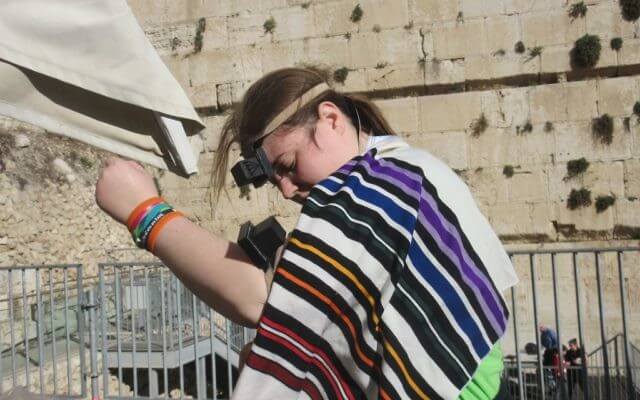
Each day, our group met for morning prayers, in such places as hotel bomb shelters, banquet rooms, outdoor tents, and the bus. We used a special Tikvah siddur from Ramah camps, we faced east, and south—depending on our location. Some participants wore kippot, tallis and tefillin. And we sang such “classics” as Modeh Ani, Mah Tovu, Halleluya and Shema, and such Tikvah Ramah favorites as the Baruch SheaMARCH, Thank You, God, and The Rise and Shine Amidah Song. (The group had no problem MARCHING to the Baruch SheaMARCH prayer when we were praying in the hotel; they weren’t sure how we could safely march on the bus ride to Masada. We decided it was safer to sit!)
The participants got up early to sing and dance and share this meaningful experience with camp friends—all before eating a sumptuous hotel or kibbutz guest house breakfast. Alexa sat in the back of the room, or at the front of the group, using Hebrew sign language to sign each acrostic prayer—Ashrei, El Baruch and El Adon. She was happy to teach her friends Hebrew the sign language she learned at Camp Ramah in New England.
The California Ramah group recruited their friends to come up and lead the Shema and VeAhavta—making sure all eight members of the camp in Ojai, California were there.
Sam wanted to make sure we left time each morning for Adon Olam–and wondered, “Who will say the Shema with us each night before bed?”
Maddy, a female participant from Camp Ramah in Wisconsin, wanted to make sure she would have an opportunity to put on family heirloom tefillin—at the Kotel. We excused ourselves from the group’s tour of the Jerusalem Archaeological Park-Davidson Center, found a special spot, and had a few moments of special prayer, wrapped in tefillin.
The participants from the various Ramah Tikvah Programs felt a sense of connection to their fellow campers. They enjoyed the predictability of the daily prayer ritual. And they looked forward to thanking God each day for the many gifts they have received. Isn’t that what prayer is all about?
Maddy asked me before the trip if she could lead birkat hamazone on Shabbat and we had a few takers for kiddush and hamotzi as well.
Our tour educator, Doron, an observant Jew himself, was blown away, observing that this knowledge of and enthusiasm for prayer was not typical of most Birthright trips, or any Israel trip for that matter. He was also impressed with their level of knowledge about Israel and Judaism in general.
When Henry offered a scholarly explanation at Tel Dan in the north to a question about Israel’s water issues, Doron calmly removed his tour guide license from around his neck and placed it on Henry. “You are our tour guide now!” Henry was so excited, sharing his YouTube video acquired knowledge about drip irrigation and desalinization. Doron used this “trick” on several occasions, rewarding participants particularly knowledgeable about the Old City of Jerusalem, Masada and more with the tour guide’s license.
In the Israel Museum, participants found many objects and exhibits to be familiar—including tefillin, chuppah, matzah baking, Chanukah menorahs and the three fully reconstructed synagogues.
In the north, at the Mishnaic village of Kfar Kedem, the lovely guide thought he would be introducing the group to pita making on a taboon (outdoor oven)—like he has done for years with so many tour groups. For this group, pita making was nothing new. Our Ramah camps each bring 40 or 50 shlichim (Israeli emissaries) to camp each summer. Our campers have been making pitot and eating fresh chumous for years!
Our ten day Israel trip was fun and educational for the participants. I too, learned a valuable lesson which we in the Jewish community should take to heart—and fund accordingly: people with disabilities are very capable of connecting in a meaningful way with Jewish ritual, practice, and knowledge, and with Israel. When our summer camps, synagogues, youth groups, schools, communities and Israel trips open their doors to include everyone, the payoff is as clear as the beautiful sky we saw from Jaffa on the last night of our trip of a lifetime.
Israel made the biggest jump in the World Baseball Softball Confederation World Rankings in 2017, advancing from No. 41 to No. 19.
The blue-and-white defeated four Top 10 nations – Chinese Taipei, Cuba, Korea and Netherlands – in its World Baseball Classic debut in March of last year.
Team Israel ended the WBC with a 4-2 record, reaching the last eight of the tournament. Israel registered three consecutive victories in Pool A in Seoul, South Korea to advance to the second round in Tokyo.
The blue-and-white then beat Cuba, before losing to the Netherlands and Japan, who both went on to progress to the semifinals.
Elsewhere, first-time winner of the World Baseball Classic, the United States moved to within 321 points of top-ranked Japan, cutting the lead by 450 points. USA Baseball National Teams are the current title holders of three WBSC World Championships: U-12 Baseball World Cup, U-18 Baseball World Cup and World Baseball Classic.
The absence of the US in the first two editions of the U-23 Baseball World Cup (2014 and 2016) has been significant, with Japan, the current U-23 world champion, maintaining the No. 1 ranking by earning 1,236 points in these two events.
Baseball’s world rankings weigh a country’s national team performance in WBSC-sanctioned international competitions (from U-12 to Professional) over a four-year period. Points earned from the 2013 WBC have expired.