disabilities

The original article is published at JPost.com

Broza performed Monday evening at a benefit at City Winery for Israel ParaSport Center, an organization he has been connected to since age seven.

David Broza has been performing for weeks in Israel and Spain, but he made sure to be back to New York in time to receive an award and play a very special acoustic show for an organization that has been dear to him from the days of his childhood in Tel Aviv.

Broza performed Monday evening at a benefit at City Winery for Israel ParaSport Center, an organization he has been connected to since age seven, when his father, who helped establish the center, regularly brought young David to hang out with Israelis with disabilities.

“I am still in touch with some of them until today,” Broza, 68, tells The Jerusalem Post minutes after landing in the US from Spain, three days ahead of his New York private show.

Thanks to his childhood experiences, the internationally renowned singer-songwriter, who has recorded over 40 albums and is best known for his 1977 song “Yihye Tov,” is as comfortable with people with disabilities as he is writing and performing songs for audiences around the world.

(credit: HADAS PARUSH)

Broza’s biography

BROZA WAS born in Haifa and grew up in Tel Aviv and Madrid, while also spending one year in England. His father, Arthur Broza, had a sister in England with cerebral palsy. This inspired his work with Moshe Rashkes, a close friend who was seriously wounded in the War of Independence. Rashkes went on to found and remain active with the center (known until 2021 as Israel Sport Center for the Disabled) for over 50 years, until his death six years ago at age 90.

David Broza reflects on how his father came to be involved with the Israel ParaSport Center in Ramat Gan, where 3,000 people with physical disabilities annually attend and compete in such competitive parasports as basketball, tennis, swimming and archery.

“He thought, if they [his sister and family members] ever came to Israel to live, they should have a club.”

Rashkes’s son, Arik, who with his wife, Orly, served as cochairmen of the New York event, recalls hearing stories of Arthur bringing his sister to the pool and “falling in love with the center.”

Arthur Broza regularly helped in many areas of the center, including fundraising and assisting with the yearly swim across the Sea of Galilee.

For young David, spending days and summers with people with disabilities “seemed natural and was fun.” He notes that “people with disabilities don’t feel sorry for themselves” and that they “fight to be active.”

He recalls pitching in at the club wherever he could be helpful. “I pushed and carried wheelchairs, picked up balls… there is no end to what a sports club needs people to do.”

Broza is proud of what the center offers people with disabilities and notes that “given the right environment, people can become successful.”

He fondly recalls participating in the yearly swim across the Sea of Galilee with participants from the center. “From the time I was seven or eight, I would swim across with them. My father and the executives were in a speedboat. It was a thrill and great fun to swim across with everyone!”

Broza also enjoyed attending summer camp with his sister, Talia, and with participants from the center. He emphasized that while neighborhood children attended camps with nondisabled children, he and Talia spent their summers with children with disabilities. “It was natural. It was a no-brainer!”

While spending so much time with people with disabilities was comfortable and natural for Broza, he notes that “society doesn’t look at it as natural.

“There is a lot of work to be done. The Israeli government needs to continue to work to bring awareness to what they [people with disabilities] need and to treat them as equals.” He emphasizes the need to “bring in funds” and “speak for them” and stresses that he will continue doing his part until he is no longer able to.

Each year, Broza returns to “Spivak” to perform for participants and their families. Many continue to refer to the Israel ParaSport Center as Spivak, a tribute to an early donor after whom a building is named. Broza notes that while the army has its own system of supporting soldiers who become disabled, there will likely be a 30% increase in people coming to the center for services and programs.

LORI KOMISAR, national president of Israel ParaSport Center, strongly believes that “David Broza is part of the center family.” She notes his father’s role as one of the center’s founders, that David has been coming to the center since age seven, and is pleased that he “has continued coming every year since.”

Komisar captures Broza’s active role during his visits. “David sits with the children on opening day, plays guitar, and sings with them. He is a source of inspiration and hope. He would probably say they are his source of inspiration and hope. David opens his heart and devotes his time and energy, and helps build awareness and support for us. But it goes beyond this and beyond the music. It’s all about the love for the children.”

Arik Rashkes, son of the center’s founder and a current board member, recalls also growing up at the center and receiving David Broza music CDs from his father, Arthur. Arik and David are now friends, and Arik stresses what “an integral part of the heart and soul of the center” Broza continues to be.

At the City Winery event, guests learned of the center’s impact from two elite wheelchair tennis players – Amit Vigoda and Ibrahim Baho. Israeli reservist Shalom Zoor, who recently returned to Tel Aviv after serving four months in Gaza, spoke of the important bond between Diaspora and Israeli Jews, and he thanked the audience for its continued support.

Rashkes then presented Broza with a piece of art as the Moshe Rashkes Heroes of Life Recipient. Broza then shared stories and performed a 10-song acoustic set, which included “Ha’isha She’iti,” “Bedouin Love Song,” and “Yihye Tov,” with an additional verse to reflect hope for the future in Israel.

Broza had planned to spend this past fall touring to mark the 40th anniversary of his album Ha’isha She’iti, but canceled the tour when the war broke out.

He has performed more than 200 shows in Israel since the start of the October 7 war. He similarly mobilized to entertain soldiers and others during previous times of difficulty in Israel, including the First Lebanon War (1982).

Read more

Original Article Published On The New York Jewish Week

Inclusive Jewish summer camp options for children and young adults with disabilities now abound.

This is part of a series of essays in honor of Jewish Disability Awareness, Acceptance and Inclusion Month.

When the Ramah Camping Movement started including campers with disabilities through its Tikvah Programs in 1970, the world was a very different place.  Tikvah’s founders, Herb and Barbara Greenberg, two Long Island school teachers, faced opposition and roadblocks almost every place they turned. They were told that “including people with disabilities would bankrupt the camps, disrupt the structure, lower the level of Hebrew and cause the ‘normal’ campers to leave.”  

One Ramah director, Danny Adelman, z’l, (director of Ramah Glen Spey in New York, and later, Camp Ramah in New England in Massachusetts) felt it was a Jewish value and imperative to include people with disabilities.  With that “yes” in the late 1960s, the Jewish inclusive camping movement was underway! Every Jewish summer camp, school, youth movement and Israel which program which supports and includes people with disabilities should pause to remember and pay tribute to the pioneering, brave work of the Greenbergs.

It wasn’t easy going at first.  Once the camp agreed to Tikvah, the Greenbergs first had to find those campers.  As the Greenbergs, long-time citizens of Israel after 29 years directing Tikvah, report, “They weren’t in the synagogues!”  Rabbis weren’t very helpful in identifying participants since families of children with disabilities weren’t coming to the synagogues—they didn’t feel welcomed.  They managed to find eight participants for that first Tikvah summer. 

That first summer 50 years ago laid the groundwork for inclusive camping within Ramah and in all of Jewish camping. Now, all 10 Ramah overnight programs and it various day camps support campers with disabilities and their families through camping programs, vocational training programs, supportive employment, Israel trips and Family Shabbatons.

In the past ten years, we have seen in increase in the number of Jewish overnight and day camps supporting campers with a range of disabilities, and a general shift in attitude toward inclusion.  Camps are doing a better job training their staffs, providing tools to support all campers. The Ramah Camping Movement offers an inclusion track at its twice a year national trainings, and the Foundation for Jewish Camp (FJC) has a network for inclusion specialists, and offers a disabilities inclusion track at its biannual Leaders Assembly. 

Families of children and young adults with disabilities now have more choices in summer camping—by location, religious affiliation, and type of camp.  And camps with camping programs are increasingly looking for ways to expand vocational training and employment opportunities for people with disabilities as they get older.  Keeping Jews in Jewish camp for as long as possible continues to be a goal of Jewish camping—for people with and without disabilities.  

Read more

Original Article Published on The New York Jewish Week

Timed to coincide with February’s JDAIM, the international group will trek Africa’s tallest mountain using Israeli designed special assistance technology.

This year, I will not be spending Jewish Disability Awareness, Acceptance & Inclusion Month (JDAIM) with my colleagues and friends at 10th annual Jewish Disability Advocacy Day on Capitol Hill (February 4th).  And I won’t be teaching about disability inclusion at synagogues or college campuses across the country.  While I will “miss” the more traditional marking of JDAIM, I will have the once in a lifetime opportunity to experience Jewish disabilities inclusion in a very unconventional setting—Mount Kilimanjaro in Tanzania!

I will attempt to trek up the 19,341 foot mountain, through five ecosystems and vast game preserves, with 27 hikers from Texas, Montana, New York, and New Jersey, as well as with participants from Israel.  The delegation includes a twice paralyzed Utah athlete and her husband, a Peruvian born cyclist and skier who is also an amputee with paraplegia, an Israeli army veteran who is paralyzed, a 9/11 first responder who experienced PTSD, a local Tanzanian man with paraplegia and others who believe in the mission of FAISR—Friends of Access Israel.

FAISR, started only several months ago, and Access Israel, founded just over 20 years ago in Israel, is an organization which uses education, advocacy and technology to promote accessibility, inclusion, respect, removal of actual and perceived barriers, and an equitable environment for people of all abilities around the world.

The trekkers will ascend the Marangu route, also known as the Coca Cola trail, to reach the peak.  In accordance with best practices and Tanzanian law which assures the safety of hikers with and without disabilities, the delegation will be accompanied by three cooks, 11 guides, and 70 porters.  Daily mileage will range from 3.1 miles on the acclimation days, to a grueling 13.7 miles during the final ascent, setting out just before midnight Saturday night with the goal of reaching the summit at sunrise.

The group should be well-rested for the final, all-night Saturday night ascent.  We will be spending a relaxing Shabbat at 15,420 feet and will enjoy vegan kosher Shabbat meals, prayer services (including Shabbat morning where we will read the Song of the Sea from a torah scroll (yes, we are carrying a kosher torah scroll up the mountain!). And I will have the privilege of teaching a favorite JDAIM Talmud text on inclusion!

The climb up Kilimanjaro is believed to be the largest delegation of hikers with disabilities.  Starla Hilliard-Barnes, who was selected as Ms. Wheelchair Montana in 2014, became the first wheelchair-user to compete in the Mrs. Montana pageant in 2016.   She is founder of Moving Forward Adaptive Sports and the charity, Gifts of Love, and will be accompanied by husband, Shannon Barnes.  Hillard-Barnes will use a specialized wheelchair, known as a Paratrek, as she ascends Kilimanjaro.  “I’ve dreamed since I was a little girl to go climb Mount Kilimanjaro,” reports Starla.  She has been hearing about Africa and Kilimanjaro her whole life from her grandparents, who were missionaries there.

In a phone interview three weeks before the trip, Hillard-Barnes concedes that she has “never sat on a Paratrek” and “never even touched one!”  The good natured Hillard-Barnes playfully reports, “It will be interesting.”  The experienced hand-cyclist, who has a great deal of hiking and camping experience feels her biggest challenge will be “giving up my independence and letting someone else be in control.”   Unlike with hand cycling, which she does on her own, she will need to rely on others when she uses the Paratrek.

Omer Zur, founder and CEO of Paratrek, the Israeli company that specializes in finding solutions for people with disabilities to enable them to enjoy nature with groups of people with and without disabilities, is very aware of the need to find the right balance between assuring the independence of the trekker, and offering assistance as needed.  He designed the first Paratrek to enable his fiercely independent father who was paralyzed 35 years ago during the Yom Kippur War to climb mountains and go camping.  “My parents wanted us to be the best version of ourselves and to go out in nature and be comfortable.”  On a three-year post-army trek, Zur realized that his father never had this opportunity.  He set out to design an apparatus for his dad.  His father was not pleased with the initial concept—a stretcher carried by Omer’s friends.  Zur then created the Paratrek, and he and his father set out on a 33-day journey.

The Paratrek has a rickshaw-style bar in the front that fits around another hiker’s waist and handlebars in the back that a second person can use to stabilize or push the trekker with paraplegia, if needed. Zur will be traveling from Israel to Tanzania with five Paratreks, extra shock absorbers, wheels and other supplies.  On the trip, Zur will make sure the Paratreks are in proper working order, and he will be there to help assure the comfort and safety of each participant.

Hillard-Barnes initially learned of the Kilimanjaro hike from Facebook friend and fellow paraplegic, Marcela Maranon.  Peruvian-born Maranon, who lives in Dallas, Texas, lost her left leg and became paralyzed from the waist down in a car crash at age 19.  Following what she described as a “very dark period” of several years, she entered rehab in Baltimore, Maryland.  Her experiences with ReWalk, an Israeli-made, FDA approved wearable robotic exoskeleton that provides powered hip and knee motion to enable individuals with spinal cord injury (SCI) to stand upright, walk, turn, and climb and descend stairs attracted a great deal of attention in the United States, Israel and around the world.  She went on to be the public face of Rewalk. She playfully notes, “I am the girl in the brochures!”  She has also fallen in love with Israel, reporting, “When I went to Israel, I felt Israel was my second home—it is so beautiful, the food is fantastic, they have the best beaches…”  Maranon and Hillard-Barnes will get to meet in person in Tanzania on February 2nd as they get acquainted with their fellow climbers and the Paratrek.

James Lassner, executive director of Friends of Access Israel, is inspired by the unique stories of each of the participants.  “With our collective physical strengths, mental toughness, and diverse abilities, we are all looking forward to joining together to conquer Kilimanjaro as a team.  Our goal is to unite as one, laugh together, cry together, trek together, and celebrate together at 19,341 feet.”

When the delegation gathers at JFK airport in New York on February 2nd, they will be one step closer to reaching the summit of Kilimanjaro, and spreading the word for inclusion.

Please follow the expedition’s updates on Facebook and Instagram.

Read more

Original Article Published on The New York Jewish Week

Howard Blas shares an important lesson from the Access Israel Conference.

I have been struggling with the role of disabilities simulation activities for many years.  Five days at the Access Israel Conference, where such activities were handled thoughtfully, sensitively and mostly facilitated and processed by people with disabilities—has convinced me that they can play an important role in changing society’s attitudes toward people with disabilities. Let me explain.

In 2015, when Lisa Tobin, the then Director of Inclusion Initiatives at the Foundation for Jewish Camp and I were completing our 201-page Inclusion resource guide, we received some feedback from members of the disabilities community that we should reconsider including disabilities simulation activities. In short, they argued that such activities do not really replicate the disability experience and they can leave participants with increased negative perceptions of disability including feelings of pity.

We ultimately decided to include some simulation activities in the training manual —with a caveat: “They are intended to offer a glimpse into the very complex world of disability.” Five days at Access Israel’s recent 7th International Conference in Tel Aviv Access Israel Conference demonstrated that it is possible to effectively and sensitively use simulations in teaching about disabilities. They key ingredient is involving people with disabilities in the training.

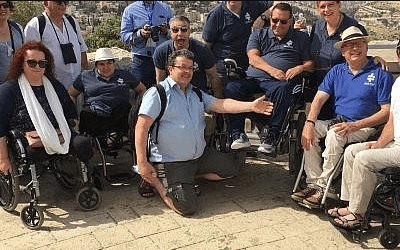
At the Access Israel Conference. Courtesy of Howard Blas

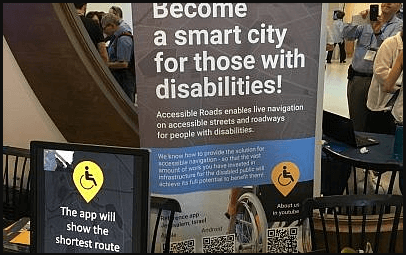
The Access Israel conference brought together over 500 people from 22 countries. Attendees heard from experts on access and inclusion on such topics as Accessible Technology, Barrier-Free Tourism, Urban Accessibility Initiatives and Challenges from Around the World, and Global Models for the Implementation of Technology. They participated in customized sessions—and panels—on such topics as Inclusive Design, Culture for All and Justice and Democracy for All, visited Israeli programs, and toured the now-accessible Old City of Jerusalem and Tel Aviv/Jaffa. Many conference attendees and presenters were people with disabilities including app and product designers, government officials and even the co-founder of Space IL, Yariv Bash.

On the first day of the conference, several attendees toured the Wingate Institute, Israel’s National Centre for Physical Education and Sport. We had the opportunity to experience a simulation activity, set up by Access Israel, during an Israeli Junior Olympics competition, which provided the judo participants, swimmers, and others the chance to play basketball with an Israeli wheelchair player, Liron Levy, navigate an obstacle course in a wheelchair, and eat a mystery cold substance in a cup—while blindfolded.

Our adult group also had the opportunity to participate in the basketball and ice cream eating activity. Liron shared his experience as a person who uses a wheelchair, and a young woman who is blind spoke to us about her experience being blind, completing university, etc. Such simulations take place with school children throughout Israel—and are always facilitated by people with disabilities. Participants in the simulation not only had a momentary glimpse in to the experience of navigating the world as a blind person, or as a wheelchair user; we had the opportunity to hear about the real life experience of people with disabilities as they navigate the world. And we engaged in a dialogue. As we better got to know our instructors who had disabilities, we did not feel pity, as critics had cautioned; rather, we felt better informed of their daily experiences navigating the world, including getting dressed, eating and traveling.

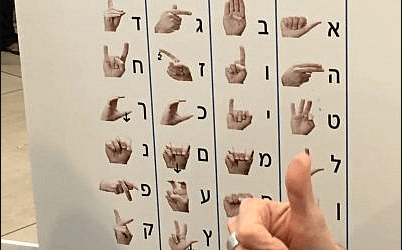
Three days later, as the main part of the conference got underway at Avenue Convention and Events Center in Airport City, conference attendees were greeted with many simulation stations as they passed through registration, on the way to the main conference hall. Again, people with disabilities were on hand to explain the simulation and to share their experiences of being blind, deaf or using a wheelchair. Many tried learning and communicating in Hebrew sign language, navigating a blind obstacle course and taking a wheelchair through a series of obstacles.

At the Access Israel Conference. Courtesy of Howard Blas

Later that evening, conference participants enjoyed a Feast of the Senses dinner. Following cocktails on a lovely Renanna event space terrace, everyone received an Access Israel blindfold and was escorted in to dinner. People in wheelchairs commented about the unique, important opportunity to experience the disabilities of others. Staff members patiently and carefully showed us to our seats, where we encouraged to feel our way to two wine glasses—and determine through our other senses which was white and which was red. And we were challenged to figure out which vegetables and fruits were in our salad.

At the Access Israel Conference. Courtesy of Howard Blas

Michal Rimon, CEO of Access Israel, introduced the meal. “We will be joined by people who live with disabilities. They will talk to you about their challenges, triumphs and successes. The more your let yourselves dive in, the more you will get from the experience.” Rimon, who has led this exercise at many past dinners, knew what the diners were going through. “Right now, you are compensating—you are using other senses more.” This helped explain my increased sensitivity to the noise in the room—and to my walking in to the room very intentionally, trying to maintain my balance.

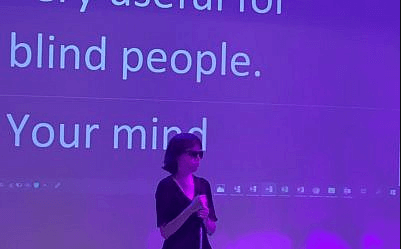
Our blindfolds were removed and we engaged in a dialogue with an Israeli woman who lost her sight at age three and learned Braille at age four. She reported that only 10% of blind people know Braille since many lose their sight later in life, when it is very hard to learn. “Learning Braille is the greatest gift I was ever given,” our guide reported. One participant asked, “What do you see in dreams?”

Our second course was a sensory course, where each participant was challenged to eat with cooking mitts—with a wooden flat board inside. Finally, our last course was a deaf simulation. A deaf man shared his experiences navigating the world as another man translated for the audience.

As the third successful simulation drew to a close, I continued to wonder why our camping inclusion manual simulation activities were met with pushback, and what made the Access Israel exercises so successful? Rimon patiently considered my questions and conceded that they too had some difficulties at first. “In the beginning, it was a big challenge to do such activities. People thought such simulations would be bad for the kids, it would make them sad, so we had to find one or two schools to start.”

Rimon describes the four pillars to their approach: knowledge, experience, knowing the person behind the disability, and paying it forward. Rimon stresses the importance of giving participants in each class the tools to pass on the experience to others. Students are given homework to go home and discuss what they have learned with their families. She notes that” schools now stand in line to participate in the program.” Rimon feels the program is “changing the DNA of the children.”

At the Access Israel Conference. Courtesy of Howard Blas

The simulation activities we experienced at the Access Israel conference were useful. Spending five days of the conference sharing and learning, eating meals, riding the tour bus and navigating the Old together with colleagues and new friends with disabilities—from a German reporter and two commissioners on disabilities of major US cities who use wheelchairs, to a deaf museum executive, to a blind member of the Google Accessibility team–went even further in changing our DNA.

Read more