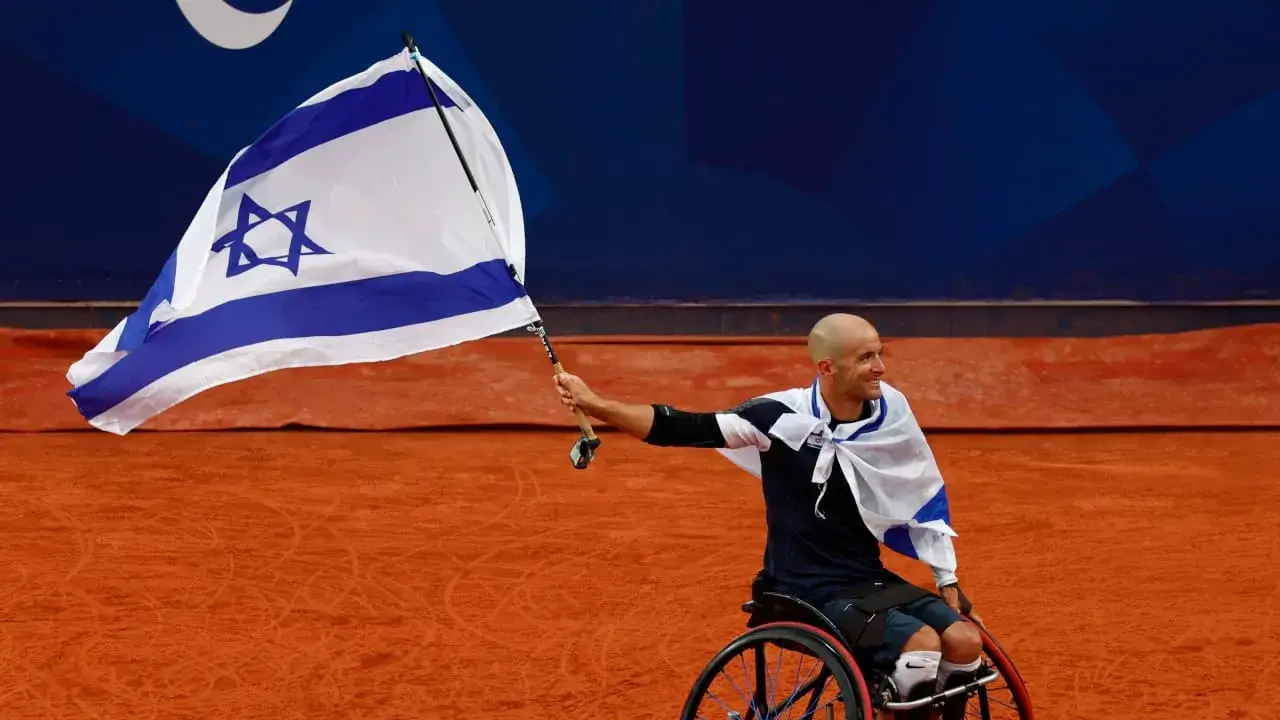
ISRAELI WHEELCHAIR tennis star Guy Sasson reached the quad singles semifinals and came within one match of completing a calendar-year Grand Slam in doubles with partner Niels Vink.
(photo credit: Gonzalo Fuentes/Reuters)
How a Modern Orthodox community and a secular kibbutz forged an unlikely friendship in the aftermath of October 7
When Rabbi Joe Wolfson and his family arrived for Shabbat at Kibbutz Nir Am in the Gaza Envelope, with a plata (Shabbat warmer) and kumkum (hot-water thermos) in hand, their host and friend, Eyal Massad, was sitting on a stool watching YouTube videos.
Despite living on a kibbutz whose members are not traditionally observant, forty-three-year-old Massad was determined to figure out how to disconnect the light bulb from his high-end refrigerator so his guests could fully and comfortably observe Shabbat. “My wife and I spent two hours next to the refrigerator watching videos, but the refrigerators were not like ours. We started to play around. I realized it needed a magnet and got it done!”
Massad’s daughters showed similar sensitivity—and curiosity—in the questions they freely asked Rabbi Wolfson’s daughters about minutiae of Shabbat observance. “They are not religious but made a big effort to not do things [that are forbidden on] Shabbat, like watch TV or turn on lights, to make us feel more welcome,” recalls Mika Wolfson, Rabbi Wolfson’s eleven-year-old daughter. “They asked a lot of questions—‘isn’t it hard not to watch TV?’ It was hard for them to remember what we could and couldn’t do.”
Unbeknownst to the Wolfsons, Massad had asked his daughters to stay off their phones and TV when the Wolfsons came for Shabbat—no small task for Israeli children who often receive their first phone in the first grade.
Rabbi Joe Wolfson and his wife, Corinne Shmuel, run JLIC TLV. Seen here, Rabbi Wolfson at a Chanukah party for evacuees
The story of how a forty-year-old London-born JLIC rabbi (affectionately known as “Rabbi Joe”), his wife, Corinne Shmuel, and their large community of mostly Modern Orthodox Anglo olim in their twenties and thirties forged a deep and meaningful relationship with members of a secular kibbutz is one of pitching in during a moment of need, trust, hachnasat orchim, and a willingness to look beyond stereotypes. Yet the unlikely relationship speaks to more than a single kibbutz and a community in central Israel. It offers a glimmer of hope for Israeli society as a whole, showing how biases can be overcome and bridges can be built across Israel’s religious and secular divide.
Anatomy of a Relationship
Located just over a mile from the Gaza Strip and adjacent to Sderot, Nir Am, with a population of 800, was founded in 1943—mainly by immigrants from Bessarabia (modern-day Moldova). The kibbutz was attacked by Hamas terrorists on October 7, 2023. Miraculously, its security squad, with assistance from a small number of border police forces and the Israel Defense Forces’ (IDF) Golani Brigade soldiers, prevented casualties among the kibbutz members. Sadly, two soldiers died in the Battle of Nir Am.
Like an estimated 200,000 to 250,000 other Israelis forced to evacuate border communities in the South and North following October 7, Nir Am’s residents were evacuated from their homes. They relocated to the Herods Tel Aviv hotel with barely the clothes on their backs, remaining in cramped quarters and eating all their meals in the hotel’s dining room for ten months.
When Rabbi Wolfson, who made aliyah in 2022, heard that thousands of evacuees were relocating to Tel Aviv, he immediately mobilized his community to help. Rabbi Wolfson and Corinne run Tel Aviv’s Jewish Learning Initiative on Campus (JLIC TLV), a young professional community near Dizengoff Street composed of mostly Anglo professionals. A division of the Orthodox Union, JLIC creates warm communities for North American and Israeli students and young professionals, and offers a religious framework that includes Torah study, halachic and spiritual guidance from a resident rabbinic couple, Shabbat and yom tov meals, and regular social events. While JLIC was initially established to support students on college campuses, it has since expanded to include other young adults in Israel and has communities in Jerusalem, Herzliya, Givat Shmuel and Tel Aviv.
In the weeks and months following October 7, the vibrant, energetic young JLIC community of Tel Aviv, which numbers around 450 members, became known for working with residents of the Gaza Envelope and the North who were living in Tel Aviv hotels. “In the early days, we hired ice cream trucks that went around to the Tel Aviv hotels,” says Rabbi Wolfson. “We looked for ways we could give.”
“Over 200 messages a day were posted on the group’s WhatsApp,” says Kinneret Yitzchak, community engagement officer of JLIC TLV. The group helped with “anything from a bride needing a last-minute wedding dress to someone needing to transport medical supplies from Miami to Israel.”
In the months following October 7, JLIC TLV volunteers ran hundreds of activities for evacuee children across twenty-four hotels.
Members of JLIC TLV approached staff in over seventy Tel Aviv hotels, explaining that they live nearby and are willing to help with whatever might be needed. They cooked meals for evacuees across five hotels. They also supported evacuees in other important ways, including running hundreds of activities such as carnivals and trips to theme parks for evacuee children across twenty-four hotels.
Perhaps their most important initiative was a family match program, through which evacuees arriving in Tel Aviv were paired with local residents “who they could go for coffee with, ask ‘Who’s a good pediatrician?’ or learn where the nice parks are.” This program, says Rabbi Wolfson, “has the potential to change a country.”
The volunteers kept going to hotels from October 7, 2023, until the last residents of Kiryat Shemona returned home in March 2025.
“Orchim, Not Mefunim!”
From the start, Rabbi Wolfson was intentional with his language, preferring to use the word orchim (guests) over mefunim (evacuees/displaced). “Nobody wants to be referred to as an evacuee,” he explains. “Whenever we run a big event, I introduce myself and our community, and I say, we view you as guests in our city, and the only thing we ask from you is that when, please G-d, you return home, whether it be to Sderot or Kfar Aza or Kiryat Shemona, you invite us back.”
Those words would eventually prove prophetic.
Visiting Kibbutz Nir Am for a day of volunteering that included painting miguniyot, portable bomb shelters
In the early months of the relationship, while the residents were living in the Herods Tel Aviv hotel, expressions of gratitude flowed in both directions.
Rabbi Wolfson recalls seeing the street signs erected around Tel Aviv expressing appreciation. “There were these beautiful posters up on Ayalon and Rokach [a high-traffic intersection in Tel Aviv] and all the major roads in Tel Aviv, paid for by the municipality of Sderot, which said, ‘Halev beSderot, anachnu beTel Aviv, todah al ha’eiruach, yachad nenatze’ach—Our hearts are in Sderot. We are in Tel Aviv. Thank you for hosting us. Together we’ll win.’ Then there were other billboards, smaller ones on the more pedestrian streets, paid for by the Tel Aviv municipality, which stated, ‘Ein kamo babayit, aval beintayim targishu babayit—There’s nowhere like home, but in the meantime, feel at home.’”
Over time, what began as organized volunteer efforts evolved into genuine personal relationships.
When kibbutz members prepared to go home in August 2024, JLIC TLV went all out to host a goodbye party. The following month, the decision was made to twin the communities with one another. This was meant to be a mutual friendship with each side giving in their own way. JLIC TLV began making trips to the South to visit and the kibbutznikim offered their new friends the kibbutz-member discount at Michsaf (“Made of Silver”), the well-known kitchenware and cutlery factory located on the kibbutz. “Getting the discount, says in a sense, ‘we see you as family,’” observes Rabbi Wolfson.
A few months later, members of the JLIC TLV community visited the kibbutz for a day of volunteering that included painting miguniyot (portable bomb shelters), running a carnival for children, hosting a barbecue, and gathering around a bonfire.
Rabbi Wolfson recalls how poignant it was to see remnants from before October 7. “They had just returned home six weeks earlier, after being away for ten months. They were feeling very fragile. The previous year’s sukkahs were still up.”
Later that year, on Tu B’Shevat, JLIC TLV members returned to plant trees alongside kibbutz residents. For Massad, the planting was heavy with symbolism. “They planted 150 trees 100 meters from the gate where we were fighting for our lives. Now, they were helping us put down new roots.”
Additional joint events followed, and the relationship continued to grow. Yet kibbutz member Chen Parchi Cohen, Nir Am’s head of resources and partnerships, admits that some kibbutz members were skeptical about the religious olim in the beginning. “A few of our older kibbutz members asked, ‘Are you sure you want to do this?’ They saw that they were religious and were worried about religious coercion.” Eventually, they were won over. They realized, says Parchi Cohen, that “even though they were religious, we could be friends.”
On Tu B’Shevat, JLIC TLV members returned to Nir Am to plant trees alongside kibbutz residents.
Although Nir Am is not considered a religious kibbutz, it maintains a synagogue used each Shabbat for prayer services. Massad, who does not consider himself Shabbat observant, goes to synagogue when Rabbi Wolfson comes for Shabbat.
When the kibbutz wanted to memorialize two soldiers who fell on October 7, kibbutz members decided to commission and dedicate a Sephardic sefer Torah. Members of the JLIC TLV community were invited to be part of the kibbutz’s hachnasat sefer Torah. Over time, Rabbi Wolfson found himself helping kibbutz members in surprising ways: koshering kitchens for Passover and arranging to sell their chametz.
Throughout, Rabbi Wolfson has been careful not to focus on religious differences. “The fact that we are religious and they are a secular community—I would not say it is incidental—is never what we lead with. It comes back to the orchim element. I said this line time and time again: This isn’t chesed, this isn’t tzedakah; we have this tradition of hachnasat orchim. In our eyes, you are not evacuees, you are guests.”
Then, in June 2025, the relationship came full circle. Ironically, while the communities in the Gaza Envelope were experiencing a relatively quiet period, residents of Central Israel found themselves coping with ongoing Iranian missile attacks. Members of Nir Am started hearing about the challenges facing those living in Tel Aviv and other parts of the country, where residents were dealing with multiple azakot (sirens) each day and night, and the constant need to run to shelters.
Now it was their turn to help. Kibbutz members graciously opened their homes to their Tel Aviv brothers and sisters. Later that year, in March 2026, during Operation Roaring Lion, when Iranian missiles targeted densely populated areas in Tel Aviv and Jerusalem, the kibbutz opened their homes again. During the ceasefire in May, Nir Am hosted sixty members of JLIC TLV for Shabbat. Parchi Cohen admits that in the days leading up to the visit, she was unsure what to expect. In the end, she says, the Shabbat exceeded expectations. Rabbi Wolfson and Corinne have already included the Massads and other kibbutz members on the guest list for her daughter’s bat mitzvah next year.
Parchi Cohen says word of the friendship has spread to other kibbutzim, many of which are eager to cultivate similar relationships. “Other kibbutzim in the area are jealous,” she says. “They ask how they can create a similar friendship with another community.”
Sign at the kibbutz welcoming JLIC TLV to the community
Noam Roffman, a member of the kibbutz who spent October 7 as part of the kibbutz’s small kitat konenut (rapid response squad) fighting for many hours, saving many lives, and subsequently attended more than 100 funerals, shared what the friendship with the JLIC TLV community means to him. Thanking the volunteers for showing up in the aftermath of October 7, he said at a Chanukah party hosted by JLIC TLV, “. . . during that uncertainty, when the institutions we relied on seemed distant, you showed up . . . . You gave your time, your energy, and your hearts to help rebuild what was broken, not just the walls and the roads, but our spirit.
“Your efforts helped restore faith in what is possible when we come together, not as strangers, but as one united community.”
Today, members of JLIC TLV still receive the kibbutz-member discount at Nir Am’s factory.
Howard Blas is a social worker, special education teacher and inclusion specialist. He frequently leads Birthright Israel trips for people with disabilities and is the author of a recent book on b’nai mitzvah and disabilities. He recently made aliyah and lives in Tel Aviv.
This article was featured in the Fall 2026 issue of Jewish Action.
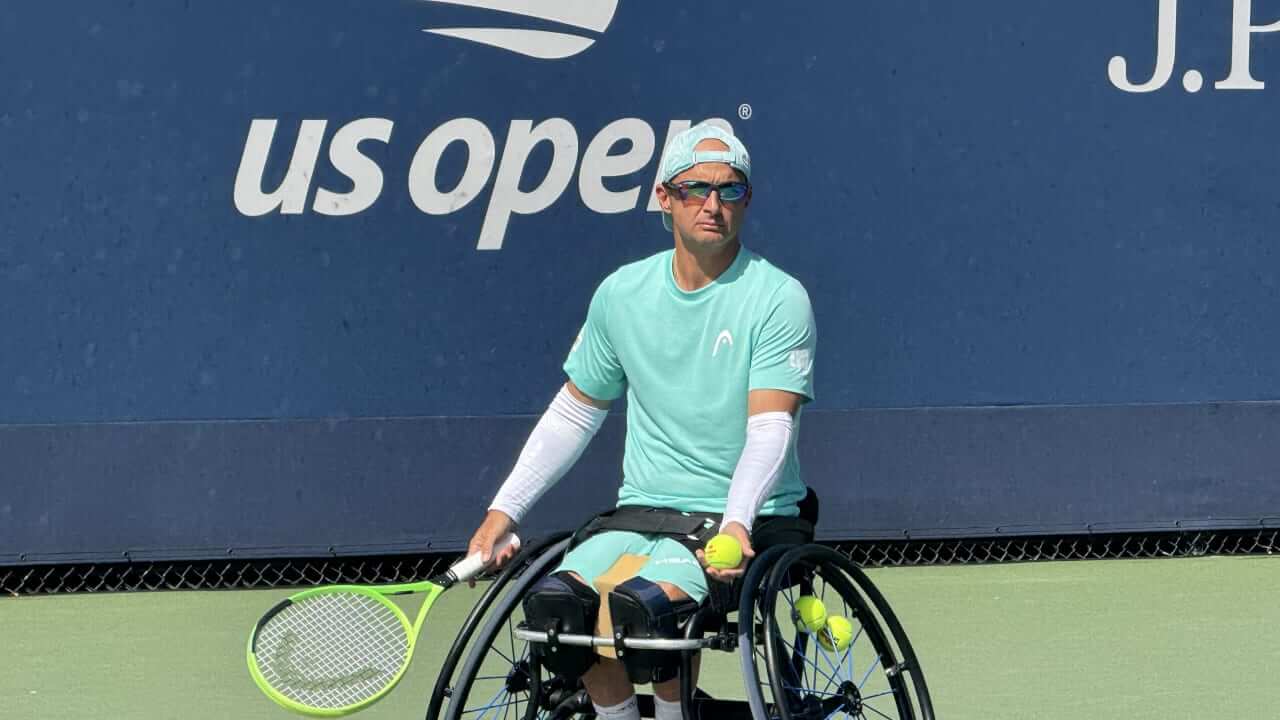
ISRAELI TENNIS star Guy Sasson opened his US Open quad wheelchair tournament with a dominant victory, while compatriot Sergei Lysov lost in doubles but is still has singles on tap. (photo credit: HOWARD BLAS)
Israeli teen, Dan Brand fell in three sets in the second round of the US Open juniors singles tournament, but is still alive in the doubles event. (photo credit: Sergio Llamera/ITF)